UP CEO Jim Vena threatens retaliation against customers who speak out against the proposed merger with Norfolk Southern
On Thursday, under pressure from the Surface Transportation Board, Union Pacific was forced to release a video of its CEO Jim Vena coldly speaking to hundreds of railroad customers and threatening to raise freight rates on those who oppose his proposed $85 billion merger with Norfolk Southern. In the same presentation, UP’s top executive attacks industry associations and mocks federal regulators. UP’s lawyers had unsuccessfully taken legal action to suppress the remarks made during a meeting of shippers.
Vena’s most revealing statement is his last words, where he threatens to punish the audience of shippers with higher rates if they oppose him:
“[If the merger doesn’t happen], Union Pacific will still be there. And if I stick around, which I probably will, I’ll probably increase everybody’s rates that said they didn’t want a seamless railroad by 3 or 4 extra percent to teach you a lesson.”
Judge for yourself. Vengefully raising rates on shippers and by extension consumers... is that in the public’s interest?
Following the release of the video, the Stop the Rail Merger Coalition @StopRailMerger issued the following statement:
“Jim Vena isn’t just threatening retaliation against customers who speak out against his merger. He’s making American working families his bargaining chip. When Vena threatens to raise freight rates, those costs don’t stop with railroad customers. They get passed along to consumers through higher prices on groceries, energy, and everyday essentials. His own words reveal exactly why giving Union Pacific even more control over America’s supply chain is a dangerous proposition. Jim Vena’s merger is a bad deal for America and must be rejected.”
The STB this week also denied NS and UP’s request to hold so-called “ex parte” meetings with STB members, meaning the meetings would be held out of public view. While meeting topics and subsequent high-level summaries would be made public, the discussions themselves would occur behind closed doors. Many parties strongly objected to the request because such closed-door meetings would reduce transparency.
Citing UP’s heavy-handed tactics that threaten shippers and hide information that should be made public, Class I railroad CPKC urged the STB to “…terminate this poisoned proceeding now” in an October 30 filing.
In response to CPKC and the controversy surrounding Vena’s remarks to shippers, on November 4, the STB wrote:
“Independent of CPKC’s letter, the Board has serious concerns about whether Vena’s statement at SWARS [Southwest Association of Rail Shippers] —as reflected in the recording — may be influencing certain stakeholders’ willingness to participate in this proceeding or share their own views without fear of commercial repercussions. The Board will not tolerate actual or threatened retaliation against a stakeholder for participating in this or any other proceeding before the Board. Retaliation, whether perceived or actual, can seriously undermine the integrity of the Board’s processes. Any evidence of retaliation in this proceeding will be considered by the Board, and evidence of retaliation, or the threat of retaliation, may affect how the Board proceeds—”
LISTEN: @UnionPacific CEO MOCKS the @STB_Newsroom's procedure to prevent system-wide meltdowns and unfair abuses:
“I know everybody should say I should always be nice to the STB. Takes them freaking months and way too long to make a decision, okay? They need to speed up.”
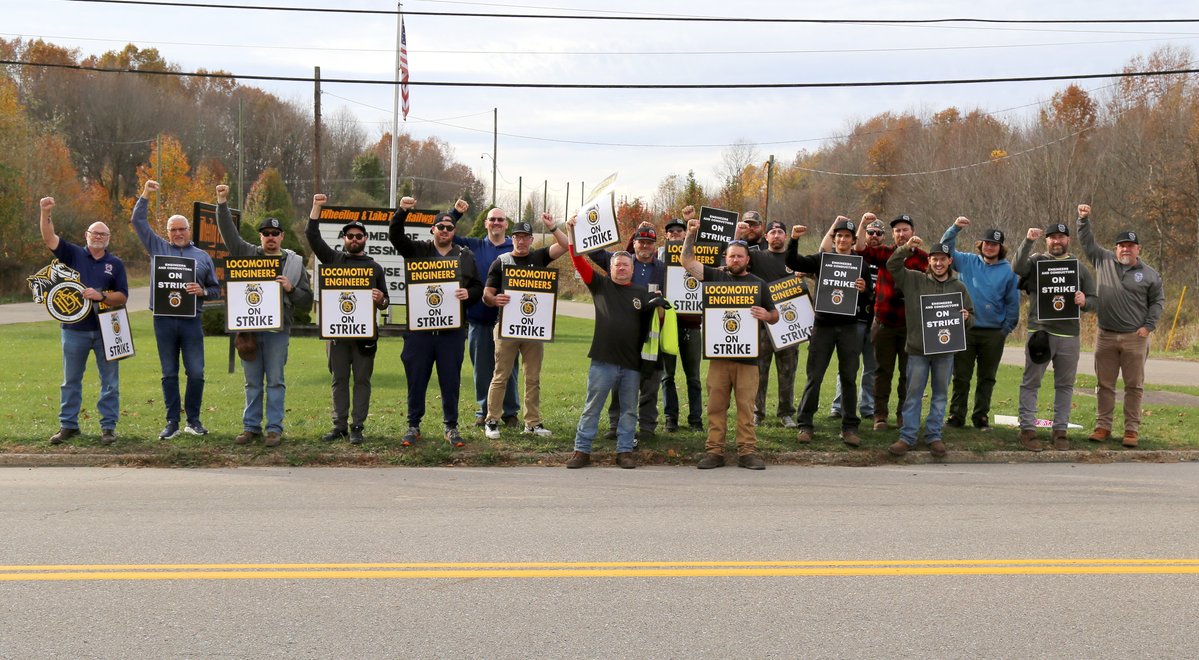
Photo highlights of BLET members on the picket lines after striking at Wheeling & Lake Erie Railway on November 11. Nine hours after the strike began, the railroad agreed to honor the BLET's contractual protections which resolved the dispute.
“Our members, officers, and staff were prepared, and their solidarity secured this result. When we are legally able to exercise our right to strike to defend our agreements, we will not hesitate to do so,” said BLET National President Mark Wallace.
BLET engineers and conductors went on strike November 11 at the Wheeling & Lake Erie Railway. The dispute was caused by the railroad���s insistence on using managers to work as conductors. This was a clear violation of the union’s contract and violated an order from the federal courts dating back to 2013
At the end of the day, about nine hours after the strike began, the railroad agreed to honor the BLET's contractual protections and stop using managers in place of union conductors. The dispute was resolved without court intervention.
“All contributed to the total team victory for our Brotherhood. I am proud of everyone who stood together to protect our members’ work and uphold our agreement,” said BLET National President Mark Wallace.
A Victory for Our Brotherhood
Today, our members at the Wheeling & Lake Erie secured an important victory.
At noon, they carried out our strike exactly as planned. Confidential preparations were paramount, every picket line was manned, and our members stood together with discipline and unity.
The railroad agreed to honor our contractual protections and stop using managers in place of union conductors. The dispute was resolved without court intervention
The opportunity to strike under these circumstances is rare. The Railway Labor Act places strict limits on our ability to strike. In the earlier W&LE case, a federal appeals court had already determined that replacing union conductors with managers presented a major dispute and violated the railroad’s obligation to maintain existing working conditions. That established legal foundation was critical to our ability to act.
Our members and officers were prepared, and their solidarity secured this result. When we are legally able to exercise our right to strike to defend our agreements, we will not hesitate to do so.
I am proud of everyone who stood together to protect our members’ work and uphold our agreement. It was my honor to walk on the picket lines with them today.
Mark L. Wallace
National President
Brotherhood of Locomotive Engineers and Trainmen
BLET members striking at Wheeling & Lake Erie Railway beginning at noon today continue to hold the line. The strike was called after the employer arrogantly violated a directive from the federal courts and its union contract.
The strike by 140 engineers and conductors was caused by the railroad’s insistence on using managers to work as conductors. This was a clear violation of the union’s contract and violates an order from the federal courts dating back to 2013.
BLET engineers and conductors are walking the picket lines at key locations including Akron, Canton and Brewster, Ohio.
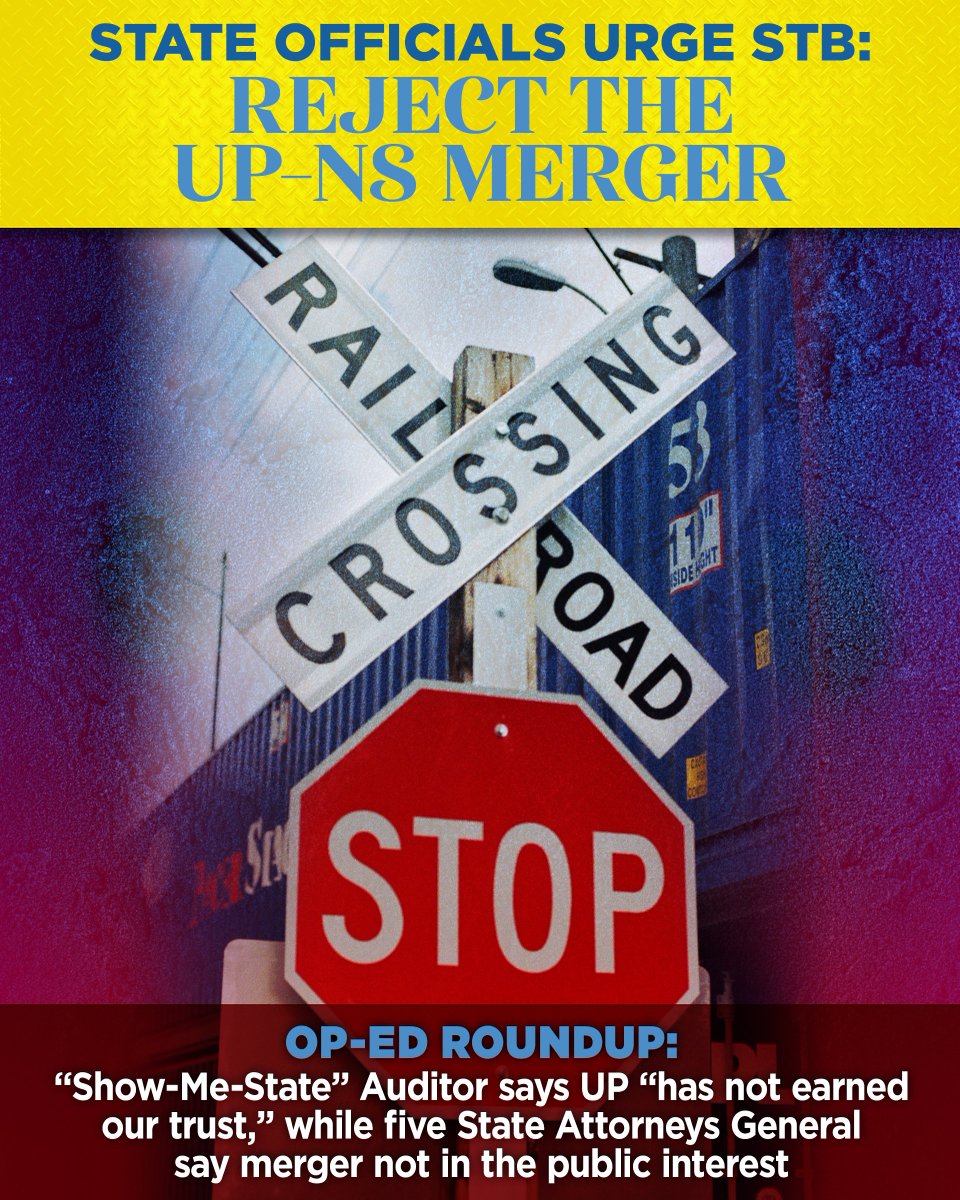
In two recent op-eds of national interest, government officials from six states have joined the growing chorus of voices questioning the transparency and economic risk of the proposed Union Pacific-Norfolk Southern merger.
Jack Bondon, who serves as the Auditor of Cass County, Missouri and who previously served three terms as a State Representative for the Missouri House 56th District, wrote that UP “has not earned our trust” in this opinion column published in The @MissouriTimes. Read the full article here: https://t.co/iPrmU2o6Sl
“When I see the approach Union Pacific has taken to move this merger forward, the Auditor in me demands more transparency,” he wrote. “… As a Show-Me-State Auditor, I say Union Pacific has not earned our trust.”
Bondon isn’t alone in raising red flags about the planned merger and asking if it’s in the public’s best interest. Writing in Montana’s Flathead Beacon, the Attorneys General representing five states called on the STB to reject the rail merger. In their opinion column, co-authored by Attorneys General Austin Knudsen (Montana), Kris Kobach (Kansas), Brenna Bird (Iowa), James Uthmeier (Florida) and Drew Wrigley (North Dakota), they wrote: “A UP-NS merger doesn’t serve farmers. It doesn’t serve shippers… It serves UP’s bottom line. Inflated prices will lead to extra profits. The STB should reject it.”
The state elected leaders assert that the proposed merger is not in the public interest, a significant measuring stick for the Surface Transportation Board in approving rail mergers. “When a company’s proposal can’t meet a legal standard, it has only one move: argue for a lower standard. That’s exactly what is happening with UP’s proposed $85 billion mega-merger with Norfolk Southern.”
Read the full article from the @FlatheadBeacon: https://t.co/uuVrX8vChS
BLET TEAMSTERS ON STRIKE!
150 BLET Teamsters at Wheeling & Lake Erie Railway have been forced to strike over management's repeated and illegal contract violations.
The group of locomotive engineers and trainmen will remain on the picket line until management stops violating their contract by funneling BLET work to management.
Strike called today at one of the nation’s largest regional railroads after employer arrogantly violates directive from the federal courts and its union contract
Trains will not run at the Wheeling & Lake Erie Railroad, which serves Ohio, Pennsylvania, West Virginia, and Maryland. Picket lines have been set up at key locations by the Brotherhood of Locomotive Engineers and Trainmen.
Engineers and conductors at the Wheeling & Lake Erie Railway (W&LE), members of the Brotherhood of Locomotive Engineers and Trainmen (BLET), are on strike today. Picket lines have been set up at key locations beginning at noon, November 11. W&LE, one of the largest regional railroads in the nation, operates trains on 840 miles of track from Hagerstown Maryland, across West Virginia and Pennsylvania, servicing Pittsburgh and cities in Northeast Ohio, terminating in Toledo.
The strike by 140 engineers and conductors was caused by the railroad’s insistence on using managers to work as conductors. This was a clear violation of the union’s contract and violates an order from the federal courts dating back to 2013, specifically related to this issue at this railroad. In 2013, the W&LE tried to use managers in place of conductors to operate trains and in some instances operate with only one crew member in violation of long-established safety practices and its union contract.
In accordance with the terms of the Railway Labor Act, a violation of the contract in this manner is considered a “major dispute” allowing the union to immediately seek “self-help” as it’s termed in the law or in other words – call a strike. Strikes under the Railway Labor Act are rare and usually only happen after prolonged negotiations, mediation and cooling-off periods. The 2013 dispute between the union and the W&LE also resulted in a strike.
“Our members at the Wheeling & Lake Erie have the full support of our national union, as well as the @Teamsters,” said BLET National President Mark Wallace, who also serves as the President of the Teamsters Rail Conference. “This employer has not only violated our contract and compromised safety standards; they also have arrogantly thumbed their nose at the federal courts. We will protect the members we represent and the communities this railroad serves by shutting down train operations until this railroad’s management abides by court orders and the terms of our agreement.”
BREAKING NEWS: BLET strikes Wheeling & Lake Erie
BLET members at the Wheeling & Lake Erie Railway went on strike at noon today.
One of the largest regional railroads in the nation, the W&LE serves Northeast Ohio, Western Pennsylvania, West Virginia and Western Maryland. Picket lines have been established by the union today at key locations.
BLET represents engineers and conductors at the Class II railroad, headquartered in Brewster, Ohio — more information to come.
Veterans Day 2026: BLET thanks all veterans and their families
On Veterans Day, November 11, the Brotherhood of Locomotive Engineers and Trainmen thanks all of our veterans for their service to our Nation.
Throughout our organization’s long and distinguished history, BLET members have embraced the tradition of service to America’s military heritage. Since our union was founded in 1863, during the time of the Civil War, our membership has always included proud veterans.
Behind every soldier, sailor, or airman who serves is a family that also serves, and they are also deserving of our respect and gratitude. Today and every day, the BLET salutes and honors all veterans. Thank you for your service and the sacrifices made by you and your families for the benefit of all of us.
Last week’s election results do not change the Brotherhood of Locomotive Engineers and Trainmen’s responsibility to its members or its approach to legislative advocacy — it’s a reaffirmation. Throughout this year, BLET has worked to build relationships with elected officials from both parties around a clear purpose: protecting railroad workers’ jobs, safety, retirement, and benefits. That bipartisan work will continue.
As the next Congress takes shape, BLET is prepared to maintain the relationships it has established and build new ones wherever needed. Changes in representation bring a responsibility to introduce our union, explain the challenges our members face, and identify opportunities to work together.
“Our strategy remains the same: we will work with anyone who will work with us,” said BLET National President Mark Wallace. “Our members expect us to represent them regardless of who holds office. We have a responsibility to build relationships, make our priorities understood, and keep working to move those priorities forward. We are prepared and ready to do that.”
Building those relationships takes consistent effort. It means meeting with lawmakers and their staff members, listening, explaining how decisions in Washington affect railroaders and their families, and following through as legislation develops. BLET will continue that work with returning members of Congress and begin it with newly elected officials.
The BLET’s priorities remain grounded in the needs of our members. We will seek support wherever we can find it, recognize those willing to help, and hold elected officials accountable for their commitments. BLET is prepared to maintain established relationships, build new ones where needed, and keep working to advance our members’ interests. That responsibility continues after every election.
PSR and related railroad policies continue to aid cargo thieves
News organizations nationwide continue to cover cargo theft from freight trains. A @CBSNews report on October 9 focused on a first-of-its-kind national blitz to crack down on rail thefts. Reporting from the Chicago area, CBS showed how federal agents, railroad police, and local law enforcement collaborated across 24 states, using infrared drone cameras to catch thieves at night. Watch the video here: https://t.co/fHMScMoye9
Police said local street gangs and transnational criminal networks are to blame for this ongoing series of train robberies. But BLET believes otherwise. For America’s Class I railroads, this is a crisis of their own making. Implementing the Precision Scheduled Railroading (PSR) operating model has led to massive job cuts among carmen and railroad police officers, making it harder for railroads to respond when thieves target trains. PSR has also led to longer freight trains operated by fewer employees. These trains are often too long to fit into sidings, leaving valuable cargo parked in unprotected areas.
Last year, BLET Division 28 President Eddie Strom testified before Congress (pictured) about the link between PSR and cargo theft, and the danger it poses to railroad workers. Thieves have stopped freight trains by cutting air hoses, and they have parked vehicles on grade crossings, forcing trains to come to an emergency stop. These brazen train robberies put the lives of BLET members at risk.
Ending PSR operations, hiring more workers, and reducing train length would help reduce cargo theft and, in doing so, better protect railroad workers while they are on the job.
While police have made some progress in recovering stolen goods, train thefts have continued. Weeks after the October 9 CBS News report, thieves again robbed a freight train, and police activity and cleanup on the tracks caused extensive delays in Chicago commuter rail operations. See the @ABC7Chicago report.
Union Pacific CEO Jim Vena has already threatened to raise costs if his monopoly merger with Norfolk Southern goes through.
You can help stop that from happening by filling out the form at https://t.co/6H263GQ1A0 and telling the STB to block the merger!
(3/3) I’ll probably increase everybody’s rates that said they didn’t want a seamless railroad by three or four extra percent to teach you a lesson.” Union Pacific had gone to great lengths to keep the video confidential.
(1/3) The video of Union Pacific CEO Jim Vena threatening to raise rates on shippers who do not support the UP-NS merger is now public. Watch it for yourself here. Vena made the remarks at the Southwest Association of Rail Shippers (SWARS) Annual Conference in Houston. He said:
(2/3) “We’re willing to make deals with customers. So come and see us. Talk about what you need to move ahead with us and how we put this thing forward. If we don’t do that, Union Pacific will still be there. And if I stick around, which I probably will,