🚨 Google has sounded the quantum alarm 🚨
Today, they released groundbreaking progress towards breaking crypto using a quantum computer.
TLDR - Existing cryptography is dead. Mempool attacks are real. We must migrate to post-quantum now.
Thread 🧵
🚨 Google just changed everything by setting a timeline for post-quantum cryptography migration: 2029 🚨
This is no longer theoretical. The clock is running.
It's the only plausible (but very ad-hoc) modification of quantum theory that would disallow *some* CRQCs.
If you take their heuristic seriously, CRQCs would be break 256-bit ECC (a.k.a. Bitcoin) but not RSA-2048.
7 million BTC exposed keys.
10,000 qubit surface codes (fast) is the current record.
7 million gates, 3000 logical qubits = 10 min solve of a batch of public keys into the private keys. 15 months left to upgrade everything completely during safety. The hash only addresses can get stolen during transfer unless the cryptography is upgraded.
I am tossing around the idea of creating an updated paper on the 2017 estimates for Quantum Phase Estimation to solve ECDLP like Bitcoin. The paper would need a few partners, the multiple mode methods of optimizing for speed, minimal qubits or error recovery are complex. I gave the stats for "speed optimized" here.
ACM A.M. Turing Award Honors Charles H. Bennett And Gilles Brassard for Foundational Contributions to Quantum Information Science
https://t.co/Cv1coDheGY
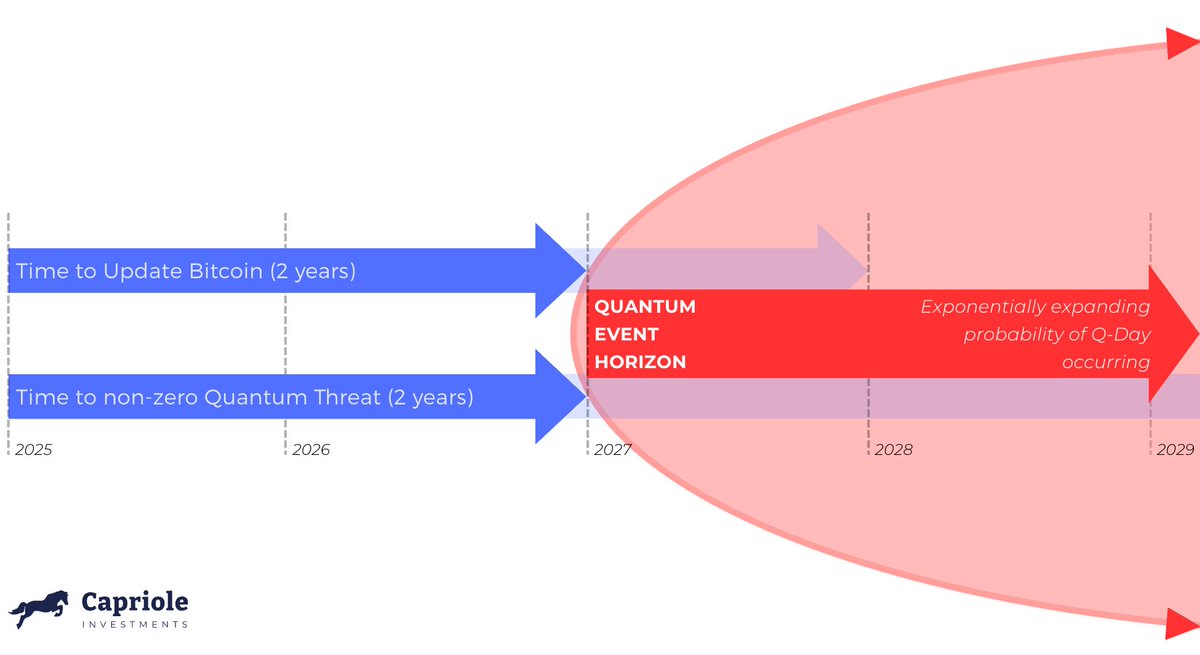
We have entered the Quantum Event Horizon. That's the reason quantum computing started to matter in 2025, and was priced in to Bitcoin. For the first time ever, the time to upgrade Bitcoin is now longer than the time to a non-zero threat of Q-Day breaking Bitcoin’s cryptography.
Scalable quantum computers are a lot closer, due to a modular control and logical error correction system.
Zurich Instruments has launched their Quantum Control System, a scalable platform built to operate large-scale quantum computers and enable long-lived logical qubits through advanced error correction.
Physical qubits are fragile and lose coherence quickly due to noise. Logical qubits encode information across many physical ones to correct errors and achieve higher stability and fidelity.
Supporting over 1,000 channels per rack, real-time microsecond feedback, high SNR direct-RF control, FPGA processing, and water cooling for thermal stability.
CEO Andrea Orzati noted it was designed for the logical-qubit era, tackling scale, fidelity, and error correction together.
Not quite a plug and play system, but nearly one. Scalable quantum computers are now a 'sone assembly required' plug and play system with testing software. https://t.co/AEXJwNPrix
Guys, it’s not just about having the new NIST-approved math.
If the developers are lazy and don't shield the 'side-channels,' a hacker doesn't need a Quantum Computer to rob you—they just need to watch how much battery your phone uses while you're signing a transaction.
We need 'Constant Time' implementations to be truly safe.
Every bank transfer, medical record, government secret, and software update today depends on encryption systems like RSA and ECC—algorithms designed decades ago.
But quantum computing changes the equation.
We’ll discuss:
• What quantum computers can actually break
• What it means for blockchain security
• Which systems are already preparing
• How builders and investors should think about the transition
Join the discussion tomorrow.
https://t.co/I0vkVaFRh2
Every bank transfer, medical record, government secret, and software update today depends on encryption systems like RSA and ECC—algorithms designed decades ago.
But quantum computing changes the equation.