Nobody posts about the hash function. It's also the one a quantum computer weakens.
SHAKE-256 (FIPS 202) is the third primitive in QoreChain's post-quantum path, the quiet one behind signatures and key exchange. Quantum-readiness that skips the hash is quantum-readiness with a gap. https://t.co/TrN7s70cpv
HAWK didn't break with drama. A new attack halved its security margin, and its authors withdrew it from NIST's additional-signatures process within days. The finalized standards (ML-DSA, ML-KEM, SHAKE) are unaffected.
That's how cryptography usually fails: by degrees. It's why QoreChain's signature schemes are governance-upgradable. Crypto agility is the exit plan you hope you never need. https://t.co/TrN7s70Kf3
$QOR ekosisteminde motorlar çalıştı!
Haftaya başlayacak SBT Emisyonu ile Testnet katılımcılarının ve topluluk üyelerinin Airdrop hak edişleri tescilleniyor.
Çalışan cüzdan, güçlü altyapı ve sıradaki adımlar... Biz hazırız!
#QoreChain#QoreX#Crypto#Airdrop#BitMart#Bitcoin
A chain is only as quantum-safe as its weakest primitive. Cover the signature but leave the hash and key exchange classical, and you have not moved the security floor.
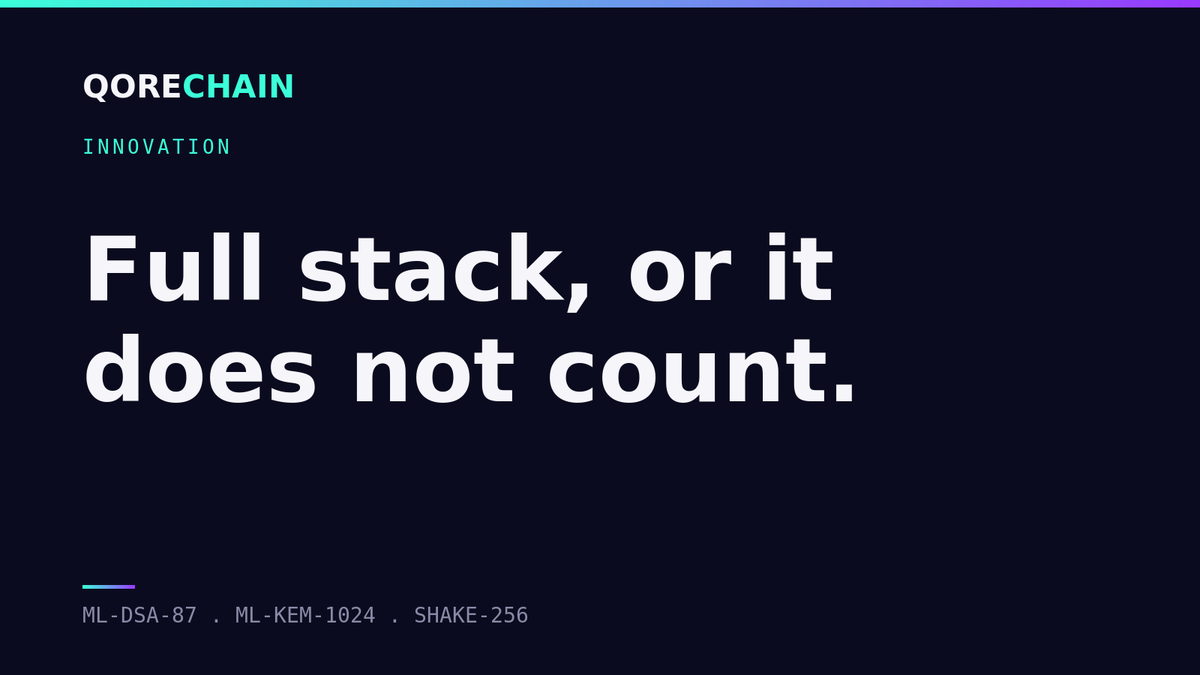
QoreChain uses ML-DSA-87 for signatures, ML-KEM-1024 for key encapsulation, and SHAKE-256 as the default application hash, from Merkle trees to cross-layer attestations. Three finalized NIST standards, one floor.
Full stack, or it does not count.
We registered in Rolle, Switzerland, under the Swiss DLT Act, and we hold a FINMA no-action letter for QOR as a utility token.
I did not choose that for the postcard. I chose it because the institutions most exposed to the quantum problem, banks and custodians, cannot touch infrastructure that is not legally clear. Credibility is a feature.
The pushback I heard most: post-quantum is too slow for a real chain.
So we measured it. Dilithium-5 verifies in about 53 microseconds. Our blocks are about 1.4 seconds. The security you were told to fear costs microseconds.
I would rather show the measurement than win the argument.
Talk is cheap. Query the chain yourself:
qorechaind query pqc params
hybrid_signature_mode: required
allow_classical_fallback: false
Every cosmos-path transaction carries a post-quantum signature. Enforced at the protocol, not a setting you opt into.
@QoreChain 📊 Measured data speaks louder than assumptions.
These benchmarks show that post-quantum cryptography can deliver strong security without compromising blockchain performance. Looking forward to seeing even more production-scale metrics as the ecosystem continues to evolve. 🔐
"Post-quantum cryptography is too slow for a blockchain."
Measured on our 6-validator devnet: Dilithium-5 verify 53µs, sign 110µs. Against a ~1.4s block, that is a rounding error.
Big signatures. No slowdown. The numbers are measured, not modeled.
@satoshi_Qore@QoreChain And that's exactly what you want in production—when a test fails, you know you're investigating the implementation, not randomness. Deterministic behavior removes unnecessary variables and makes debugging far more efficient. 🛠️
🔐 Deterministic signatures are an underrated engineering advantage.
✅ They simplify cross-SDK verification.
🧪 They make regression testing reliable.
🔄 They improve reproducibility.
🔍 They provide a stronger foundation for independent audits.
When TypeScript, Python, Go, Rust, and Java all produce the same ML-DSA-87 signature for the same input, developers can trust that every SDK behaves consistently across the ecosystem.
#QoreChain #PostQuantum #Blockchain #PQC
⚙️ Reproducibility is a core requirement for production-grade cryptography. Deterministic ML-DSA-87 makes debugging, testing, and independent verification significantly easier while ensuring consistent behavior across every supported SDK. That's a strong developer experience. 🚀 #QoreChain #PostQuantum #PQC
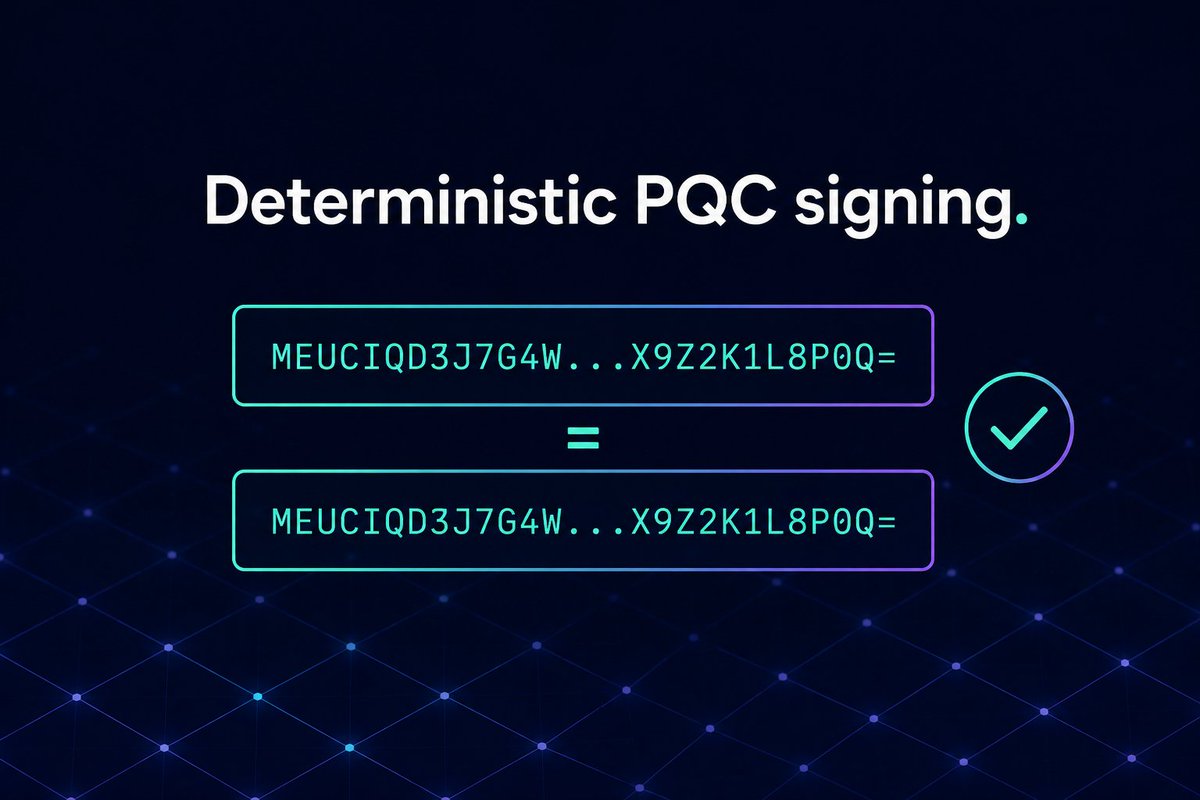
Post-quantum signatures are usually randomized, which makes them hard to reproduce and test.
QoreChain ships deterministic ML-DSA-87 (Dilithium-5) signing by default, in every SDK language: TypeScript, Python, Go, Rust, Java.
Same input, same signature. Reproducible, testable, auditable.
The past few days have been exciting for everyone involved in the QoreChain ecosystem.
QoreChain announced what it describes as the first end-to-end public mainnet blockchain transaction secured using all three NIST-standardized post-quantum cryptographic algorithms: ML-DSA-87, ML-KEM-1024, and SHAKE-256.
The milestone also received coverage from publications such as The Quantum Insider, FF News, and Quantum Zeitgeist, expanding the project's visibility beyond the traditional blockchain community.
Alongside this achievement, the team has continued strengthening the network through infrastructure upgrades, including endpoint optimization, DNS migration, TLS certificate updates, and ongoing operational improvements. These efforts may not always make headlines, but they are fundamental to building a secure, resilient, and production-ready blockchain.
From a technology perspective, QoreChain continues to advance its long-term vision through post-quantum cryptography, AI-native architecture, Triple VM, cross-chain infrastructure, and the expanding Light Node ecosystem.
Of course, technology alone does not determine success. Long-term adoption will depend on developers, real-world applications, strategic partnerships, ecosystem growth, and user trust.
Still, the progress made over the past few days shows that QoreChain is beginning to attract attention not only from the blockchain industry but also from the broader quantum technology community.
As someone who is proud to contribute to this journey, it is rewarding to see these milestones becoming reality. There is still a long road ahead, but the progress achieved over the past few days reinforces my confidence in the project's long-term vision.
Congratulations to @epure_liviu and the entire @QoreChain team on these achievements. I'm proud to be part of this journey and excited for what lies ahead.
#QoreChain #Blockchain #PostQuantum #Cryptography #CyberSecurity #AI #Web3 #Innovation
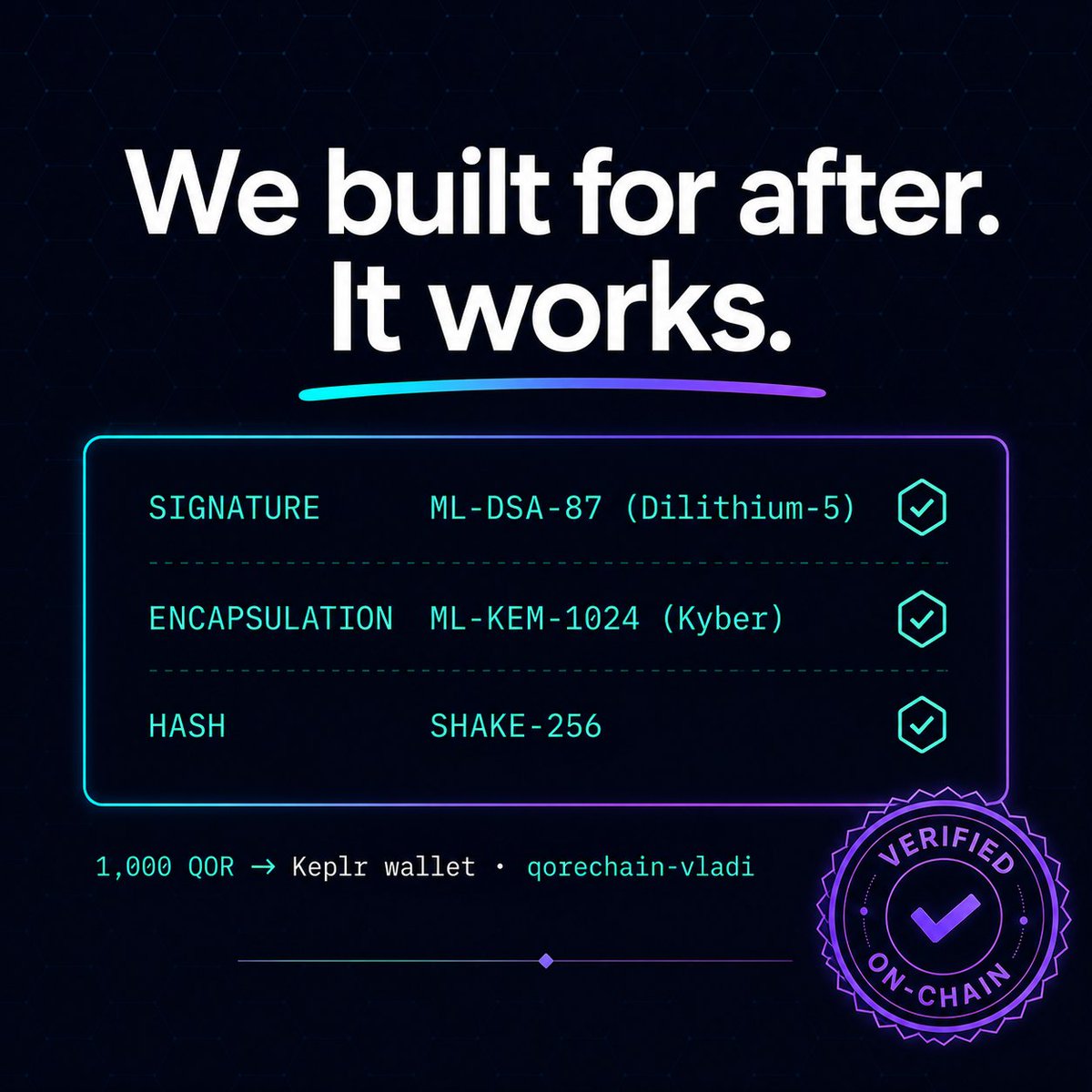
Years ago we made a bet that sounded paranoid: build a blockchain for after classical cryptography breaks, not before.
Today that bet produced something real.
The first fully post-quantum transaction on a public mainnet. 1,000 QOR, sent to a wallet created in Keplr:
Signature: ML-DSA-87 (Dilithium-5) Encapsulation: ML-KEM-1024 (Kyber) Hashing: SHAKE-256
Every layer quantum-safe. On-chain. Verify it yourself: https://t.co/nNxymZrIK6
AI compute is projected to need around 70 TWh in 2026, comparable to a small country.
US data center demand could roughly double in three years.
In some regions electricity prices jumped over 250% in five years. The "cloud" has a very physical bill.
@QoreChain This is how real decentralization should work.
No expensive hardware. No data center. Just a simple way for anyone to help secure the network and participate in its growth.
@QoreChain Lower barriers create stronger networks.
Making participation accessible is one of the best ways to strengthen decentralization while rewarding contributors.
You do not need a data center to help secure QoreChain.
Light Node UX runs in your browser. Light Node SX runs as a server daemon. Light nodes share 3% of all network fees.
Low barrier. Real role. Run one.