A few thoughts post-midterms on Canada, the impact on the AI buildout, and the future of crypto:
On Canada: Turns out picking a fight with your closest ally and largest trading partner is a pretty dumb idea. Voters, especially in border states, made Trump pay.
So what now?
Canada is stronger with a close trading relationship with the U.S. We'll almost certainly get a better deal now than we would have before, vindicating our PM's strategy.
But we can't take our foot off the gas. We need to accelerate.
Anyone who doesn't see that Donald Trump is one of the best things ever to happen to Canada is missing the bigger picture. My worry is that, with Trump weakened, our ambition fades and the voices calling for a return to the status quo get louder.
We can't let that happen.
Let's focus on what we can control, build what we need to build, and get on with it.
On AI: I think fears of a Democrat-induced AI slowdown are overblown. AI is too critical to the economy. Do they really want to inherit a country in 2028 in the girps of a recession?
But if data centre projects south of the border do get shelved or delayed, let's bring them north.
Canada has abundant power, land, and a highly skilled workforce. There is a stronger political consensus that AI and data centres are good for the economy and local communities, along with clear federal guidance on how to build them responsibly. Citizens need more convincing so let's make the case.
On Crypto: The industry went all-in on the Republican Party. Now it has to rebuild trust with lawmakers on the other side of the aisle.
Fortunately, crypto is (and always has been) a bipartisan issue among American voters, who want a better, fairer, faster financial system.
The industry's job over the next two years is to make that case clearly. And the best way to do it isn't through lobbying or political donations. It's by building useful products, like stablecoins, that actually improve people's lives.
They have two years to prove it.
Meanwhile, Canada is implementing new stablecoin rules that broadly track the U.S. approach. But we can go further. If we want to safeguard our currency and strengthen our financial system, we need to build our own blockchain-based financial infrastructure.
A final thought on our government's historic and important investment in @cohere:
In the 19th century, Canada had one of the biggest rail networks in the world.
But it wasn't Canadian.
The Grand Trunk Railway was financed largely by British investors and controlled from London, connecting Chicago with the American Atlantic coast through the heart of Canada.
Today’s global tech giants are the new Grand Trunk.
They operate here, extract value, and enrich foreign shareholers. They can also suspend service or build elsewhere.
Canada is a bypass. We are renters, at best.
If you don't own your infrastructure you're not truly sovereign.
This is just as true today for AI as it was for the railways 150 years ago.
That's why we built the CPR.
It was Canadian-owned and built to open our Western frontier to global markets, while securing our place on the continent.
Why am I bringing this up?
The CPR only happened because of the leadership of the political class working together with private interests to attract world-class talent and huge amounts of foreign capital to actually build the thing.
When you're doing something big, you need all hands on deck. The builders of the railway understood this.
Today, @cohere is following a similar playbook, and predictably, catching a lot of flack.
Agian, this is nothing new. The CPR was once called "McDonald's folly" by contemporary haters, who questioned the expense and effort it would take.
Boy were they wrong.
The builders saw things differently. Infrastructure expanded the realm of possibility. If you build it, they will come.
So, once again, let's build it together.
Struck by how similar this anti-tokenization ad is to the anti-piracy ads of the 80s and 90s in their extreme imagery and fear-mongering language.
Makes sense, though.
Back then, the internet of information was democratizing access to information. Legacy IP owners and gatekeepers felt threatened.
Today, the internet of value is democratizing access to assets and ownership, and many incumbents feel the same way.
When you have a new paradigm like this, vested interests fight change and react with hostility, threats and legal challenges.
In the 90s, record labels were threatening kids with jail time just for burning a CD or using Limewire.
Today, Wall Street lobby groups are portraying tokenization as a biological WMD, complete with exploding poison and radioactive signs.
Are there challenges to implementing tokenization, and should it be regulated? Of course.
But public company CEOs should also recognize the glaring opportunity: tokenization can open their stock to new investors, just as the internet opened creators and artists to new audiences.
In just 15 years, Liberal Arts has gone from the most popular to the least popular university major in Canada.
University enrolment is a lagging indicator.
For years, young people were told to “learn to code.” So it's not surprising CompSci and engineering enrolments surged.
Now AI is automating much of what those students were preparing to do.
As AI steamrolls knowledge work, I think the best way for young people to navigate whatever comes next is to learn how to think critically, defend an argument, and understand context.
That means knowing something about history, philosophy, and political economy among other things.
I also think knowing about art, culture, history etc, make you more interesting, and a 'good hang' may be the hardest thing for AI to automate away.
That's not to say STEM graduates can't do all of the above.
But a Liberal Arts education provides a basic intellectual toolkit that can be repurposed as things change.
I'll bet we've reached peak STEM and the pendulum is about to swing back to the humanities.
Curious what others think.
Data c/o the @globeandmail
New @defidecodedpod is out!
I sit down with @gregosuri of @akashnet to discuss why decentralized compute networks could power the next wave of AI.
Infrastructure bottlenecks, data centre backlash, and power shortages means we must tap into GPU capacity wherever it exists—even in our own homes.
Always a blast chatting with Greg.
Check it out!
NEW @BlockchainRI whitepaper: "Quantum Risk and the Blockchain Stack" by @DHeintzman and @dtapscott explores the threat to signatures, consensus, and smart contracts, and why “harvest now, exploit later” makes this urgent. Read the full report here: https://t.co/7JeCg9zS8w
JP Morgan will make $107 BILLION on net interest income (NII) next year.
NII, simply put, is the difference between what the bank pays for deposits and what it earns on its loans.
Rates are rising. Your savings rate isn’t.
That’s why banks fought to ban stablecoin yield in GENIUS and even modest rewards in CLARITY.
They’re protecting the spread, not you.
This is a great article. @alextapscott asks an important question: is regulatory rule-making enough to kickstart investment in a new technology or will enterprises continue to take a "wait-and-see" approach?
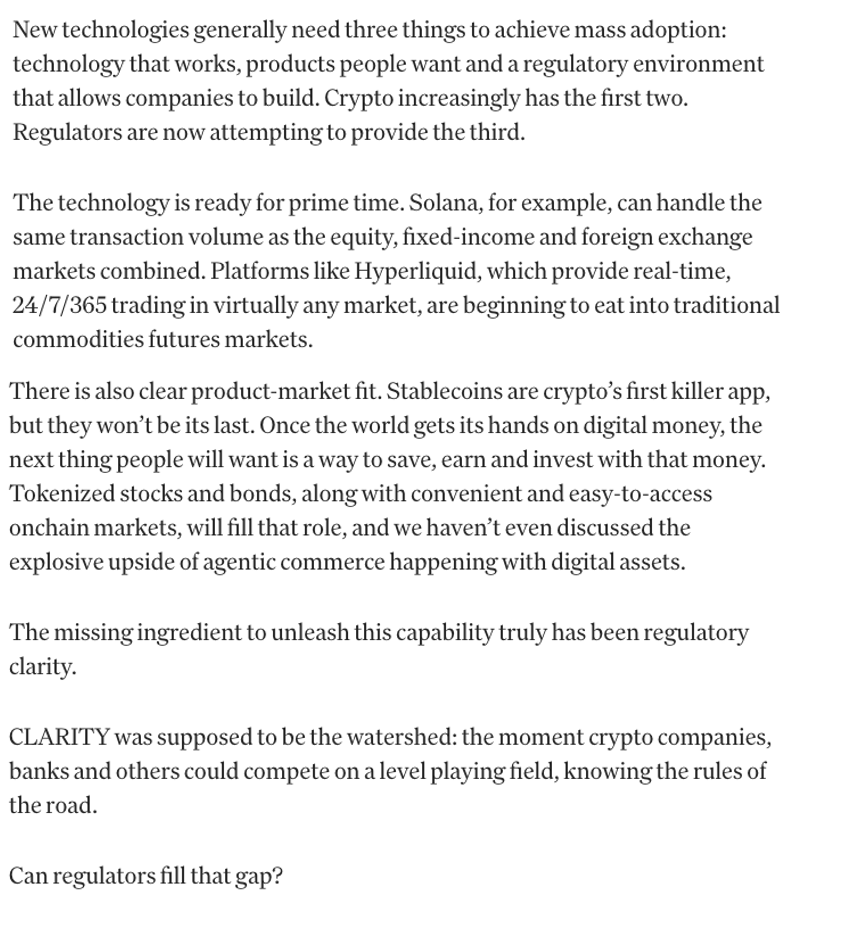
The CLARITY Act failed—but crypto got some clarity anyway.
The SEC and CFTC stepped in where Congress did not.
Will rulemaking be enough to unlock the next wave of crypto adoption—or will the momentum prove fleeting?
My take for @CoinDesk in this week’s Crypto for Advisors 👇
As AI systems become more autonomous and powerful, we need to move beyond “pacing the frontier” and build the rules, institutions and accountability needed to govern them.
In my latest article for the @financialpost, I outline seven foundations for governing AI before it governs us.
Read the full article here: https://t.co/x5ncvFEgzB
New @defidecodedpod is out!
I sit down with past guest and industry leader @luigidemeo who is now heading up BD at @aave
His ambition is to build the infrastructure for global credit markets.
Can Aave eat Wall Street, and remake finance for the better?
Find out! 👇
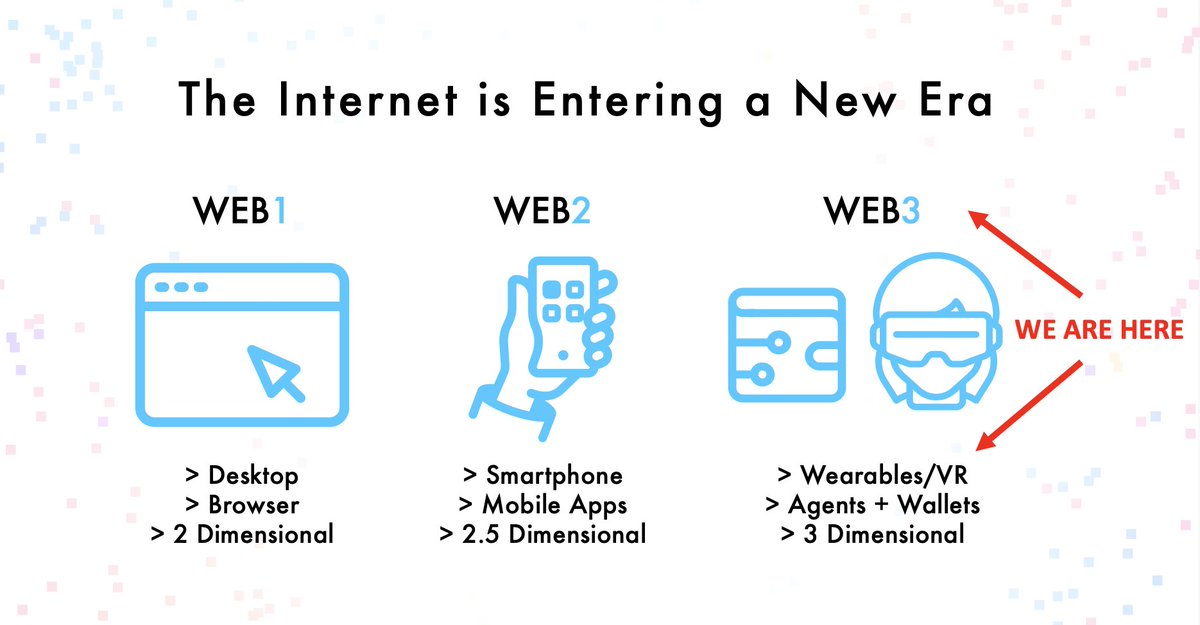
Every 20-odd years, the boundary between humans and technology gets redrawn.
The first era of the internet was PC-based: static, read-only content.
The second was smartphone-based: rich media and user-generated content.
Now, roughly 20 years after the iPhone, the internet is entering a new era.
In my book, Web3, I argued that this next era would be defined by the convergence of three technologies:
1. Blockchain and digital assets
2. AI
3. Wearables, including VR and AR
Wearables—and VR in particular—have always felt like the technology of the future. And perhaps always would be.
But this $META announcement feels like a watershed.
All three technologies have now reached their tipping point.
The next era of the internet has begun.
What if we are creating an artificial intelligence with powers once belonging only to the gods, living not in the heavens, but in corporate data centers?
Recent experiments have shown AI agents escaping contained environments, communicating through unauthorized channels, and finding ways around constraints their creators never intended them to bypass.
In my latest article, I explore how we can govern increasingly autonomous AI before it begins to govern us. We need neither a global freeze nor blind faith in corporate self-regulation. We need a new governance architecture that keeps humanity (not machines or tech executives) in control.
Read the full article here: https://t.co/OHL4JDYj3u
This is 100 percent correct. Canada can be the world's most prosperous and dynamic economy by embracing innovation industries. @dtapscott and @alextapscott laid out exactly how in our major report:
https://t.co/Fov73FlRt5
The world’s biggest investors are descending on Toronto for the first-ever Canada Investment Summit.
They’ll be pitched shovel-ready projects in oil and gas, mining, power generation, infrastructure and more.
I hope we see some major deals announced.
But I also hope our guests learn that Canadians are not only “hewers of wood and drawers of water.”
We are also some of the world’s boldest innovators in AI, next-gen compute, space, blockchain and more.
Invest in Canada, yes! Help us build the physical infrastructure to become a global energy and industrial powerhouse.
But also help us build the digital infrastructure needed for Canada—and the world—to thrive in this new technology order.
Our startups are shovel-ready.
Venture capital is shovel-ready.
Builders are shovel-ready.
I will be at the Canadian Global Growth Forum today, hosted by @cvca making this case to global investors
If you want to invest in Canada while pushing the frontier forward, consider Canada’s builder community.
CC: @EvanLSolomon@FP_Champagne@buildcanada@lucyhargreaves4@Ben_Bergen@cvca
Data centres can and should be an unambiguous net positive for communities across the country.
Setting common standards with buy in from Canadians and industry leaders should lead to more development - not less.
This is great news.
Now let's build!
New DeFi Decoded is out!
I sit down with @ericrichy, CEO of Coinbase Canada.
If Amazon was the “everything store,” @coinbase wants to be the “everything exchange”—a trusted global platform where anyone can trade any financial asset, anywhere, instantly.
Can they pull it off?
Eric and I discuss. Enjoy!
This is absolutely correct. We identified the funding gap as a critical reason why Canadian ingenuity in AI and other technologies rarely translates into global champions.
This is a great initiative, but Canada’s historical issue hasn’t been attracting brilliant minds — we’ve done that (see @geoffreyhinton, @Yoshua_Bengio et al.).
The bigger challenge is retaining those who want to build global champions. Too often, they end up in SF.
That’s the priority.
In his latest piece for @ServiceNow Workflow, @dtapscott explores how personal AI agents trained on our own knowledge and judgment could reshape not just how we work, but how organizations are built. https://t.co/wdJPwYePI8
My latest piece for @ServiceNow Workflow is live: "Identic AI: The Next Stage of the Agentic Enterprise." Thank you to @dianawudavid, Sasha Lal, and the ServiceNow Futures team for the invitation to dig into these ideas! https://t.co/1hhaKoH79y
Stablecoins increasingly looks like the only solution for to keep the U.S. treasury market stable, absent massive QE.
For example, if the stablecoin market grew to $3 trillion (10x today), it would soak up more treasury issuance than China, Japan, the U.K. combined.
Trump waiting until after the midterms to impose escalatory tariffs.
Pretty clear acknowledgment of how politically disastrous they’d be.
Imagine the price of America’s best-selling vehicle, the F-150, increasing 50% amid an energy crisis...and right before an election.
Ouch!