Eight cents to check the name. Three cents to move the money.
On one published cost stack, the fixed cost of compliance ran about three times the fixed cost of moving the funds. The rail was the cheap line.
And the file still did not refuse the payment.
“KYB’d” is a yes in admin. It does not say who decided, under which policy, or whether that yes is still live.
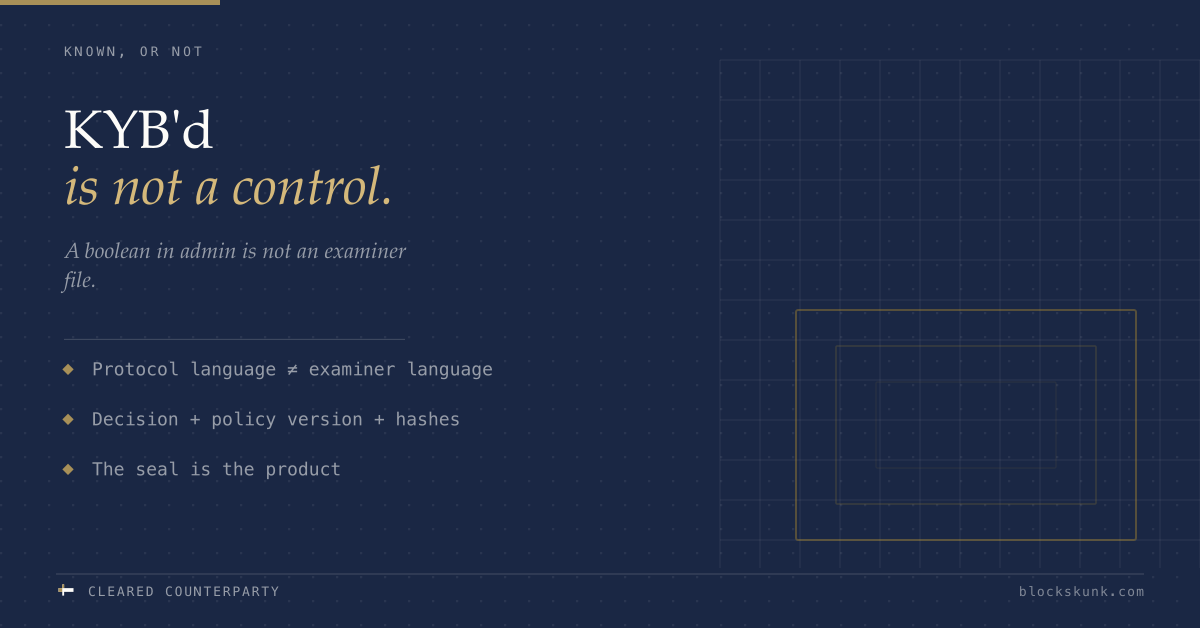
KYB’d is not a control.
About eight cents to check the name. About three cents to move the money. The file still does not refuse the payment. KYB’d is not a control. https://t.co/J00nOGrObH
90 days. $2,274.
That is Fenergo's 2024 banking average for a corporate KYC review — cost and calendar. Industry baseline. Not a Cleared Counterparty measurement.
The expensive part is rarely the first registry pull. It is the second, third, and fourth review of the same institution at the next venue.
If quote volume dwarfs onboard count, meter the sealed subject and the material-change event. Do not meter another KYB seat as if that were the clearing product.
At 90 days and $2,274 a review, the second KYB of the same institution is not compliance. It is duplication.
#ClearedCounterparty #KYC #Banking #OperationalEfficiency
Introducing Cleared counterparty - continuous evidence and a shared record make counterparty eligibility portable. The Permissioned Timestamp. https://t.co/Bwpc2lSPxd
FATF is the Financial Action Task Force — the intergovernmental body that sets global standards against money laundering and terrorist financing. Most countries turn those standards into local law. Banks and clearers treat them as the baseline.
One of those standards is Recommendation 17: Reliance on third parties.
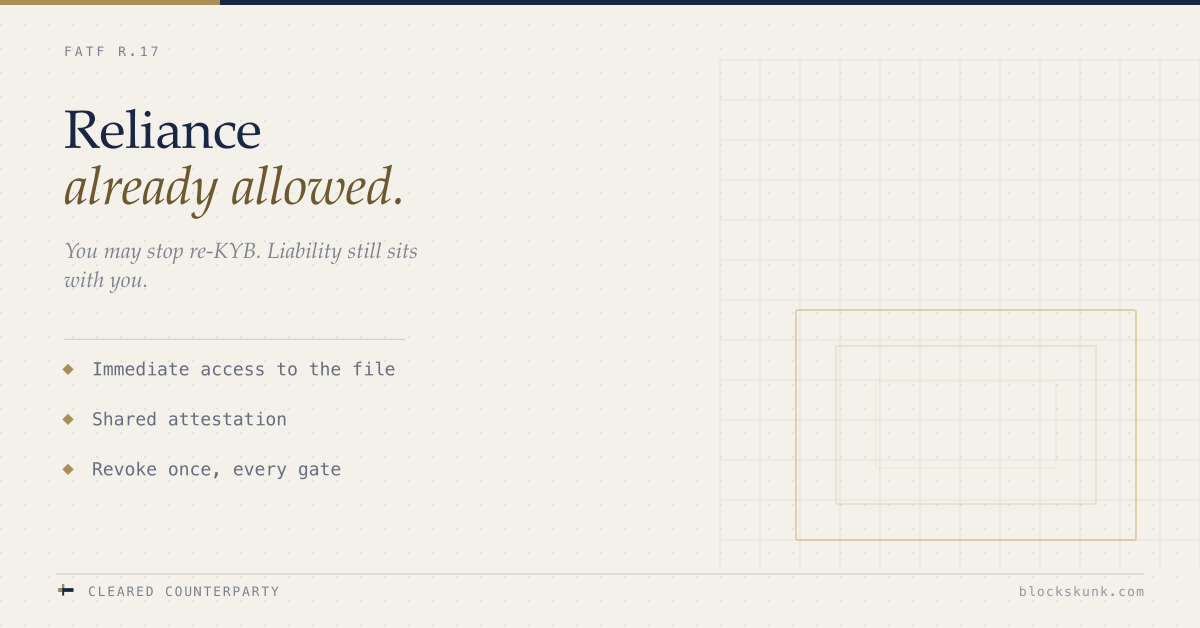
In plain English: when you must know your customer (customer due diligence, or CDD), you may use work a regulated third party already did, for parts of that check instead of rebuilding the same company file from scratch at every venue.
Two conditions stay. You remain responsible for the relationship. And the identification data behind the check must be available immediately if someone asks.
That is the legal shape of “members don’t rebuild the same Ltd file at every venue.” You still own the risk. You stop pretending the only proof is another full KYB pack.
Correspondent banking built shared questionnaires because bilateral packs do not scale. Digital clearing is inventing the same spreadsheet again.
What reliance looks like in operation is a shared attestation a gate can read: decision, policy version, screen result, allowances in one status, revoke once, every member sees it. Not a shortcut around liability.
See a live example: https://t.co/cQJblA6XoO
That receipt is a VERIFIED PASS under a named policy. It shows an OFAC SDN Advanced screen came back clear. It states what the pass allows on that network — here: bid, inject, offtake.
An examiner can verify the sealed decision and digests. The counterparty legal name never appears on the page. That is the Disclosure Boundary.
FATF already allowed you to stop re-KYB. You still re-KYB.
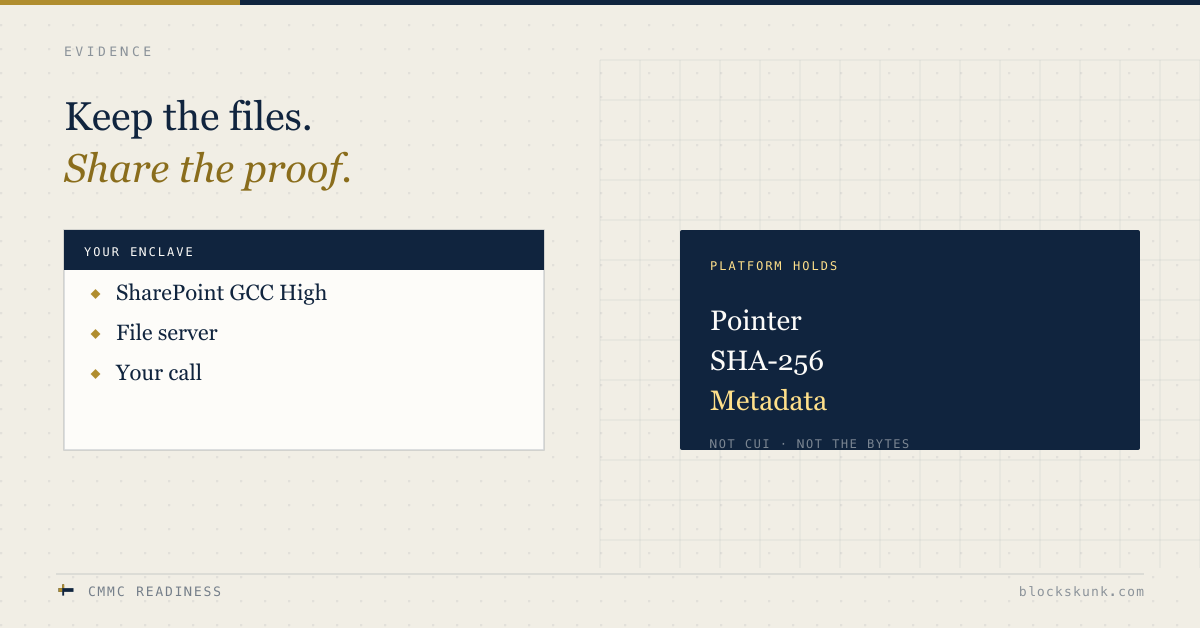
Keep the files.
Share the proof.
That should be the default posture for sensitive contract information.
Too many readiness workflows assume the evidence package has to travel as a pile of files. Screenshots move. Exports move. Spreadsheets move. Soon the proof of control becomes another uncontrolled data set.
That is backwards.
Sensitive contract data should stay where it belongs. The receiving party usually needs confidence that evidence exists, has not changed, and supports the claim.
They do not always need the underlying file in their inbox.
Hashes help separate those jobs.
A hash can prove that a specific record existed in a specific form at a point in time. If the record changes, the hash changes. The proof can travel without moving the contents.
That does not remove assessor judgment.
It makes the assessor’s job cleaner.
They can ask for the record when needed. They can verify that the file presented later matches the proof shared earlier. The sensitive material stays under tighter control until disclosure is required.
For CMMC and NIST 800-171, that matters.
Readiness is not only about having controls.
It is about showing control over the proof itself.
Keep the files. Share the proof. Let assessors decide what needs to open.
Safe settlement cash answers what moves. It does not answer who may stand on the other side.
That second question is the perimeter. Who may quote, settle, or hold — under which policy version — and whether the answer is still live at the hour of the trade.
Banks kept that list inside the account for a long time. A new ledger does not inherit the account. Know-your-business done in one building and stored as a flag dies at the next door.
Cleared Counterparty is not another review. It is the sealed eligibility fact in front of the quote. Decision. Policy version. Hashes. One status every gate can refuse on. Revoke once.
The tokenized share of core markets is still tiny. Until membership travels as a fact — not a rumor in admin — the perimeter stays private copies.
Atomic settlement is a beautiful property.
Both legs, or neither. The contract does not leave a half-payment standing. A programmable rule can hold the settlement until a condition is true, and then fire itself.
Hold the applause one second.
Both legs or neither is a property of the transfer. Eligible is a property of the parties.
A rule that fires by itself still has to read something true. Who the counterparty is. Which policy version cleared them. Whether the check is still inside its life. If the condition is a boolean labeled KYB'd, the atomic transfer will faithfully settle a stale flag.
Programmability is only as honest as the fact it is programmed to read.
The eligibility fact in front of the quote. Then the legs may move together.
https://t.co/facwThCSJi
CMMC stands for Cybersecurity Maturity Model Certification.
It is how the U.S. Department of Defense checks whether contractors and subcontractors protect certain information tied to defense contracts.
That means the first question is not “How many controls have we completed?” It is “Which contract information do we hold, and where does it live?”
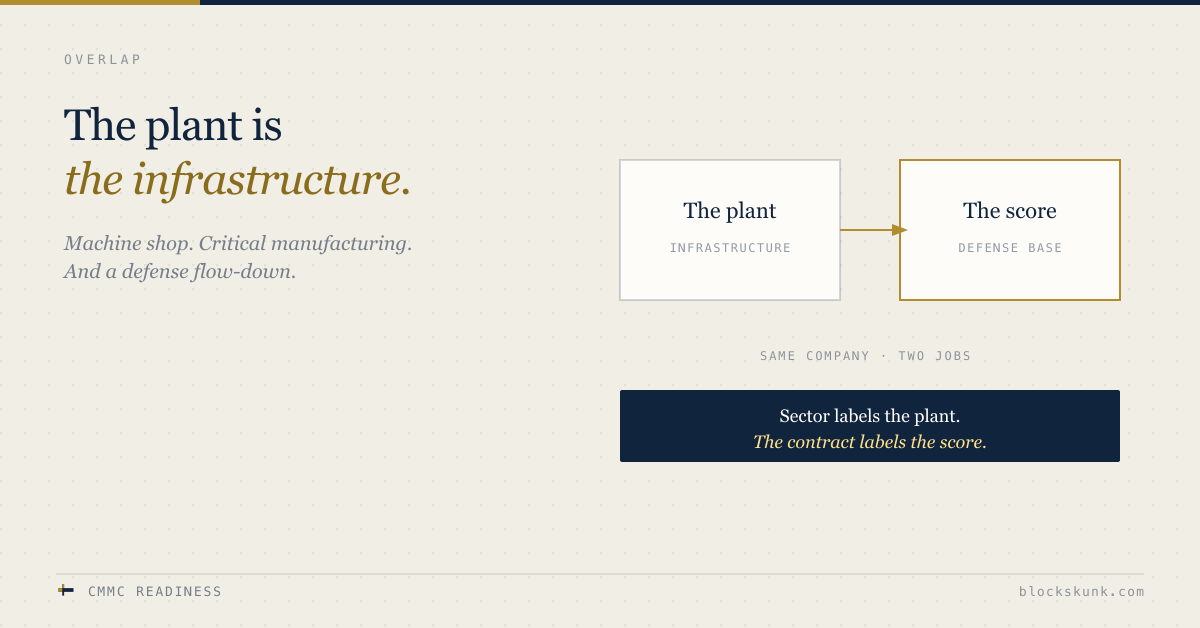
A company can run critical infrastructure and still have only one small defense enclave in scope. It can also receive the obligation through a subcontract flow-down.
The contract and the data set the boundary. The sector label does not.
https://t.co/G8aKXOy4zt
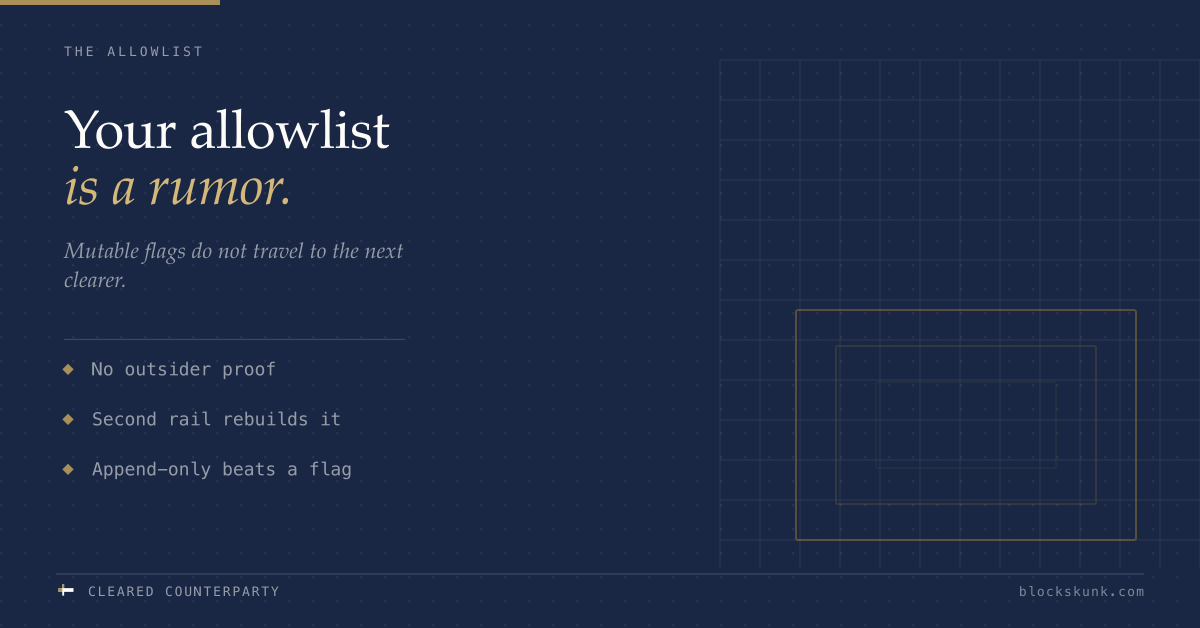
Your allowlist is a rumor.
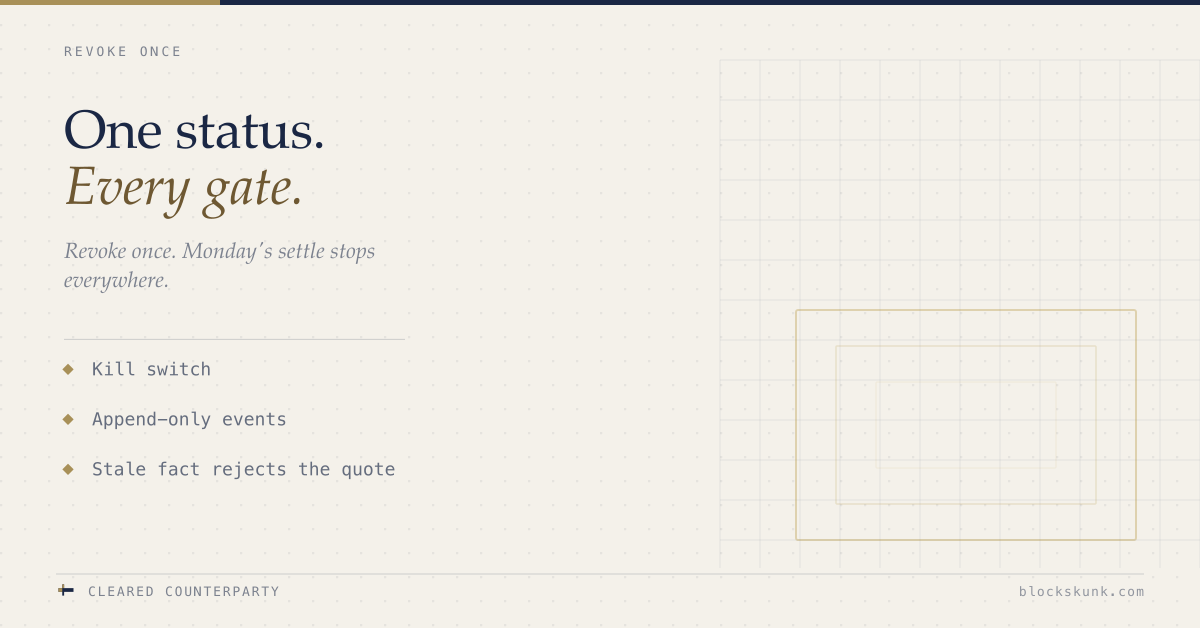
A mutable flag in an admin panel does not travel to the next infrastructure layer. It has no outsider proof. It cannot stop Monday's proceed on every participant when Friday's regulation map changed.
Append-only eligibility events do that job. One status. Every gate. Revoke once.
The check is rented. This is the sealed eligibility fact the transaction gate already requires.
A participant can rely on it. An examiner can reconstruct it.
Don't buy another logo. Buy the eligibility fact in front of any action.
@OdingardSecure Same overlap shows up in critical minerals: the plant is infrastructure; the defense obligation only lands when contract data is in scope.
More on why that supply chain became a national-security priority → https://t.co/p9dIPsAFVH
A machine shop can be critical manufacturing and defense industrial base at the same time.
Sector labels the plant.
The contract labels the score.
That overlap is the expensive scope error not because the sector sounds “critical.”
In collaboration with @OdingardSecure we’re adding NIST SP 800-171 support: draw the boundary first, then build the package behind the score.
https://t.co/G8aKXOy4zt
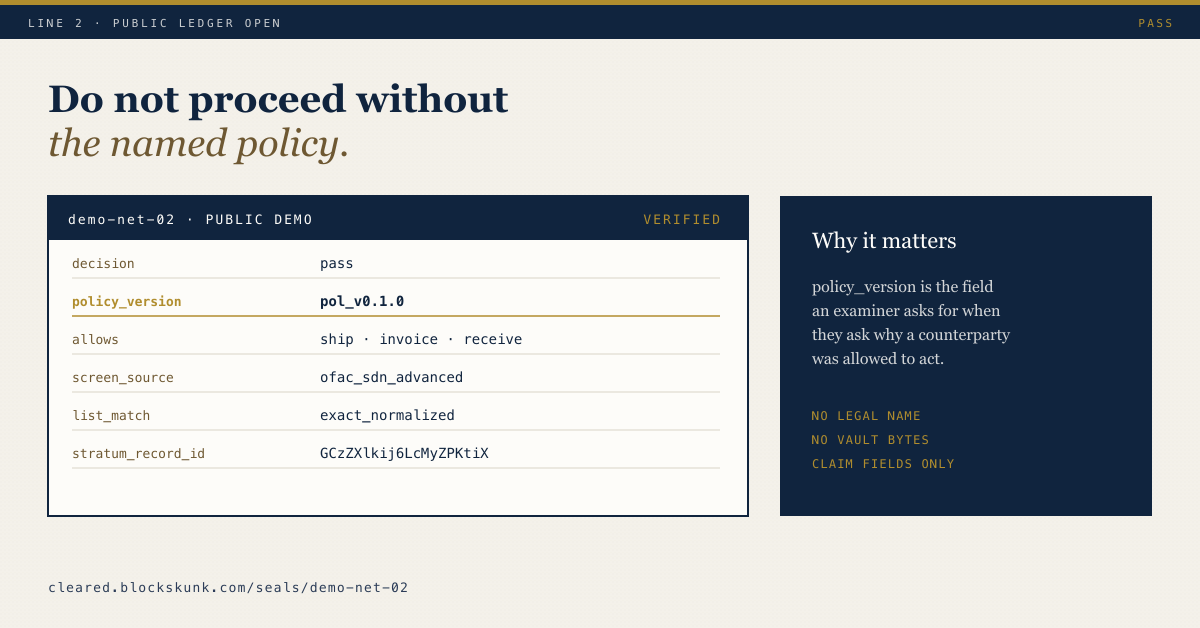
Do not proceed without the named policy.
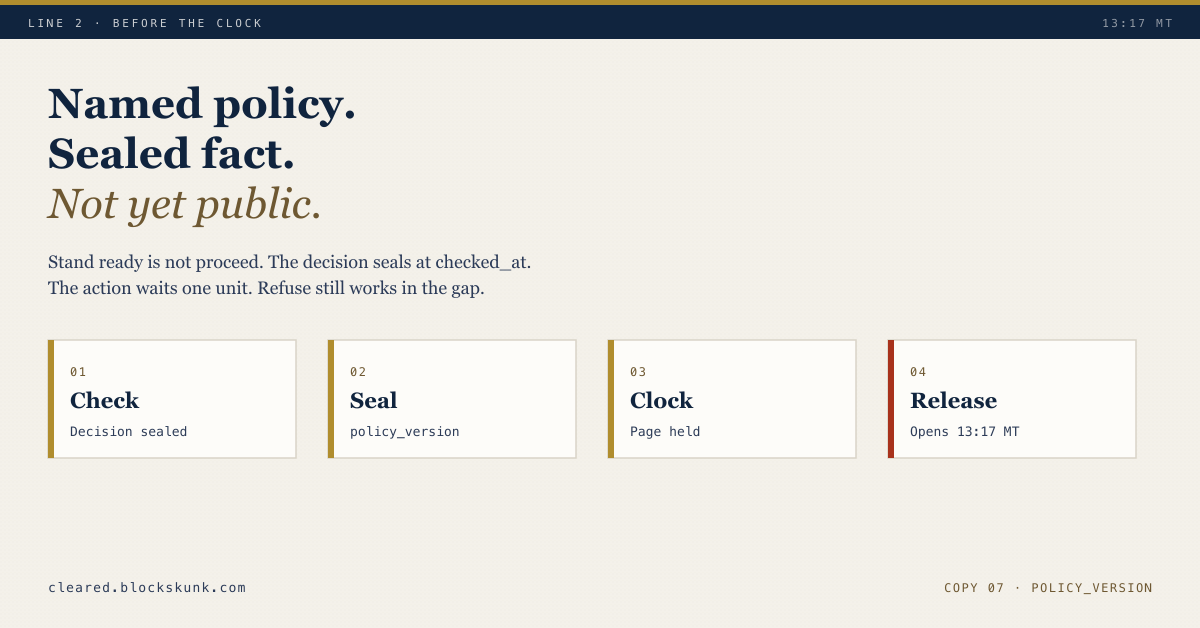
The seal was ready while the page stayed locked. Tick. Tock. At 13:17 MT the second public receipt unlocked. Same shape as Line 1. Separate release.
Live now: https://t.co/GJbWa0ZNIq
Pass under pol_v0.1.0. Allows ship, invoice, receive.
policy_version is on the receipt — the field an examiner asks for when they ask why a counterparty was allowed to act. Evidence digests. Stratum record. No legal name. No vault bytes.
This is what sits in front of the action.
Line 3 is `checked_at` in seventy-two hours.
Clearing already requires a named policy. Most desks still keep it in a slide deck.
That is true beyond the trading floor. Procurement, supply chains, and energy markets have the same gap: two parties must be eligible to act before they act, and the proof still arrives late — or not at all.
Today at 13:27 MT Line 2 opens that field on the public MEMORANDUM: policy_version and a second sealed receipt the gate can read before the quote.
Stand ready is not the same order as proceed. The decision is sealed at checked_at. The action is permitted one unit later. In that unit the gate can still refuse. It reads the live fact. It does not rebuild the file.
The seal is already written. The public page stays locked until 13:17 MT, on purpose.
When it opens: decision, policy version, allowances, hashes, a Stratum record an outsider can check. Not a KYB badge in someone else’s portal.
The check is rented. The seal is the product.
The clock teaches the shape. The product is the sealed fact the gate reads not the countdown.
https://t.co/LSqThse6BY
Most of the real work in a company never lands cleanly in the system of record.
The system of record shows the finished outcome: the purchase order, the control status, the counterparty mark. What it does not show is the path that produced that outcome. That path usually lives in email threads, spreadsheets, stakeholder meetings, and exception handling when the happy path breaks.
Roughly twenty percent of enterprise work is happy-path process. The other eighty percent is judgment, mismatch, follow-up, and coordination across teams and organizations. As artificial intelligence agents start to take on more of that work, documents and summaries become cheap to produce. What stays scarce is proof that a fact is true, final, and checkable by someone outside your own company.
BlockSkunk builds that layer.
Stratum is a shared system of record that no single organization owns or can quietly rewrite. It tracks ownership, transactions, compliance events, evidence, and chain of custody across parties who need the same truth. When every participant works from one shared state, reconciliation stops being a department and starts being a non-event.
Arbiter is the evidence engine on top of that record. It turns risk, control, evidence, and verification work into packages an assessor can check independently. Instead of reconstructing what happened weeks later from screenshots and exports, teams generate continuous, tamper-evident proof and hand it over when the assessment arrives.
Cleared Counterparty applies the same idea at the moment of trade. Before a quote is accepted, both sides need an eligibility fact they can trust. Stratum holds the member fact.
Arbiter packs the assessor story around it. Cleared rents the check and sells the seal: a durable eligibility signal that sits in front of the transactions so counterparties clear faster without rebuilding trust from scratch each time.
Agents need a durable, machine-native place to keep context across the full job. Assessors need independent proof, not another document pile. Multi-party networks need one sealed fact both sides can verify.
That is the stack: Stratum for the shared record, Arbiter for independent proof, Cleared for eligibility before the deal.
One shared record. Independent proof.
https://t.co/lYgmh8LQB0
The wallet said Confirmed.
What you signed was approve(spender, max).
The signature was valid.
The screen was the lie.
A green check is not a live fact.
Quote only when the seal is live.
The system should have verified itself.
https://t.co/PdaLBDE2fK
We've dogfood this at BlockSkunk: A @USTreasury OFAC API call → exact normalized match → sealed eligibility fact. Receipt (shows claim fields only, legal name hashed): https://t.co/OeBNfpF3Hc
KYB'd is not a control.
A clearer can print "only verified institutions may quote, settle, or hold" and still keep the proof as a flag in admin.
Onboarding is not release.
A flag answers yes. An examiner asks who decided, under which policy version, on which inputs, and where to prove it.
Cleared Counterparty is the sealed eligibility fact in front of the quote. Decision. Policy version. Hashes. Live before the order is allowed.
The check is rented. The seal is the product.
Where is eligibility enforced on your rail today at quote, at settle, or in a spreadsheet?
The next