Network participants verify transactions against shared rules, and a consensus mechanism determines which ones make it into the record.
So, NO central referee. NO single gatekeeper.
It's just a network following the same rules and agreeing on what gets recorded.
Would it be absolute chaos?
An open record that everyone has access to write in.
Doesn't sound like the combo that would knock traditional financial systems out, right?
Wouldn't it be messy? Wouldn't they need a referee to moderate things?
Blockchain says NO
Here's why 👇
Instead of relying on a central authority (referee) to approve and manage every entry into this record, a blockchain relies on rules built into its network.
Anyone can submit a transaction, but that doesn't mean every transaction gets accepted.
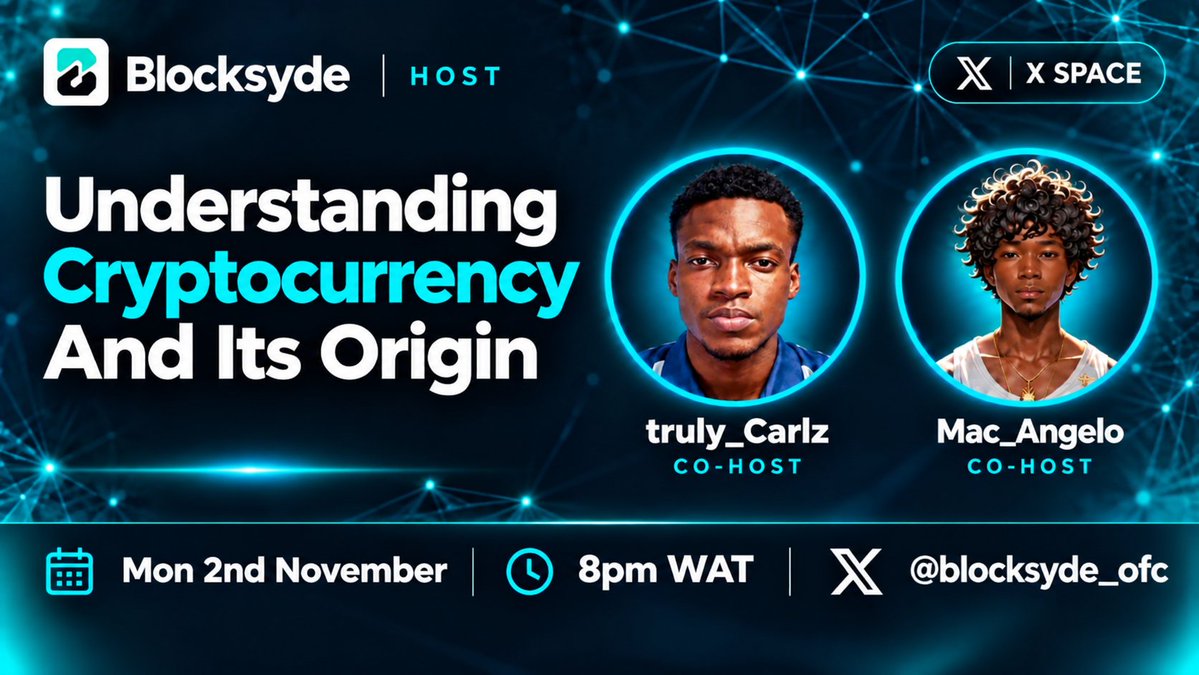
Join us on 𝕏 Spaces series tonight🔥
Today we dive into crypto and its origin!
An episode that promises to be fun and enlightening 🎙️🔥
Join us tonight at 8 PM WAT on X spaces
@blocksyde_ofc
Why do different blockchains use different consensus mechanisms❓
Because every design makes different trade-offs.
Some prioritize open participation and security. Others focus on speed, lower energy use, or a smaller, known group of validators.
Blockchains use different consensus mechanisms to agree on which transactions get recorded. Here are some of the popular ones:
1. Proof of Work (PoW): Miners compete using computing power to earn the right to add new blocks. (Bitcoin, Starcoin, etc)
5. Proof of Authority (PoA):
Approved validators take turns or are selected to produce and validate blocks. (VeChain's authority-based model)
The methods are different. But the goal is the same → keeping a shared blockchain record consistent; Not relying on a central authority!
Blockchains use different consensus mechanisms to agree on which transactions get recorded. Here are some of the popular ones:
1. Proof of Work (PoW): Miners compete using computing power to earn the right to add new blocks. (Bitcoin, Starcoin, etc)
Now, you know that a consensus mechanism is the way which a blockchain achieves consensus (agreement) on its record.
Next, we discuss the different consensus mechanisms used by different blockchains to achieve consensus.
4. BFT-based consensus:
Validators exchange messages and vote to agree on blocks, even if some participants fail or act dishonestly within the protocol's security limits. (Hyperledger Fabric uses an ordering service that can use BFT-based implementations)