Institutional adoption from companies like @Mastercard prove what we've known for years: blockchain integration is an infrastructure upgrade, not a trend.
OpenAI's business is as simple as this:
They sell tokens.
Bigger models cost more. Smaller models cost less. More reasoning steps have a higher price. Background agents running constantly are also priced in.
The long-term vision: intelligence becomes a utility like electricity or water.
"People buy it from us on a meter and use it for whatever they want to use it for."
The demand he sees is exponential. And the only failure mode is not having enough supply.
If demand outpaces supply, one of two things happens:
1. Prices spike and only wealthy individuals and large companies get access.
2. Society makes centralized planning decisions about who gets compute and who doesn't.
Both of those outcomes are bad so the solution is to flood the market.
For investors: The companies that own the infrastructure of the intelligence grid, chips, data centers, model providers are positioned the way electric utilities were positioned in the early 20th century.
Every industrial advance for the next 50 years runs through them.
Our analysts are already positioned in the companies at the center of this. They called $AMD, $MU, $CRDO and $NBIS before the big runs.
Don't miss the next call, link in bio.
Why should you pay attention to a new stablecoin like MGUSD?
When an institution like @MoneyGram issues a stablecoin, adoption is accelerating.
@tomerweller at @stable_summit 👇
Numbers that leave an impression.
@The_DTCC is the "premier post-trade market infrastructure for the global financial services industry," and it's coming onchain with Stellar.
Can you see what’s happening on $XLM right now?
Hundreds of millions in corporate credit and tokenized bonds are moving onto Stellar while most people scroll past it.
$500 million. One bond. VuMe Bond 2030.
Tokenized under Luxembourg’s securitisation law. CSSF regulated. Issued on Stellar.
That is half a billion dollars in structured debt choosing a public blockchain for issuance and settlement.
Germany’s Bitbond also issued a tokenized corporate bond under MiFID II.
The same regulatory framework used across trillions in European securities. On Stellar.
Janus Henderson launched tokenized products through Anemoy. FSC regulated.
A $350B asset manager bringing institutional products on-chain. Again, on Stellar.
This is the pattern people are missing.
Not meme speculation.
Not random DeFi experiments.
Real financial products.
Corporate bonds.
Institutional credit.
Tokenized debt.
All operating under regulatory frameworks traditional finance already trusts.
Every asset added to Stellar increases the network’s real-world financial footprint.
The same network DTCC selected.
The same network MoneyGram integrated.
The same network Bermuda partnered with.
Now hosting a single regulated bond worth $500 million.
The institutional flywheel around $XLM keeps getting bigger.
Those of us who have been around tech long enough recognize this pattern: When the internet was first commercialized, the largest companies resisted putting their businesses online because they did not want their data on the public internet. So they built proprietary extranets, closed and permissioned networks that used TCP/IP but only allowed certain companies in.
But open networks beat closed ones. Every one of those extranets died, and now every business runs on the open internet.
The same thing is happening in banking right now. JPMorgan, Citi and Wells Fargo can see that blockchains are superior (faster, cheaper, global) but they want to control them. So they are launching their own private, permissioned networks. Sound familiar?
This too will fail. Interoperability and global reach always beat control.
The banks will spend years and billions trying to keep their closed networks competitive with open ones, and they will lose that race.
The web3 startups building new payment, banking and financial services companies onchain should be thrilled about this. Every year the banks continue this doomed strategy is another year of head start for the people building on open rails.
Not every network can be both practical and blazing fast, but we manage 🏃🏻♂️
Dan Doney, Managing Director and CTO of @The_DTCC explains that trust starts with your track record, and ours is airtight.
Projections in the rearview & nothing but open road ahead 🏎️
@tomerweller discussing the “insane” RWA growth on Stellar this year during his fireside with @cryptauxmargaux at @stable_summit.
"Tokenizing just to tokenize is not beneficial. You tokenize because it is best for the fund."
--@DenelleDixon today on @business discussing RWA growth on the Stellar network and why institutions like @The_DTCC tokenize on Stellar.
Activity on the Stellar network is shifting from issuance to real usage, with the numbers to prove it.
In Q1 of 2026, the convergence of tokenized assets and multicurrency stablecoins propelled payment volume to a record $5.5 billion, a 71% increase year-on-year.
When you build with institutions in mind from day 1, bringing them onchain is easy.
@DenelleDixon on @CoinDesk talking about the partnership between Stellar and @The_DTCC.
According to @nchakar, the tokenization water is warm. It’s time to jump in.
Nadine joined us at Meridian 2025 to talk about why @The_DTCC moved early to bring traditional finance onchain.
Never owned $XLM, and probably never will. But credit where it’s due, the XLM team has made a lot of smart decisions over the past 7 years, and it’s finally starting to pay off with real adoption
-Burned half their supply
-Introduced turing complete smart contracts
-Scaled their validators & implemented strong redundancy of their Tier 1 Ops
The DTCC’s Tokenization Announcement - What It Really Signals
The Depository Trust & Clearing Corporation (@The_DTCC ) moving toward tokenization is not small news.
It is structural.
We’re talking about:
~$114 trillion in custody
~$4.7 quadrillion in annual processing volume
The core post-trade plumbing of global capital markets
When this entity says, “we are tokenizing,” it means:
The ledger is coming to the center of the system - not the edge.
Most tokenization efforts today look like:
• Permissioned ledgers (bank or consortium-controlled)
• Walled gardens with limited external routing
• Asset representation without universal liquidity paths
These limitations create exactly what I describe below:
🔥 Digitized assets without a neutral, efficient way to move value between systems. 🔥
Without interoperability + liquidity, tokenization is just:
a faster database, not a new financial system.
With interoperability + liquidity, tokenization aligned with
XRP + ILP (@Interledger) + XRPL + RippleNet + @Ripple Stewardship + Voluntary Lawful Adoption = New Monetary World
The SEC just gave DeFi frontends a meaningful signal: if you're not custodying assets or executing orders, we won't come after you. Most detailed safe harbor yet. But it's not a rule, it expires in 5 years, next administration can pull it, etc. More substance than we’ve seen in a staff statement. Still not a rule. Still expires. But it’s solid progress in the right direction.
https://t.co/q7044OuaJC
Austin Campbell delivers a brutal reality check on the "Trilemma of Compliance."
He argues that you cannot have permissionlessness, smart contracts, and real-world assets simultaneously without a federal judge eventually "rugging" the system.
"In the US legal system, asset commingling has a simple standard: freeze everything and figure it out later."
"If you think the blockchain makes crime legal, you haven't met a federal judge."
PayPal didn't pick $XLM on a whim. Neither did MoneyGram👇
PYUSD live on Stellar with 430M+ users. MoneyGram connecting crypto to cash across 170+ countries with $36M on-chain. Stablecoin remittances already live in Colombia
When companies this big trust a chain, others follow
🚨 Tom Sullivan, Managing Director at DTCC Digital Assets 🚨
The DTCC is
Tokenizing U.S. Treasuries
Tokenizing Russell 1000 stocks
Tokenizing liquid ETFs
And doing it with • Full legal rights preserved • Same utility as traditional assets • A measured rollout (not flipping a switch overnight)
This isn’t speculation anymore. This is infrastructure being built in real time.
They’re not opening the 100 Trillion market all at once…
…but they ARE opening the door.
Pay attention. 👀
Shout out to The Defiant, for the interview
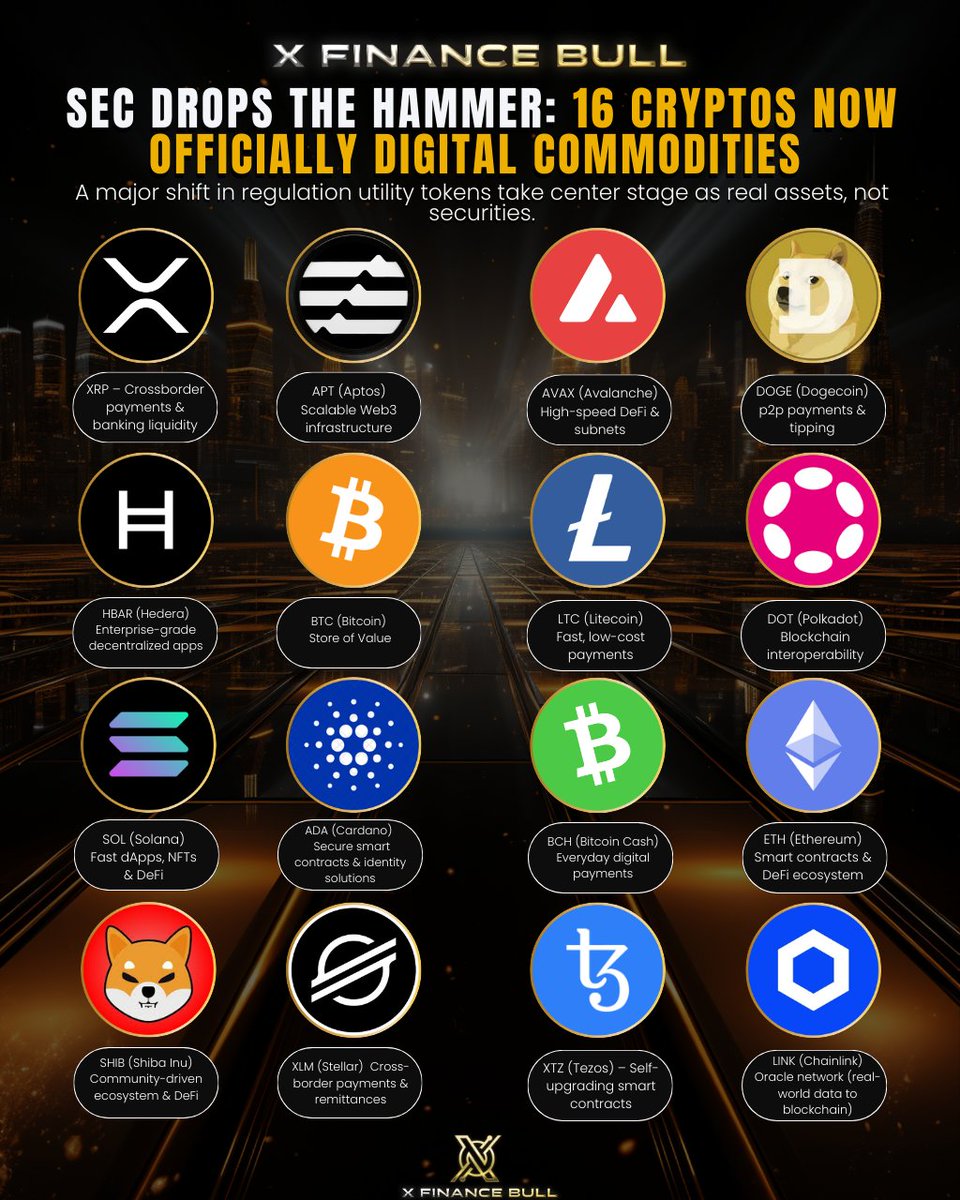
🚨The SEC officially classified 16 crypto assets as digital commodities. And $XRP is right at the top.
Not securities. Commodities. Real assets with real utility. Recognized by the two most powerful financial regulators in the United States.
Look at this list and what each one does.
$XRP. Cross-border payments and banking liquidity.
$APT. Scalable Web3 infrastructure.
$AVAX. High-speed DeFi and subnets.
$DOGE. Peer-to-peer payments and tipping.
$HBAR. Enterprise-grade decentralized applications. $BTC. Store of value.
$LTC. Fast, low-cost payments.
$DOT. Blockchain interoperability.
$SOL. Fast dApps, NFTs, and DeFi.
$ADA. Secure smart contracts and identity solutions.
$BCH. Everyday digital payments.
$ETH. Smart contracts and the DeFi ecosystem.
$SHIB. Community-driven ecosystem and DeFi.
$XLM. Cross-border payments and remittances.
$XTZ. Self-upgrading smart contracts.
$LINK. Oracle network connecting real-world data to blockchain.
Every single one. Utility-driven. Classified as a commodity. Not a security.
This is the moment the industry has been waiting for since 2013. The SEC and CFTC drew the lines together. Joint guidance. Harmonized taxonomy.
Chairman Atkins said most crypto assets are not securities. Chairman Selig co-signed.
XRP leads this list for a reason. Payments and banking liquidity. That's the use case that touches more institutional money than any other on this list.
Cross-border settlement. FX bridging. Treasury liquidity. The backbone of global finance.
The utility era is here.
And $XRP is at the front of it.