An elderly man arrived at the CJP protest in a wheelchair.
Abhijeet Dipke stepped down from the stage to personally receive him because he thought the man would be a PM Modi hater. As soon as he arrived, the CJP protesters started raising anti-Modi slogans in front of him, shouting, Modi is a thief.
But the elderly man strongly scolded the CJP protesters. He told them, Stay absolutely quiet. PM Modi is not a thief. Narendra Modi has been serving the country for longer than your age. He worked as the Chief Minister of Gujarat for 12 years, and after that he has been continuously serving as the Prime Minister. PM Modi is honest. It is only because of some people sitting within the system that Narendra Modi's name is being tarnished. You all are fools for saying such things.
Hearing this, Abhijeet Dipke's face completely dropped. He stood there silently listening because he had come to receive the elderly man thinking he would speak against PM Modi. Instead, the man taught the ill-mannered CJP protesters a lesson.
Do you know about this man?
He is R.C. Majumdar, who built an 11-volume, 9,000-page history of India using inscriptions, numismatics & Sanskrit texts.
Zero British colonial bias. Zero post-independence political tailoring. Just evidence.
Read on this 🧵
@physics__wallah Looks like Physics Wallah needs English Wallah! A full page ad without checking copy? That too in an English newspaper in an English savvy city edition. Privilege of public money?
We had the honour of meeting Manuel Aaron Sir, Pioneer of Indian chess. At 92 his passion is still unmatched and analyzing all top-level games. Truly inspiring and lot of respect🙏🙏
Congrats to Vaishali akka! 🔥🔥Proud of what you have achieved! Inspiring to see how you handled the critical moments in the tournament! Happy to see the results for all the hard work!
DAY 2. Same footpath. Same violation.
This time — a Court Advocate. Black coat, white shirt. KA53 EW6186. On camera.
If law-keepers don’t respect the law, what hope do pedestrians have?
@BlrCityPolice@blrcitytraffic — footpaths are NOT bike lanes.
#Bengaluru#RoadSafety
A bus conductor in Karnataka told his driver:
“Stop wherever Grade 10 students ask for a lift… they have board exams from the 18th.”
“Even if we get late, it’s okay. Let’s help them.”
He even urged other buses to follow the same.
This shows the true heart of Karnataka State Transport — where duty meets humanity. ❤️
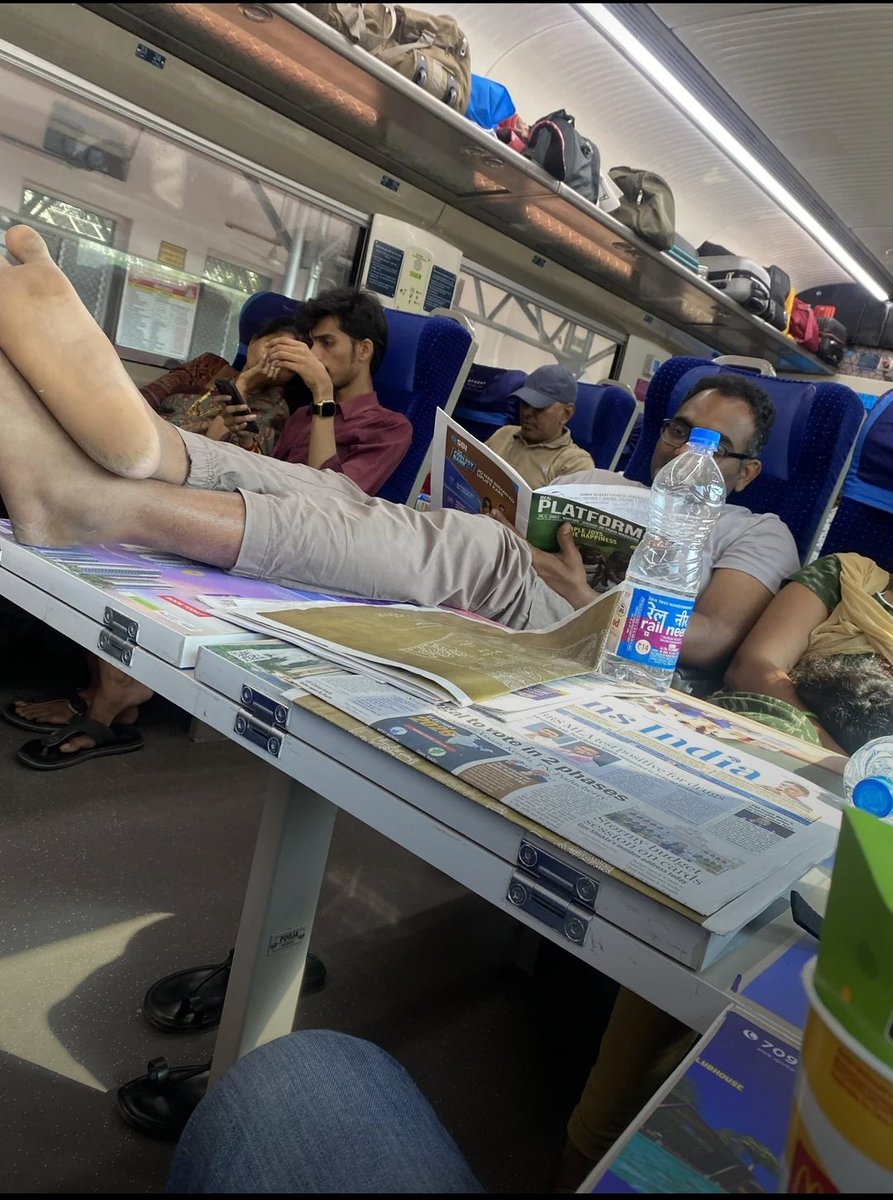
Watching someone on a Vande Bharat train put their bare feet on the tray table where people eat was honestly infuriating. The table had newspapers, bottles, and is literally meant for food service.
What made it worse he had a small kid sitting with him.
@PatrioticSoul33 I hope this mother and daughter never come to live in the south esp Bangalore and Hyd. Truly toxic cultured pair. Should not the lawyer community protest for misuse of profession? To keep the dignity of the profession pl file 100s of PILS or whatever needs to be filed.
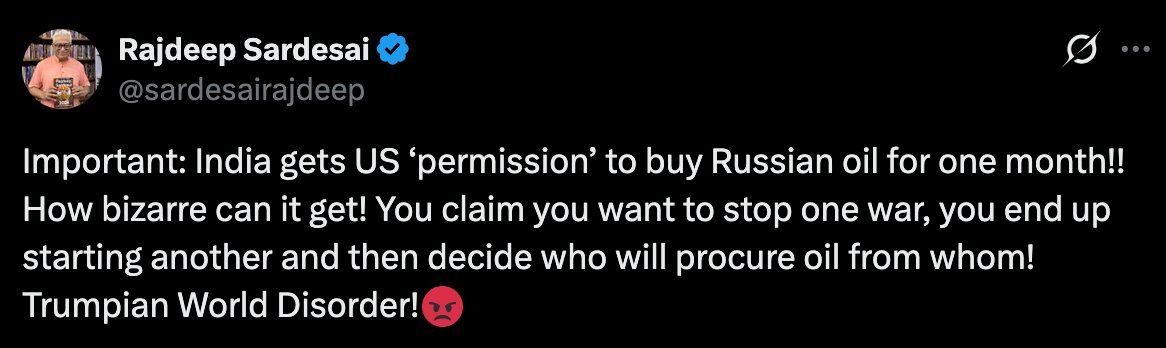
We must see a lot of posts today on "US giving permission to India" trying to use it to mock India by some small-minded Indians who can't accept India winning in every crisis for some reason.
But let's be clear: India didn't care about this US permission for Russian oil ever.
Russian oil flowed into India even under US sanctions and objections for 3 years since Russia-Ukraine war started. In fact, it increased substantially even as US and EU were crying about India buying Russian oil and threatening India.
So let's appreciate India for such strong decisions in national interest previously that kept oil manageable in spite of big world wide conflicts and threats by world powers. India has worked in its overall strategic interests clearly.
This statement by the US is for their own domestic audience because news reports were out in plenty that India was increasing Russian oil - which it was still buying even in February.
If I had to sit across the table with global FIIs and present the India story 🇮🇳, this is how I would do it.
Dear FIIs,
Here is a country where foreign institutional investors (you) have taken out close to USD 30 billion of equity capital over the last two years and yet the system held steady. There were no capital controls, no emergency restrictions, no policy panic. Markets absorbed the selling, FX reserves remained strong and policy continuity was preserved. That resilience itself is a signal.
Here is a country that, post COVID, chose fiscal discipline when much of the world chose fiscal drift. Over the last four to five years, India has followed a clearly articulated consolidation path, steadily reducing deficits rather than oscillating between stimulus and shock. The medium-term framework remains anchored close to 4%, with current guidance at around 4.3 percent by FY27.
Here is a country that proved discipline does not mean sacrificing growth. For the third consecutive year, government capital expenditure has crossed Rs 10 lakh crore, focused squarely on productive assets. Roads, railways, ports, power transmission, defence manufacturing, logistics corridors. This is capex that compounds into productivity, not spending that disappears into consumption.
Here is a country that is visibly strengthening its sovereign balance sheet. India’s government debt stands at around 60% of GDP, with a stated intent to gradually move toward 50% by 2030. Put that in context, the US today operates at roughly 120% debt to GDP. China is moving toward 100% plus, driven by local government and quasi-fiscal stress. Brazil remains in the mid-90s, with upward pressure. Direction matters, and India’s direction is clearly different.
Here is a country that combines macro discipline with one of the strongest consumption engines in the world. India is a 1.4-billion-population market, with rising per-capita income, a growing middle class, rapid urbanisation and improving access to credit and digital payments. Consumption is not dependent on leverage alone. It is driven by demographics, income formalisation and aspiration. This creates a long runway for demand across housing, autos, consumer goods, travel, financial services, and healthcare.
Here is a country where inflation, despite global shocks, remains among the lowest globally, hovering around 2–3 percent. In a world dealing with sticky inflation, supply disruptions, and geopolitical pressures, India has managed price stability without choking growth. That gives policymakers room to act and investors confidence in real returns.
Here is a country that has executed reforms which permanently altered economic behaviour. The UPI digital payments infrastructure has created a real-time, near-zero-cost financial backbone processing billions of transactions every month. It has formalised consumption, widened the tax base, reduced friction, and improved transparency.
Here is a country that introduced real capital discipline through the Insolvency and Bankruptcy Code. For the first time, lenders have time-bound resolution, capital has credible exit mechanisms, and promoters face consequences. This reform changed credit culture, recovery expectations and risk pricing across the system.
Here is a country where tax reform is now visible in cash flows, not just policy papers. Under GST, India collected a record Rs 22.08 lakh crore in FY25, with an average monthly run-rate of around Rs 1.84 lakh crore. Collections have more than doubled in five years, reflecting deeper formalisation, stronger compliance, and a broader economic base. This is quiet compounding at work.
Here is a country that moved beyond slogans to execution in manufacturing through Production Linked Incentive programs. The total approved PLI outlay is about Rs 1.97 lakh crore (roughly USD 28 billion). triggering incremental production exceeding Rs 16.5 lakh crore and creating over 12 lakh direct and indirect jobs.
Here is a country that cleaned up its financial system instead of postponing the problem. NPAs were recognised, banks recapitalised, governance tightened, and balance sheets repaired. Today, the banking system is among the strongest it has been in decades, capable of supporting sustainable credit growth.
Here is a country where political stability and policy continuity have become a competitive advantage. Economic direction does not change every election cycle. Large infrastructure projects get completed. Reforms are compounded rather than reversed. For long-term capital, this stability is invaluable.
Here is a country that is honest about its shortcomings. India still faces challenges - air pollution, especially in urban centres; civic sense and urban discipline which require long-term investment in education and behaviour; last-mile infrastructure where road quality and urban planning still need improvement and regional inequality, which must be addressed as growth broadens. Every large economy has its flaws. India’s are visible, acknowledged, and 'hopefully' be part of the policy agenda as we move forward.
Here is a country that, in an uncertain global environment, offers something rare - predictability at scale, with the humility to improve where it falls short.
India today is not a short-term trade.
It is a structural allocation, with upside driven by reform, consumption, and execution and risks that are visible, not hidden.
Join Indian Army as an Engineer | SSC (Tech)–67 Entry
Who Can Apply?
* Unmarried Male & Female Candidates
* Age: 20 – 27 years (as on 01 October 2026)
* Engineering Graduates (Final Year Students Eligible)
Last Date to Apply:
* Women – 04 Feb 2026
* Men – 05 Feb 2026