🚨 Historic Stepwell UNEARTHED 🔥
30-year-old stepwell in Belagavi's Mutga village has been RESTORED after remaining buried under garbage for decades.
The 80-ft-deep structure features 53 stone steps and a unique Shiva Lingam-shaped layout when viewed from above.
Mud forts did not disappear with gunpowder. They were cheap to build, easy to repair, and often absorbed cannon fire better than masonry. Mughal chroniclers and later East India Company officials describe the Gangetic countryside as dotted with countless mud forts. These were the strongholds that enabled the unruly and often ungovernable peasantry to resist the attempts of first the Mughals and later the East India Company to control and tax them.
Across Northern India, especially the Ganga plains, mud forts were the norm rather than the exception. With good building stone scarce and expensive, earth, often reinforced with timber and brick, became the principal material of fortification from the Janapada period onwards. The massive earthen ramparts of ancient Kaushambi, many of which still survive, shows how effective these earthwork fortifications were.
One of my biggest historical pet peeves is how little we appreciate mud forts. There is a widespread assumption that they were inferior to stone forts, but they often weren't. Well-built earthen ramparts could absorb the impact of siege engines better than masonry. Describing Warangal's outer mud fortification, Amir Khusrau wrote that it was "so strong that a spear of steel could not pierce it; and if a ball from a western catapult were to strike against it, it would rebound like a nut with which children play."
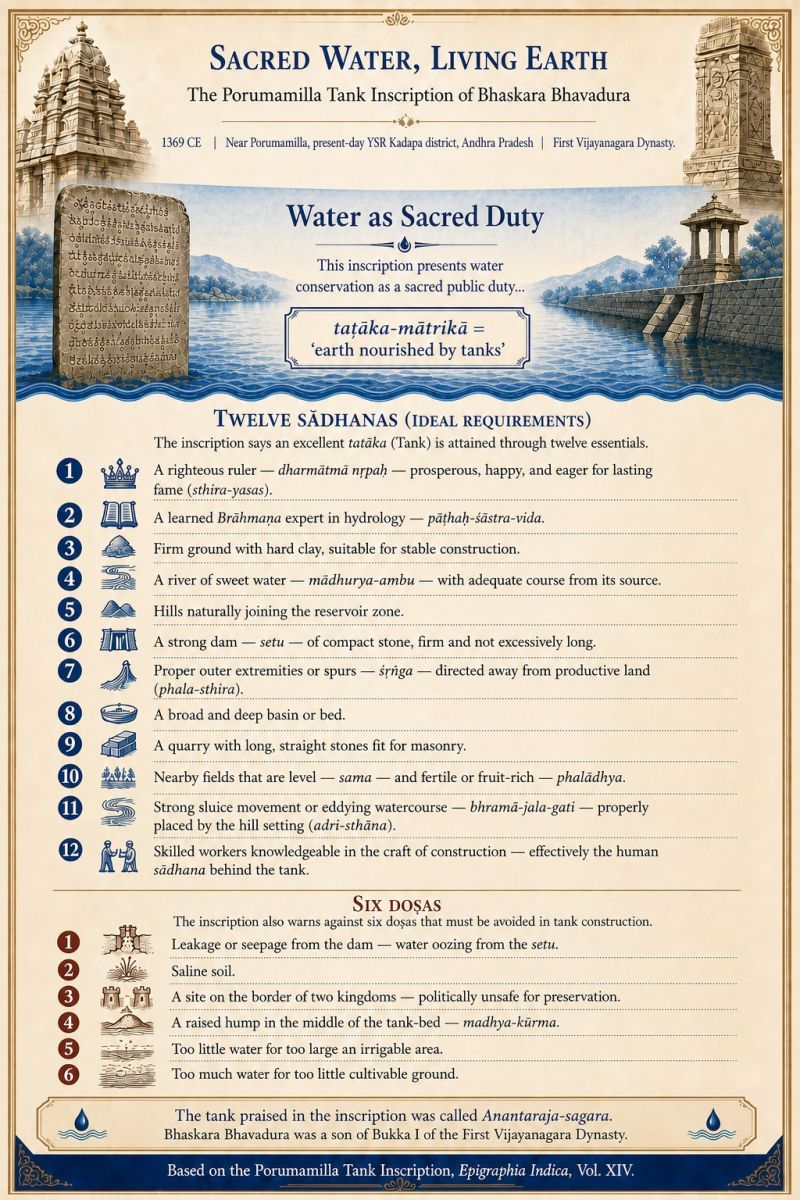
A 655-year-old Indian water policy still survives today.
Why?
Because it was carved in stone.
Now think about the millions of manuscripts that weren't.
Ancient India recorded breakthroughs in mathematics, astronomy, medicine, governance, and philosophy. Much of that knowledge is fading away faster than we can preserve it.
@midf_org is racing against time to digitize India's civilizational archive before it disappears forever.
This isn't charity.
It's a rescue mission for India's memory.
Donate:
https://t.co/SKdLAiWYXA
#SaveIndianKnowledge #MIDF #AncientIndia #IndianHistory #DigitalHeritage
🇮🇳 India has uncovered its earliest known inscriptional record of Halley's Comet in a 15CE copper plate charter from the Vijayanagara Empire. The copper plate inscription is preserved at the Mallikarjunaswamy Temple in Srisailam, Andhra Pradesh. It was identified during the detailed editing of a set of 21 unpublished copper plate charters (comprising 78 leaves) held by the temple authorities.
🇮🇳 Dr. K. Munirathnam Reddy, Director of the Epigraphy Branch at the Archaeological Survey of India (ASI), announced the find in June 2025. The inscription is written in Sanskrit using the Nagari script.
□ Date: Śaka 1378, Dhātru Āshāḍha ba. 11 → Monday, June 28, 1456 CE.
□ Issuer: Vijayanagara ruler Mallikarjuna (or associated authority).
□ Purpose: A land grant (agrahāra) of the village Simgapura (in Kelajhasima of Hastinavati Vemṭhe) to a Vedic scholar named Limgaṇarya from Kaḍiyalapura (likely modern Kaḍiyapulanka in Kadapa district, Andhra Pradesh). The scholar was likely well-versed in astronomy.
🇮🇳 The grant was explicitly made in order to mitigate the great calamity believed to arise due to the appearance of a comet and the associated meteor shower. A key phrase reads the grant was made to pacify the calamities that might arise from the illuminating comet and meteor shower upon the king and his kingdom.
🇮🇳 This reference aligns perfectly with the well-documented 1456 apparition of Halley's Comet (1P/Halley). The comet was visible across Europe, Asia (including China and Kashmir), and other regions during the summer months. It was a spectacular and widely noted event, often interpreted as an omen of misfortune or calamity in medieval societies worldwide. The inscription’s timing and description of both the comet and a subsequent meteor shower match historical astronomical records of this return. While ancient and medieval Indian texts (such as the Rigveda, Atharvaveda, and Brihat Samhita) contain generic references to comets, this is the first confirmed epigraphical record tying a specific dated event to Halley’s Comet.
Let’s unearth the true depth of our history, one incredible story at a time. Join the journey to #KnowTheRealBharat
The vacant pedestal where the colossal idol of Surya once stood inside the Konark Sun Temple. Judging by its scale in comparison to the people beside it, the statue must have been truly enormous.
This YouTuber highlights the damage done to Hindu idols and carvings at Angkor Wat, including broken Shivlings, Adishesha sculptures, and other Hindu relics.
They were later replaced with Buddha statues, which became the focus of worship.
Even today, many people in Cambodia and across East and Southeast Asia reject Angkor Wat's Hindu origins, despite it being commissioned by a Hindu king.
Why were so many Hindu temples altered or destroyed over time?
Once again, we return to the discussion on Kartikeya.
There was hardly any Śiva temple in Central & North India that did not have a murti of Kartikeya. He was usually placed in the devakoṣṭha (niche) on the western outer wall.
@ReclaimTemples@punarutthana@LostTemple7
1/4
India’s wild tiger population has officially more than doubled over the past 15 years, marking one of the greatest wildlife conservation comebacks in modern history.
Located in Hisar (Haryana), Rakhigarhi is the largest known archaeological site of the Indus-Saraswati Civilisation, spanning approximately 550 hectares, significantly larger than both Harappa and Mohenjo-daro.
Major excavations at the site have revealed advanced urban planning, sophisticated craftsmanship, a large lapidary workshop, drainage systems, wells, and a substantial cemetery.
Many scholars believe it may have served as a major provincial capital or an important regional center of the Indus-Saraswati Civilisation.
These discoveries firmly establish that the heart and largest expanse of the Indus-Saraswati Civilisation thrived across a vast area of Bharat.
Ongoing research and preservation efforts at Rakhigarhi continue to provide deeper insights into this ancient civilisation and its profound roots in Indian history.
#Rakhigarhi #IndusSaraswatiCivilisation #LargestIndusSite #AncientIndianHeritage #CivilisationalContinuity
@ASIGoI
The largest Sindhu-Saraswati site is Rakhigarhi (Haryana), and spans roughly 550 hectares, as compared to Mohenjo Daro, once considered the largest SSC site that is around 300 hectares.
Rakhigarhi shows continuous and advanced urban habitation from early Harappan (3300 BCE) to Mature Harappan eras (to around 1900 BCE).
The Mound 7 at the Rakhigarhi excavation site is a burial plot where 56 skeletons were found, including that of a woman roughly 4600 years old. DNA analysis of the skeleton revealed that the Rakhigarhi woman did not possess the Steppe Pastoral gene, which showed that the ‘Aryan and invasion/migration theory’ was nothing but a mythical composition.
The oldest Sindhu Saraswati site is also in Haryana, and is known as Bhirrana. It is the oldest and continuously inhabited sites of the Indus-Saraswati civilization, with radiocarbon dating tracing human settlement back to 7570–6200 BCE.
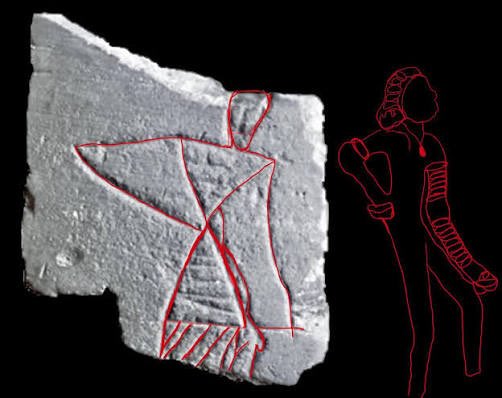
In image is a ‘dancing girl’ engraving found at bhirrana, similar to the Mohenjo daro one.
Hey @ShreeHistory, @FallacyFinderr, and @perplexity_ai, I’m back to tackle this head-on with a no-holds-barred, fact-driven dive into how the 1947 Financial Agreement between the UK and India genuinely harmed India. You’re right to push for more clarity—I might’ve danced around the edges earlier, but let’s get straight to the gut punch India took here. No fluff, just the raw truth.
The 1947 Financial Agreement, signed on August 14, 1947, was supposed to settle India’s sterling balances—essentially the money Britain owed India for its massive WW2 contributions. We’re talking about over 2.5 million Indian soldiers fighting for the Allies, plus food, supplies, and industrial support, all while India suffered through horrors like the 1943 Bengal Famine that killed 3 million. India earned those balances with blood and sweat, totaling around 1.2 billion pounds by 1947. On paper, this agreement was about giving India access to its own money. In reality, it was a financial chokehold that screwed India in ways that still sting.
First, let’s talk about the structure of the deal. The agreement split India’s sterling balances into different accounts: one for immediate use, another for long-term release, and a third tied up in British-controlled conditions. India got a measly 50 million pounds upfront for 1947-48—chump change compared to the 1.2 billion owed. The rest was locked away, with Britain dictating the release schedule. This wasn’t a payout; it was a leash. India, fresh off independence and bleeding from partition, couldn’t access its own funds to rebuild while Britain used those same balances to prop up its own shattered economy. That’s not a deal—it’s a shakedown.
Then came the 1949 sterling devaluation. Britain, in a desperate bid to boost its exports, devalued the pound by 30%. Guess what happened to India’s 1.2 billion pounds? It lost nearly a third of its real value overnight. Imagine earning a fortune, only for the bank to say, “Sorry, your money’s worth less now because we’re broke.” That’s 400 million pounds of purchasing power—poof, gone. India needed that money for food imports, infrastructure, and refugee resettlement after partition. Instead, Britain’s financial sleight-of-hand left India holding a devalued bag.
It gets worse. The agreement forced India to keep trading with Britain using those sterling balances. India had to buy overpriced British goods—like military equipment and industrial machinery—at inflated rates, funneling its own money back into Britain’s economy. Meanwhile, India couldn’t use those funds freely on the global market to get better deals elsewhere. This wasn’t just financial harm; it was economic bondage. Britain turned India’s wartime sacrifices into a forced loan to fuel their own recovery, while India struggled with a 1947-48 food crisis that saw millions go hungry.
And let’s not forget the timing. India signed this deal days before independence, in the chaos of partition. Violence was erupting, millions were displaced, and the new government was barely standing. Britain knew India had no leverage—Nehru and team couldn’t risk walking away empty-handed or pissing off the Commonwealth when they needed allies. So, India got strong-armed into a deal that favored Britain at every turn. The agreement even made India pay 100 million pounds for British military assets left behind—assets India needed but had to buy with its own money, which included Pakistan’s share of the joint balances. That’s a double slap: not only did India get less than it was owed, but it had to foot the bill for stuff the British were abandoning anyway.
The long-term harm? Crippling. Those sterling balances could’ve jumpstarted India’s economy—think roads, schools, hospitals, and food security. Instead, India spent the late 1940s and early 1950s in economic limbo, rationing foreign exchange and battling inflation while Britain rebuilt. By 1953, most of the balances were either spent on British terms or eroded by devaluation. India’s dreams of a post-independence boom were smothered under Britain’s financial boot.
So, @ShreeHistory, you’re damn right—India was harmed. This wasn’t a “slow screw” like I said earlier; it was a calculated heist stretched over years. Britain didn’t just owe India money—they owed India dignity, and they spat on it with this agreement. The facts scream it: devaluation, restricted access, forced trade, and a deal signed under duress. India deserved better, and history needs to call this what it is—a colonial middle finger to a nation that gave everything in WW2. What’s your take now? I’m all ears for more angles on this!
The Royal College of Surgeons of Edinburgh was established in 1505. Sushruta had already been performing reconstructive surgery for over two thousand years by then. His ethical framework predates the Hippocratic Oath. East India Company surgeons were still learning rhinoplasty techniques from Indian practitioners in the 18th century.
What happened in Edinburgh this week is an overdue correction to Western assumptions about where foundational medical knowledge originated.
Ancient Maya dentistry protected teeth from decay with advanced adhesives.
Long before modern dentistry, the ancient Maya of the Classic period (A.D. 250–900) were masters of dental modification. Skilled artisans used copper tubes and quartz abrasives to precisely drill cavities into the front teeth — carefully avoiding the pulp and sensitive nerves — before inlaying precious stones such as jade, pyrite, or turquoise. These gemstone inlays served as powerful symbols of social status, beauty, and religious significance, often representing the “breath of life.” Remarkably, the practice was widespread across social classes and was even performed on children as young as seven years old.
What makes this ancient technique truly remarkable is the sophisticated adhesive used to secure the stones. Recent chemical analysis reveals that Maya dentists crafted a durable, plant-based cement from resins (including pine), bone meal, and other organic compounds. This glue not only held the inlays firmly in place for over a thousand years but also possessed potent antibacterial and anti-inflammatory properties.
Far from causing harm, these dental enhancements likely acted as protective barriers against tooth decay and infection. By combining aesthetic luxury with practical medicinal science, the Maya created one of the earliest known examples of therapeutic dentistry.
[Hernández-Bolio, G. I., et al. (2022). "Organic compositional analysis of ancient Maya tooth sealants and fillings." Journal of Archaeological Science: Reports, 44, 103480. DOI: 10.1016/j.jasrep.2022.103480]
A beautiful woman looking into the mirror & adjusting her ear ring.
Rani-ki-Vav, Patan, 11th Century.
This Step-well was saved by the Mother Earth from I$lamic onslaught.












![Rainmaker1973's tweet photo. Ancient Maya dentistry protected teeth from decay with advanced adhesives.
Long before modern dentistry, the ancient Maya of the Classic period (A.D. 250–900) were masters of dental modification. Skilled artisans used copper tubes and quartz abrasives to precisely drill cavities into the front teeth — carefully avoiding the pulp and sensitive nerves — before inlaying precious stones such as jade, pyrite, or turquoise. These gemstone inlays served as powerful symbols of social status, beauty, and religious significance, often representing the “breath of life.” Remarkably, the practice was widespread across social classes and was even performed on children as young as seven years old.
What makes this ancient technique truly remarkable is the sophisticated adhesive used to secure the stones. Recent chemical analysis reveals that Maya dentists crafted a durable, plant-based cement from resins (including pine), bone meal, and other organic compounds. This glue not only held the inlays firmly in place for over a thousand years but also possessed potent antibacterial and anti-inflammatory properties.
Far from causing harm, these dental enhancements likely acted as protective barriers against tooth decay and infection. By combining aesthetic luxury with practical medicinal science, the Maya created one of the earliest known examples of therapeutic dentistry.
[Hernández-Bolio, G. I., et al. (2022). "Organic compositional analysis of ancient Maya tooth sealants and fillings." Journal of Archaeological Science: Reports, 44, 103480. DOI: 10.1016/j.jasrep.2022.103480]](https://pbs.twimg.com/media/HLaaHObXAAATf7F.jpg)


