The Enneper surface, one of only two complete minimal surfaces of total curvature negative four pi, was discovered in 1864 and first intersects itself when the radius in the parameter disk attains the square root of three, after which distinct sheets cross while mean curvature remains identically zero.
The four-wing attractor is a strange attractor of a three-dimensional dissipative dynamical system whose long-term trajectory folds into four interconnected wing-like lobes that densely occupy a bounded region of phase space.
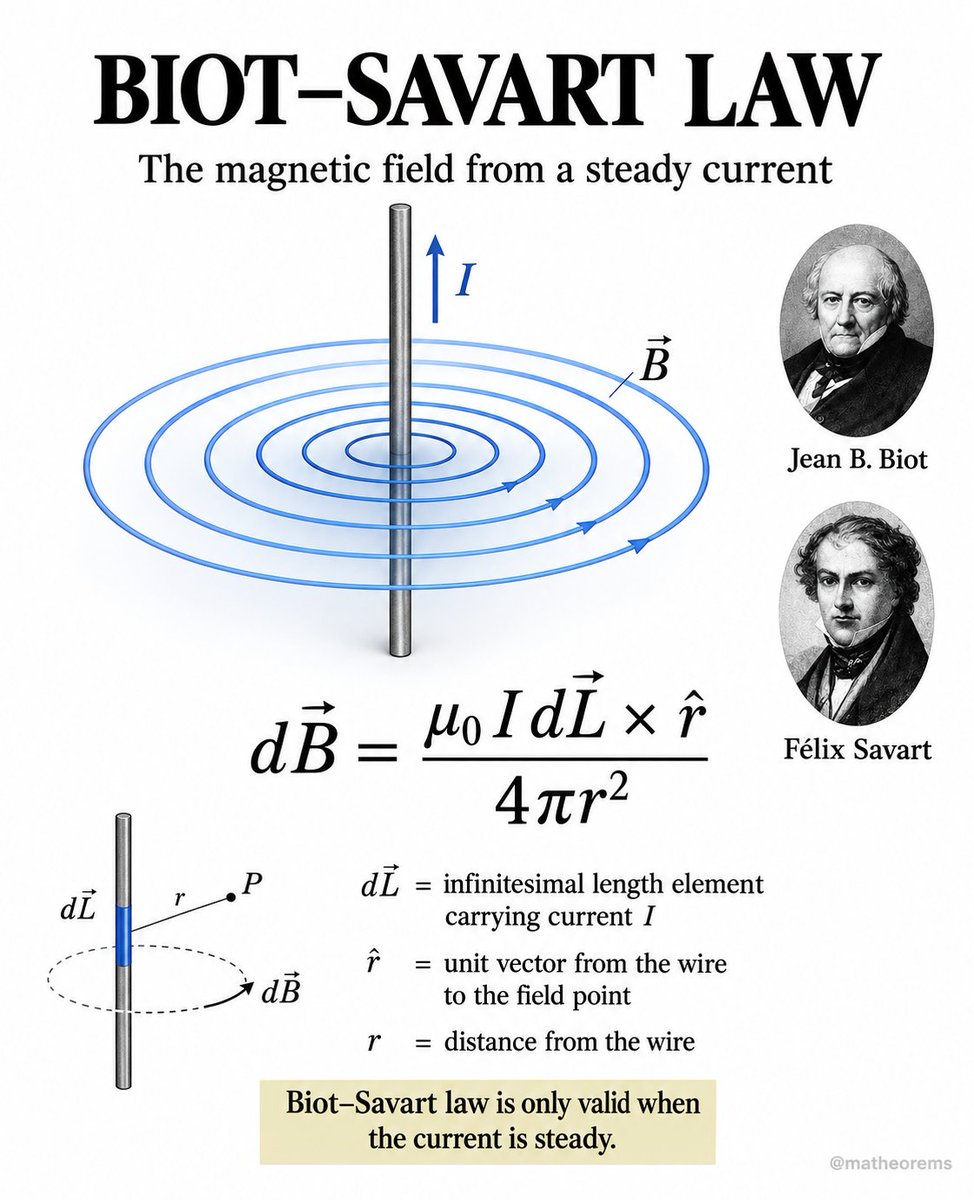
How does a straight wire create perfect circles of magnetism?
The Biot-Savart law:
d𝐁 = (μ₀ I d𝐋 × 𝐫̂) / (4π r²)
Every infinitesimal current element dL adds a field that falls as 1/r² and points perpendicular to both the current and the line to the point. Valid only for steady currents.
Motors, MRI machines, and particle accelerators all rely on this.
Why does a pyramid hold only one-third the volume of the prism sharing its base and height?
Four shapes, one idea: volume = base area × height, adjusted for how the solid occupies space.
V = a³ V = πr²h V = ⅓ a²h V = ⁴⁄₃πr³
Cross-sections of a pyramid shrink with the square of remaining height; their integral is ⅓. A sphere stacks changing disks the same way.
3D printing, architecture, imaging and graphics use these every day.
One idea of space inside, four equations.
Mathematics, Chaos, Strange Universe.
A jellyfish-like entity emerges.
(Turn sound on.) Video by Wes Schaefman, used with permission. Book: https://t.co/uvJR8SSo3P, TikTok: https://t.co/Ezv1NYdexU
In three-dimensional space the determinant of a matrix whose columns are three vectors equals the signed volume of the parallelepiped those vectors span; changing the middle column so the base parallelogram doubles in area while height stays fixed therefore yields a volume of two cubic units.
Every known physical process involves four fundamental interactions. The strong interaction binds quarks and nuclei. The weak interaction changes particle identities and enables beta decay. Electromagnetism builds atoms and chemistry. Gravity organizes planets, stars, and galaxies.
The first three are described by quantum field theory. Gravity is described by general relativity. Bringing all four into one consistent framework remains one of physics’ deepest unsolved problems.
The Law of Large Numbers states that the average result from a large number of independent trials approaches the expected value of a single trial.
For independent random variables X1, X2, ..., Xn that each have the same finite expected value μ, the sample average converges to μ as the number of trials increases:
lim (n → ∞) [ (X1 + X2 + ... + Xn) / n ] = μ
This convergence occurs with probability approaching 1.
Graph from the 2025 paper "Revisiting the IPIP-NEO personality hierarchy with taxonomic graph analysis," published in the European Journal of Personality, which introduces Taxonomic Graph Analysis (TGA) applied to a large IPIP-NEO dataset (N=149,337).
Primary authors include Alexander P. Christensen (often credited in visualisations and press), Hudson Golino, alongside A. Samo, L. E. Garrido, F. J. Abad, and S. T. McAbee; the work builds hierarchical personality structures from the bottom up using network methods.
This approach yields the exact three-tier structure shown (28 facets → 6 traits including new ones like Sociability, Integrity, and Impulsivity → 3 meta-traits: Stability, Plasticity, Disinhibition), aimed at refining personality models beyond traditional Big Five frameworks.
Taxonomic graph analysis of personality questionnaire data uncovers this three-tiered network.
Bottom-level facets cluster into six mid-level traits - Neuroticism, Sociability, Conscientiousness, Integrity, Openness to Experience, and Impulsivity - which organize under three meta-traits:
Stability, Plasticity, and Disinhibition.
Node colors align with the legends shown, and connecting lines indicate empirical statistical associations identified in the IPIP-NEO dataset.
It is used to refine personality assessment tools and investigate links between traits and mental health conditions.
The 2026 Fields Medals have been awarded at the International Congress of Mathematicians in Philadelphia.
The recipients are:
• Yu Deng (University of Chicago)
• John Pardon (Stony Brook University)
• Hong Wang (New York University & IHES)
• Jacob Tsimerman (University of Toronto)
The Fields Medal recognizes outstanding mathematical achievement by researchers under 40. Each post below summarizes the official citation and key contributions.
Sarah Peluse, born circa 1994, is a leading mathematician in arithmetic combinatorics and analytic number theory.
She started college at fifteen and earned her Stanford PhD in 2019. With Prendiville she found the first effective bounds on polynomial progressions in dense integer sets.
With Greenfeld and Iliopoulou she showed large integer-distance sets lie nearly on a line or circle. She proved Miller’s conjecture on symmetric group character tables.
Now an associate professor at Stanford, she received the Mirzakhani New Frontiers Prize, Salem Prize, and 2026 AWM Microsoft Research Prize. Her work keeps reshaping the field.
He didn’t invent SQL. He invented why SQL works.
Edgar “Ted” Codd sat at IBM in San Jose, watching people hunt records through pointer mazes. He wanted something cleaner: tables as mathematical relations, questions as algebra.
In 1970 he gave data its operators:
- σ selects the rows that fit a condition,
- π keeps only the columns you need,
- ⋈ joins tables where meaning overlaps.
He wasn’t trying to make the math look pretty. He was tired of people having to know the machine’s private wiring just to ask a simple question. That was the point of data independence: you should be able to reach for the rows, the columns, the connections, and leave the storage headaches to someone else. IBM dragged its feet. The rest of the field did not. And those three marks are still sitting under almost every query we write.
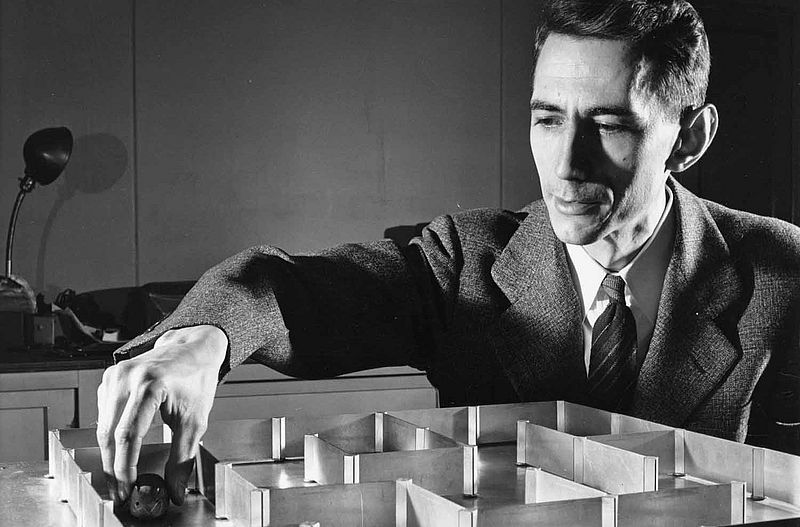
Theseus, the mouse.
In 1950, Claude Shannon and his wife Betty sat on their living room floor and built a machine that could remember.
They named it Theseus - a little mechanical mouse that wandered a maze, bumped into walls, tried again, and eventually found the goal. The first time through, it was all trial and error. After that, something quietly astonishing happened: it never forgot.
Place Theseus anywhere it had already been, and it would go straight there. Drop it in a new stretch of corridor and it would explore until it recognized familiar ground, then add that new piece to its memory and keep going. Rearrange the walls, and it would start over - patiently learning the new layout.
The “brain” wasn’t inside the mouse. It lived underneath the maze: a network of telephone relays that stored every successful turn. Shannon called it a toy. History has been less modest. Many now see Theseus as one of the first machines that actually learned from experience.
The original maze is still at the MIT Museum.
Mazin Gilbert put it simply: Theseus “inspired the whole field of AI. This random trial and error is the foundation of artificial intelligence.”
Bosons are the integer-spin particles that transmit the fundamental forces and generate mass.
Photons, gluons, and the W and Z bosons mediate electromagnetism, the strong force, and the weak interaction, while the Higgs field supplies mass through spontaneous symmetry breaking.
In quantum field theory they appear as excitations that obey Bose-Einstein statistics, so identical bosons can occupy the same state. Gravity remains the exception: its proposed carrier, the graviton, has never been observed.





![mathemetica's tweet photo. The Law of Large Numbers states that the average result from a large number of independent trials approaches the expected value of a single trial.
For independent random variables X1, X2, ..., Xn that each have the same finite expected value μ, the sample average converges to μ as the number of trials increases:
lim (n → ∞) [ (X1 + X2 + ... + Xn) / n ] = μ
This convergence occurs with probability approaching 1.](https://pbs.twimg.com/media/HLZr-_xbQAAlcK3.jpg)