Pascal's triangle is good for more than coin flips. There's a recipe for π hiding in one of its diagonals.
Take every other number down the third diagonal: 4, 20, 56, 120, 220. Turn them into fractions, alternate the signs, scale by two thirds and add 3.
Watch the running total bounce above and below π, a little closer each time. The gold digits are the ones that have stopped changing.
🚀 FROM GRANDPA STARHOPPER TO A HISTORIC STARSHIP CATCH!
At first, the giant mechanical chopsticks catching a skyscraper-sized rocket steal the show. But look closely at the red arrow… there’s Grandpa Starhopper watching from the sidelines! 😂❤️
Back in 2019, that little stainless-steel prototype made its first short hops at Starbase. It may have looked like a flying water tank, but it helped lay the groundwork for Starship’s development.
From tiny hops to catching rockets midair, what an incredible journey!
Never forget where it all began. 🥹🔥
You’re in command of your financial future with Power E*TRADE. Get a seamless cross-platform experience and powerful tools on our award-winning platform.
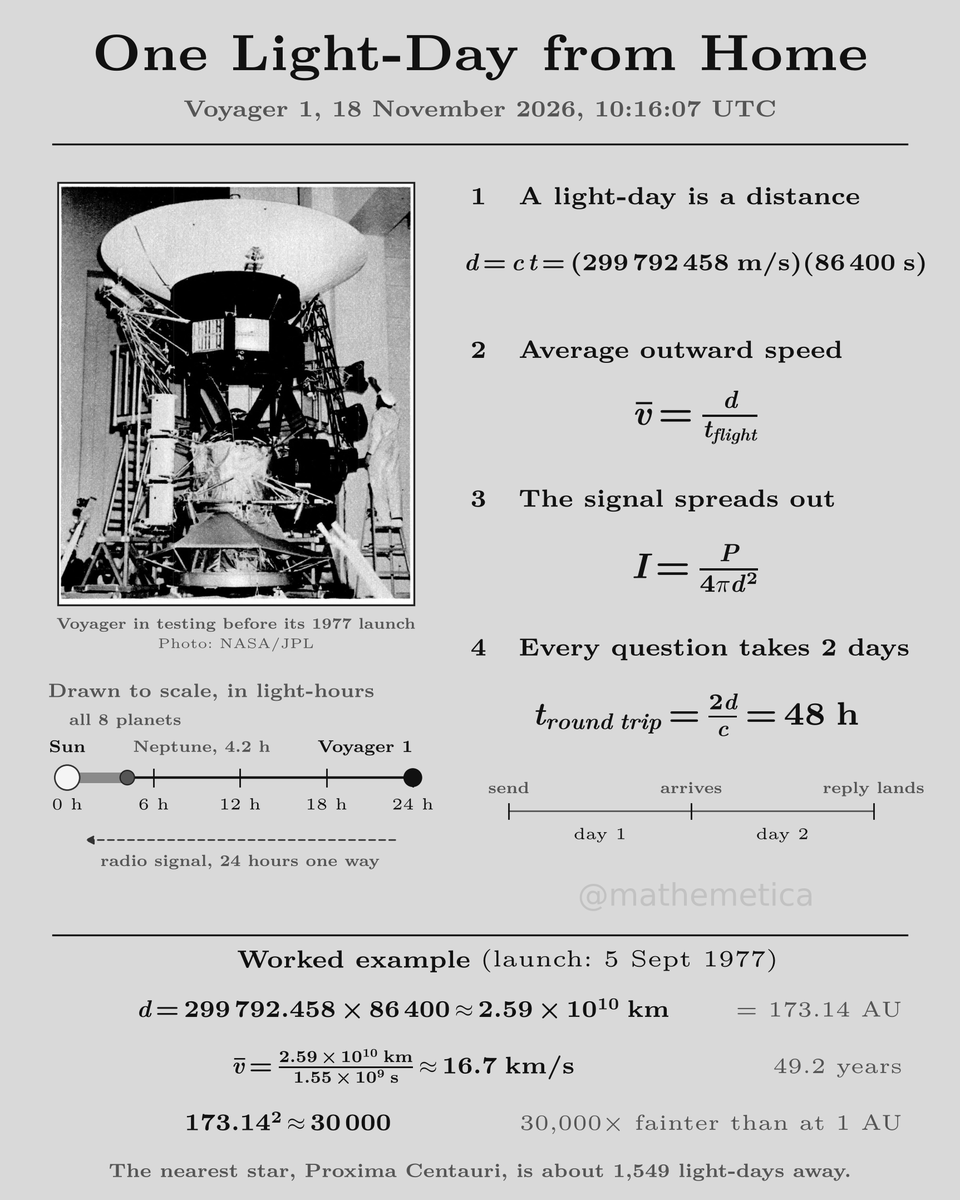
Voyager 1 is now one full light-day from Earth.
A light-day is simply distance = speed of light × one day: d = 299792458 m/s × 86400 s ≈ 2.59 × 10¹⁰ km, or 173.14 AU.
After 49.2 years of flight that average outward speed is only about 16.7 km/s. The same distance means any command we send today reaches the craft tomorrow and the reply returns the day after i.e 48 hours of pure waiting.
Signal strength falls as 1 over 4π d². At 173 AU the radio link is roughly 30,000 times fainter than it would be at Earth’s orbit.
The Helical Truth: Chasing the Sun at 220 km/s Updated version Discover the true shape of planetary trajectories as our Solar System travels at ~220 km/s through the Milky Way
Five Bots now have full-time roles on our accounting team. We onboard, train, and manage them just like human teammates.
Here's how we built them to handle the order-to-cash process, from provisioning customer accounts to collecting payments.
https://t.co/v3uuGoLWhP
Dent the surface any way you like. As long as the charge is inside, the flux out of it doesn't change.
Here's why. Follow a thin cone out from the charge. Where the surface is further away or tilted, the patch is bigger, but the field through it is weaker by exactly the same amount.
Watch the flux stay put while the surface area wobbles all over the place. Then the charge slips outside, every cone goes in and back out, and the flux drops to zero.
The Moon’s orbit is an ellipse with e ≈ 0.055, so the Earth–Moon distance swings between roughly 363,000 and 405,000 km. Apparent size is inversely proportional to distance, and brightness to distance squared.
On 24 November 2026 the full Moon is 360,768 km away and spans 33.1 arcminutes. A full Moon near apogee spans 29.5. The supermoon is about 12% wider and 26% brighter, since 1.124² ≈ 1.26.
Without a photo for comparison, the difference is hard to notice.