Healthcare Programs worth Over 164 Million Nakfa
The Ministry of Health’s Southern Region branch reported that healthcare programs worth over 164 million Nakfa were implemented in 2024. The announcement was made during an activity assessment meeting held in Mendefera on 20 and 21 February.
Dr. Amanuel Mihreteab, Head of the Regional Health Office, stated that modern disease diagnostic equipment has been introduced in all 12 sub-zones of the region, significantly improving disease detection. He also reported that the prealence of communicable diseases, particularly malaria, had decreased by 12% compared to the previous year.
Dr. Amanuel further highlighted that, with the contributions of both the public and local administrations, 32 maternity waiting rooms have been constructed. As a result, the number of pregnant women delivering in health facilities has increased by over 300%, while maternal and infant mortality rates during childbirth have significantly declined. Vaccination coverage has risen to 88%, and tuberculosis cure rates have reached 95%. He also noted the crucial role played by barefoot doctors in disease prevention and treatment.
According to reports presented by the sub-zones, cataract surgery was performed on over 1,328 patients, and the public contributed 2.8 million Nakfa toward the development of health facilities.
Participants held extensive discussions on the issues raised during the meeting and adopted several recommendations.
Mr. Habteab Tesfatsion, Governor of the region, emphasized the importance of research-based programs to control disease prevalence. He also affirmed the regional administration’s contribution to improving healthcare infrastructure.
Speaking at the event, Ms. Amina Nurhussein, Minister of Health, pledged to intensify efforts to enhance healthcare services and reduce maternal and infant mortality rates to zero. She also called for coordinated efforts among Government institutions to achieve national health goals.
President Isaias Afwerki remains steadfast in his commitment to fostering peace and stability in the #HoA, continuously promoting cooperation, and regional unity to ensure a brighter future for all. #Eritrea#Ethiopia#Somalia#EritreaPrevails ‘እዞም ሰባት ግን መን'ዮም?'
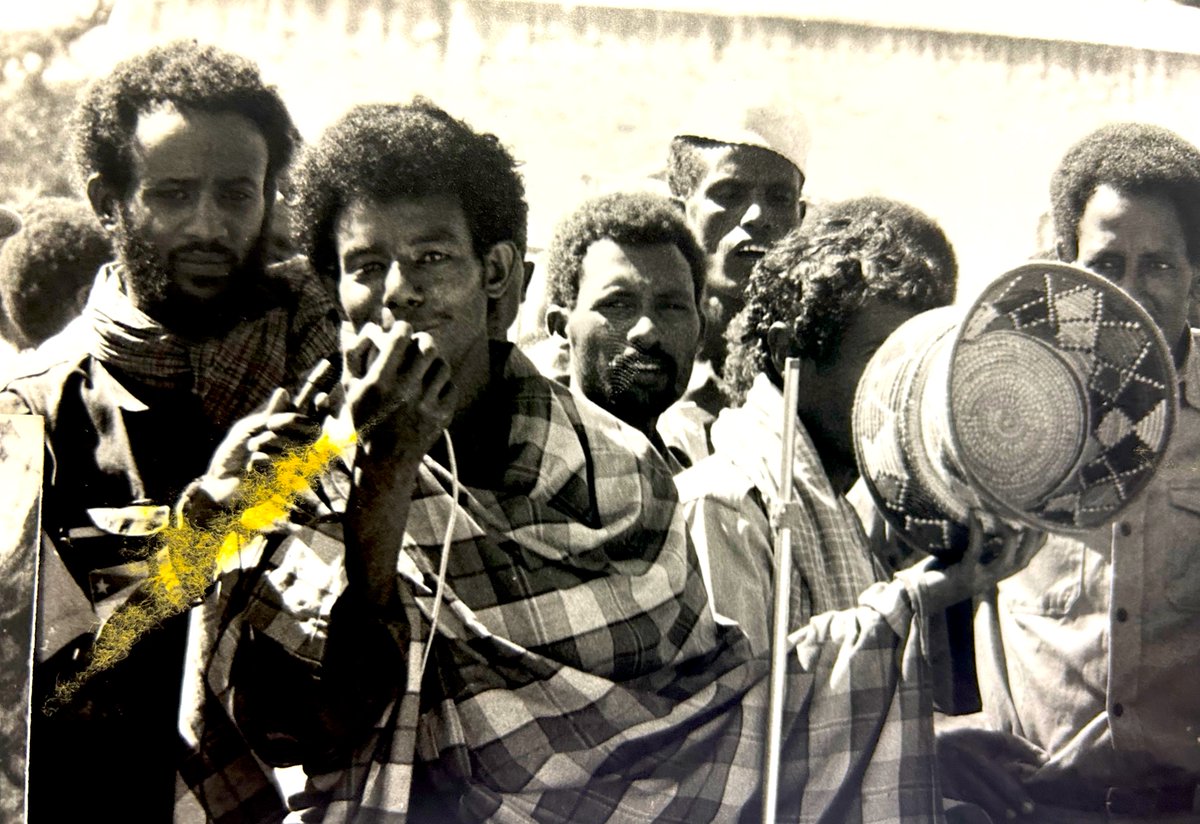
In 1977, Sebhat Efrem delivered a speech titled "One Step Backward and Two Steps Forward" in Keren. The image captures two prominent figures from the EPLF freedom fighters, General Sebhat Efrem and Ambassador Tesfmaichael Geratu, who worked towards the liberation of Eritrea in their younger years. At that time, the EPLF had successfully liberated 70% of the country despite facing significant challenges. The Derg, led by Mengistu Hailemariam, was supported by the USSR, East Germany, Cuba, Yemen, and the entire Eastern Bloc, fielding 300,000 Ethiopian soldiers. In response, the EPLF made a strategic retreat to the Nakfa trenches. The struggle lasted over 14 years, guided by the motto "Never Kneel Down." The fighters firmly believed in themselves and the self-reliance of the Eritrean people. Their unwavering determination paid off, leading to the complete liberation of the country on May 24, 1991. #DiscoverEritrea
Abiy Ahmed’s administration has once again fallen back on its familiar strategy—shifting blame onto Eritrea to mask its own failures. When Ethiopia was on the brink of collapse, it was Eritrea that played a key role in preventing the TPLF from seizing Addis Ababa. Yet, in less than a year, Abiy turned against Eritrea, seemingly as part of a broader geopolitical scheme. His misguided attempt to dismantle Amhara FANO and then use the TPLF against Eritrea collapsed, leaving him scrambling for new scapegoats.
In a desperate move, he sent former Ethiopian president Mulatu Teshome Wirtu (Oromo) to spread outdated and baseless propaganda against Eritrea and President Isaias Afwerki. Among the many fabrications was the claim that Eritrea created FANO—an outright distortion of reality. In truth, FANO was formed by Amhara nationalists to defend their region against TPLF aggression, with Abiy himself initially tolerating or even supporting them. Now that his secret pact with the TPLF has unraveled, he is resorting to historical revisionism in an attempt to deflect blame.
This pattern of deception is deeply ingrained in Ethiopian politics—whenever internal crises escalate, an external enemy is fabricated to mislead the public. However, these propaganda tactics are losing their effectiveness. Ethiopians are fully aware of who supported the TPLF, who betrayed FANO, and who is now rewriting history to serve their own political agenda. Eritrea has no need to manufacture resistance movements in Ethiopia—Abiy’s own policies have done more than enough to generate opposition against him.
Professor Ahmed Hussien has already exposed these falsehoods, providing a clear and factual account of how and when FANO was created. Instead of confronting its own failures, the Ethiopian government continues to weave narratives designed to distract from its growing internal crises. Sending Mulatu to peddle tired propaganda is just the latest in a long line of desperate attempts to shift blame.
The assertion that Eritrea created FANO is not only false but also an insult to the intelligence of the Ethiopian people. FANO arose in direct response to TPLF aggression, and Abiy was well aware of its existence from the beginning. Now, as his political miscalculations come back to haunt him, he clings to reckless scapegoating rather than addressing the root causes of Ethiopia’s instability.
But these tactics will not save him. The Ethiopian people see through these manipulations, and with each lie, the government’s credibility crumbles further. Eritrea remains committed to its principles of sovereignty and regional stability, while Ethiopia continues to weaken itself through deception and self-inflicted crises.
Congratulations
Women's football club championship in Eritrea has gone to Club #Denden.
Credit #LuwamMeasho
ክለብ ደንደን ሻምፕዮን ክለባት ኩዕሶ እግሪ ደቀንስዮ ኤርትራ ኾይና።
The Pancea does not Lie in Externalizing the Conflict or Scapegoating Eritrea
In classical fashion, Ethiopia’s former figure-head President, Mr. Mulatu Teshome, raises a false-flag alarm to accuse Eritrea for stoking a “new conflict in the Horn of Africa”. Audacious claim is precisely intended to conceal and rationalize a war-mongering agenda. The facts are otherwise crystal-clear:
1. Contrary to distorted historical accounts that Mr. Mulatua attempts to project, Eritrea and Ethiopia went to war in 1998 precisely because the TPLF-led Ethiopian regime occupied sovereign Eritrean territories - including Badme, Adi Murug and other places - in flagrant violation of international law and the OAU cardinal principle on the sanctity of colonial boundaries.
2. Even after the costly war, Ethiopia continued to defy international law and occupy sovereign Eritrean territories in breach of the Arbitral EEBC Award for twenty long years. Mulatua endorsed – even if his authority was arguably nominal - the violation of international law as well as the “regime change” agendas of regional destabilization of the Melles regime during his Presidency in those times (2013-2018).
3. Eritrea normalized ties with Ethiopia in 2018 when the Abiy Government publicly announced its readiness for the full and unequivocal acceptance and implementation of the EEBC Award of 2002. Eritrea reciprocated in good-faith and worked in earnest to foster and nurture good-neighbourly ties with Ethiopia on the basis of full respect of each other’s sovereignty and territorial integrity.
4. But soon, Ethiopia was embroiled in a deadly conflict with its Tigray region when the latter unleashed what was widely termed as a War of Insurrection on the night of 3 November 2020. Eritrea gave sanctuary to the contingent of the Ethiopian Northern Command who escaped from coordinated and massive assaults in the TPLF “blitzkrieg”. The TPLF’s war plans also included massive and phased attacks on Eritrea.
5. Eritrea’s involvement in the imposed war was dictated by these circumstances as well as the request of the Ethiopian Government. Shameful and unconscionable acts of backstabbing aside, the Ethiopian Government and its Defense establishments officially and publicly paid tribute to Eritrea’s indispensable role during Ethiopia’s dark days.
6. As underlined in previous occasions, the Pretoria Agreement is an exclusive matter for the Ethiopian Government and its internal protagonists. Eritrea has neither the interest nor the appetite to obstruct or tamper with a purely internal Ethiopian affair.
7. Indeed, Eritrea duly re-deployed its troops within its internationally recognized sovereign borders. Still, those who never accepted the EEBC Arbitral Award in good-faith, or harbour some intent in fomenting conflict, have and continue to peddle false allegations of Eritrean troop presence in “the border areas”— apparent euphemisms/references to Badme and other similar territories.
8. The ill-intent and provocations have not been confined to these acts only. For reasons that are difficult to fathom, the Ethiopian Federal Government has unleashed, in the past months, an intensive and unwarranted campaign of provocation against Eritrea through its “thinly-veiled” agenda of acquiring ports and maritime land “legally if possible and militarily if necessary”.
9. The commotion and disquiet precipitated by Ethiopia’s opaque MOU with “Somaliland” remains another element of regional tension. Ethiopia is also embroiled in another vicious internal war in the Amhara Region.
10. In a nutshell, the myriad problems besetting the region stem and find their fulcrum in Ethiopia; not elsewhere. And the panacea does not lie in externalizing the conflict or scapegoating Eritrea.
Thread🧵 on ERi-TV documentary on Fenkil
(1/2)
In recent weeks, I found myself drawn into an ERi-TV documentary series that masterfully unravels one of the most pivotal chapters in #Eritrea’s struggle for independence: Operation Fenkil. The documentary reveals seemingly unrelated preparations that led to victory. It depicts Eritrean fighters striking deep in #Ethiopia, disrupting enemy forces and installations. The documentary highlights the quiet but essential work of those whose contributions often go unnoticed—military intelligence meticulously gathering information on enemy positions and capabilities, demining squads clearing paths to victory, medical teams treating the wounded in makeshift clinics while themselves facing enemy fire, the logistical masterminds who ensured that fighters and their supplies moved swiftly, and the combat cameramen and women whose courage matched the fighters they filmed.
I do not intend to go into the details of the documentary, as that would not do justice to the work of the producers or the experience of the audience. Instead, I want to reflect on the enduring lessons it reinforces—lessons that are neither novel nor obscure, but ones that history has inscribed again and again in the struggles of nations, societies, and individuals. Niccolò Machiavelli once remarked, “Whoever wishes to foresee the future must consult the past; for human events ever resemble those of preceding times. This arises from the fact that they are produced by men who ever have been, and ever shall be, animated by the same passions, and thus they necessarily have the same results.”
First, an enemy is only as fearsome as one's mind allows. This was evident in a 1989 encounter between EPLF and #Sudanese military commanders in Damazin, southeastern Sudan. An EPLF division, joined by Oromo Liberation Front (OLF) fighters, traveled nearly 1,500 kilometers through Sudanese territory to launch an offensive on Assosa, a strategic Ethiopian town. When reviewing battle plans, Sudanese commanders, relying on intelligence, estimated it would take at least two months to break enemy lines. In contrast, Eritrean commanders, drawing from their own intelligence, believed the operation could be completed within days—perhaps hours. The Sudanese saw this as reckless bravado, but reality proved otherwise. Assosa fell within hours, achieving the mission’s objectives with astonishing speed. This contrast reveals a crucial lesson: perceiving an enemy as unbeatable or unstoppable stifles imagination and limits planning to minimizing losses rather than securing victory. But seeing an adversary as challenging yet defeatable fosters innovation, adaptability, and bold strategy. In war, as in life, fear itself is often the greatest obstacle.
@hawelti@ERMedia91@EriTVNetwork@ERiTV_Official
We Haven't Forgotten. 16th Feb-Remembering the massacre of innocent Eritreans by #Ethiopia|n colonialists. Ethiopians must know the crimes committed by their ancestors in #Eritrea. In spite of this Eritreans remain committed to peaceful coexistence. Link 👉🏾https://t.co/UuXXzG2B6l
As the leadership in Arat Kilo crumbles from within, the Prime Minister of Ethiopia and his paid officials, along with their cadres, are desperately trying to divert attention toward Eritrea, loudly crying on any media platform they can find. However, the reality on the ground tells a different story. During the previous war, Eritrean forces played a crucial role in halting the TPLF’s advance toward Addis Ababa, stopping them at Debre Berhan. Now, the situation has shifted dramatically—what was once a single faction has tripled in size, and each force is advancing toward Arat Kilo. This time, nothing will stop them from toppling an administration that has never truly governed beyond Addis Ababa. The cracks in the regime are widening, and its downfall is only a matter of time. The Arat Kilo rat is financed not other than 👇🏾. #MoveAUoutOfEthiopia
This morning, Republicans finally released their scheme to gut Medicaid and give tax cuts to billionaires.
Within minutes, House Democrats convened to make clear this will not stand.
⬇️⬇️⬇️
#Eritrea is participating in the 38th World Cultural and Artistic Festival, which is being held in India from 7 February. The annual festival is organized in collaboration with India's Ministries of Foreign Affairs and Tourism.
The festival, known as the Surajkund International Crafts Mela, features cultural troupes from 51 countries. Eritrea's cultural troupe, "Sibrit," presented an artistic performance that showcased Eritrea's traditional culture and the unity in diversity of the Eritrean people.
ኤርትራ፡ ብ7 ለካቲት ኣብ ዝተኸፍተ መበል 38 ኣህጉራዊ ፈስቲቫል ባህልን ጥበባትን ህንዲ ትሳተፍ ኣላ። ኣብ’ዚ 51 ሃገራት ዝሳተፍኦ ዘለዋ መድረኽ፡ ጉጅለ ሃገራዊ ባህሊ ‘ስብሪት’ ንያታዊ ባህልን ብዙሕነትን ብሄራት ኤርትራ ዘንጸባርቕ ምርኢት ኣቕሪባ።
MOI
The great Nelson Mandela was freed from a South African prison 35 years ago today.
Far right extremists are once again determined to turn back the clock here in America and throughout the world.
We will never abandon the long walk toward freedom.