Bill McGuire is editor of the Island Farmer; contributor to Eastern Graphic and West Prince Graphic; Avondale golfer; board member with Cornwall Curling Club
'Zapper’ sparks new approach
to weed control on Island crops
By Bill McGuire
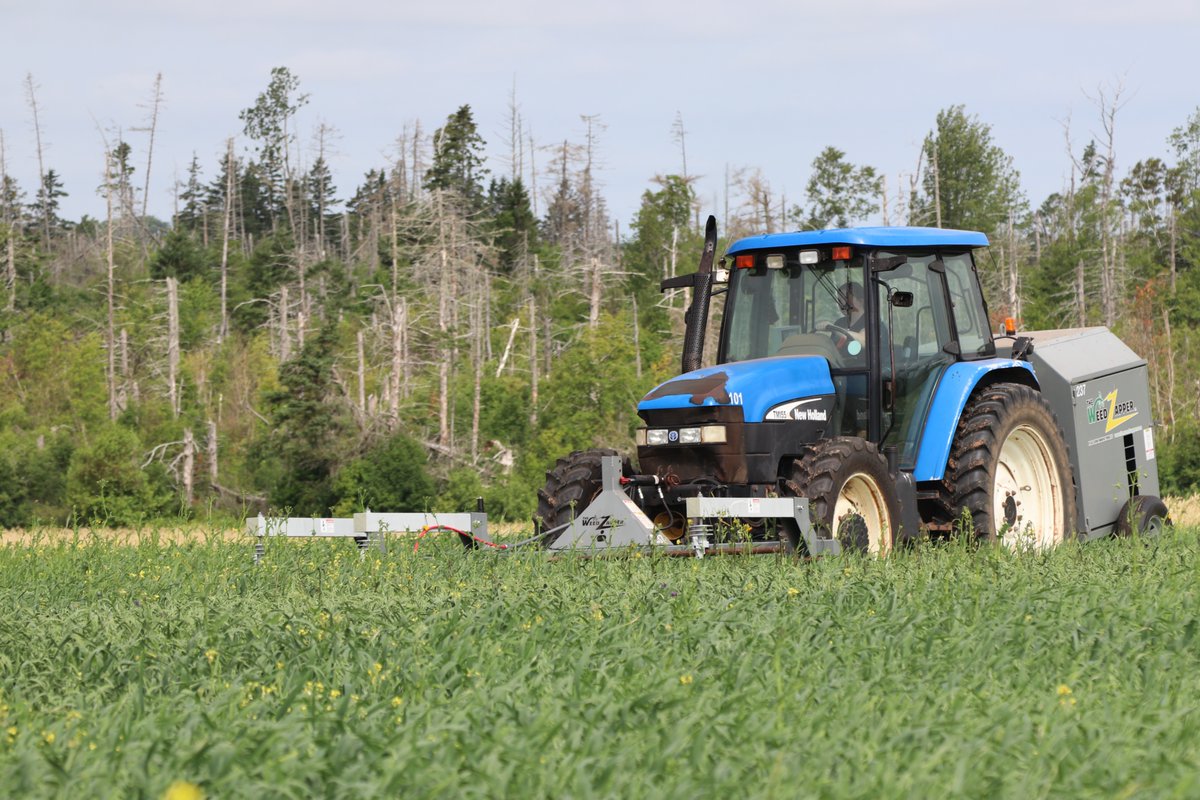
HARRINGTON -- The “Weed Zapper,” a high-voltage machine that researchers hope could transform weed control in horticultural crops on Prince Edward Island, is being tested at Agriculture and Agri-Food Canada’s (AAFC) Harrington Research Farm.
The 'Zapper' sits on a tractor with an oversized generator attached to its rear and a long copper boom stretched across its front.
For Nicolle MacDonald, a biologist with AAFC’s Pest Management Centre, the arrival of the Weed Zapper a year ago was the start of a two-year research project to test whether electricity can replace some of the chemicals now used to manage problem weeds in crops such as potatoes, carrots, beets, turnips, beans, and lowbush blueberries.
“Farmers are looking for new tools,” MacDonald told the Island Farmer in an interview Sept. 22. “We’re seeing more herbicide resistance and fewer chemical options available. The Weed Zapper is an alternative tool we want to evaluate in an integrated weed management system.”
The concept of electric weeding isn’t new. The first experimental machines were built in the 1970s in the United States to control bolting beets in sugar crops. The equipment never gained wide adoption, partly because of cost and the availability of other herbicides. But in the last decade, electric weeding tools have been catching on again, especially in the U.S. Midwest and South America, where herbicide resistance has forced growers to look for alternatives.
MacDonald said interest in Canada has grown in the last five years, and AAFC purchased its first Weed Zapper for Harrington in 2024. The machine is built around a 195,000-watt generator mounted on the rear of a tractor. A cable carries the current to a height-adjustable copper pipe at the front, which can span 11 to 15 feet wide. As the tractor moves forward, weeds that are taller than the crop canopy brush against—or even come close to—the pipe. Electricity surges through the plants, rupturing their cells from the inside out.
“It looks a little like lightning,” MacDonald said. “You’ll see small sparks when it connects with the weeds, and within minutes the plants start to wilt. A few hours later they’re black and shriveled.”
Despite the dramatic results, safety remains a priority. The Weed Zapper is equipped with multiple built-in sensors. The unit shuts off if the operator leaves the tractor seat, and it won’t start unless the tractor is moving. Still, MacDonald emphasized caution.
“You definitely don’t want to be near it when it’s operating,” she said. “We recommend keeping at least 50 feet away. There’s always the risk of current traveling through the soil or along fence lines. And because we’re dealing with electricity, fire safety is critical. The plants need to have moisture in them—if it’s too dry, you could risk sparks igniting straw or stubble.”
That fire risk limited some of the field work this past summer. “In some crops, the conditions just weren’t right,” MacDonald explained. “I was able to treat potatoes and carrots when there was good dew in the morning, but for later-planted beets it was too dry.”
The Weed Zapper works best in shorter crops where problem weeds grow taller than the canopy. On PEI, that includes potatoes, carrots, rutabagas, beans, and blueberries. Lambsquarters, pigweed, and sow-thistle are among the species MacDonald is testing.
Weed seeds are another focus. If the Weed Zapper can prevent viable seeds from forming, it could help reduce infestations in future years. MacDonald is measuring seed viability in treated weeds to determine whether this benefit holds up.
“This isn’t a piece of equipment you’d use every day,” MacDonald said. “In many crops you might only run it once or twice in a season. That opens up the possibility of cost-sharing between growers or co-ops, where a community owns a unit that gets used across several farms.”
MacDonald has already taken the machine out for field demonstrations on Island farms, drawing interest from local producers. “It definitely turns heads going down the road,” she laughed. “People aren’t used to seeing a generator that size behind a tractor.”
“This year was about learning the machine as much as learning about weed response,” she said. “There’s still a lot we don’t know, but we’re excited about the possibilities.
“It’s not going to replace all herbicides, but it can be another tool in the toolbox,” she said.
(See more in the current edition of the Island Farmer)
-30-
Orwell Cove Florist Finds Healing in a Field of Colour�
By Bill McGuire
�Island Farmer
ORWELL COVE – When life gave her a devastating diagnosis, Rosemary Naddy planted hope.
The small but vibrant half-acre of blooms surrounding her home in Orwell Cove isn’t just a business — it’s a living therapy garden, a personal support system that helped Naddy reclaim her strength after being diagnosed with a serious illness.
The Old Barn Flower Company has become both an outlet for healing and a quiet source of joy for her community.
“It all started as horticultural therapy,” Naddy said, standing in the small shop attached to her home, the air fragrant with late-season blooms. “I was laid up with chemo, watching the Easter Beef Show on TV, and just started ordering seeds. I had to do something to keep my mind sane.”
That first spring, in 2022, she put those seeds into the soil. Friends and neighbours began dropping by, first to check in, then to pick up bouquets. Soon, what began as a way to occupy her hands and heart grew into a subscription-based cut-flower business — one rooted as much in compassion as in commerce.
“It was never meant to be a business at first,” she explained. “It was just a way to share flowers with friends, but it took on a life of its own. I opened subscriptions on Islander Day, and within six hours, everything was sold out.”
Subscribers prepay for monthly bouquets that they pick up throughout the growing months. “There wasn’t one flower sold at the door this summer,” she said with a smile. “They were all pre-sold before I’d even planted.”
A practicing veterinarian before her illness forced her to pause her career, Naddy said physical work in the garden is now part of her recovery. “The drugs can make you weak,” she said. “But this labour makes me strong. The exercise, the routine, being outdoors — that’s what keeps me healthy.”
Her days are full: watering, cutting, bundling, arranging, packaging. And she loves every minute of it.
She continues to receive treatment at the Queen Elizabeth Hospital every three weeks, and gives herself daily injections to keep her illness under control. “Everything is stable,” she said. “I feel great, and I work harder than I ever did.”
For Naddy, flowers are about more than beauty — they’re about connection. She often finds her bouquets passed from one person to another, gifts of kindness that ripple outward. “People buy them for themselves, but a lot of the time, they’re shared again,” she said. “Someone might give theirs to a friend having a hard day, or to a church, or to a neighbour.”
Nancy MacLeod of Kinross, a close friend who once babysat Naddy’s children, helps with the flowers and subscriptions. “It’s such a perfect thing for her to be doing,” said MacLeod. “These flowers don’t just brighten Rosemary’s days — they brighten everyone’s.”
That spirit of community filled Naddy’s farmyard on October 5, when she hosted her first Build-a-Bouquet workshop. Expecting maybe a dozen guests, she was astonished when more than 45 registered.
“It’s just a way to celebrate,” she said. “To bring people together, learn about flowers, and have fun.”
Naddy is modest about the emotional impact of her work. But it’s clear her gardens have become a symbol of quiet strength — for her, for her family, and for others who visit.
“I think flowers just lift people,” she said. “You can’t help but smile when you see them.”
Despite the challenges, she remains optimistic and deeply grateful. “The flowers gave me something to look forward to,” she said. “They gave me purpose when I needed it most. And now, they give back to everyone around me.”
When asked what’s next, Naddy laughed. “I might be expanding again,” she said. “My husband says I’ll have the whole farm covered before I’m done.”
(See more in the current edition of the Island Farmer.
-30-
Islanders rally to support Lil Farm On The Jib after signs stolen just two weeks before Open Farm Day
By Bill McGuire
HAZELBROOK -- When Denise Pippy-Docherty of Hazelbrook discovered that all eight of her family’s road signs had been stolen just two weeks before Open Farm Day, she and her husband Kendall felt defeated.
The signs—posted along Route 1 between Stratford and Mount Albion and on MacLennan’s Road near their property—were critical for guiding visitors to Lil Farm On The Jib, the family’s sunflower u-pick. Half of every bouquet sold goes directly to the Queen Elizabeth Hospital.
It was the Docherty’s first time involved with Open Farm Day and things hadn’t gotten off to a good start.
“We couldn’t afford to replace the signs right away,” Denise recalled. “We just hoped whoever took them had dumped them in a pile somewhere and that someone might find them and we might get them back.”
Kendall posted a message on social media, asking if anyone might have seen the signs. What happened next surprised the family. Soon after, Islanders began stepping up—offering not only new signage but also straw bales, a portable toilet, and other supplies needed to host the event.
“It was overwhelming,” said Denise. “We’ve always tried to give back to the community through the sunflowers, but the way people rallied behind us this year really showed what Islanders are made of.”
Richard’s Roofing purchased and delivered replacement signs; A.H. Wood Farms and the Wood family donated round bales of straw for displays; Joel Irving, ‘The Hay King’ from Irving Valley Farms donated round bales to place in the fields and for supplying the square bales for wagon rides; Wilfred and Marilyn MacMillan of MacMillan and Sons Farms in Pownal also supplied large round bales; Steven MacKinnon from KM Liquid Waste Management provided a portable washroom; while Awesome Blossom Orchards of Bethel added extra help for the day.
“All of these people jumped in because they wanted to see Open Farm Day succeed,” Kendall said. “They knew that 50 percent of everything we sold was going to the QEH, so it wasn’t just helping us—it was helping Islanders.”
The support paid off. On September 21, Lil Farm on the Jib welcomed a steady stream of visitors. Wagon rides, children’s snacks, and armfuls of golden sunflower bouquets made the day festive.
The Dochertys estimate that this year’s sales will push their total donations to the Queen Elizabeth Hospital Foundation past the $20,000 mark. Previous years’ proceeds had also supported animal rescue groups and the Stratford playground project, but in recent years the focus has remained on health care.
“Our sunflowers are more than just flowers,” Denise said. “They’ve become a way for us to share some sunshine and give back.”
This year marked the family’s first official participation in Open Farm Day, which celebrated its 25th anniversary across Atlantic Canada with 26 PEI farms taking part.
“We weren’t sure how things would go after the signs disappeared,” Denise admitted. “But the community made sure our farm was ready. We ended up having one of our best days ever.”
“It showed us that what we’re doing really matters,” Kendall said. “Yes, we lost our signs, but we gained something much more important—the reminder that Islanders take care of each other.”
(See more in the current edition of the Island Farmer)
-30-
Farm groups
unite to fight
power bill hike
By Bill McGuire
Island Farmer
A recent regulatory hearing that could have far-reaching implications for PEI farmers’ electricity costs focused on a Maritime Electric proposal to remove the province’s residential second block electricity rate.
The hearing was held before the Island Regulatory and Appeals Commission (IRAC) in Charlottetown.
The residential second block electricity rate is a long-standing pricing structure that provides a discount to residential customers who use more than 2,000 kilowatt hours per month.
While intended for households, that second block has also been applied to many Island farms where residences and operations share a meter. The change, if approved, would see those farms paying significantly more for power.
“This is a big deal,” said Donald Killorn, executive director of the P.E.I. Federation of Agriculture. “Many potato and dairy operations are on residential service. Losing the second block would raise their cost of production and, in effect, have them subsidize other Islanders’ electricity bills.”
The Federation, working in close partnership with the P.E.I. Potato Board and the Dairy Farmers of Prince Edward Island, served as a full intervener in the hearing. Legal counsel from Key Murray Law and expert consultants from Bowman Economics represented Island farmers, presenting data to demonstrate how the proposal would unfairly impact agriculture.
Maritime Electric’s application to phase out the residential second block dates back to 2019. The delay, he added, wasn’t necessarily a bad thing.
“Our research estimates that every year of postponement saved Island farmers about $1.5 million,” he said. “Neither side was in a rush, and Maritime Electric had bigger issues to deal with.”
Eliminating the second block without an alternative rate would mean farmers paying up to 120 per cent of their cost of electricity, effectively subsidizing residential users.
Killorn said the Federation’s position is clear: if the second block disappears, a farm-specific rate class must replace it.
(See more in the current edition of the Island Farmer)
-30-
Luke Vessey regains crown
at giant pumpkin weigh-off
SUMMERSIDE — Luke Vessey of York proudly displays his 1,190 lb. entry after he was declared the winner of the 32nd annual PEI Giant Pumpkin and Squash Weigh-Off held Saturday, Oct. 11 at Kool Breeze Farms in Summerside.
Vessey, a dairy farmer at Yorkton Farms, dethroned defending champion Mark Tremere of Marshfield who claimed the crown last year with a 1,473.5-pound entry, edging out Vessey, who brought in a 1,311-pounder.
Vessey, who is also president of the PEI Giant Pumpkin and Squash Growers Association, also won in 2023. In an interview with the Island Farmer last month, Vessey was confident he had a winner growing is his patch in York which he estimated was already close to1,200 lbs. at that time.
And as the pumpkins were checked in Saturday morning prior to the start of the noon weigh-off, it was visibly apparent that Vessey had the winning pumpkin as his orange behemoth towered over all opposition.
Tremere thought he had an early contender to challenge Vessey as the two perennial pumpkin powerhouses were preparing earlier this summer for another showdown, but a crack appeared on Tremere’s promising entry and it eventually breached and faded from contention.
Tremere did enter a smaller pumpkin and won 7th place with a 374-lb’er.
In second place Saturday was an entry from Fred and Shirley Ansems of Steam Mill, NS, near Kentville in the Annapolis Valley, with a 805 lb. entry.
Fred Ansems is the Atlantic representative on the Great Pumpkin Commonwealth which the PEI association joined over the past year. The association connects local contests to a global network of weigh-offs.
Vessey said, “That means our results now get posted online with all the other sites, and growers can qualify for prizes beyond PEI. It also gives Canadian growers another location to weigh in, which should help draw in more competitors.”
With PEI now a Commonwealth member, it made Ansems eligible to enter the Island weigh-off and he arrived with a variety of entries. Besides his second place finish here Saturday in the giant pumpkin category, Ansems won in a variety of first-time categories including a 9-foot long gourd, giant watermelon, giant tomato, bushel gourd and marrow.
Ansems had entered weigh-offs in NS the previous two weekends and PEI growers can now enter events in NS, NB and beyond.
Vessey and most onlookers were surprised that his pumpkin didn’t weigh-out a lot heavier on the scales. It was widely expected the orange giant might approach 1,500 lbs. Vessey said the summer drought and prolonged sunny, hot conditions might have played a factor but he wasn’t really sure what happened. He said he plans to change his nutrients next season to ensure more weight on his biggest pumpkins.
The Thanksgiving weekend weigh-off has become a staple at Kool Breeze Farms in Summerside, and hundreds of Islanders and visitors showed up to watch the event here Saturday under sunny skies, breezy conditions but comfortable temperatures.
(See more photos and interviews in the October 29 edition of the Island Farmer.)
Highlights in current edition
of May 28 Island Farmer
—
Bird flu kills Summerville poultry flock
For the first time, highly pathogenic avian influenza (HPAI), commonly known as bird flu, has been confirmed in a domestic poultry flock on Prince Edward Island. The Canadian Food Inspection Agency (CFIA) verified the presence of the H5N1 strain on May 16 in a non-commercial flock in Kings County. The infected flock—approximately 200 birds—was located in the Summerville area.
—
New Foreign Animal Disease Lab at AVC
The Atlantic Veterinary College (AVC) at the University of Prince Edward Island is nearing final certification by the Canadian Food Inspection Agency (CFIA) of its new Foreign Animal Disease (FAD) Testing Laboratory. The lab recently marked another step closer to completion with a recent media tour of the state-of-the-art facility designed to play a critical role in detecting and monitoring high-risk animal diseases in Atlantic Canada. Once fully certified, the lab will conduct testing for foreign animal diseases such African swine fever, foot and mouth disease, classical swine fever, avian paramyxovirus-1, and Highly Pathogenic Avian Influenza (HPAI), among others.
(Plus sidebar stories)
—
�Scott Howatt follows agriculture path
For Scott Howatt of Tryon, agriculture has always been more than just a profession — it’s a legacy steeped in a family farm tradition that spans generations, shaped by both resilience and personal choices. This spring, Howatt was the winner of the prestigious Recognition Award from the PEI Institute of Agrologists — an honour reflecting a lifetime of quiet leadership and service to the Island’s agriculture community. But before he became a key figure with the PEI Potato Board, representing growers in complex negotiations with Cavendish Farms, his path began on a mixed farm with beef cattle and seed potatoes — and a family trying to find its way forward in a rapidly changing industry.
(Plus sidebar stories)
—
Mooney launches drone technology for ag
Chad Mooney is charting a bold new flight path for Island agriculture, using drone technology to help local farmers boost yields, improve sustainability, and cut costs. As the founder of AgronomAI, a new drone-based agronomy startup based in eastern PEI, Mooney is bringing high-tech tools to Island fields with the goal of helping producers make more informed crop decisions. His demonstrations — now attracting attention from both farmers and politicians — offer a glimpse of how artificial intelligence and aerial data collection can shape the future of food production on PEI.
—
More animals loose on PEI roads
PEI RCMP are reminding motorists to stay alert on Island roads following approximately 80 animal-related calls over the past year involving animals on or near roadways. That is approximately 20 more calls than the year before, said Cpl. Gavin Moore, PEI RCMP Media Relations Officer.
—-
Malpeque MP named minister of ag
Heath MacDonald says he’s “humbled” by the opportunity to serve as Canada’s new Minister of Agriculture and Agri-Food — and he's already hitting the ground running. In a statement to the Island Farmer following his swearing-in ceremony May 13, the Malpeque MP emphasized his dual priorities: strengthening Canadian agriculture at home and abroad, and ensuring that Prince Edward Island continues to have a strong voice at the federal Cabinet table.
—
Young farmers hire co-ordinator
PEI Young Farmers (PEIYF) has taken a major step forward in the association’s revitalization efforts by hiring Jamie Ward of Stratford as its first program co-ordinator. The newly created, part-time position is funded through the provincial Department of Agriculture and designed to help the rejuvenated organization build capacity, coordinate activities, and strengthen support for young people working in or entering the agriculture industry.
-30-
Island Farmer Highlights, May 14, 2025
Some snapshots of stories in today's Island Farmer:
-- PEI’s process potato growers have signed a tough contract with Cavendish Farms that calls for a price decrease of 5.1% this year. Combined with last year's decrease of 2.49%, it means process growers face a drop in price of over 7.5% over the past two years.
-- Chad Mann, the CEO of Amalgamated Dairies Limited in Summerside since 2018, has notified ADL's board of directors that he is stepping down effective August 1st. The board has appointed Ken Smith as its new CEO effective August 4th.
-- Jaime Matos of Matos Winery and Distillery in St. Catherines is cautiously optimistic that dropping interprovincial trade barriers—in response to US tariff threats-- could finally open up sales opportunities in the rest of Canada. Matos says it was easier to sell a bottle of wine in Japan or China than in New Brunswick.
-- Matt MacFarlane, Green Party MLA for Borden-Kinkora, is successfully pushing a bill through the PEI Legislature amending the Planning Act that gives farmland a heightened level of scrutiny when development or subdivision applications are submitted.
-- The pace of early potato planting is slower this spring than in recent springs because of cool, wet weather lingering into early May. But good weather this week should see planting activity pick up.
-- Gordon MacBeath of Goldenflo Holsteins in Marshfield was re-elected chair of Dairy Farmers of PEI at the organization's 40th annual meeting held in Summerside.
-- John Visser, former chair of the PEI Potato Board, was elected to the board of the Fruit and Vegetable Growers of Canada at the group’s annual meeting in Quebec City.
-30-
CARDIGAN -- PEI Wild Blueberry Growers Association directors are backing the creation of a commodity marketing board and are urging growers to vote in favour during an upcoming plebiscite this spring.
If approved, the board would have the authority to negotiate a price with the province’s two major processors before the 2025 season begins.
Association President Benny Nabuurs of Cardigan says the board strongly encourages all eligible growers to participate in the plebiscite. “As a board, we’re recommending they vote yes,” Nabuurs said in a Feb. 17 interview. “But we want as much participation as possible and for everybody to have a say. Have your voices heard.”
This is not the first time PEI’s wild blueberry growers have voted on forming a marketing board. A similar plebiscite some four years ago saw growers reject the idea. At the time, some growers argued that a small province like PEI would not be able to influence pricing on a larger scale.
However, Nabuurs says the past two years of plummeting prices have changed the conversation. “After that plebiscite, we had a record price of 70 cents per pound, but since then, it has dropped nearly in half to 35–42 cents,” he said. “That’s below the cost of production. Growers are losing money.”
(See more in today's Island Farmer)
SUMMERSIDE – The 2024 Plowdown Challenge winner, Matt Dykerman, didn’t just take home bragging rights—he also underscored the importance of manure as a valuable soil input for PEI potato growers.
Dykerman, an employee at Linkletter Farms in Summerside, emerged victorious in the second edition of the Plowdown Challenge, a research initiative led by Agriculture and Agri-Food Canada (AAFC) at the Harrington Research Farm.
The competition asked growers to predict the yield of a Mountain Gem potato crop grown using nutrients supplied from a plowdown crop. Unlike the previous year, which relied on red clover and a cover crop, the 2024 trial incorporated rotted dairy manure in addition to red clover—a combination that proved to be highly effective.
The actual Plowdown yield for the 2024 crop was 293 hundredweight (cwt) per acre, far surpassing the average guess of 200 cwt. Dykerman’s prediction of 275 cwt was the closest to the final number, earning him the win. He and Roger Henry, lead technician at AAFC’s Harrington facility, discussed the results at the 2025 PEI Potato Conference in Summerside on February 12.
(See more in today's Island Farmer)
SUMMERSIDE—Stepping out of the cab of a large John Deere tractor, a youthful Kitt Carson looked exhilarated. The Summerside resident had just completed an obstacle course, carefully maneuvering a round hay bale through a series of pylons as part of the Give Her the Gears training program at Green Diamond Equipment.
"It was fun," said Carson. "I work with older machinery on the farm, so this was a bit more confusing with all the buttons and technology. But once I got the hang of it, it was pretty straightforward."
Carson, who works at Red Pine Farm in Fernwood—Ranald MacFarlane’s dairy and hog operation—was one of the participants in the Turtle Level 1 training, designed to introduce women to tractor operation and farm equipment safety.
"I milk cows every night, and Ranald does the mornings," Carson explained. "I also help with the pigs, including taking some to the Mennonite butcher shop. That part I hate doing."
(See more in today's Island Farmer)
Farmgate milk prices took a slight dip across Canada in February, but dairy farmers are expected to see an increase in farm cash receipts by 3.0 per cent in 2025, mostly because of higher milk production and increasing consumer demand.
While the Canadian Dairy Commission (CDC) approved a minor decrease in farmgate milk prices by 0.0237%, effective February 1, the Canadian dairy outlook for 2025 remains bright with steady growth ahead.
The outlook is based on data from the CDC, Dairy Farmers of Canada and The Bullvine, a respected industry newsletter.
The consensus for 2025 is that Canadian dairy farmers face a mixed outlook with slight price dips offset by growing demand and sustainability gains. Despite challenges, the industry shows resilience, with projected market growth to $22.92 billion by 2033.
(See more in today's Island Farmer)
The PEI Cattle Producers has announced that Ellen Davis is the first-ever livestock champion for the province.
“We are excited that Ellen is coming on board,” said a Cattle Producers spokesperson.
Davis is from the Port Elgin area of NB and has many years of livestock experience in New Brunswick and Nova Scotia. She has a Bachelor of Science Degree majoring in Animal Science from Dalhousie Agricultural Campus and was raised on a cow/calf farm.
“She is familiar with PEI as well,” said the spokesperson. “Ellen will be starting here with us in mid-March and is looking forward to helping promote our beef industry here on PEI.”
Approval for hiring a livestock champion was confirmed last fall by PEI Agriculture Minister Bloyce Thompson and additional details were provided earlier this year as the province detailed a new suite of initiatives aimed at growing PEI’s livestock sector.
(See more in today's Island Farmer)
Thirty years ago in 1995, Jimmy Carruthers, a successful and respected dairy farmer in Hamilton, was recognized with the PEI Soil Conservationist of the Year Award, in the Livestock Category.
The award goes to a deserving farm business which recognizes practices that conserve or protect soil and water resources--from the PEI Soil and Crop Improvement Association.
This year on Feb. 19, the annual Soil Conservationist of the Year Award (Livestock Division), was officially renamed the J. Carruthers Award as a tribute to the late Jimmy Carruthers who passed away suddenly in late December 2023.
The ceremony took place at the 35th annual PEI Soil & Crop Conference in Charlottetown. On hand for the formal renaming were Jimmy’s son Mike, who now operates Carruthers Farm, and his grandson Brayden.
Officiating at the formal ceremony were Kevin MacIsaac, a past president of the PEI association, and current president John Hooper of North Milton.
(See more in today's Island Farmer)
ELMSDALE - For Colton Griffin, working alongside Brendon Harper at WP Griffin Inc. has been a lesson in dedication and determination.
As sales and crop manager for the family-run potato growing and packing operation in Elmsdale, Griffin has seen firsthand how Harper’s strong work ethic and eagerness to learn have made him a valuable asset to the farm.
“He’s as hard a worker as they come,” Griffin said. “He doesn’t stand around—always looking for something to do. That’s a rare quality.”
Harper, who juggles responsibilities between the potato and beef operations at WP Griffin, is known for jumping in wherever needed. Griffin recalled watching Harper tackle some of the toughest tasks on the farm without hesitation.
Harper’s determination is even more remarkable given the challenges he faces due to cerebral palsy. Tasks that require climbing or heavy lifting can be difficult, but Griffin said Harper never shies away from hard work.
combines on-farm experience with classroom learning.
From running the bin piler in the potato warehouse to clearing land in the summer, Harper tackles every job with enthusiasm. “He’s been a really hard worker, honestly,” Griffin said. “He makes the rest of us feel lazy.”
(See more in today's Island Farmer)
The Harris family of Belle River, pioneers in sustainable tillaging, was named the 2025 Soil Conservationist of the Year in the Cash Crop category during the PEI Soil and Crop Conference, Feb. 19 in Charlottetown.
The award presentation took place during an awards lunch that was part of the Cereals and Oilseeds 2025 event, co-organized by the Atlantic Grains Council and the PEI Department of Agriculture.
Accepting the award on behalf of the family, Kyle Harris expressed his appreciation for the recognition.
“It’s an honor to be recognized for the work we’re doing,” Kyle said. “We don’t do it for the awards, but it’s good to know that we can farm this way and still be profitable.”
Kyle, his father Rob, and his brother-in-law Chris Devries operate Harris Farms, growing cash crops on 1,800 acres. The family is known for its commitment to conservation farming, particularly through no-till and strip-till techniques that improve soil health and reduce erosion.
(See more in today's Island Farmer)
For Brendon Harper of Tignish, no obstacle is too great—not cerebral palsy, not an increasingly essential position with a major West Prince potato grower, and not a daily two-hour drive each way to Charlottetown to improve his farm skills.
The dedicated young apprentice is proving that perseverance, passion, and education can open doors in agriculture, even when faced with physical challenges.
Harper, employed at WP Griffin Inc., a major potato grower and dealer in Elmsdale, has been steadily building his skill sets in both potato farming and beef cattle management. His journey took a major step forward when he enrolled in the PEI Farm Technician Apprenticeship Program in January, a unique two-year initiative that combines classroom learning with on-farm experience, leading to a Blue Seal certificate.
Harper’s initial role at WP Griffin involved general labor, grading potatoes, and working in the packing plant. However, his interest in mechanics and livestock led him to the farm’s shop, where he began assisting with equipment and caring for cattle.
(See more in today's Island Farmer)
SUMMERSIDE—A unique farm equipment training program designed to empower women in agriculture, called Give Her the Gears, provided hands-on training to both novice and more experienced women working on farms.
The 2-day program took place in Summerside, hosted by Green Diamond Equipment. Laurie Loane, executive director of the PEI Agricultural Sector Council, spearheaded the initiative. She emphasizing the need for such programs to build confidence and capability among women in the industry.
“This is the very first one we’re putting on, and it’s called Give Her the Gears,” said Loane. “I sit on a national board for the Canadian Agricultural Human Resource Council, which is all about empowering women and increasing their involvement in agriculture. So when I had the opportunity to apply for funding, I put together this two-day training.”
The event was divided into two levels: Turtle Training (Level 1) for women new to farm equipment and Rabbit Training (Level 2) for those with more experience. The names refer to tractor speed settings—turtle for slow gear and rabbit for faster operations.
(See more in today's Island Farmer)
SUMMERSIDE – Donald Stavert, a seed potato grower from Lower Freetown and the newly elected chair of the PEI Potato Board, addressed what many at the 2025 PEI Potato Conference on Feb. 12 referred to as the "elephant in the room": the looming threat of U.S. tariffs on Canadian potato exports.
During an interview with the Island Farmer, Stavert acknowledged the uncertainty created by the proposed 25% tariff on Canadian exports, introduced by U.S. President Donald Trump. While the tariffs have been delayed until March, the possibility of implementation has left many in the PEI potato sector anxious.
PEI exports well over $1 billion worth of fresh and frozen potato products to the U.S. annually. A 25% tariff would have serious consequences for growers and processors alike.
"Tariffs don’t help anybody; they’re a trade hindrance," Stavert said. "The consumer likely doesn’t fully understand what these tariffs mean, but it’s going to hurt us on PEI and the US Eastern Seaboard, which is our primary market. We rely heavily on those 60 million people for our exports."
Beyond market access, growers are facing further uncertainty with planting season approaching. "We don’t know yet how this will affect input costs. It throws the whole food supply chain into a state of unpredictability," he added.
(See more in Feb. 19 Island Farmer)
Prince Edward Island continues to be a leader in Canada’s beef industry, with Islanders holding key roles in national breed associations.
One of the most recent examples is Jennie Mutch of Earnscliffe who was elected president of the Canadian Simmental Association (CSA) in October 2024.
Ronnie Ford of Oyster Bed Bridge was elected president of the Canadian Angus Association in June, 2024.
Mutch, a longtime Simmental breeder, has been active within the CSA for years. She first joined the national board in 2020 as the Maritime Simmental Association representative and has now stepped into the presidency following a period of steady involvement. Her election comes at a time of growth for the breed and increasing demand for Simmental genetics in both purebred and commercial cattle operations across Canada.
“It’s an exciting time to be part of the breed as we continue to celebrate success and growth,” said Mutch.
(See more in Feb. 19 edition of the Island Farmer)