I have seen videos being shared on WhatsApp of sub-county and parish councillors struggling to take oath in English. Those sharing them usually intend to shame and ridicule these local leaders. But I think the shame is ours, not theirs.
A nation does not become sovereign by merely changing a flag. It becomes sovereign when its people can think, govern, argue, judge, trade, teach, and swear allegiance in languages they actually understand. English was never neutral. It was an administrative tool of empire, designed to sort people, rank them, and decide who sounded “educated” enough to rule.
So when a sub-county leader takes an oath in English before citizens who may not even understand it, the issue is not communication. It is legitimacy.
The tragedy is that we then mock trusted local leaders because they did not pass through the formal education system long enough to polish their English. Yet many of them understand their people, land, conflicts, histories, and daily realities better than the polished elites laughing at them.
Functional legitimacy must matter more than pronunciation. A society that measures intelligence through a foreign language risks humiliating its own wisdom.
Politicians keep asking education to solve what only industry can solve.
Schools can produce graduates. They cannot, by themselves, produce factories, firms, markets, contracts, credit, and opportunity.
When industrial growth remains weak, education becomes a waiting room for frustration.
You cannot mass-produce graduates in an economy that does not mass-produce opportunity.
Congratulations to:
1st Place: Brian Osende from Tafari Engineering SMC.
2nd Place Tie: Tony Mutuwa of Qontrac Constructions and Civil Engineering Ltd and Mugume Reagan of Winaz Commercial Investment.
3rd Place Tie: Musafiri Patience from Joadah Design Institute and Leslie Kaneene from Cool Bricks.
On securing the top spots and advancing to the Grand Finale! These finalists will now have the opportunity to collaborate, bringing their diverse expertise together to develop a comprehensive and affordable housing solution for the nation.
We can’t wait to see how they bring their vision to life. The best is truly yet to come.
#HFBZimbaChallenge
@nbstv@benmwine@the_idau@UNABSEC_UG@ugandaclays
Day 2: The final day of the #HFBZimbaChallenge bootcamp is officially underway at Forest Park Buloba.
The stakes are at their highest as 12 participants present their concepts to the judges, vying for a spot in the top 4 grand finalists.
The quest to innovate affordable housing for Uganda drives on. Stay tuned.
@ugandaclays@benmwine@InvestorsClubUg@nbstv@nextmediaug@UNABSEC_UG@the_idau
Dr. Albert Cook should not be the reason you wake up at 5am to take your child to school.
Yes, he was a missionary doctor. Yes, he contributed to medicine in Uganda. That is history, and it deserves its place. But when our children wake up in the dark, fight traffic, sit through long school days and return home exhausted, we must ask a harder question: what exactly are they being prepared for?
Education is not about memorising who arrived first. It is about building the mind that will design the next bridge, the next cement plant, the next agricultural processing hub, the next medical breakthrough. If a curriculum places colonial figures at the center of our story while giving limited space to African engineers, African scientists, African industrialists and indigenous systems of knowledge, the message becomes subtle but powerful: progress came from outside. That is not a small narrative issue. That is psychological infrastructure.
Our children should wake up early to learn how land systems shape productivity, how infrastructure drives wealth, how minerals become industries, how cities are designed for movement and production, not congestion and speculation. They should learn how to build, innovate, and compete. They should understand the economic logic of their own country before mastering the biographies of visitors to it.
Learn about Cook. Yes. But also learn about African medical pioneers. Learn about indigenous knowledge systems. Learn about the builders who are shaping this nation today. Balance matters because education is not just about information. It is about identity formation.
If we do not rebalance what sits at the center of our story, we will continue producing graduates who know who “discovered” them but do not know how to design their own future. Our children should wake up at 5am for skill, for dignity, for competence, and for sovereignty of mind. Anything less is just early morning memorisation.
Joe Biden in 1997: ‘Admitting the Baltic States into NATO would cause a vigorous and hostile reaction from Russia🇷🇺.’
The US’🇺🇸 foreign policy elites knew that NATO expansion would eventually provoke Russia into a serious reaction…they expanded NATO to the point where they even dangled membership for Ukraine
Their plan was to give Russia no other option but to act, and thus drag Russia into a proxy war to bring it to its knees. That failed, and that failure had catastrophic consequences for Ukraine, and the European economies.
Meanwhile, the US’ military-industrial complex turned out to be the only winner in the West, enriching itself off of the destruction of the proxy war.
Cosmetic gynecology procedures are not just masappe, they are much more than that.
It is about wellness,health, confidence and much more.
#WomensHealth
Fun fact: Some houses can be built without cement and still stand strong for over 200 years!
Check out these brilliant ideas 😅
#HFBZimbaChallenge#HFBZimbaRegionalPitches
Many are the afflictions of a nation. One of them is sitting on iron ore and clapping while foreigners smelt it into steel, build their skylines, their railways, their armies, then sell it back to us ten times the price.
Another affliction is borrowed hands. We import contractors to build our roads, our dams, our power lines, even our homes. We hand them our money, they hand us back the receipts, and we call it progress. We even cut ribbons on projects we did not build, and boast as if dependency is development.
History laughs at us. No nation ever became strong on imported steel or borrowed hands. Not Britain. Not Germany. Not America. Not China.
Strength is always forged at home. It cannot be imported, borrowed, or donated. Nations that tried to buy it with aid or outsource it with foreign contractors remained weak.
Uganda must learn fast. Our ore must become our steel, our hands must raise our bridges, our minds must design our future. No one will hand us dignity wrapped in charity.
What we need is vision to see beyond the raw stone, faith to believe in our own capacity, and courage to sweat for our destiny.
Because a nation is not given. It is forged. And only Ugandans can forge Uganda.
Do You Really Need Solid Blocks for That Wall?
=====
Allow me to take you back to class today. No assignments. Just a group discussion.
17 bags of cement give us 680 hollow blocks, each measuring 200 × 200 × 400 mm, with a compressive strength of 3.5 MPa. Yes, 3.5 megapascals. In wall-building terms, that is already strong, already functional, and more than what your wall will ever need.
But some clients still insist, “I only use solid blocks.”
Alright then, let’s entertain that.
To make 680 solid blocks of the same size, you need double the cement, 34 bags, just to reach 7.5 MPa.
That’s double the cost,
double the pressure on your budget,
and zero added value,
unless you are building a basement for those honouring EPS tickets. You know them. Those unpatriotic citizens.
Now let’s put on our engineering helmets.
Take a typical residential house wall, 3 meters high. That gives us about 15 courses of blockwork. We are wishing away the mortar joints.
Each course, per meter of wall, takes 2.5 blocks. The block is 400 mm long, so you only fit 2.5 blocks in one metre, assuming we ignore mortar joints.
So we have:
15 × 2.5 = 37.5 blocks per metre of wall
Assume each block weighs 35 kg (conservative estimate for a solid block since most solid block weigh just below 30kg).
Then:
37.5 × 35 = 1,312.5 kg
Now double that to include roof load:
1,312.5 × 2 = 2,625 kg
This is the maximum dead weight acting at the base of 1 metre of wall, that most critical point of a continuous vertical wall.
The cross-sectional area of the wall is:
200 mm = 0.2 m
So: 1 m × 0.2 m = 0.2 m²
Now apply Senior Two Physics:
Stress = Force ÷ Area
Stress = 2,625 ÷ 0.2 = 13,125 kg/m² = 0.13 MPa
Yes, just 0.13 MPa. That’s the actual stress your block needs to handle.
And remember, if we used 15 kg for a typical hollow block, that light weight thing with holes in the middle, the stress would be much lower.
So, now that you know we need only 0.13 MPa stress, why are we chasing 7.5 MPa?
By now, you understand why the traditional soil blocks perform well in walls, and they contain zero cement.
In fact, in over 20 years of engineering practice, I have never seen a building collapse because of weak walls. So, this obsession with strength is not about structure. The real concern is durability.
We want blocks that do not disintegrate under rain, sun, and time. That is why we insist on a minimum cement content to ensure the block lasts. And a solid block of 7.5MPa has a lower cement mix ratio compared to a hollow block of 3.5MPa. Strength has much to do with the quantity of materials in a unit volume. And when you combine that with Eco Concrete Ltd @ecoconcreteUG ’s industrial-scale machines, you get a product that is strong enough, durable enough, and gives your money 20% more mileage on your building walls.
We camp on your site.
We guide your team.
We bring knowledge into your construction decisions.
You can get a free quotation of our concrete product via https://t.co/Iz2KGIclPp
@ApolloBuregyeya I love your approach to construction.
We need to change the way we construct, we want to build fortresses that have no value in the future.
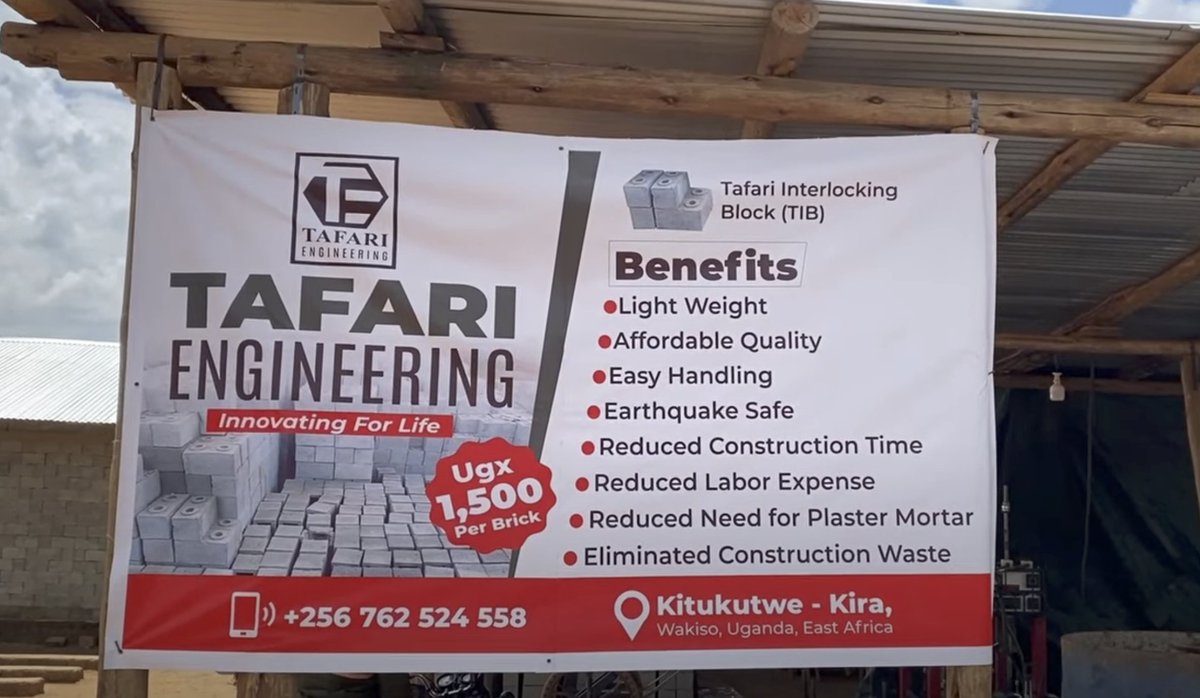
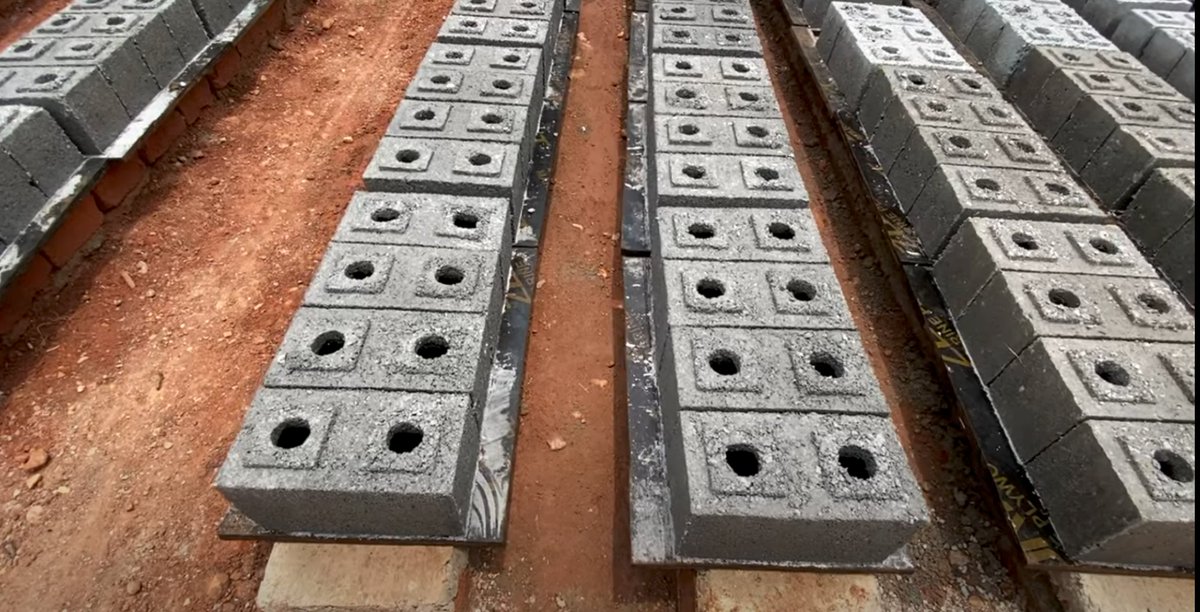
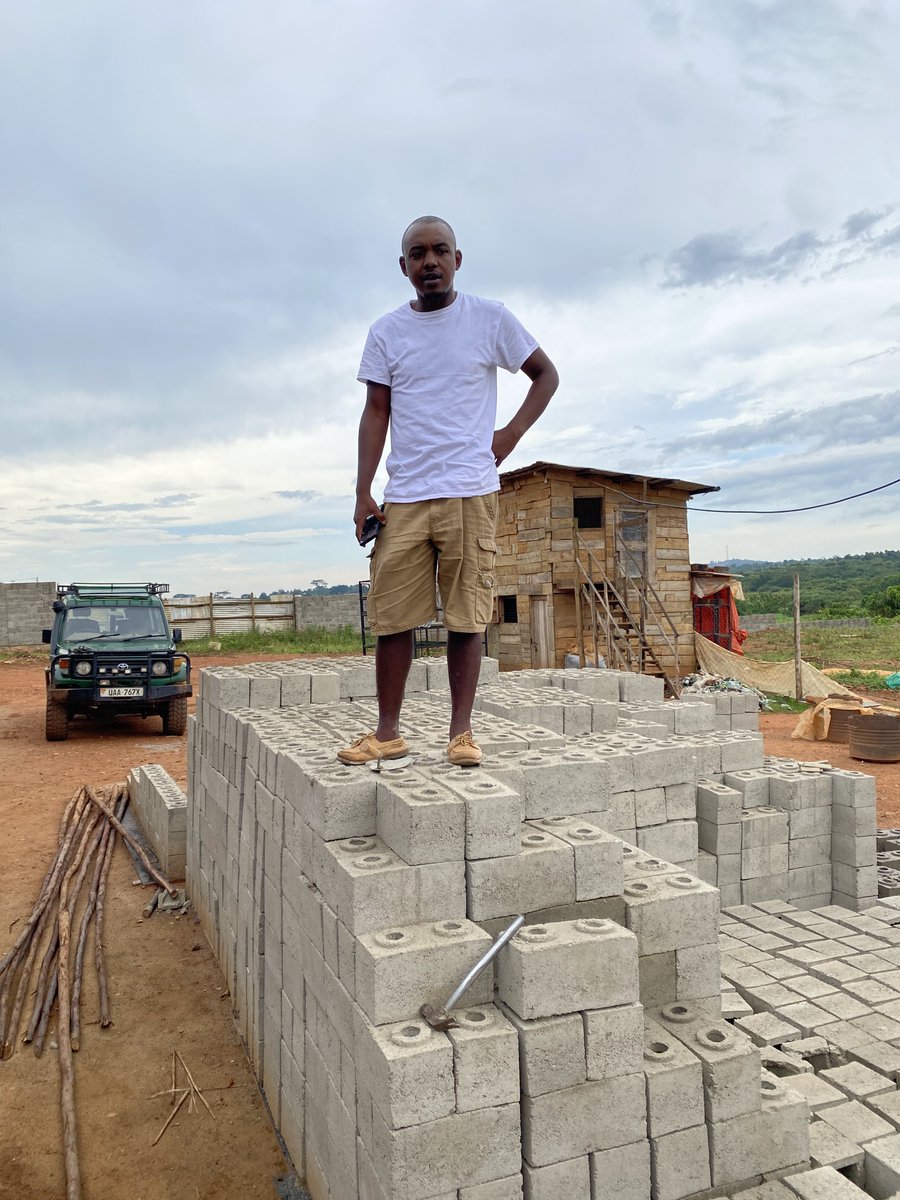
@PoliceUg used Tafari Interlocking Blocks for the dressing rooms for the future home of @UgPoliceFC. They saved over 32% on walling. From Foundation to ring beam; 6 bags of cement, and built in 5 days.
Asante!!
@TafariSafaris
Our very own Brian Osende is transforming Uganda’s construction scene! 🚀🔥. The Tafari Brick is; Stronger, eco-friendly, and cheaper to build with—this innovation is making homeownership more affordable. The future of building is here!
Read More🔗https://t.co/6wloKTTy1I
Kids in European countries with little to no mineral wealth proactively learn about mining while African kids, sitting on some of the world’s most valuable resources, are taught nothing about that, But hey, at least we know who “discovered” the Nile River in case it ever comes up