🚀 Introducing MiniVAgent — a generative AI workspace for building visual, node-based workflows.
Design, connect, and run AI pipelines visually:
• Build workflows with modular nodes
• Generate media using flexible AI integrations
• Experiment, iterate, and scale ideas fast A clean, developer-friendly foundation for creating powerful AI-driven media workflows.
⭐ Try it out and contribute!
🔗 https://t.co/oTqGfyAogo
Introducing Flue — The First Agent Harness Framework
Flue is a TypeScript framework for building the next generation of agents, designed around a built-in agent harness.
Flue is like Claude Code, but 100% headless and programmable. There's no baked in assumption like requiring a human operator to function. No TUI. No GUI. Just TypeScript.
But using Flue feels like using Claude Code. The agents you build act autonomously to solve problems and complete tasks. They require very little code to run. Most of the "logic" lives in Markdown: skills and context and AGENTS.md.
Flue is like Astro or Next.js for agents (not surprising, given my background 🙃). It's not another AI SDK. It's a proper runtime-agnostic framework. Write once, build, and deploy your agents anywhere (Node.js, Cloudflare, GitHub Actions, GitLab CI/CD, etc).
We originally built Flue to power AI workflows inside of the Astro GitHub repo. But then @_bgiori got his hands on it, and we realized that every agent needs a framework like Flue, not just us.
Check it out! It's early, but I'm curious to hear what people think. Are agents ready for their library -> framework moment?
Claude’s pricing changes seem to be pushing more developers to seriously evaluate alternatives, and Codex looks like one of the biggest winners right now.
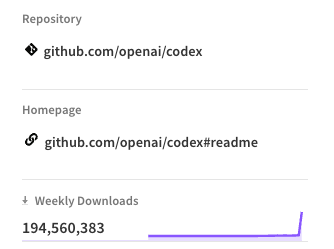
A strong signal is the npm traction: @openai/codex is now sitting at nearly 195M weekly downloads. When pricing shifts, teams usually start optimizing for the same things: more predictable costs, faster execution, and less friction for developers trying to ship.
That helps explain the growing attention around Codex. It offers a faster path from idea to code, helps automate repetitive work, and keeps workflows lean without adding unnecessary complexity.
Docs:
Package:
Are you seeing more teams evaluate Codex after the Claude pricing updates, and are they comparing other models at the same time?
#ai #coding #developers
You think cutting AI coding-agent token usage by 50–80% is impossible?
You’re wrong.
Most tokens aren’t spent on code.
They’re spent on repeated context:
- Old decisions
- Long tickets
- Docs
- Logs
- Project notes
- Huge RAG chunks
That’s where context compression helps.
Tools like Caveman and Microsoft LLMLingua compress context before it reaches the agent, so the model gets the same intent with less noise.
Less noise.
Lower cost.
Faster answers.
Better agent performance.
The goal isn’t less context.
It’s denser context.
If you’re building coding agents, this is one of the highest-leverage optimizations to explore.
#ai #agents #llm #automation
Google just dropped LangExtract.
If you’re building RAG apps, this is worth paying attention to. It’s Google’s open-source library for extracting structured data from unstructured text with LLMs, which could help make retrieval workflows more reliable and easier to maintain.
Feels especially relevant for document-heavy AI systems and automation use cases. Would you test it in a real pipeline?
https://t.co/PraCfanlfS
#ai #rag #automation #opensource
We just raised $30M at a $500M valuation, bringing our total funding to $47M.
Led by @craft_ventures , with @PaceCap , @chemistry , TruArrow, and others.
But before anything else: this belongs to the community.
ComfyUI started as one developer and one open-source repo. No roadmap. No company. Just creators who wanted real control over how they built with AI.
That community is now:
→ 4 million users
→ 60,000+ community-built nodes
→ 150,000+ daily downloads
Every number traces back to people who built in the open, for anyone to use.
Here's where the funding goes:
→ Comfy Cloud: for teams and studios that need security and scale
→ Collaborative workflows: versioning and iteration built for how studios actually work
→ A better local experience: more seamless, more stable
→ Ecosystem reliability: making 60,000+ community nodes more dependable
→ Day-one model support: every major release, compatible at launch
We are not building a walled garden.
We are building open infrastructure, built to last.
Thank you genuinely,
The ComfyUI Team
New workflow test just dropped: Multi-Background Character Test.
This setup shows how MiniVAgent’s new Split Text node can turn one prompt into multiple scene variations by splitting text with a separator. It’s a simple way to generate different backgrounds, moods, product shots, or descriptions from a single workflow.
In this example, one character is placed across multiple environments with the same visual pipeline, making it much easier to explore variations fast and stay consistent.
Try the workflow from GitHub
#ai #automation #buildinpublic
We just released Gemma 4 — our most intelligent open models to date.
Built from the same world-class research as Gemini 3, Gemma 4 brings breakthrough intelligence directly to your own hardware for advanced reasoning and agentic workflows.
Released under a commercially permissive Apache 2.0 license so anyone can build powerful AI tools. 🧵↓
Big update for MiniVAgent: multiple provider support is here.
Just starting with OpenAI and GPT models, this makes it easier to build AI-driven text and image workflows across providers in one node-based workspace.
MiniVAgent is a visual workflow app where you can connect AI nodes on a canvas, run full flows, and experiment faster with modern models.
Check out the repo and let me know which provider support you’d like to see next.
https://t.co/oTqGfyAogo
#ai #automation #openai #webdev
What’s the best way to change the viewing angle of an object from a single image while keeping the result realistic and consistent?
I’m especially curious about workflows that work well for product images and multi-angle transformations. What approach has worked best for you?
#ai #imageediting #computervision
Meet Airi: an open-source project from moeru-ai that makes AI more approachable to explore and build with.
If you like discovering new tools in the AI space, this one is worth a look. Check it out on GitHub and see what you can build with it.
https://t.co/IGITSZ8eow
#ai #opensource #github
GPT-5.4 mini and nano are out now.
If you want faster performance and lower cost without sacrificing reliability, these new models are built for it.
Use GPT-5.4 nano for high-volume tasks like classification and entity extraction.
Use GPT-5.4 mini for coding, computer use, and latency-sensitive agent workflows.
For complex reasoning and general-purpose work, GPT-5.4 remains the default choice.
All latest OpenAI models support text and image input, text output, multilingual capabilities, and vision.
#ai #api #openai
Fun testing agent flows when the output looks this good.
Experimenting with composition, color, and variation across a full set has been a great reminder of how creative these workflows can feel. Always exciting to see ideas come together from single pieces to a complete collection.
#ai #creativeworkflow
Meet Lightpanda — a fast headless browser built from scratch for AI agents and automation.
It’s not a Chromium fork. It’s a new browser written in Zig, designed for speed, low memory use, and instant startup. With support for CDP, Puppeteer, Playwright, and chromedp, it’s a strong option for scraping, testing, and LLM workflows.
Open source, fast, and built for modern web automation. Check it out:
#ai #automation #opensource #webdev