Vipin Kumar is an Indian construction worker in Romania.
One day, while he was walking near Nicolae Romanescu Park in Craiova, he saw a girl slip through a thin layer of ice and start struggling in the sub-zero water. Her father tried to reach her but became trapped in the broken ice.
Without any hesitation, Vipin used a nearby sledge to slide toward her. When the ice broke beneath him as well, he plunged into the freezing water, managed to grab the child, and held her above the surface for nearly 30 minutes until emergency crews arrived.
Both Vipin and the girl suffered severe hypothermia and were rushed to the hospital, where they received treatment.
Romania granted honorary citizenship to Vipin Kumar for his bravery and for risking his own life to save the girl.
Nowadays, social media is filled with hate against India, and Indians are increasingly being targeted. But when stories like this emerge, they rarely receive the same attention. They are not shared as widely, and somewhere along the way, these stories get buried and forgotten.
In 2012, a 19-year-old aeronautical engineering student from Coimbatore presented propulsion research at a NASA event. Dr. APJ Abdul Kalam noticed, sought him out for a meeting, and handed him a recommendation letter with one challenge: prove your concept.
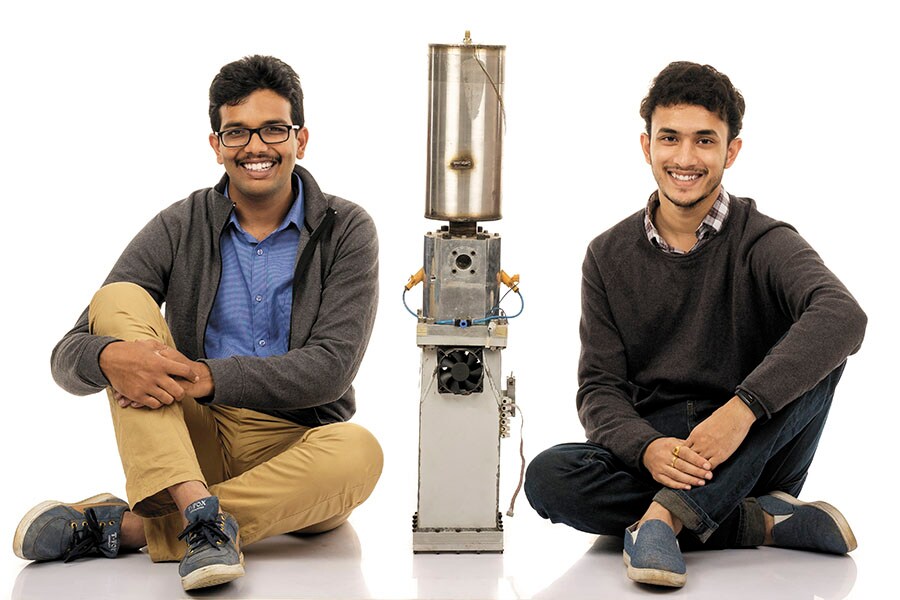
That student was Rohan M. Ganapathy. Three years later, he and family friend Yashas Karanam co-founded Bellatrix Aerospace from IISc's incubation lab in Bengaluru. The problem they chose to solve touches every satellite in orbit.
Nearly all satellites run on hydrazine, a propellant that has been standard since the 1960s. It is deeply toxic, carcinogenic, and so hazardous that it requires specialized crews and loading facilities near the launch site. India imports all of it. Nobody was building an alternative.
Bellatrix built two. Rudra is India's first high-performance green propulsion system, delivering hydrazine-equivalent thrust while cutting handling costs by over 60%.
Jal is a microwave plasma thruster that uses water as propellant, which Bellatrix claims is the world's first such system built by a private company. Both have been tested in orbit: Rudra fired on ISRO's POEM-3 in January 2024, and again on POEM-4 in January 2025.
Their third product, Pushpak, is an orbital transfer vehicle the company says can bring satellite deployment costs from $45,000 to $25,000 per kilogram. In October 2024, Bellatrix signed an MoU with ISRO's commercial arm, NewSpace India Limited, to integrate Pushpak into its launch missions. The company has raised $31 million to date, backed by BASF Venture Capital, Inflexor Ventures, and Cactus Partners.
For India, a domestic green propulsion stack means less dependence on imported hydrazine, lower costs for Indian satellite startups, and export-ready technology in a global market actively moving away from toxic fuels.
Kalam asked Rohan to prove his concept. More than a decade later, the proof has been fired in orbit.
@rohanooty@BellatrixAero@YashasKaranam
Market cap only values equity. EV gives a fuller picture for comparisons across companies with different debt levels, especially useful in ratios like EV/EBITDA or EV/Sales.
Enterprise Value (EV) is a better measure than market capitalization for assessing a company’s total value because it accounts for the full capital structure: it reflects what it would theoretically cost to acquire the entire business (equity + debt, minus cash).
EV = Market Capitalization + Total Debt - Cash & Cash Equivalents
India's Biggest Economic Challenge Is not Inflation, Oil, or War - It is an Unskilled Population Addicted to Distraction.
Every time oil prices rise, economists panic. Every time a war breaks out in the Middle East or Europe, television studios declare that India's economy is under threat. And yes, both matter. But neither represents India's greatest economic challenge. The real crisis is unfolding much closer to home.
It is a generation that spends more time consuming content than creating value. A workforce that debates geopolitics without mastering spreadsheets, artificial intelligence, coding, welding, precision manufacturing, sales, finance, communication, or even basic problem-solving. An economy where attention has become the most wasted national resource.
India is one of the youngest countries in the world. That should have been our greatest competitive advantage. Instead, we risk turning our demographic dividend into a demographic liability.
The Age of Endless Consumption
Never before has information been so accessible. Yet never before have so many people spent so much time learning so little. Hours disappear into political debates, celebrity gossip, cricket controversies, influencer reels, conspiracy theories, and outrage cycles that have absolutely no impact on an individual's earning potential. Ask someone how many hours they spent on social media last week. Then ask them how many hours they invested in acquiring a new professional skill. For many, the answer is uncomfortable. We have become experts at commenting on the economy while contributing very little to it.
Degrees Are Not Skills
India has no shortage of graduates. It has a shortage of employable graduates. Companies repeatedly report the same problem: vacancies exist, but suitable candidates are difficult to find. Not because people lack certificates. Because many lack practical skills. The world is rewarding competence, not credentials.
- Can you solve problems?
= Can you communicate effectively?
- Can you sell?
= Can you lead a team?
- Can you analyze data?
- Can you use AI to improve productivity instead of merely asking it amusing questions?
- Can you create something that another person is willing to pay for?
Those are the questions that determine economic success. Not the number of degrees hanging on a wall.
Attention Is the New Currency
The biggest theft today is not of money. It is of attention. Every notification fragments concentration. Every endless scroll delays mastery. Every hour spent consuming outrage is an hour not spent building expertise.
Modern economies reward deep work, specialized knowledge, creativity, and disciplined execution. Algorithms reward emotional reactions. Unfortunately, millions choose the algorithm.
The Coming Divide
Artificial intelligence is not replacing everyone. It is replacing people who refuse to learn. The future will belong to workers who continuously upgrade themselves. Those who combine human judgment with technological tools will become dramatically more productive. Those who stop learning will find themselves competing for fewer opportunities at lower wages. The divide will not be between rich and poor. It will increasingly be between skilled and unskilled.
National Growth Begins With Individual Discipline
Governments can build highways. Businesses can build factories. Universities can build campuses. But none of them can force an individual to develop skills. Economic transformation begins with personal responsibility. Spend one less hour arguing online. Spend one more hour learning. Read instead of scrolling. Build instead of complaining. Acquire one valuable skill every year. Become indispensable.
If millions of Indians made that simple choice, the country's economic trajectory would change more profoundly than any fiscal stimulus, any election promise, or any temporary fall in oil prices.
Wars will end. Oil prices will rise and fall. Markets will recover. But a nation that neglects skill development while surrendering its attention to endless distraction will struggle long after those headlines have disappeared.
The strongest economy is not built by the loudest voices. It is built by the most capable people.
#JaiHind
@dilipjain077@grok When you’re not an engineer and have to explain like a 5 year kid……
You cannot climb a steep hill in 1 gear and cannot come down in neutral!
@farzlicioustahe Please suggest where all we can eat Andhra Meals in the cities mentioned
Hyderabad, - Annapurna Mess, Ameerpet
Chennai,
Mumbai,
Delhi,
Vijayawada,
Las Vegas,
London
If I am correct, in 1970-90 there are around 14-15 lakes connected to each other and the farthest instance I could find the follwoing lakes were connected - Ramkrishna Puram, Safilguda, Moulali, Kapra and they are interconnected due to varying terrain of geography! Can’t find the names of upstream above RKPuram and Kapra