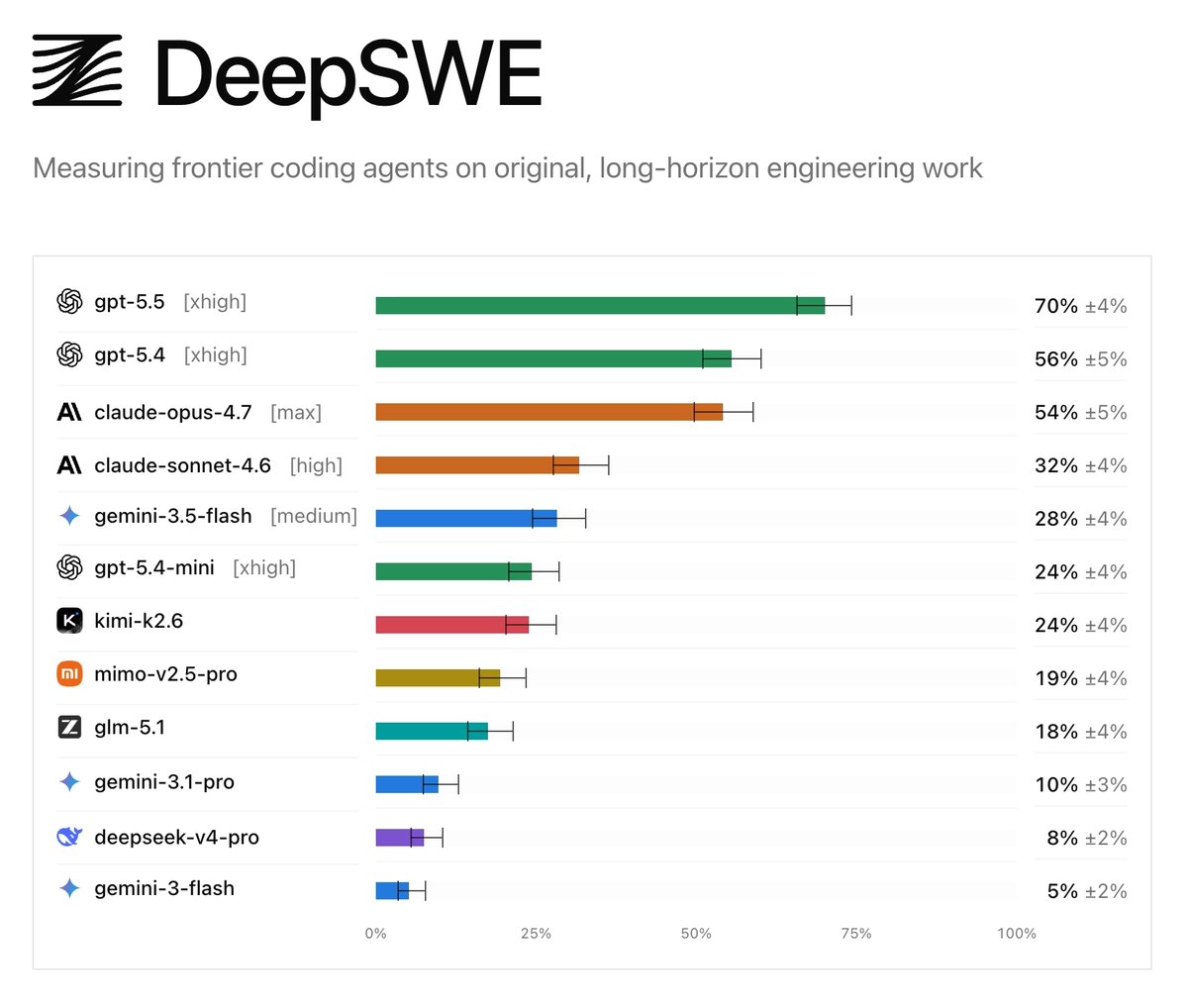
Today we’re releasing DeepSWE, a new standard for agentic coding benchmarks.
On public leaderboards, top models often look relatively close in capability. DeepSWE shows where they actually diverge, reflecting the realistic experience of developers in their day-to-day work.
Gavin Baker is one of the best tech investors alive and he explains why the AI cycle might actually avoid a bubble.
Every major technology in history ended in a bubble. Railroads, canals, the internet and even the PC. Every single one.
The pattern is always the same:
1. Investors get excited about a genuine breakthrough
2. Diversity of opinion breaks down
3. Everyone converges on the same thesis
4. Valuations disconnect from reality and then it collapses.
But Baker thinks AI is different this time and that's because of a physical constraint that no past technology ever had:
Watts and wafers.
TSMC is run by what he calls "flinty old men and women" who view themselves as the guardians of the most important institution in Taiwan. Jensen Huang flies to Taipei every three months and pushes them to double or triple capacity. They expand about 5%.
Here's Baker's math:
If TSMC actually gave Jensen what he wanted, Nvidia could probably sell $1.5 to $2 trillion worth of chips next year. He really believes that. The demand is there.
But a boom that size would almost certainly end in a bust. And a bust is catastrophic for TSMC. So TSMC's conservatism isn't a bottleneck. It's a release valve. A real-world physical constraint that enforces discipline on the whole cycle and prevents the kind of overbuilding that turned the internet boom into the dot-com crash.
Baker believes TSMC is the key reason why we won't have an AI bubble.
@ModernSoftwareX@trisha_gee@trisha_gee: I had hoped to get at least a few concrete examples how other teams solve this "huge bottleneck" code review when we generate so much code and how they avoid spending much more time for code review than to generate the code ? you have some ?
Software has _always_ been written by unreliable agents.
“We care more about measuring correctness now because agents write unreliable code” is a story that doesn’t hold up.
We care because testing used to be 50% of the work and now it’s 99%.
- Will Wilson @AntithesisHQ
#bugbash
What we are losing with AI is syntax -- and good riddance. The less our brains are occupied by semicolons and braces the better. There are much more important things for us to consider and manage.
@tmaiaroto I think the code will get cleaner, because it won't be humans writing it. Humans will, instead, be managing it. And it's easier to force someone else to be clean than it is to be clean yourself. ;-)
🇪🇺 European shareholders cannot vote because most banks do not enable it.
If Tesla wants EU and international shareholders to be able to vote, Tesla must initiate a process to enable that like the last time with help of a UK law firm.
If this does not happen, the vast majority of international shareholders will not be able to comply with your request.
@energy_charts_d Ok sehr gut! Habe es angesichts der negativen Strompreise eine Konstante Einspeisevergütung für Solaranlagen Betreiber noch zeitgemäß?
@htmx_org Clean code is not and was never about testing each single function that’s totally a misunderstanding. It was always about testing the API exactly because otherwise your tests would be too fragile. Instead, design the API first then you write the test and then the implementation.
We are living in a timeline where a non-US company is keeping the original mission of OpenAI alive - truly open, frontier research that empowers all. It makes no sense. The most entertaining outcome is the most likely.
DeepSeek-R1 not only open-sources a barrage of models but also spills all the training secrets. They are perhaps the first OSS project that shows major, sustained growth of an RL flywheel.
Impact can be done by "ASI achieved internally" or mythical names like "Project Strawberry".
Impact can also be done by simply dumping the raw algorithms and matplotlib learning curves.
I'm reading the paper:
> Purely driven by RL, no SFT at all ("cold start"). Reminiscent of AlphaZero - master Go, Shogi, and Chess from scratch, without imitating human grandmaster moves first. This is the most significant takeaway from the paper.
> Use groundtruth rewards computed by hardcoded rules. Avoid any learned reward models that RL can easily hack against.
> Thinking time of the model steadily increases as training proceeds - this is not pre-programmed, but an emergent property!
> Emergence of self-reflection and exploration behaviors.
> GRPO instead of PPO: it removes the critic net from PPO and uses the average reward of multiple samples instead. Simple method to reduce memory use. Note that GRPO was also invented by DeepSeek in Feb 2024 ... what a cracked team.
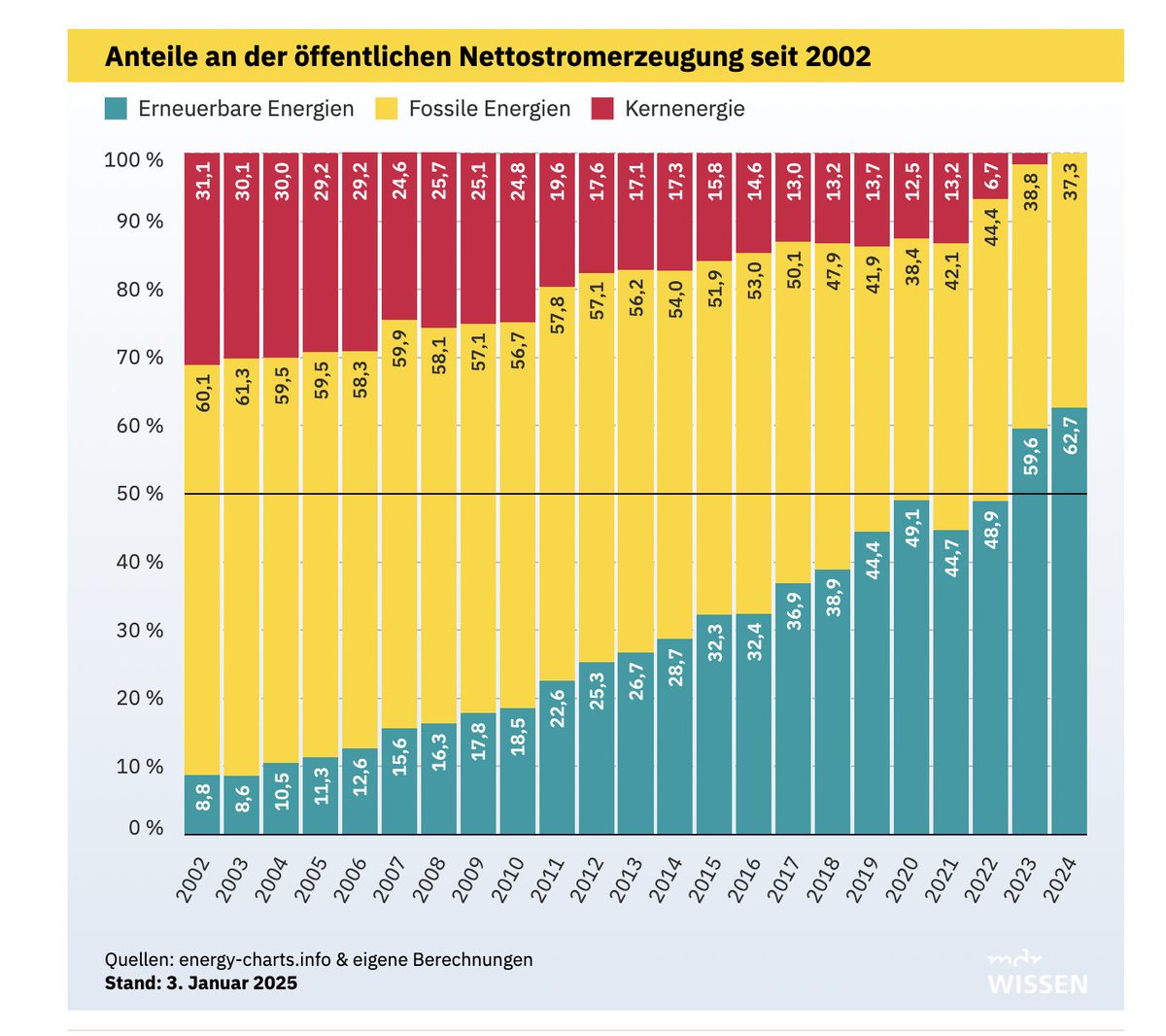
2024 war das erste Jahr seit 1961, in dem Deutschland keinerlei Atomstrom produzierte und was wurde von FDP, Union & Springer alles gewarnt: Blackouts, Brownouts, explodierende Strompreise, neue Abhängigkeit von Russland und die Renaissance der Kohle. Nun, nichts davon ist eingetroffen. Im Gegenteil: Strom war jederzeit verfügbar, wir sind seit 2023 unabhängig von Putin, die Preise haben sich stabilisiert, mit 37,2% Anteil haben wir einen historischen Tiefstand fossiler Brennstoffe erreicht und mit 62,7% einen neuen Rekordanteil Erneuerbarer Energien. Anstatt die Debatte den ewigen Zweiflern zu überlassen, sollten wir diese Erfolgsgeschichte viel häufiger erzählen & verbreiten😊