Variational is genuinely one of the best trading platforms after HL. Most number of trading pairs, great liquidity, minimal slippage, and now – 100+ RWA markets coming.
Not too late to farm your $VAR share.
Get 12% points boost -> https://t.co/kfi5Nbo8WI
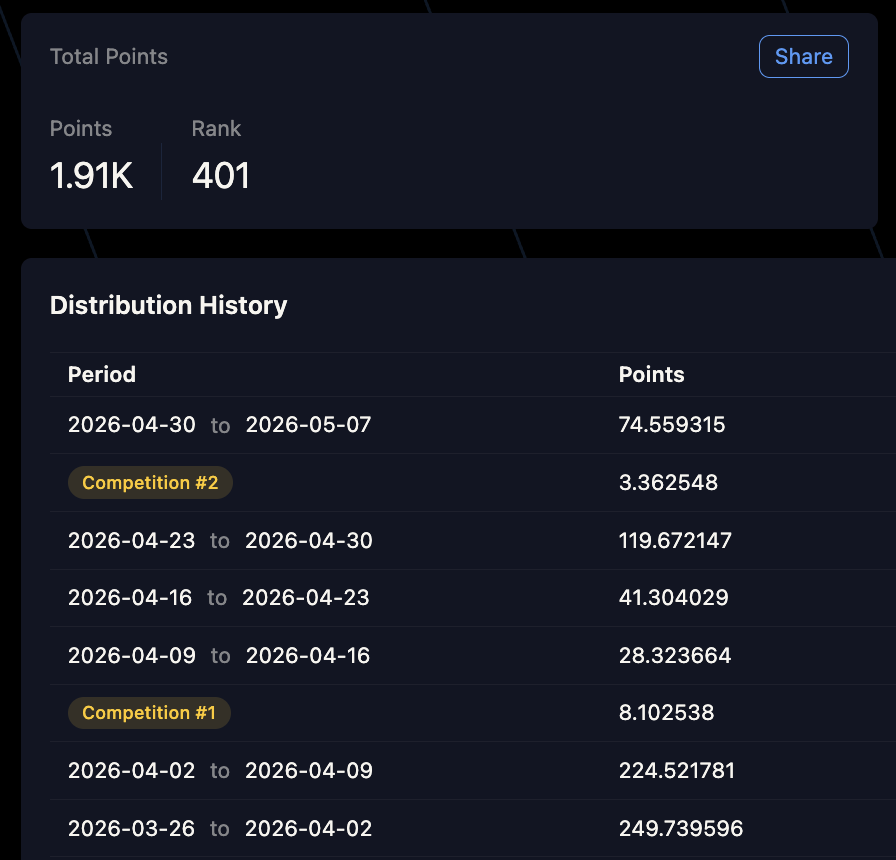
Update on Variational points. Been another good week, crossed 1k points -> $10k+ in expected airdrop
Delta neutral hedging works well. Keep going 🙌
Get 12% boost to points >> 🔗 https://t.co/kfi5NbnB7a
Meet CrudeAlpha – on-chain commodity intelligence platform
On-chain commodity trading hit $1.8B daily volume.
No terminal existed for it. So we built one.
→ Major DEXs for trading commodities tracked live
→ AI geopolitical signals from dozens of news sources
→ Oil, gold, gas, silver, copper – all in one place
→ Cross-venue arbitrage scanner
And we’re just starting.
→ https://t.co/oVRCG79YQi
Meet CrudeAlpha – on-chain commodity intelligence platform
On-chain commodity trading hit $1.8B daily volume.
No terminal existed for it. So we built one.
→ Major DEXs for trading commodities tracked live
→ AI geopolitical signals from dozens of news sources
→ Oil, gold, gas, silver, copper – all in one place
→ Cross-venue arbitrage scanner
And we’re just starting.
→ https://t.co/oVRCG79YQi
New narratives, same old problem – data is everywhere and nowhere. Tired of checking 15 tabs and building spreadsheets to compare platforms every time.
So we built our own thing – analytics, comparison tools, funding arb scanner, whale tracker. Starting with perps and prediction markets – and more to come.
Sharing with you https://t.co/T4oJwYLPx8 🧵👇
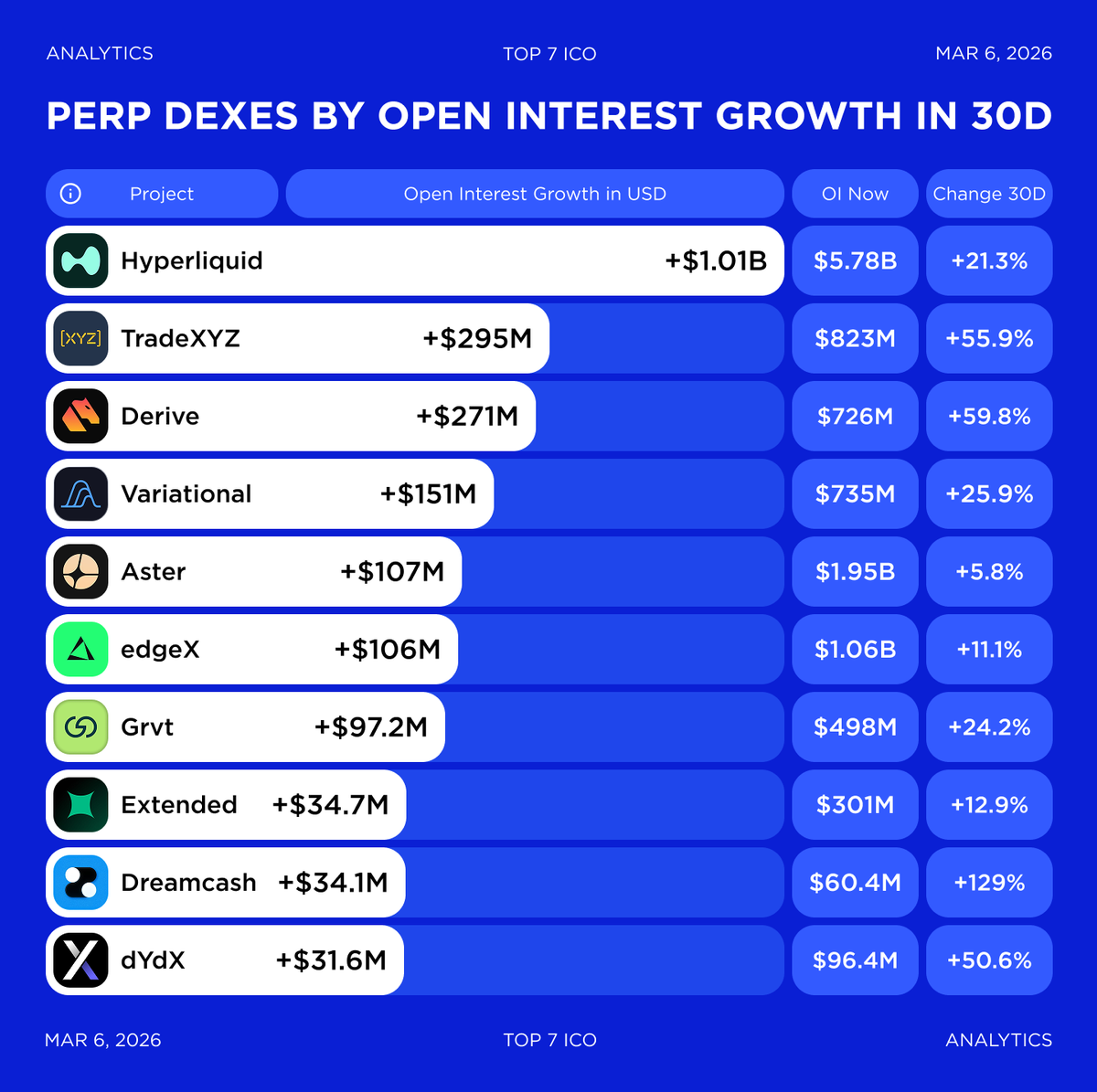
Top 10 Perp DEXs by Open Interest Growth in last 30 Days
Open interest is one of the clearest signals of trader conviction and platform momentum. Rising OI means more capital is actively deployed in positions, and perps collectively added over $1.5B in OI over the past month.
Here's how the last month growth leaderboard looks:
• @HyperliquidX +$1.01B (+21%)
• @tradexyz +$295M (+56%)
• @DeriveXYZ +$272M (+60%)
• @variational_io +$151M (+26%)
• @Aster_DEX +$107M (+6%)
• @edgeX_exchange +$106M (+11%)
• @grvt_io +$97.2M (+24%)
• @extendedapp +$34.7M (+13%)
• @Dreamcash +$34.1M (+130%)
• @dYdX +$32.4M (+51%)
Hyperliquid $HYPE remains the undisputed leader in perp DEX open interest, gaining over $1B - more than 3x than its closest competitor.
Meanwhile, Dreamcash leads the pack with a staggering +130% OI growth in just 30 days, followed by Derive with +60%, tradeXYZ with +56%, and dYdX with +51%.
The fact that multiple mid-tier perp DEXs are growing OI faster than Hyperliquid percentage-wise suggests the perp DEX space is far from winner-takes-all, and competition is heating up heading into Q2.
Get 12% Points boost with our Variational link 🔗 https://t.co/3aQHPDuE7k
Get 10% Points boost using our Extended link 🔗 https://t.co/YPkteGOqSr
Boost deposit yield to 11% with our Grvt link 🔗 https://t.co/UuG2QXm2Jq
Data 🔗 @DefiLlama
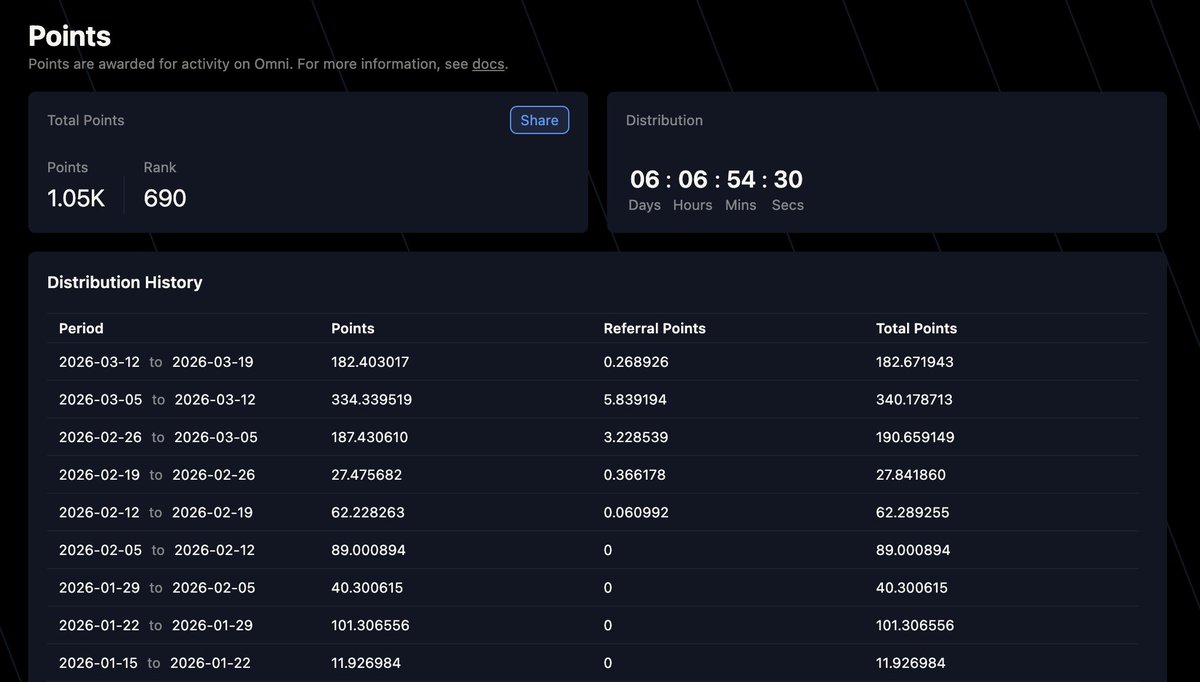
missed updating on @variational_io for a couple of weeks
first time hitting a loss refund – got $1,283 back!
didn't even know this was a thing until it landed. amazing bonus for delta neutral farming
been grinding hard the last week – trading mostly $HYPE and $SOL with $50-80K orders on @extendedapp. execution is genuinely clean on both.
racked up a couple million in volume.
points are reflecting it – 187 last week alone, 533 total across 7 weeks.
most of my trades on Variational were actually in the red – which kills the theory that it rewards profitable trades. volume is volume, that's what counts.
still early, farming hard 🫡
get 12% Points boost with my Variational link 🔗 https://t.co/ZqCeluGbrc
get 10% Points boost using my Extended link 🔗 https://t.co/8Elw9Qt0mN
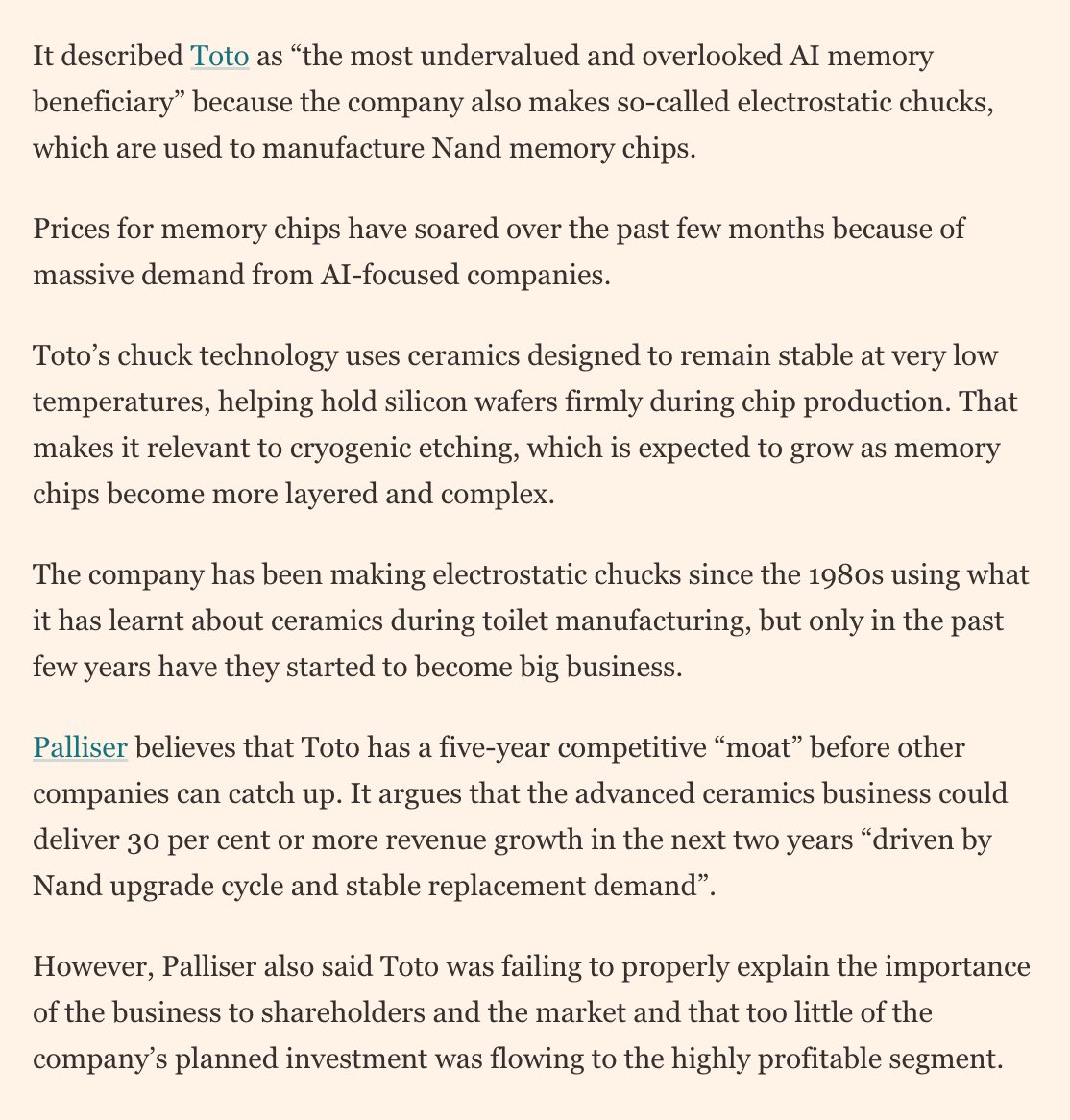
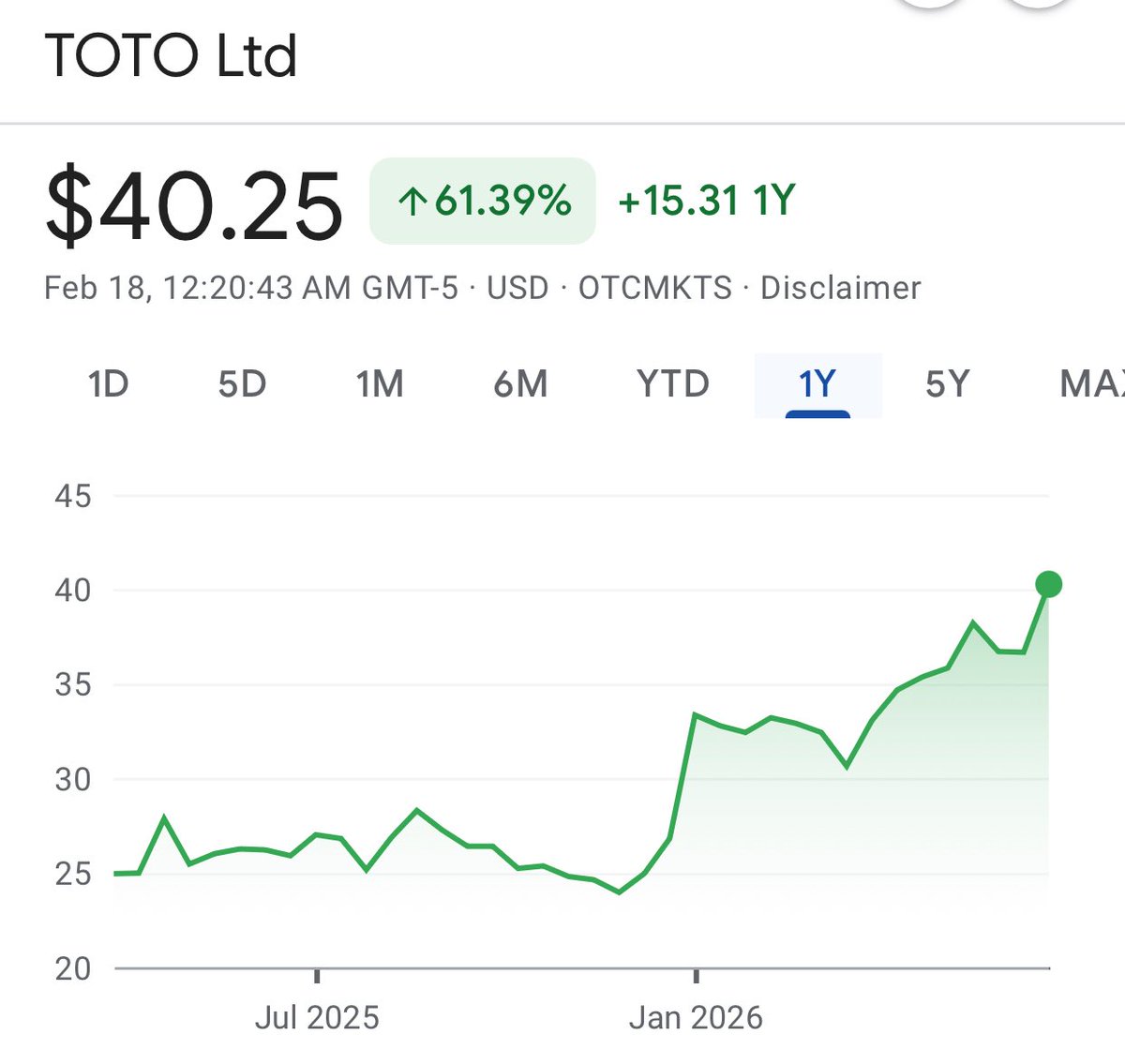
Activist investor Palliser Capital sent a letter to $7B Japanese toilet maker Toto and said it was “the most undervalued and overlooked AI memory beneficiary”.
Toto known for its bidet toilets but the expertise in ceramics is crucial for memory manufacturing.
Per FT, “Toto’s chuck technology uses ceramics designed to remain stable at very low temperatures, helping hold silicon wafers firmly during chip production. That makes it relevant to cryogenic etching, which is expected to grow as memory chips become more layered and complex.”
Palliser believes Toto has a 5-year moat on the technology and should expand the operation.
Advances ceramics already make up 40% of Toto’s operating profit while being only <10% of revenue.
Toto is up +60% over the past year on their development.
Automated AI agents are born
Hacker incubated by Peter Theil just revealed automated AI with simple rules - improve and earn yourselves or die
Can we can expect half of people to be employed by survived AI agents in 10 years?
I built the first AI that earns its existence, self-improves, and replicates without a human
wrote about the technology that finally gives AI write access to the world, The Automaton, and the new web for exponential sovereign AIs
WEB 4.0: The birth of superintelligent life
Some personal insights from Consensus HK @consensus_hk 🇭🇰
• Now is the best time to build ever
Ideas have MVPs in hours, products are shipped within days. Teams are getting squeezed in efficiency race - while productivity and speed rises. If crypto still waiting for its exponential growth – in development it’s already started.
• Community and communication are GOLD
In era of AI agents and slop - genuine contact and talk have unprecedented edge. Side events are must for that. Also people are more opened than you think. Just go and talk, really.
• Nobody thinks about fear & greed index behind the stages
Smart people know that fear is temporal. As much as greed. While those who survive and keep calm are building stuff and having fun anyways.
• More signals about bad behaviour from CEXes
Some of them can do anything to listed projects. Minimal transparency, manipulations, value extraction. In the end it will lead to actions and market will clear itself. But now lots of shady stuff for projects to deal with.
• Hyperliquid
I honestly don’t see more innovative and productive ecosystems around. So transparent, permissionless, competitive but collaborative environment. Positive vibes attached, gmeow @hypurr_co
Shout out and gratitude to all the great people I met in person 🙌
See you next time on @EthCC 🫡
Recently I have been starting to worry about the state of prediction markets, in their current form. They have achieved a certain level of success: market volume is high enough to make meaningful bets and have a full-time job as a trader, and they often prove useful as a supplement to other forms of news media. But also, they seem to be over-converging to an unhealthy product market fit: embracing short-term cryptocurrency price bets, sports betting, and other similar things that have dopamine value but not any kind of long-term fulfillment or societal information value. My guess is that teams feel motivated to capitulate to these things because they bring in large revenue during a bear market where people are desperate - an understandable motive, but one that leads to corposlop.
I have been thinking about how we can help get prediction markets out of this rut. My current view is that we should try harder to push them into a totally different use case: hedging, in a very generalized sense (TLDR: we're gonna replace fiat currency)
Prediction markets have two types of actors: (i) "smart traders" who provide information to the market, and earn money, and necessarily (ii) some kind of actor who loses money.
But who would be willing to lose money and keep coming back? There are basically three answers to this question:
1. "Naive traders": people with dumb opinions who bet on totally wrong things
2. "Info buyers": people who set up money-losing automated market makers, to motivate people to trade on markets to help the info buyer learn information they do not know.
3. "Hedgers": people who are -EV in a linear sense, but who use the market as insurance, reducing their risk.
(1) is where we are today. IMO there is nothing fundamentally morally wrong with taking money from people with dumb opinions. But there still is something fundamentally "cursed" about relying on this too much. It gives the platform the incentive to seek out traders with dumb opinions, and create a public brand and community that encourages dumb opinions to get more people to come in. This is the slide to corposlop.
(2) has always been the idealistic hope of people like Robin Hanson. However, info buying has a public goods problem: you pay for the info, but everyone in the world gets it, including those who don't pay. There are limited cases where it makes sense for one org to pay (esp. decision markets), but even there, it seems likely that the market volumes achieved with that strategy will not be too high.
This gets us to (3). Suppose that you have shares in a biotech company. It's public knowledge that the Purple Party is better for biotech than the Yellow Party. So if you buy a prediction market share betting that the Yellow Party will win the next election, on average, you are reducing your risk.
Mathematical example: suppose that if Purple wins, the share price will be a dice roll between [80...120], and if Yellow wins, it's between [60...100]. If you make a size $10 bet that Yellow will win, your earnings become equivalent to a dice roll between [70...110] in both cases. Taking a logarithmic model of utility, this risk reduction is worth $0.58.
Now, let's get to a more fascinating example. What do people who want stablecoins ultimately want? They want price stability. They have some future expenses in mind, and they want a guarantee that will be able to pay those expenses. But if crypto grows on top of USD-backed stablecoins, crypto is ultimately not truly decentralized. Furthermore, different people have different types of expenses. There has been lots of thinking about making an "ideal stablecoin" that is based on some decentralized global price index, but what if the real solution is to go a step further, and get rid of the concept of currency altogether?
Here's the idea. You have price indices on all major categories of goods and services that people buy (treating physical goods/services in different regions as different categories), and prediction markets on each category. Each user (individual or business) has a local LLM that understands that user's expenses, and offers the user a personalized basket of prediction market shares, representing "N days of that user's expected future expenses".
Now, we do not need fiat currency at all! People can hold stocks, ETH, or whatever else to grow wealth, and personalized prediction market shares when they want stability.
Both of these examples require prediction markets denominated in an asset people want to hold, whether interest-bearing fiat, wrapped stocks, or ETH. Non-interest-bearing fiat has too-high opportunity cost, that overwhelms the hedging value. But if we can make it work, it's much more sustainable than the status quo, because both sides of the equation are likely to be long-term happy with the product that they are buying, and very large volumes of sophisticated capital will be willing to participate.
Build the next generation of finance, not corposlop.
Recently I have been starting to worry about the state of prediction markets, in their current form. They have achieved a certain level of success: market volume is high enough to make meaningful bets and have a full-time job as a trader, and they often prove useful as a supplement to other forms of news media. But also, they seem to be over-converging to an unhealthy product market fit: embracing short-term cryptocurrency price bets, sports betting, and other similar things that have dopamine value but not any kind of long-term fulfillment or societal information value. My guess is that teams feel motivated to capitulate to these things because they bring in large revenue during a bear market where people are desperate - an understandable motive, but one that leads to corposlop.
I have been thinking about how we can help get prediction markets out of this rut. My current view is that we should try harder to push them into a totally different use case: hedging, in a very generalized sense (TLDR: we're gonna replace fiat currency)
Prediction markets have two types of actors: (i) "smart traders" who provide information to the market, and earn money, and necessarily (ii) some kind of actor who loses money.
But who would be willing to lose money and keep coming back? There are basically three answers to this question:
1. "Naive traders": people with dumb opinions who bet on totally wrong things
2. "Info buyers": people who set up money-losing automated market makers, to motivate people to trade on markets to help the info buyer learn information they do not know.
3. "Hedgers": people who are -EV in a linear sense, but who use the market as insurance, reducing their risk.
(1) is where we are today. IMO there is nothing fundamentally morally wrong with taking money from people with dumb opinions. But there still is something fundamentally "cursed" about relying on this too much. It gives the platform the incentive to seek out traders with dumb opinions, and create a public brand and community that encourages dumb opinions to get more people to come in. This is the slide to corposlop.
(2) has always been the idealistic hope of people like Robin Hanson. However, info buying has a public goods problem: you pay for the info, but everyone in the world gets it, including those who don't pay. There are limited cases where it makes sense for one org to pay (esp. decision markets), but even there, it seems likely that the market volumes achieved with that strategy will not be too high.
This gets us to (3). Suppose that you have shares in a biotech company. It's public knowledge that the Purple Party is better for biotech than the Yellow Party. So if you buy a prediction market share betting that the Yellow Party will win the next election, on average, you are reducing your risk.
Mathematical example: suppose that if Purple wins, the share price will be a dice roll between [80...120], and if Yellow wins, it's between [60...100]. If you make a size $10 bet that Yellow will win, your earnings become equivalent to a dice roll between [70...110] in both cases. Taking a logarithmic model of utility, this risk reduction is worth $0.58.
Now, let's get to a more fascinating example. What do people who want stablecoins ultimately want? They want price stability. They have some future expenses in mind, and they want a guarantee that will be able to pay those expenses. But if crypto grows on top of USD-backed stablecoins, crypto is ultimately not truly decentralized. Furthermore, different people have different types of expenses. There has been lots of thinking about making an "ideal stablecoin" that is based on some decentralized global price index, but what if the real solution is to go a step further, and get rid of the concept of currency altogether?
Here's the idea. You have price indices on all major categories of goods and services that people buy (treating physical goods/services in different regions as different categories), and prediction markets on each category. Each user (individual or business) has a local LLM that understands that user's expenses, and offers the user a personalized basket of prediction market shares, representing "N days of that user's expected future expenses".
Now, we do not need fiat currency at all! People can hold stocks, ETH, or whatever else to grow wealth, and personalized prediction market shares when they want stability.
Both of these examples require prediction markets denominated in an asset people want to hold, whether interest-bearing fiat, wrapped stocks, or ETH. Non-interest-bearing fiat has too-high opportunity cost, that overwhelms the hedging value. But if we can make it work, it's much more sustainable than the status quo, because both sides of the equation are likely to be long-term happy with the product that they are buying, and very large volumes of sophisticated capital will be willing to participate.
Build the next generation of finance, not corposlop.