$UBER & $LYFT
I see so many people saying these companies will go out of business because Waymo and Tesla are “eating their lunch.”
Uber has 199 million monthly active consumers across mobility and delivery. Lyft has 28.3 million active riders and completes roughly 18 million rides per week.
Waymo is growing quickly, but currently completes about 500,000 trips per week.
AVs will become another source of transportation supply. The value is in aggregating demand, maximizing vehicle utilization, and providing riders with the best coverage and pricing.
AVs will be the commodity.
The marketplace is the moat.
$KSCP Knightscope preliminary Q2 2026 revenue triples to ~$9M
— Up over 200% from $2.7M in the same quarter last year, a new quarterly record
— Now serving 434 clients across 42 states
— Numbers are preliminary/unaudited — full results expected mid-August
— Company also unveiled its new "Autonomous Security Force" strategy combining hardware, software, and licensed security agents
Not financial advice.
$UBER just announced its biggest move yet outside of rides.
Uber launched a $14.8 billion offer to acquire Delivery Hero, which would create the largest food delivery platform outside of China.
Management expects the deal to boost earnings after closing and produce roughly $1 billion in potential synergies.
Uber is not just building a ride-hailing company anymore.
It is building one of the strongest global consumer platforms in the world.
This is exactly why I continue to buy $UBER.
What do $PLTR and $ZETA gain from their partnership?
$PLTR Foundry doesn’t understand consumer marketing signals and doesn’t have agentic AI for marketing campaigns.
$ZETA has spent years building Athena for precisely this goal.
The partnership gives $ZETA access to government and enterprise entities that are already $PLTR's clients.
$ZETA expects the partnership to generate $100 million in annual revenue.
Glad I have $ZETA in portfolio.
I consider it my duty to provide analysis on innovative robotics companies that most others ignore. One such company is Ubtech Robotics Corp $UBTRF. My thesis is as follows:
1. Ubtech is the publicly traded humanoid robotics leader in China. Two competitors include Unitree Robotics and Agibot, but neither are publicly traded. The company currently produces thousands of Walker S2 units which are actively deployed at multiple factories and logistics warehouses. They are actively scaling up their production capacity towards a goal of 10,000 units annually. No U.S. company can currently match this capacity.
2. They recently introduced the UWORLD U1 Series which is an ultra-realistic android specifically designed for home companionship and emotional support. There were approximately 13,000 pre-orders, which signals high consumer demand. This is historic considering this will be the first company to mass produce lifelike androids.
Between their industrial and now consumer robots, this is one of the most interesting companies out there. With a market cap less than $6 billion, I think the valuation is extremely fair, with much potential for future growth.
BREAKING: Trump decides to impose punitive tariffs on Belgian imports—after Belgium knocked the USA out of the World Cup.
.
.
.
,
Just kidding. Please don't short Belgian stocks :D
$QQQ $SPY $UBC $KBC $ARGX
$LMT Lockheed Martin Wins A Seven-Year Undefinitized Contract Action For Up To $35B To Quadruple Production Of Terminal High Altitude Area Defense Interceptors
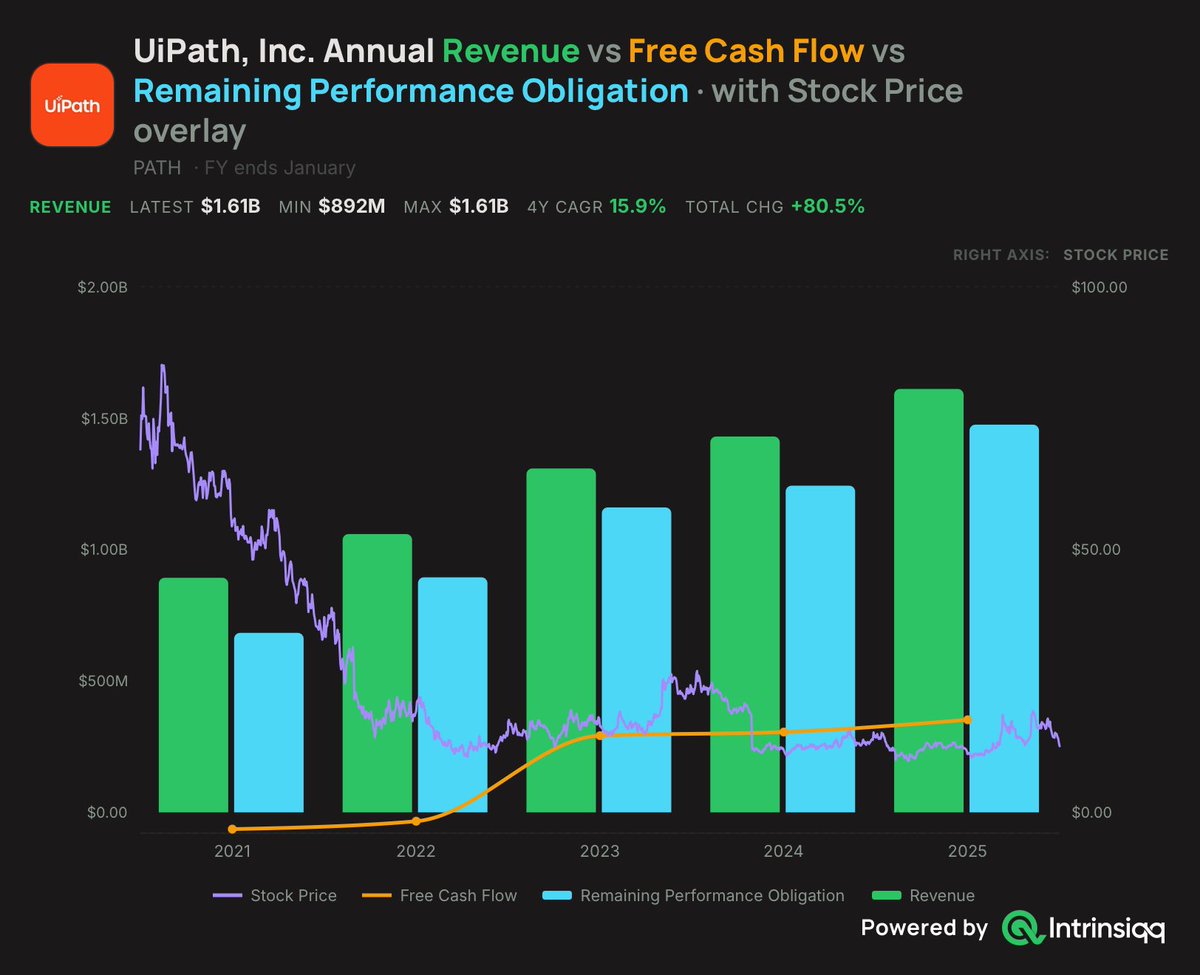
$PATH buying back hundreds of millions in stock, generates 80% gross margins & amazing Free cash Flow. PPS barely 2 x BV & LT Debt/Equity below 10% Total Assets 3.2B $PATH a buy/value investment.
The reality is the "SaaS apocalypse" is just accelerating how platforms onboard Agentic AI.
One of the best examples of this and one of the most undervalued AI companies is $PATH UiPath.
Down 36% in 2026 alone. But they have 20 years of experience with RPA now Enterprise AI with agents.
Next time you read a Sakana AI PR announcement, look at the companies actually doing it with real customers at scale. Forward P/E is now 11.00.
A $10 stock price, that's insane.
2) $PATH
This one is much more asymmetric.
Market cap: around $5.45B
Cash and marketable securities: $1.42B
Cash-adjusted value: around $4B
FY27 revenue guide: ~$1.78B
FY27 ARR guide: ~$2.06B
FY27 non-GAAP operating income guide: ~$430M
That means $PATH is trading around:
2.3x cash-adjusted forward revenue
2.0x cash-adjusted forward ARR
9.4x cash-adjusted forward non-GAAP operating income
That is cheap.
And the business is not dead.
Last quarter:
Revenue grew 17% YoY
ARR grew 12% YoY
Net retention was 109%
GAAP gross margin was 82%
Non-GAAP adjusted FCF was $130M
They hit first-quarter GAAP profitability for the first time
The market is acting like $PATH is broken.
The AI angle for $PATH might be the most misunderstood.
Everyone keeps talking about AI agents but agents need to execute.
They need to click, pull data, update systems, process documents, complete tasks, and work across legacy enterprise software.
That is what $PATH was built for.
Robots, agents and business orchestration is the bull case.
If enterprises actually use AI agents at scale, $PATH should be one of the companies that helps those agents do real work.
The risk with $PATH is also obvious.
Competition is real.
The market needs to believe $PATH can become an AI automation platform, not just an old RPA company.
But that is why the valuation matters.
At around 2x ARR after cash, the market is not pricing in much success.
If growth reaccelerates even modestly, the upside can be very strong.
OpenAI / Altman just got a body blow from $MSFT Satya Nadella:
Microsoft plans to move Copilot to usage-based pricing with open-source AI model DeepSeek instead of OpenAI due to costs $NVDA $AMD $MU $ORCL
Even though this represents <5% in pro forma revenue for OpenAI, others could follow suit, creating a bigger issue...
Microsoft CEO Satya Nadella's shift to offer DeepSeek-V4 alongside a move to usage-based token pricing for Copilot Cowork is an absolute watershed moment for the AI industry.
The era of "all-you-can-eat" flat-rate corporate subscriptions is ending because agentic AI (AI that continuously plans, codes, and loops in the background) is dramatically more expensive to run than simple chatbots. The financial and strategic ripple effects across tech, hardware, and venture capital break down as follows:
- AI Models Cost Prohibitive: OpenAI (GPT-5.5) and Anthropic (Claude 4.8) have priced themselves into a corner. Reportedly, DeepSeek V4 Pro costs roughly one-third as much as Claude for inputs and one-seventh as much for outputs.
- Taking Away Pricing Leverage: Microsoft is OpenAI’s biggest backer, but Nadella is explicitly executing a "multi-model platform strategy." He noted on X that "we do not want a world where enterprises cede all value to a small number of models." By introducing a hyper-efficient open-source competitor, Microsoft is stripping OpenAI of its premium pricing leverage.
- What this Could Mean for AI Hardware: The shift to open-source, highly optimized "Mixture-of-Experts" (MoE) architectures like DeepSeek means enterprise software can achieve the same results using significantly fewer compute cycles. If the industry shifts from bloated, massive frontier models to lightweight, fine-tuned open-source models, the frantic, exponential panic-buying of premium AI chips could cool down longer term.
o Bull Interpretation: AI is moving to usage-based enterprise billing. This transforms AI into a metered utility (like electricity or AWS cloud storage). As enterprises optimize their costs via cheaper models, total volume and actual utilization of AI agents will skyrocket. The sheer scale of agentic workflows running continuously will still require an immense, unyielding baseline of infrastructure.
- This development explains exactly why the public market has started applying a heavy discount to proxy investment vehicles holding pre-IPO tech blocks.
o Closed-end venture vehicles like $DXYZ, $VCX, and Powerlaw Corp. $PWRL hold concentrated secondary allocations in OpenAI and Anthropic, both of which are currently in the confidential stages of prepping trillion-dollar IPOs. With Microsoft proving that it will happily swap out closed-source models to preserve its own corporate margins, the public markets are realizing that the long-term enterprise software moats of OpenAI and Anthropic are far less secure than originally hyped.
- Political Issue: This move introduces a massive geopolitical paradox. The Trump administration has been actively tightening restrictions on advanced AI models leaking out of the United States. Now, Microsoft—one of America's most foundational tech institutions—is adopting a model born out of a Chinese lab (DeepSeek) simply because the raw economics of American frontier models are unsustainable. To protect itself from political blowback, Microsoft has heavily modified the model, layered it with Western safety/bias overrides, and restricted it entirely to self-hosted Azure environments.
BREAKING: "If I don't like it, we'll go back to shooting at them, dropping bombs on their head."
President Trump warns Iran that any change to the peace agreement or failure to comply could bring an immediate military response.