CRYPTO SPACE IN 2026:
Bitcoin's founder unfairly mined roughly 5% of the total supply early on, then disappeared (and could potentially dump it at any time). Jeffrey Epstein was paying 3 of the 5 core Bitcoin developers in 2015.
Ethereum's founder hates his chain, and "The Merge" (the switch from PoW to PoS), which he led, was a big mistake. He also held 40% of Ethereum's total supply from 2016 to 2021.
Tether's CEO keeps artificially pumping Bitcoin and the entire crypto market by printing billions of USDT every month out of thin air. Its CEO is now buying gold instead of Bitcoin, showing a lack of interest in further supporting the crypto space.
BNB's founder has liquidated the entire crypto industry for years and is likely still doing so. He also owns 90%+ of the BNB supply via personal holdings and Binance stakes. He got jailed for crypto-related illegal activities.
Ripple's CEO is selling billions of dollars worth of XRP every month. He owns around 40% of the total XRP supply.
Solana's founder has coordinated market manipulation and doesn't even use his own chain.
Tron's founder is accused by his ex-girlfriend of market manipulation, insider trading, and fraud related to Tron.
Dogecoin's founder dumped his coins 10 years ago and has never cared about Dogecoin since. The Dogecoin Foundation is nowhere aligned with the vast majority of community's interests, and Elon Musk has been hyping it for years now, resulting in artificial hype-driven pumps.
Cardano's founder misappropriated community treasury funds to support personal or external projects, leading to public denials and ongoing conflicts with parts of the Cardano ecosystem (including the Foundation). He even called the FBI on a bug hunter who exploited the multi-billion-dollar market cap coin instead of praising and rewarding them. Furthermore, he always overpromised on Cardano's capabilities (which is the most vaporware ghost chain in human history), meaning that he is selling a vision rather than a finished, competitive product. Yes, the same "decentralized" chain that forces KYC on everyone through their staking partners. He can't help but dig himself deeper and deeper into a hole. Now he is releasing an entirely new coin to fleece retail with.
Chainlink's founder holds around 30% of this ghost chain's total supply.
Zcash's founder used to receive 20% of the mining rewards until late 2020, resulting in unfairly allocated benefits on top of the miners.
Avalanche's founder bribed lawyers to legally attack competitors; its co-founder walked away and never talks about it.
-------------------------
You look at that list of crypto founders and it is pretty bleak. You have guys going to jail, dumping their unfairly allocated bags on top of the holders, or just abandoning their own chains. Then you have Charlie Lee.
Charlie is in a league of his own. While others were busy hyping vaporware or buying gold, Charlie has been quietly building and funding Litecoin and Bitcoin for over a decade. He did not just copy code and run; he shaped the entire industry. Remember, Litecoin was the testnet for major Bitcoin upgrades like SegWit, Lightning Network, Taproot, Bech32. He helped Bitcoin and Ethereum scale and succeed just as much as he helped his own coin. He is not competing out of ego; he is pushing the whole space forward.
He also solved one of the biggest problems in crypto: privacy. With the MWEB upgrade, he made Litecoin truly fungible, turning it into actual digital cash that you can use without everyone tracking your every move.
And he is putting his money where his mouth is. He is not liquidating the industry or buying yachts. He is back in the trenches, joining the board of @LiteStrategy (with dozens of investors, including Citadel's Ken Griffin) to help bring institutional adoption to Litecoin. He is literally working to get Wall Street to buy $LTC.
In a sea of grifters and tech bros who hate their own users, @SatoshiLite is the top guy who actually loves his coin and the community. He is the real deal.
If you genuinely care about the crypto space and value Satoshi's proof-of-concept (which Litecoin absolutely fulfills) as well as Charlie Lee's efforts for Litecoin and Bitcoin all these years since 2011, you oughta support Litecoin's developments and projects:
https://t.co/936xqogx5d
https://t.co/2yWrs8JVlR
At best Zcash is a Silicon Valley VC extraction / pump and dump scheme. At worst it was created as a state sponsored honeypot.
Litecoin is the decentralized digital cash of the people. I am buying $LTC.
At best Zcash is a Silicon Valley VC extraction / pump and dump scheme. At worst it was created as a state sponsored honeypot.
Litecoin is the decentralized digital cash of the people. I am buying $LTC.
Litecoin should not still be here.
It launched in 2011, watched thousands of flashier coins promise to replace it, and quietly buried almost all of them.
The survivor everyone wrote off is about to do the one thing nobody expected.
In this conversation, Roc and Aztec of LitVM walk through a major expansion that finally brings smart contracts to one of crypto's oldest names.
Their argument is that the recent downturns, which they attribute to predatory shorting, are masking a quieter trend, with capital steadily rotating back into proven legacy assets that have already weathered more than a decade of cycles.
The project itself is a purpose-built layer-two (L2) modular stack that brings Ethereum Virtual Machine compatibility natively to Litecoin.
They point out that while the major chains support dozens of layer twos, LitVM is the only one building on Litecoin, using zero-knowledge cryptography to let users launch smart contracts and real-world assets trustlessly.
Here is the part that should make you pay attention.
With no airdrop incentives dangled in front of anyone, the testnet has already crossed 40 million transactions and 3 million unique active wallets, which means people are showing up for the technology rather than a payout.
Roc and Aztec explain what that signals, and why they believe the oldest survivor in crypto might be the one writing its most important chapter yet...
@LitecoinVM
Disclaimer: This content was produced in collaboration with the other party and is intended for informational purposes only. It does not constitute financial or investment advice. Always conduct your own research before making any decisions.
00:00 Mario Nawfal, Roc, and Aztec break down the current market cycle and the reasons capital is returning to legacy chains.
04:40 The founders address crypto's narrative crisis and why sovereign networks are essential against financial weaponization.
13:51 The discussion shifts to LitVM and how it delivers smart contract and EVM functionality directly to the Litecoin network.
23:14 The team elaborates on LitVM's position as Litecoin's exclusive layer two and their community-driven distribution strategy.
35:48 The founders reveal strong organic testnet numbers before Mario closes out the session.
Two OGs
One created digital scarcity
The other perfected digital payments
$BTC gets the headlines, $LTC keeps building
More than a decade later, both are still here
That says everything ⚡️🟠
Zcash had a big I guess vulnerability (nobody even covered that).
And then they suspended txns for 24hrs (nobody noticed or covered it).
And all explorers are connected to single node (for some reason).
And retarded kol has some special explorer which says chain is working.
And CEXs withdrawals still suspended.
They can debate all day but zcash was down, not all of it but majority of it and some big vulnerability, some 3 pools (which are majority) decided to halt txns, literally.
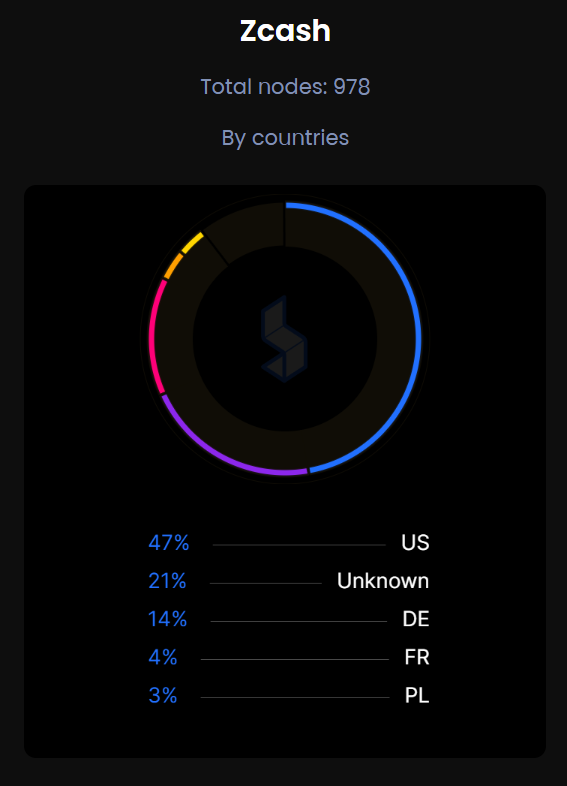
This also shows that zcash is highly centralized:
1/3 of nodes (300+) sit on hetzner.
90 nodes sit on a single /24 subnet.
Zcash presents itself as a “privacy coin” built to protect your identity. But behind the marketing is a coin shaped by American and Israeli university labs funded by the Pentagon and Israel’s Ministry of Science. The people behind Zcash come straight from Israel’s intelligence-shaped tech world.
When Zcash launched, its creators performed a secret ceremony to generate the cryptographic keys for the system. If even one participant kept a copy, they could break the coin entirely. Zcash patched parts of this over time, but the early risk never disappears. A privacy coin should never rely on trust in a handful of insiders.
If you speak up for Palestine, Sudan, Congo, or stand against oppressive regimes, you need safe tools. Zcash is not one of them. It was shaped by governments, banks, and institutions with long histories of surveillance and control. Its creators openly market it as “traceable”. Its price surge is hype-driven. Its origins are tied to the same powers activists resist.
Choose real privacy tools. Use community-built tools with privacy like Litecoin (MWEB) or Monero.
Zcash had a big I guess vulnerability (nobody even covered that).
And then they suspended txns for 24hrs (nobody noticed or covered it).
And all explorers are connected to single node (for some reason).
And retarded kol has some special explorer which says chain is working.
And CEXs withdrawals still suspended.
They can debate all day but zcash was down, not all of it but majority of it and some big vulnerability, some 3 pools (which are majority) decided to halt txns, literally.
This also shows that zcash is highly centralized:
1/3 of nodes (300+) sit on hetzner.
90 nodes sit on a single /24 subnet.
In May, Litecoin stayed above 200,000 daily active users every single day, with a high of 237,000 on May 20.
A network that keeps doing its job whether anyone is watching or not.
Zcash presents itself as a “privacy coin” built to protect your identity. But behind the marketing is a coin shaped by American and Israeli university labs funded by the Pentagon and Israel’s Ministry of Science. The people behind Zcash come straight from Israel’s intelligence-shaped tech world.
When Zcash launched, its creators performed a secret ceremony to generate the cryptographic keys for the system. If even one participant kept a copy, they could break the coin entirely. Zcash patched parts of this over time, but the early risk never disappears. A privacy coin should never rely on trust in a handful of insiders.
If you speak up for Palestine, Sudan, Congo, or stand against oppressive regimes, you need safe tools. Zcash is not one of them. It was shaped by governments, banks, and institutions with long histories of surveillance and control. Its creators openly market it as “traceable”. Its price surge is hype-driven. Its origins are tied to the same powers activists resist.
Choose real privacy tools. Use community-built tools with privacy like Litecoin (MWEB) or Monero.
Zcash had a big I guess vulnerability (nobody even covered that).
And then they suspended txns for 24hrs (nobody noticed or covered it).
And all explorers are connected to single node (for some reason).
And retarded kol has some special explorer which says chain is working.
And CEXs withdrawals still suspended.
They can debate all day but zcash was down, not all of it but majority of it and some big vulnerability, some 3 pools (which are majority) decided to halt txns, literally.
This also shows that zcash is highly centralized:
1/3 of nodes (300+) sit on hetzner.
90 nodes sit on a single /24 subnet.