Everyone writes about stablecoins as a technology story. Kenneth Bok @BokKenneth wrote a people story.
The nurse at Singapore's Lucky Plaza isn't a case study. She's a person in a Sunday queue figuring out how much of her paycheck actually reaches her family. The cross-border plumbing she depends on was built in 1985. Domestic wallets transformed payments inside Asian countries years ago. Across borders, nothing changed.
Stablecoins didn't emerge because technologists were clever. They emerged because the system was broken and nobody was fixing it.
When did the stablecoin conversation stop being about the people it was supposed to help?
https://t.co/gBKDhuAeUl
@BetaMoroney@efipm@BrettKing@spirosmargaris@jasuja@enricomolinari@mikeflache #fintech #tech #finserv #AI
3/ Endorsed by leaders at Circle, Coinbase, OCBC, StraitsX, and by @richardturrin (whose Cashless is the other half of this conversation). Kindle $9.99.
My second book is out today.
INTERNET MONEY: The Rise of Stablecoins
How dollar tokens went from a trading-desk workaround to rails settling trillions a year, and the US-Europe-Asia contest over what comes next.
Foreword by Alex Manson, CEO of SC Ventures.
https://t.co/c1AskXCW92
2/ The book in one line: stablecoins stopped being a crypto story and became a payments, banking, and geopolitics story. GENIUS Act, MiCA, HK's licensing regime, and what banks do now.
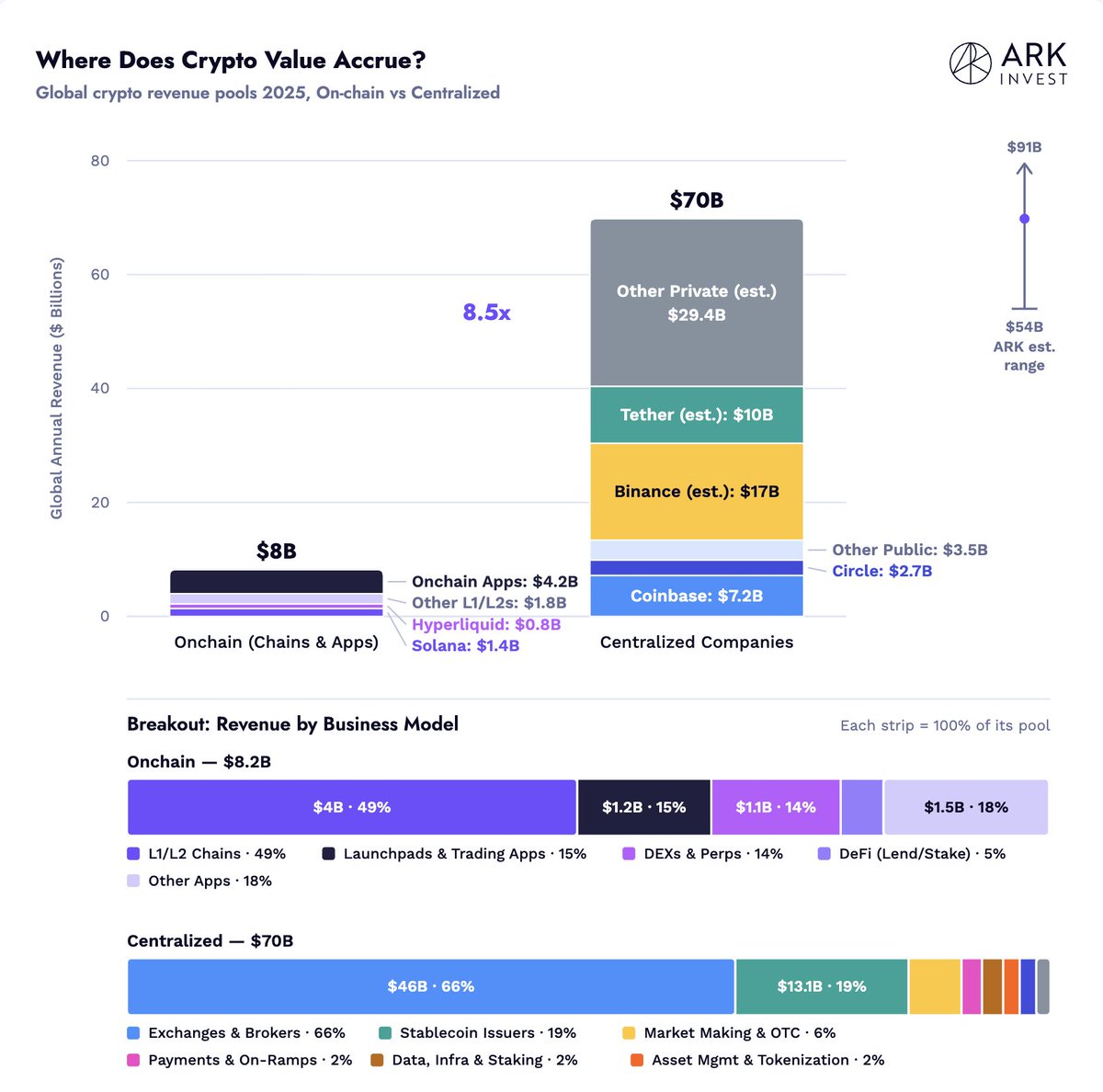
Who is actually accruing the value created in crypto?
This started as a conversation on the @Blockworks TG group with @santiagoroel and a few others.
Venture in crypto has shrunk a lot! and imo the main reason is that on-chain revenue pools have been far smaller than anticipated.
From Blockworks data, total on-chain revenue was roughly $8B in 2025, so I wanted to see how much off-chain/Centralized companies are capturing from this industry by comparison.
So consider the off-chain pool: public companies like coinbase, Gemini, BitGo, Bullish, plus crypto revenue from Robinhood, Galaxy etc and private players like Binance, Tether, FalconX, Anchorage, etc.
The result surprised me: off-chain companies generate ~$70B roughly, consider roughly a range between 60B to 100B, 8.5x more than on-chain protocols and L1s.
To put that $8B in perspective: even if you give on-chain protocols generous 70% EBITDA margins and a 30x multiple, the entire addressable market cap today is ~$168B ($8B × 70% = $5.6B EBITDA × 30x). That's the whole on-chain pie, less than a single mega-cap tech company.
Do the same for centralized companies at a more realistic 40% EBITDA margin: $70B × 40% = $28B EBITDA × 30x = ~$840B of justified market cap. Even with lower margins, that's 5x the entire on-chain ecosystem. And to put even that in perspective: the entire centralized crypto industry, all of it combined, is basically worth one OpenAI or Anthropic.
The breakdowns are telling too. On-chain, L1/L2 chains take almost half the pool (~49%), with launchpads/trading apps and DEXs/perps splitting most of the rest. Off-chain, it's exchanges and brokers dominating at ~66%, with stablecoin issuers second at ~19%, everything else (market making, payments, infra, asset mgmt) is single digits. Both worlds are extremely concentrated at the top of the same funnel: trading and the rails to do it.
From a venture perspective, you were often better off investing early in L1s and traditional exchanges than in most tokens. It was a bit simpler than we thought.
To me the common denominator: off-chain companies sit much closer to the end user than protocols and L1s. They own that relationship and monetize it well. They abstract away crypto's complexity: trade, stake, store, manage without ever touching a coldcard or metamask app and people pay up BIG for that.
On-chain is clearly in a bear market, but the lesson for protocols, L1s, and on-chain primitives is to build and verticalize more. Get closer to the end user.
One caveat: this is an approximation, done with Claude's help. Many of these companies don't have public earnings, so the private side (Binance, Tether, and especially "other private") is mostly an educated guess. Directionally though, the gap is hard to argue with.
Q2 results are out.
→ Arc Mainnet launches September 16.
→ Founding validators joining Circle include BlackRock, DTCC, Galaxy, Global Payments, ICE, Mastercard, MoneyGram, SBI Group, Standard Chartered, Sumitomo Corporation, and Visa.
→ We received our federal trust bank charter from the OCC to establish Circle National Trust, one of the first stablecoin issuers to hold a federal bank charter.
→ USDC captured nearly 70% of stablecoin transaction volume in June, according to Visa Onchain Analytics.
Full results: https://t.co/v1jSV7zRFs
Thanks @MalaysiaBCW for a strong few days in KL.
Keynote on the Institutional Stage: “Internet Money: How Stablecoins Are Rebuilding Finance From the Payment Layer Up.” In emerging markets, stablecoins aren’t a future payment rail. They’re already money.
Also joined @davewychew, Ranjit Singh Gill and @jsjaitawat for “From TradFi to Tokenized Finance.” Good signal on where institutional appetite actually sits.
Appreciate the invite.
Stablecoins are no longer just a crypto payment tool — they are becoming part of the new financial settlement layer.
At the DFNS Institutional Stage, Kenneth Bok (@BokKenneth), Digital Assets Lead, Partnerships & Ecosystem at SC Ventures (@scventuresDNA), presented:
“Internet Money: How Stablecoins Are Rebuilding Finance From the Payment Layer Up”
A keynote on how stablecoins are reshaping payments, settlement, financial infrastructure, and the way value could move across global markets.
Capital markets are entering a new phase, where traditional finance, tokenization, and blockchain infrastructure start to converge.
At the DFNS Institutional Stage, Kenneth Bok (@BokKenneth) from SC Ventures (@scventuresDNA), Ranjit Singh Gill from Kenanga Investors Berhad, and Jitendra Singh Jaitawat (@jsjaitawat) from Helix (@helixfi) joined moderator Dave Chew (@davewychew) from HomeCrowd for the panel:
“From TradFi to Tokenized Finance: The Next Evolution of Capital Markets”
A strong discussion on tokenized finance, institutional adoption, market infrastructure, and how capital markets could evolve as more assets move on-chain.
Stablecoins and tokenized deposits are not competing technologies. They are opposite monetary architectures.
One is inelastic: every new token requires a dollar that already exists.
The other is elastic: created by lending, extinguished by repayment. The money supply breathes.
From that one distinction the interesting questions follow: who intermediates credit if deposits migrate, how policy transmits when narrow money grows, why a stablecoin depegs while a bank runs.
Full essay: https://t.co/9tCcAZquux
Meanwhile the ordinary internet quietly went post-quantum (Chrome, iOS, Signal). Blockchains face the harder half — signatures, user by user, no one in charge — and have barely started.
Full synthesis, incl. what's NOT at risk and a practical playbook:
https://t.co/i5kyjSBCr8
The estimated hardware needed to break Bitcoin's cryptography just fell by a factor of 20.
Three serious papers landed this quarter — Coinbase's advisory board (Aaronson, Boneh), Project Eleven, and Google Quantum AI + Ethereum Foundation + Stanford.
They disagree on timing. Not on direction.
What surprised me:
→ 6.9M BTC (a third of supply) already has public keys exposed on-chain
→ Ethereum: >65% of ETH exposed
→ The systemic risk is stablecoin admin keys. A forged wallet signature steals one balance. A forged minting key breaks a currency.
Circle 🤝 Standard Chartered
@StanChart has launched institutional USDC minting and redemption through DIFC, becoming the first G-SIB to offer institutional access to USDC through a regulated banking channel.
A major milestone for institutional stablecoin adoption.
https://t.co/U18owEHWrm
a16z-BACKED RWA STARTUP GOLDFINCH FINANCE TO WIND DOWN
Goldfinch Finance is shuttering after originating $100M in loans. The governance vote on the wind-down is set to pass on June 23. Depositors face 2+ year recovery as $GFI trades 99.8% below its 2022 peak.
Read more here:
https://t.co/C3VmjGhxhu
A Singaporean and an American take out the same home loan.
The Singaporean pays ~1.5%. The American pays 6–7%.
Now flip to savings — it reverses.
Same two people, opposite outcomes. It’s all one hidden number almost nobody sees. I wrote up why 👇
https://t.co/6Oyr8rDv5T
Great new piece from massive international bank @StanChart on Uniswap!
They project ~40x growth in tokenized assets active in DeFi, with Uniswap "uniquely positioned to scale to meet this opportunity"
Full report below: