@InvisibleIbis Yeah, he usually says something like "the philosopher subordinates poetry to philosophy." But it's still unclear why poetry remains necessary to the mixture, or how that subordination happens.
Stanley Rosen makes a good adjustment, philosophy itself is an act of poetic techne:
@InvisibleIbis I agree it's ambiguous, and S gets into trouble at points, like when he's forced to recognize that Platonic dialogues only work as mixtures of philosophy and poetry, among other things. There's no cordon sanitaire.
@InvisibleIbis To be clear, I was glossing Strauss and not agreeing with him.
What you write makes sense. Sometimes S seems to say that philosophy ought only to be the explicit contemplation of unchanging physis. I've never found this rigidity very convincing. It's a weakness IMO.
@InvisibleIbis with the claim that Plato's "philosophical poem" combines tragedy (Agathon's speech) and comedy (Aristophanes' speech), outcompeting both poetic forms.
I think we can extrapolate S' views on "the quarrel between philosophy and poetry" to history as well.
@InvisibleIbis Right. S seems to believe that this pre-theoretical mania can drive someone to become Socrates, Aristophanes, or Thucydides. S defends philosophy over poetry or history as the best attempt at wisdom and the true target of eros.
He concludes the lecture on the Symposium...
@InvisibleIbis that Strauss believed axiomatically that something about man in the pre-scientific/-philosophical state leads him to pose fundamental questions about the truth of nature; a subsection of man will always have the presentiment to replace opinion with knowledge.
@InvisibleIbis By axiom I mean the literal sense of "what is worthy of belief." Surely, Strauss was interested in the question of how the significance of philosophy emerges from a pre-philosophical state (I take this to be your point about the T chapter), but I don't think it's wrong to say...
@InvisibleIbis Images are particular, concepts are universal. For Strauss, Thucydides (like Aristophanes) is very philosophical, but implicitly so, since he remains a narrative historian. P and A are explicitly philosophical.
Gauchet, Manent, and Remi Brague have been peddling Notre-Dame or Claremont-style postliberalism for decades by now. They appear more genteel and less conspicuous (in comparison with, say, MacIntyre, Deneen or Anton) due to a slightly more "learned" presentation.
Quite telling that AfD can accomodate someone with views like Höcke's, while RN has consistently distanced itself from Zemmour's messaging. The German right is more movement than party, a huge advantage for them.
As Quinet noted long ago, the National Assembly did not go far enough in disestablishing the church with the 1790 Civil Constitution. Nonjurors retained crucial spiritual terrain for the inciting of counter-revolution and, eventually, a tragic but avoidable religious civil war.
The French Revolution went from slightly restricting church power and the confiscation of church properties in 1789 to the open murder of thousands of priests and the practical abolition of Christianity in France by 1792. One of their first supporters was a bishop, Talleyrand.
I imagine ways to improve my life through excessive middlebrow philanthropy. Say I gave the Edvard Munch Musem $100,000, wouldn't they more or less have to look the other way, if I insisted on sleeping on a cot in a storage room?
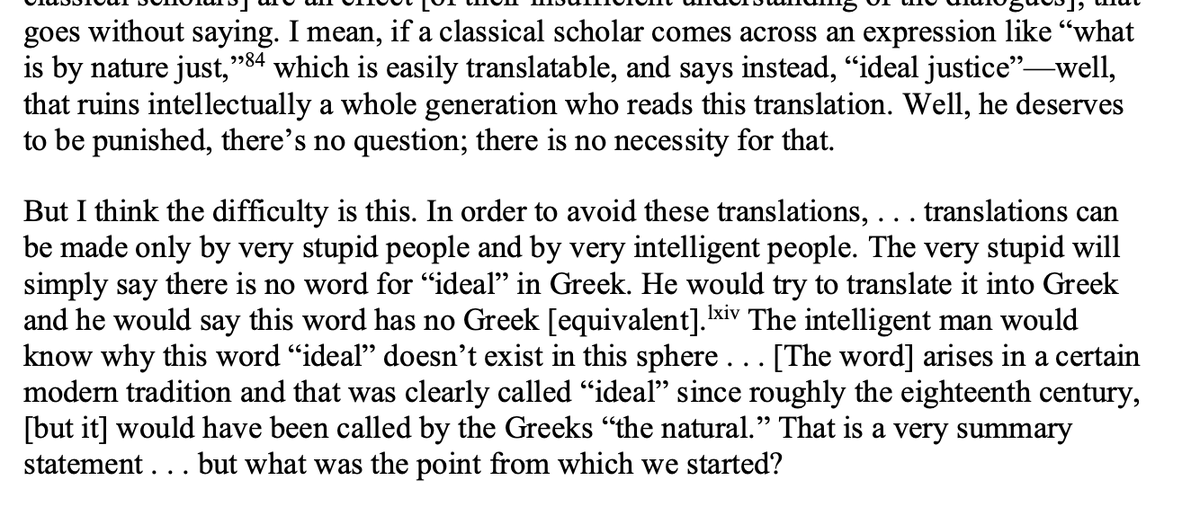
Strauss' lectures are at their most entertaining when he suddenly derails the discussion to (justly) make extended and aggrieved digressions on the boneheadedness of translators.