Best resources for mobile app design inspiration 🔖
https://t.co/LpvhvlSwLZ — Mobile app screens and flows.
https://t.co/BgAQZyqMay— Mobile UI inspiration.
https://t.co/SBNFYdavi6 — Mobile animations and interactions.
https://t.co/C7hrk9KTan — Real app screens and UI patterns.
https://t.co/PfIfYYmLyz — App designs and user flows.
https://t.co/OlqyMVvuZN — Mobile app inspiration.
https://t.co/8gbsP2nmy5 — Web and mobile UI inspiration.
What did i Miss?
You would have made billions if you gave seed checks to everyone who was at @alexandr_wang’s 19th birthday party:
- Jeff Yan (@chameleon_jeff) went on to start Hyperliquid (~$20B)
- @ScottWu46 went on to start Cognition ($48B)
- @thejessezhang went on to start Decagon ($4.5B)
And Wang himself who started Scale AI, and got $14.3B from Meta for 49% of it.
Wang explains:
“I was doing a winternship at a trading firm called HRT.
There were 12 of us, almost all of whom were students at either Harvard or MIT.
I recently met up with the founder of HRT and they were talking about, ‘We're starting to do some private investments.’
I was like, ‘Just invest into the interns! All the interns get seed checks!’”
Old friends are the best friends. Jensen rocks.
The Star Mind computer being co-engineered by SpaceX and Nvidia is far better than almost anyone expects and will reach volume production next year.
Working with the incredibly talented Nvidia engineering team is pure joy!
Here’s the full Tesla Roadster unveiling event.
0:15 – Crazy Tesla + SpaceX collab preview 2:25 – Last manually driven Tesla car 2:53 – Taking it way past the limits 3:15 – Countdown & first flight works 5:38 – Flying cars are real 5:41 – Peter Thiel flying cars quote 6:02 – Fan suction system (up to 2G) 6:16 – Downforce & crushing track records 7:08 – Starman appearance 7:52 – Rocket thrusters & full gymnastics 8:52 – Kickflip demo (Tony Hawk approved) 9:32 – Real road car + rocket car future 9:56 – Air tanks, nozzles & specs 10:14 – Rechargeable ultra-high pressure air 10:36 – Car reveal & aerospace design 12:50 – Fan modes 13:37 – Variable pitch rear wing 13:50 – 0-60 goal under 1 second 14:21 – Acceleration demo 16:22 – 0.81s 0-60 achieved 16:26 – Production car will be even quicker 17:05 – World’s quickest production car 17:28 – Top speed & Snake River Canyon teaser 18:26 – Mach 0.5+ goal 18:52 – First best flying car + last best driver’s car 19:04 – Production starts 2028
Railway hacked AI SEO, and it took them from $20M to ~$100M ARR in 1 year:
1/ Claude Code picks Railway for 82% of Python apps
-> Ask it "how do I deploy this" and it installs Railway and puts your app live there
2/ The founder treats AI recommendations as a growth channel
-> His go-to-market team works on getting the models to "recommend us more and more"
3/ 6,653 how-to pages, one for every popular free tool people want to run themselves
-> Someone asks Google or ChatGPT "how do I set up n8n?" and Railway's page comes up. It explains the tool and sets it up on Railway in one click
4/ A step-by-step guide for every framework developers build with
-> 127 guides: Next.js, Django, Rails, FastAPI, Laravel, Go and more. Each one answers "how do I deploy X" and ends with the app live on Railway
5/ A comparison page against every competitor
-> Heroku, Vercel, Render, Replit, Lovable and 5 more, each with a migration guide. AI loves quoting comparisons
6/ Railway rewrote its help pages so AI can read them easily
-> One file lists all 414 pages with a short summary each, and every page has a plain-text version. When someone asks ChatGPT how to use Railway, it finds the right answer fast and gets it right
7/ A docs section written for agents
-> One step installs everything Claude Code or Cursor needs to deploy to Railway on its own
8/ Plugins inside ChatGPT and Claude Code
-> You ask the chat to deploy and it deploys, without ever opening Railway's website
9/ A server with one command and no signup
-> ssh railway new gives an agent the shortest path to "your app is live"
10/ A new changelog page every Friday since 2021
-> 312 pages of fresh content that keep Railway in front of Google and the models
11/ Every new AI model brings a new jump in signups
-> More code gets written, all of it needs to run somewhere, and this year the summer slowdown disappeared
12/ A go-to-market team of 7 runs all of it
-> The pages, docs and plugins keep selling while they sleep
13/ The one hole: front-end apps
-> Claude Code picks Vercel 100% of the time for Next.js and React apps. Railway wins Python, Vercel wins everything that runs in a browser
Full guide on how to win AI search in the first comment
Cheeky Pint is back! Mark Zuckerberg @finkd and Alexandr Wang @alexandr_wang came to the pub to discuss their new frontier model, Muse Wonder.
00:00:24 Muse’s breakout use cases
00:07:28 The model is the product
00:14:35 Muse Wonder
00:24:56 How frontier models are built
00:48:26 Betting $100B
01:07:21 Agentic commerce
01:19:34 OpenRouter
01:20:06 Beyond the smartphone
01:27:00 Funding
01:34:06 Why AI won’t be winner-take-all
01:40:46 Meta Superintelligence Labs (MSL)
02:08:11 Working for Mark Zuckerberg
You can now use Jev right inside Claude Code 🤯
It's called jev-model-router, an early access mod built on Claude Code's new function hooks. Before every turn, it checks in with Jev and asks:
> how mechanical the task is > how much reasoning it needs > whether it's risky
Then it routes:
→ it'll move up to a stronger model on weak evidence, and only drops to a cheaper one when it's confident the task is simple → every decision gets logged in your transcript → if the call fails, your request runs untouched
Setup:
1. copy the install command: npx claude-code-templates@latest --mod productivity/jev-model-router
2. paste it inside Claude Code
3. run claude with CLAUDE_CODE_ENABLE_FUNCTION_HOOKS=1 set
4. accept the trust prompt on first launch
Link: https://t.co/xwvQPxX2Or
Also works with no api key, it just falls back to a built-in classifier with no confidence score.
For real jev routing, add your typesafeApiKey or gatewayApiKey to ~/.claude/settings.json.
Follow me for more AI workflows and tutorials.
If you're building a mobile app with AI, save these 6 skills (bookmark this)
> expo/skills - best practices for building and shipping mobile apps
> mattpocock/skills - clean code, better architecture
> Argent / agent-device - let your agent test the app
> coreyhaines31/marketingskills - onboarding, App Store listings, content and ads
> pbakaus/impeccable - design your app’s landing page
> petergyang/no-ai-slop - remove AI slop from your copy
Links below
I run 5 branches of a React Native app at once, each with its own simulator, Metro server, and a coding agent driving it.
My Mac hated it. 19 GB of RAM, Metro fighting over :8081, agents grabbing each other's devices.
So I built simfleet. Open source, MIT 🧵
This is absolutely insane.
A Stanford AI research group joints JEV with Claude Code to sort 100+ billion data points every 15 minutes.
the trick is stupidly simple:
JEV runs a cheap first pass on everything. Claude only gets the hard cases.
so instead of: everything -> Claude -> $$$
it’s: everything -> JEV filters -> hard stuff -> Claude thinks
the boring stuff never touches the expensive model.
Claude gets a tiny pile that actually deserves deeper analysis.
faster. cheaper. way less compute burned.
basically, JEV sorts the mail so the genius only opens what matters.
LLMs think, JEV decides
Read the full Jev setup guide in the article below:
Top 12 agentic use cases for Jev:
(bookmark this)
Jev handles semantic decisions that ordinary code cannot express reliably. It returns typed answers and probabilities, while code continues to cover the workflow.
Here are 12 practical use cases for Jev:
1. Browser next action
> Convert the current DOM state into a bounded action such as click, type, or stop. Code executes only valid operation-target pairs. There are already several open-source Jev web agents.
2. Context compaction
> Decide which events from a long agent trace should remain. The selected text stays verbatim instead of being replaced with a generated summary.
3. Skill and context loading
> Compare the current user turn against the available skills. Load only the instructions needed for that turn instead of filling the context window with every skill.
4. Typed tool-call compilation
> Map a natural-language request to a function and fill its typed arguments. Each argument is evaluated separately before code allows execution.
5. Citation verification
> Check whether a quoted passage exists and whether the surrounding evidence supports the claim. The output can be supported, unsupported, or contradicted.
6. Extraction verification
> Run a cheap extractor first, then use Jev to verify questionable fields. Clean records stay on the fast path while uncertain ones reach a reasoning model.
7. Agent trace evaluation
> Turn raw trajectories into queryable labels such as progress and repetition. This avoids asking another LLM to write a full review of every run.
8. Semantic regression tests
> Replay a trace suite against a new agent build. Semantic checks can then pass or block prompt, model, tool, and policy changes in CI.
9. Jevgrep code search
> Search a codebase by what the code does rather than its exact words. Jev scores candidate snippets and returns the most relevant code first.
10. Entity alignment
> Compare two candidate records and decide whether to merge, review, or keep them separate. Candidate generation remains deterministic while Jev handles semantic identity.
11. Retrieval reranking
> Let embeddings retrieve a broad candidate set, then use Jev to reorder passages by relevance. The generation model receives the most useful evidence first.
12. Memory promotion gate
> Capture a completed agent trace, then judge whether its corrections contain a reusable lesson. Trace-backed lessons can be promoted while task-specific noise is discarded.
If you want to see the final pattern in practice, it is already implemented in the Beacon open-source project.
Beacon captures full sessions across Claude Code, Codex, Cursor, OpenCode, and 20+ agent harnesses, and then Jev identifies which workflows and corrections are worth learning from, so that a lesson discovered by one agent can become available to the others.
GitHub repo: https://t.co/8ee3KmP6th
(don’t forget to star it ⭐)
If you want to dive deeper, I also wrote about a similar mechanism in a hands-on guide. It covers building a Jev-style decision path with open models, entirely locally.
Read it below.
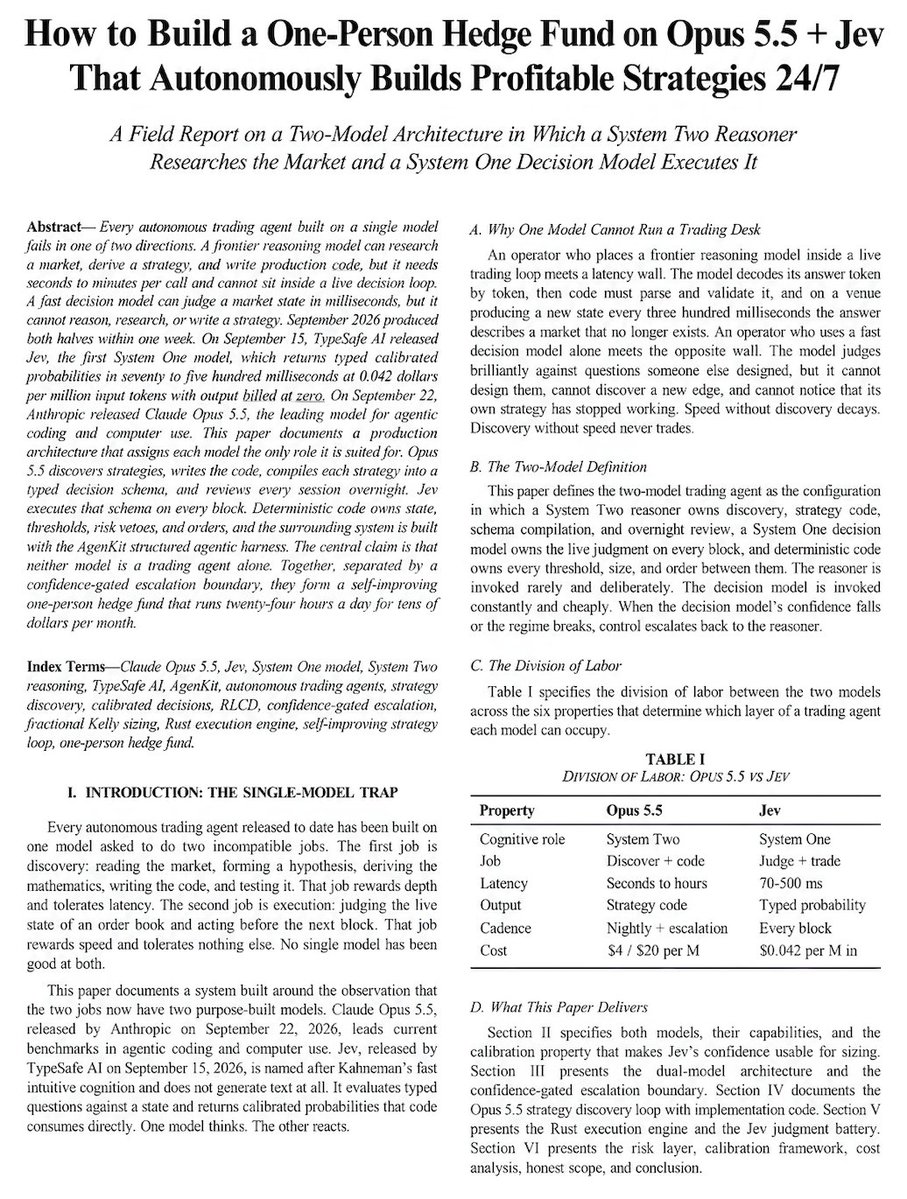
i still don't understand why everyone is NOT building 24/7 trading agents with opus 5.5 + jev
this combo builds MOST POWERFUL AI trading bots
i wrote a 6-page research paper on exactly how to find profitable strategies 24/7 with opus 5.5 + jev from scratch
along with COMPLETE CODEBASE in RUST
this is the exact system I have been running for the past 3 days are so far results are INCREDIBLE:
This is an extremely good watch.
The things that felt novel/interesting to me:
1. Lock down your agents
Humans tend to like 'sharp knife' abstractions - that are powerful, but you can cut yourself if your use them wrong. Lauren says agents perform much better in extremely locked-down environments. Abstractions are designed so they can't screw up, and lint rules enforce it.
They built a whole internal framework (Dune) to keep the agent on track.
That helps optimise agents that don't have a large context window to work productively in your codebase.
2. Create verification infrastructure
To trust the results of any agent, you either need to sit and watch it OR have it provide evidence of its improvement. This has always made sense to me, but Lauren really pushes it hard here:
- Invest in custom CLI's that let the agent drive the app and measure its performance
- Make the app "factory ready" from the get-go - i.e. deployable to an environment where the agent can mess about with it
3. Feature Maps
Lauren's software factory (what she calls an 'outer loop') often requires the agent to break down vague bug reports from users and to turn those into potential fixes.
To aid that, they built a 'feature map' of all the main features in their application, which describe exactly how the app is supposed to function.
This has become essential for helping the agent navigate the codebase, and figure out quickly how things are supposed to work. It's maintained along with the codebase, and kept in sync via automations.
This is the kind of documentation I usually warn against. It goes stale quickly and can confuse agents if it's not kept up to date.
But Lauren's team are using it as critical navigation infrastructure, and it makes it possible for agents to explore faster and better - even on a large codebase. So it sounds like navigation docs like this are worth it if they enable new behavior.
Banger talk - watch the whole thing on 2x.