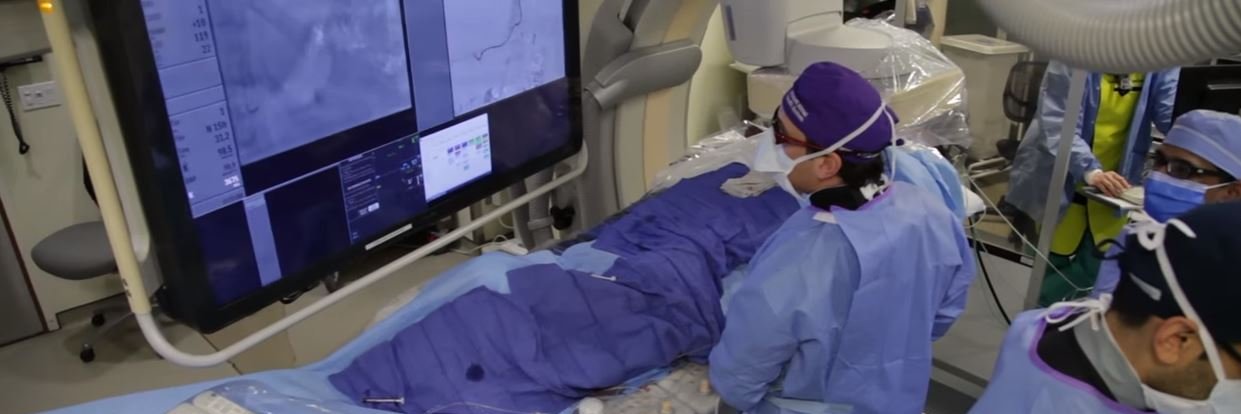
@CVIR_Journal Glad this debate is happening in print. n-BCA already gives fast, homogeneous gland filling without DMSO pain or MRI artifact, and that's the bar any new liquid embolic in PAE has to clear. @MountSinaiIR#PAE#BPH#IRad
Great to see the BPH toolbox keep growing. Prostatic artery embolization belongs in the same conversation, especially for large glands and for men who want to avoid surgery or protect ejaculatory function. Urology and IR working together gives patients the most options. #BPH #PAE #IRad @MountSinaiIR@MountSinaiIR
@SDhandMD@CVIR_Journal@MinaMakaryMD Glue already solved it: fast, no DMSO pain, cheaper, no MRI artifact. And homogeneous filling of the gland probably matters more than how deep you go.
@CVIR_Journal Great to see more liquid embolic PAE data. How far the embolic penetrates into the prostatic arterial tree is the key variable, and standardizing how we grade it will help everyone compare results. @MountSinaiIR#PAE#BPH#IRad
@CVIR_Journal Consensus on selection and technique is exactly what GAE needs as volumes grow. I hope access route gets real attention too: pedal access has been a clear win for my knee patients, with no groin and easy genicular selection. @MountSinaiIR#GAE#IRad
@CVIR_Journal MSK embolization keeps expanding beyond the knee, and hip OA is a natural next frontier. Exciting to see more data here. @MountSinaiIR#IRad
@AmerUrological When BPH surgery fails or isn't a fit, PAE is often the option patients haven't heard about yet. Happy to compare notes with urology colleagues on where embolization fits in the pathway. @MountSinaiIR#PAE#BPH#IRad
@_backtable@bahetimd For me the endpoint is the cast, not a volume number: a stable catheter position, a slow controlled push, and stop once the bleeding segment is bridged and you see the first hint of reflux. Great panel, @bahetimd. #IRad
@CVIR_Journal Love seeing radial and snuffbox held up in the emergency embolization setting. Access choice matters when minutes count, and 421 cases is a meaningful look. #RadialFirst#IRad
@CVIR_Journal Post-TKA pain is one of the most frustrating problems to treat, and an option that avoids revision surgery is valuable. Curious how durable the response is past 12 months in this group.
@theendoscopist Classic non-target delivery pattern. On our side, prevention is meticulous mapping with cone-beam CT, coiling the right gastric/GDA or other gastric feeders when needed, and a distal catheter position. Great teaching images for both GI and IR.
@willsuh76@YouTube Love this. YouTube taught a lot of us radial. On the IR side we use radial and distal radial for PAE, UFE, Y90 and visceral work every day. The biggest win is the patient sitting up and walking right after.
@_backtable@kavikrishVIR@MisonoVIR Couldn't agree more. Same principle drives our glue PAE and AVM work: the cast doesn't depend on the patient's clotting, and a slow, controlled injection from a stable catheter position matters more than any single agent. Great episode.
Live @MountSinaiIR Publication Alert!! from @arianacmills and the team
A Twenty-Three-Year Single Center Experience with Elective Transcatheter Coil Embolization of Unruptured Splenic Artery Aneurysms - Journal of Vascular and Interventional Radiology https://t.co/9r1K4pPfro
SIR co-hosted "Embolization Day" with @FDA at their White Oak Campus in Maryland on Sept. 17. FDA employees got a look at embolic devices and learned about the many diseases IRs treat using embolization. Thank you to the SIR members and the FDA for participating in this event!
Congrats Sid Padia and UCLA on the first positive RCT for GAE. Standing ovation at CIRSE. First positive level 1 data for GAE versus usual medical care for knee OA in the US.
https://t.co/Rh45N3FMVc