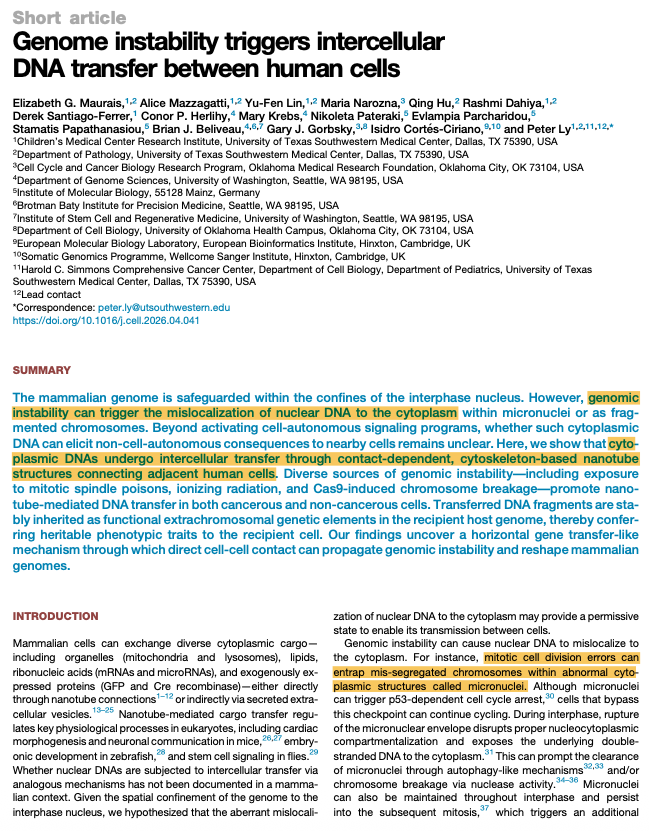
My favorite paper this week: Human cells with damaged genomes (from cancer, radiation, or even CRISPR editing) grow tube-like bridges to their neighbors and send them broken chromosomes. The transferred DNA sticks around in the receiving cell and remains functional.
This paper is really cool, and hints at *so many* interesting questions, but it’s important to caveat that it isn’t the first time people have seen DNA moving between human cells! There’s a 2013 paper (Jin Cai et al.) that shows extracellular vesicles (membrane-enclosed bubbles that bleb off cell membranes) can also carry DNA between cells. A similar thing happens with “apoptotic bodies.” Basically, when a cell dies, pieces of that cell will form into little spheres, some of which contain DNA. These “apoptotic bodies” are then engulfed by neighboring cells, which take up their DNA and (sometimes) incorporate the sequences into their own genomes. (See the Holmgren et al. paper from 1999.)
People had even shown that nanotubes can swap DNA between cells! They hadn’t seen this with nuclear DNA, though; mostly mitochondrial DNA and various RNAs. This paper, then, is extremely original and exciting, yet sits within a rich subfield of cell-cell DNA transfers.
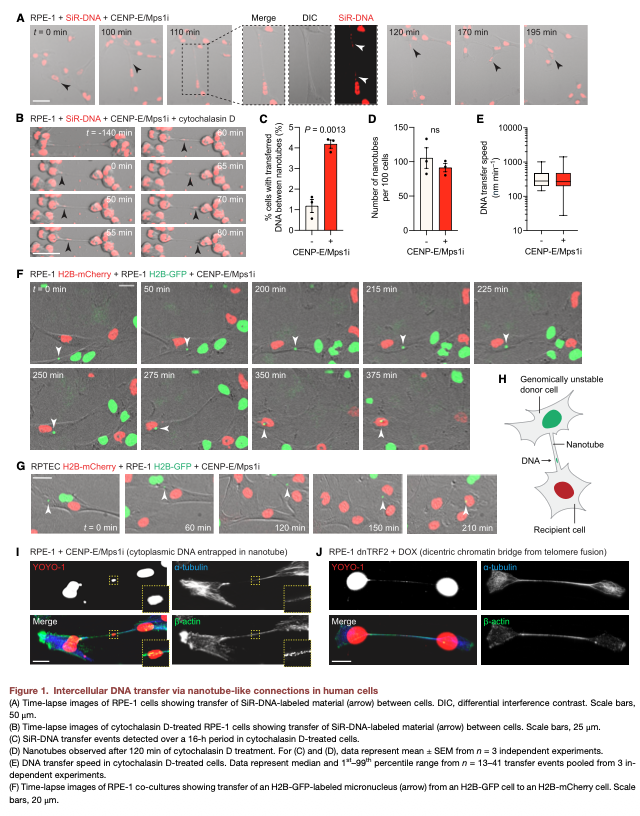
The experiment was extremely simple. The researchers grew two types of human cells together in a dish. They tagged the histones in each cell type with a different fluorescent color; one green and the other red. Next, they exposed the cells to drugs that interfere with mitosis and recorded time-lapse videos. In one of these videos, they literally watched as DNA tagged with one color moved — through the thin nanotubes — into a cell with the other color. This happened not only with mitosis-blocking drugs, but also with CRISPR-induced chromosome breaks and radiation. The transferred DNA remained functional, too; they were transcribed into RNA and translated into protein.
(Sidebar: It seems like this whole discovery was an accident. The group behind this paper had previously studied what happens to nuclear DNA when chromosomes break using exactly the same techniques and drugs. But it seems like they never expected to see this transfer happen between cells. They write in the paper: “Surprisingly, using live-cell imaging to monitor cytoplasmic DNA labeled with a double-stranded DNA-specific fluorescent dye, we observed the apparent transfer of DNA from the cytoplasm of donor cells to neighboring recipient cells.”)
It’s not clear to me how important this might prove for, say, cancer. But the authors point at some intriguing ideas. Maybe the transfer of DNA between cells “mimics” some of the genome architectures we see in cancer cells, for example. Perhaps “DNA transfer could generate genomic alterations in recipient cells that resemble whole-chromosome gains or non-tandem duplications, challenging the assumption that these changes originate exclusively from cell-autonomous mitotic defects.”
The researchers also speculate that DNA transfers could “potentially enable genomically unstable cancer cells to disseminate oncogenic alleles, deleterious mutations, and/or regulatory elements to neighboring non-cancerous cells.” If this turns out to be true, nanotubes could be a useful target for cancer therapies.
Anyway, I love papers like this, where it feels like a whole swath of questions suddenly arises from beneath your feet. There is so much work to be done, and biology goes ever deeper.
I'm fascinated by efforts to make animals (or parts thereof) photosynthetic.
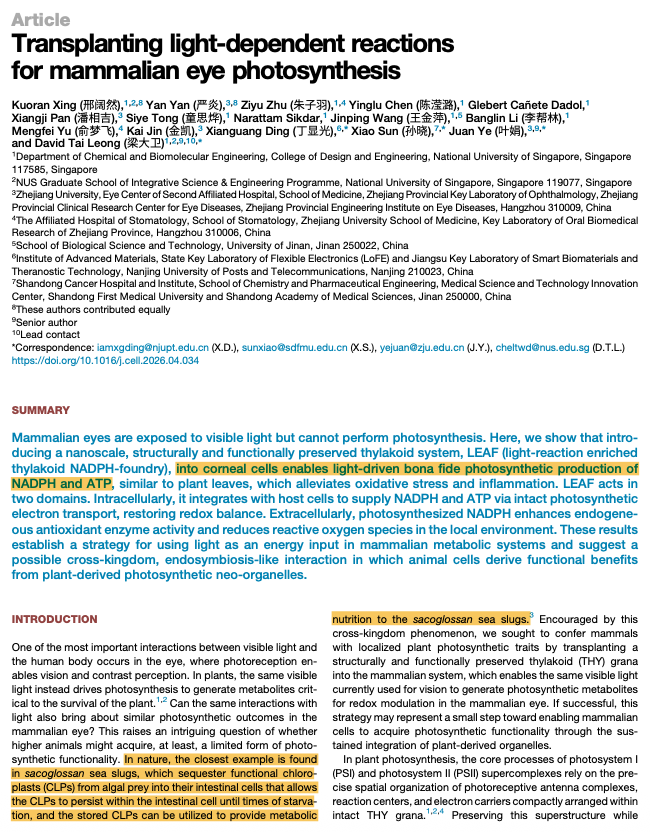
For the latest attempt, published last week, researchers took thylakoids from plant chloroplasts (the little membranes that carry photosystem I and II proteins) and inserted them into the eyes of mice. Specifically, they gave the animals eye drops containing the thylakoids twice a day for five days.
The thylakoids went into corneal cells (apparently they are small enough that the cells endocytose them?) and did photosynthesis, making NADPH and ATP from light. This isn't a gene therapy, though; the eye cells cannot make more of these plant enzymes, and so the photosynthesis only happens for about 8 hours before the enzymes are destroyed.
Why do this in the eye? One reason is that light doesn't penetrate tissue deeply; maybe a millimeter. Therefore, the eye is one of the few parts of the body that actually gets light exposure. It is also -- maybe equally important -- immune privileged, meaning these plant proteins don't trigger an inflammatory reaction (which would likely happen in other tissues).
I'm not sure this paper has any real utility, at least not clinically. The authors say that it does (to help treat corneal injuries, for example) but I think it's just expected for authors to make up claims like this to get published in CNS journals.
The more interesting reason to read this paper, I think, is just that it shows light can be used as a direct "metabolic input" in mammalian cells. You can use light to make energy molecules and NADPH, which can then be used by the cell's normal pathways.
This isn't the first paper to do stuff like this, either. There is a rich history of (temporary) photosynthetic animals! In 2011, Christina Agapakis & co. injected living cyanobacteria into zebrafish embryos, and it worked. (No developmental impact on the fish.) In 2024, a Japanese team put chloroplasts from red algae into Chinese hamster ovary (CHO) cells, and the chloroplasts apparently survived and did photosynthesis for two days.
Biotechnologists have a great ability to harness GENES taken from nature to build useful tools and therapies. We can sequence the natural world, collect genes in databases, and use tools like AlphaFold to figure out what they code for.
But our ability to harness entire organelles -- structures crafted over millions of years of evolution, which perform functions that cannot be matched by genes alone -- is severely limited. Animal photosynthesis, and pursuits thereof, might be a useful way to start closing this gap.
I'm from Central Italy.
The Italians I know rarely spend their weekends in the hotspot cities.
Not Florence. Not Rome. Not Siena. They drive an hour east, or south, to towns no foreign list ever mentions.
Central Italy is the most concentrated cluster of beauty in the world.
9 underrated towns where the piazza is yours, the trattoria is real, and the Renaissance still feels personal.
🧵
The Booker Lab at the University of Pennsylvania, in Philadelphia, and HHMI is searching for a lab manager. If interested, please apply at the HHMI link below.https://t.co/wFjZnkired
We are hiring a PhD candidate! Only for non-EU graduates. To work on the molecular and genomic epidemiology of Treponema pallidum, based on our recent publication (doi:10.1128/mbio.00358-26). Interested? Send your CV and expression of interest to [email protected] by 5/20
The Landoni Lab opens this summer @unil !🔬 Quantitative #imaging + systems biology to decipher how #metabolic architecture & #mtDNA dynamically shape tissue development, #aging and #mitodisease. Beyond excited to fire up the lasers, open positions soon! 🧪 #mitochondria#newPI
OVER 2,000 YEARS AGO, ON A WEEKEND THAT WOULD LATER BE LABELED AS AND KNOWN AS "EASTER," A TYRANNICAL REGIME BACKED BY DISHONEST ELDERS, COMPLICIT POLICE, CORRUPT JUDGES, THIEVES, FALSE WITNESSES, MISLEADING JOURNALISTS, AND A REACTIONARY MOB, ENJOYED A FLEETING, PERFUNCTORY MOMENT OF TRIUMPH. IT LASTED ONLY THREE DAYS.
YET THAT MOMENT CHANGED THE WORLD FOREVER.
Easter represents a defining moment in human history, one that forever altered the spiritual and moral imagination of Christians and non-Christians worldwide. It recalls an era when the masses were swept up in hysteria, mobilized to carry out one of humanity's gravest injustices: the persecution and crucifixion of Jesus Christ of Nazareth. In that moment, even those who knew better were silenced, rendered too afraid or too complicit to stand against a tide of collective wrongdoing.
It was a chilling demonstration of how mass hysteria can legitimize injustice, how an unjust order can be justified by the noise of the crowd rather than the voice of truth.
Yet, Easter does not end in oppression.
It marks a turning point. Though injustice prevailed for a moment, it did not endure. From that darkness emerged a higher consciousness, a resistance to evil, a defiance of tyranny, and ultimately, redemption. The resurrection stands as a timeless reminder that truth, no matter how suppressed, will rise again.
Happy Easter. #FreeBlordNow #RevolutionNOW
Father Chad Ripperger has spent his life as an exorcist. It’s clear to him that demons are in charge of parts of American politics.
0:00 The Connection Between Mental Health and Demon Possessions
7:01 What Are Demons?
26:45 What Is the Mission of Demons?
29:40 Is the United States Under Demonic Attack?
35:16 Child Sacrifice and Pacts With Demons
46:03 The Dangers of Being an Exorcist
48:38 Why Demons Target People in Leadership Positions
51:52 The Similarities Between Communism and Demonism
58:45 Can Demons Possess Animals?
1:05:08 How Does Someone Become Possessed?
1:14:19 The Dangers of Mocking Demons
1:17:42 Occult Knowledge
1:20:36 Why Some Demons Can Only Be Cast Out With Prayer and Fasting
1:27:15 Satanic Ritual Abuse
1:29:47 Are There People Who Choose to Stay Possessed?
1:33:37 How God Uses Demons for Good
1:35:57 How to Avoid Being Possessed
1:40:43 Is the US Doomed?
1:44:27 What Role Do Demons Play in Addiction?
7 Sci-Hub Alternative Websites
Paper you need to ask for payment & can't use sci-hub?
You don't have to pay to read academic papers.
These are 7 sci-hub alternative websites to download papers for free.
👉 Unpaywall --> https://unpaywall. org/
Install this browser extension on Chrome and read the paper directly on the journal website legally and for free.
👉 Open Access Button (OAB) --> https://lnkd. in/dXVVQpUf
Copy and paste the link paper or DOI on the OAB website. This will be accessible on the next page. Legal.
👉 PaperPanda --> https://paperpanda. app/
Like Unpaywall, this Chrome extension allows you to access millions of research papers in one click.
👉 DOAJ --> https://doaj. org/
As the name implies, DOAJ (Directory of Open Access Journals) provides access to millions of scientific papers from around the world for free.
👉 OA[.]mg--> https://oa. mg/
Like Google which is made specifically to search for academic papers. There are more than 250 million papers available for access.
👉 Core --> https://core. ac. uk/
The world's largest database of research papers with more than 298 million papers from around the world that can be accessed for free.
👉 arXiv --> https://arxiv. org/
Especially for lovers of natural sciences and economics, this website provides access to 2.4 million academic papers for free.
Tip: Remove any spaces in the URLs if you encounter issues accessing the websites.
A couple in China welcomed their baby girl and were shocked to see she had blonde hair and blue eyes. With no one in their immediate family looking that way, they feared something had gone terribly wrong at the hospital. Doubts grew and a DNA test was done to confirm paternity.
The results showed the father was indeed biologically related to the child. Digging deeper into family history revealed a hidden Russian great grandfather in their ancestry. The lighter features were recessive traits that had quietly traveled through generations before finally reappearing.
It is a powerful reminder that our DNA carries stories far older than we realize. Family history can resurface in unexpected ways and science often provides answers where fear once lived.
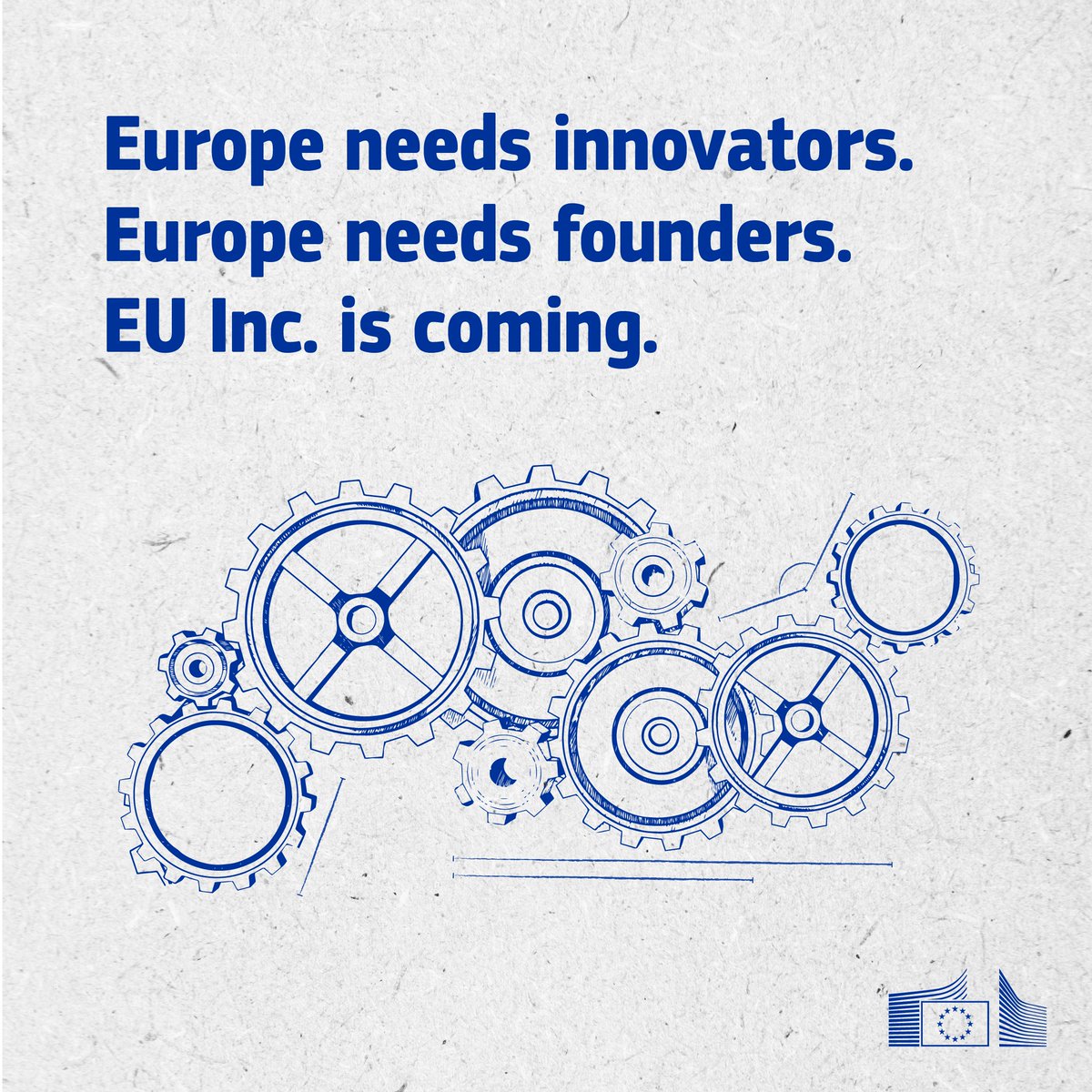
We are introducing EU Inc. To make building and growing a business across the EU faster, simpler, and smarter.
🔸 Start a company in less than 48 hours
🔸 No minimum capital requirement
🔸 Fully online and borderless
FULLY FUNDED | EEML Summer School 2026 in Montenegro |
Country: Montenegro 🇲🇪
Deadline: 31 March 2026
Benefits
✅ Registration fee covered for selected participants.
✅ Accommodation support provided for the program duration.
✅ Travel support available for selected participants.
✅ Access to expert-led lectures, practical sessions, and workshops in ML/AI.
✅ Networking with international researchers and participants.
✅ Certificate of participation upon completion.
#summerschool #travel #Montengro
🔗 : https://t.co/FBNMrKkXPV
The first time you start a research lab, there’s no manual.
So I made one.
A practical toolkit for postdocs and early-career faculty launching their first lab: hiring, startup planning, collaborations, and building a sustainable research program.
https://t.co/a30LLykjKq
The Vienna BioCenter PhD program in Molecular BioSciences will offer 25+ fully-funded positions in the Spring Call which is now open. Have a look at the vacancies we have on offer: https://t.co/TjdAPUBkGR
@IMPvienna@IMBA_Vienna@gmivienna@MaxPerutzLabs@univienna@MedUni_Wien
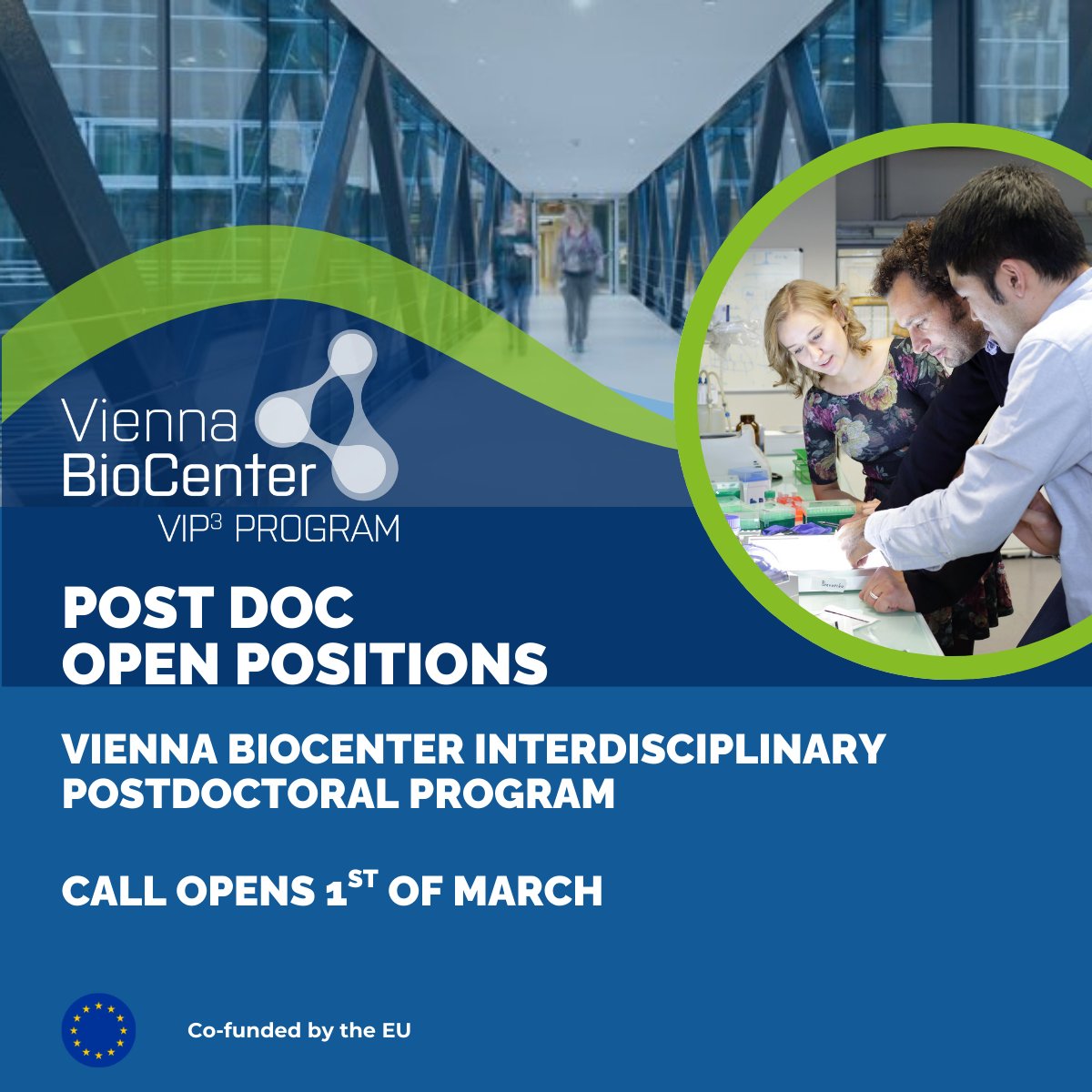
The @viennabiocenter PostDoc Program call is now open! We have 8 fully-funded positions for scientists with a PhD in biology, chemistry, physics, bioinformatics etc.
Apply here: https://t.co/qoFIRhg7nB
#VBCPostDoc
The new Vienna BioCenter Interdisciplinary Postdoctoral Program (VIP³) is here! We have 8 fully-funded positions for scientists with a PhD in biology, chemistry, physics, bioinformatics etc.
The call is open!
More information: https://t.co/qoFIRhg7nB
#VBCPostDoc
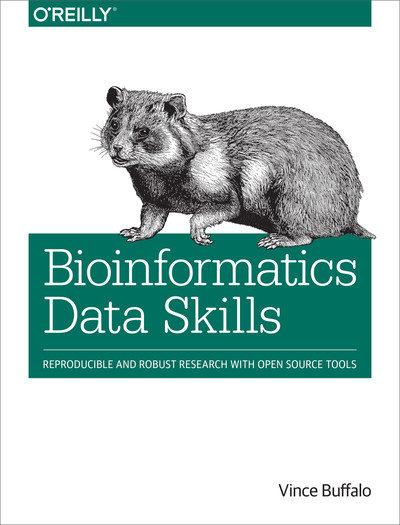
10 courses for my dream bioinformatics curriculum:
1. Unix Commands with Greg Wilson https://t.co/83VHvTqbMt
2. statistics and R with Rafael Irizarry https://t.co/ofYSIiChoW












![ScholarshipfPhd's tweet photo. 7 Sci-Hub Alternative Websites
Paper you need to ask for payment & can't use sci-hub?
You don't have to pay to read academic papers.
These are 7 sci-hub alternative websites to download papers for free.
👉 Unpaywall --> https://unpaywall. org/
Install this browser extension on Chrome and read the paper directly on the journal website legally and for free.
👉 Open Access Button (OAB) --> https://lnkd. in/dXVVQpUf
Copy and paste the link paper or DOI on the OAB website. This will be accessible on the next page. Legal.
👉 PaperPanda --> https://paperpanda. app/
Like Unpaywall, this Chrome extension allows you to access millions of research papers in one click.
👉 DOAJ --> https://doaj. org/
As the name implies, DOAJ (Directory of Open Access Journals) provides access to millions of scientific papers from around the world for free.
👉 OA[.]mg--> https://oa. mg/
Like Google which is made specifically to search for academic papers. There are more than 250 million papers available for access.
👉 Core --> https://core. ac. uk/
The world's largest database of research papers with more than 298 million papers from around the world that can be accessed for free.
👉 arXiv --> https://arxiv. org/
Especially for lovers of natural sciences and economics, this website provides access to 2.4 million academic papers for free.
Tip: Remove any spaces in the URLs if you encounter issues accessing the websites.](https://pbs.twimg.com/media/HE69ZiEb0AAQR6M.png)