The Economics Behind Ethereum & $ETH Value Capture
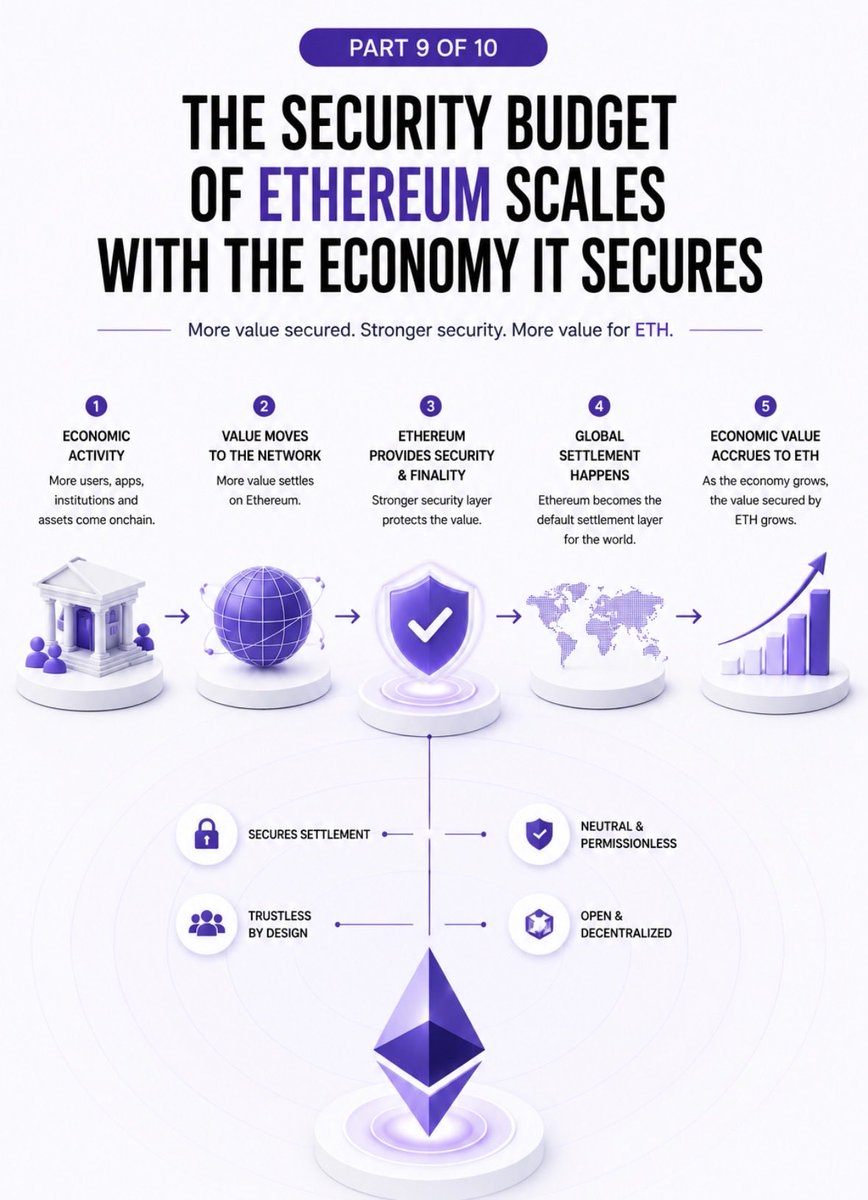
Part 9 of 10 - Security Must Scale With the Economy
As Ethereum secures more economic value, the network itself must become stronger.
A permissionless financial system cannot protect trillions of dollars with a weak economic foundation.
That’s why $ETH isn’t just used to pay for transactions.
It is the economic asset securing the entire network.
As more businesses, institutions and applications rely on Ethereum, the amount of value that depends on its security grows.
Over time, the value securing the network should scale alongside the value being secured.
That’s what makes Ethereum fundamentally different from traditional infrastructure.
You can find a visualization of this concept below together with the previous parts. 👇
In Part 10, we’ll bring everything together and explain why ETH has the potential to become the neutral monetary asset of the internet.
The Economics Behind Ethereum & $ETH Value Capture
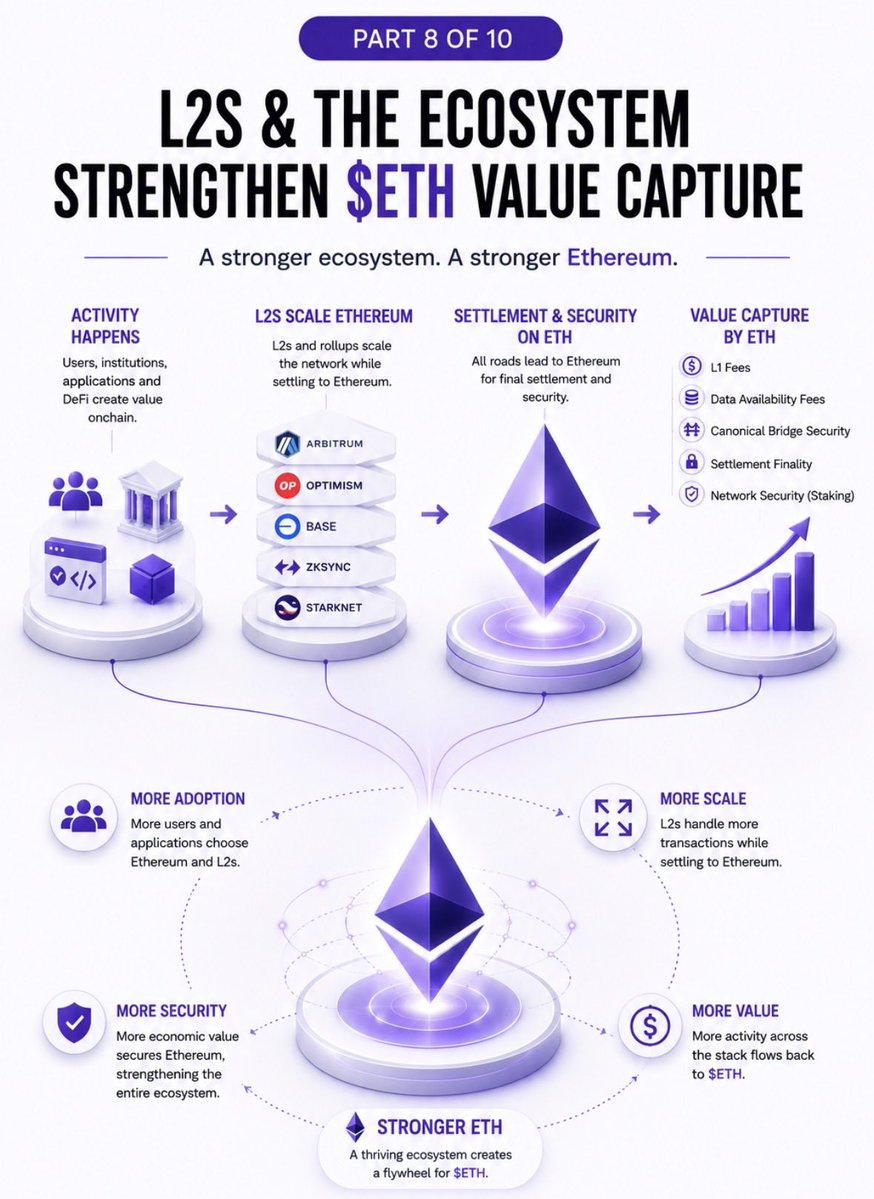
Part 8 of 10 - A Stronger Ecosystem, A Stronger ETH
A common misconception is that Layer 2s and the broader ecosystem weaken Ethereum by moving activity away from the base layer.
In reality, they expand the network.
More applications, users and institutions create more economic activity. That activity ultimately depends on Ethereum for settlement, security and coordination.
As the ecosystem grows, so does the importance of the asset securing it.
That’s why a stronger ecosystem doesn’t compete with $ETH, it can strengthen its long-term economic role.
You can find a visualization of this relationship below, together with the previous parts. 👇
In Part 9, we’ll explore why Ethereum’s security budget can grow alongside the economy it secures.
The Economics Behind Ethereum & $ETH Value Capture
Part 7 of 10 - The Monetary Premium
A monetary premium emerges when an asset is valued not only for what it can do today, but also for the trust, security and economic role it can provide over time.
$ETH combines several qualities that can support this. It is scarce, productive through staking, essential to network security and deeply integrated into settlement, collateral and onchain finance.
As more value depends on Ethereum, demand for a neutral asset that helps secure and coordinate that system can grow with it. That is where utility begins to evolve into monetary premium.
This is not separate from the network’s economic activity. It is the result of that activity, security and trust reinforcing one another. 🙏
You can find a visual representation below, together with the earlier parts. 👇
In Part 8, we’ll explore how L2s and the wider ecosystem can strengthen this value-capture model rather than weaken it.
The Economics Behind Ethereum & $ETH Value Capture
Part 6 of 10 - Why Global Settlement matters ?
Every financial system needs a trusted place where value is finalized.
That’s what settlement is.
If more businesses, institutions and applications choose Ethereum as that settlement layer, the network doesn’t just process transactions, it secures an increasing amount of global economic activity.
The more value that depends on Ethereum’s security, neutrality and decentralization, the more important its economic foundation becomes.
It has the potential to become one of the strongest long-term demand drivers for $ETH. 🙏
You can find a visualization of this process below and also the other parts. 👇
In Part 7, we’ll explore why this can ultimately strengthen ETH’s monetary premium, this part many people get wrong.
The Economics Behind Ethereum & $ETH Value Capture
Part 5 of 10 — Ethereum Is More Than Infrastructure
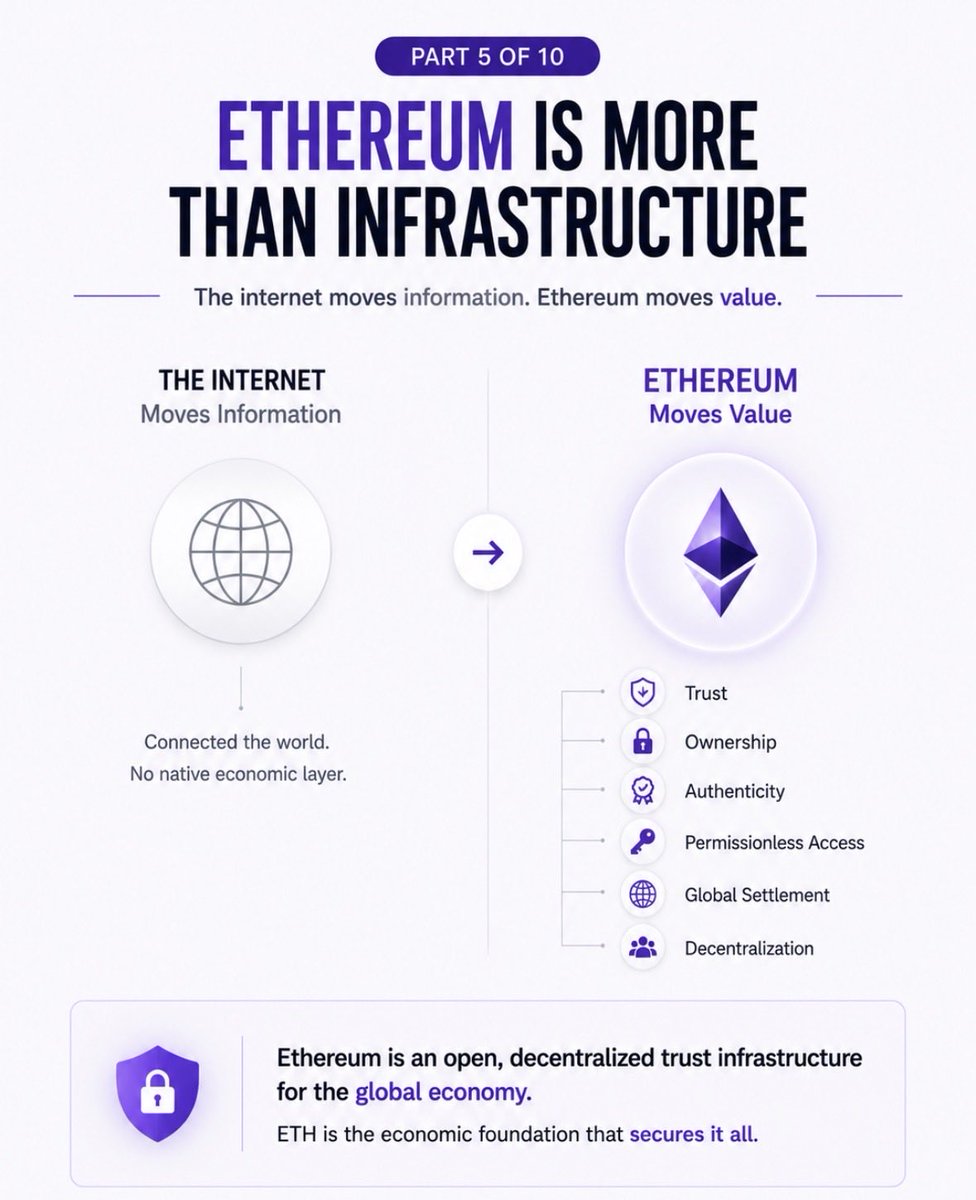
The internet transformed how information moves, but it never had a native economic layer. The value it created was captured by the companies built on top of it.
Ethereum is fundamentally different. It enables the permissionless movement of value while securing trust, ownership, authenticity and global settlement on an open, decentralized network. ETH isn’t separate from this system, it’s the economic foundation that secures it.
That’s what makes Ethereum more than infrastructure. It has the potential to become the trust layer of the digital economy🙏
You can find a visualization of this comparison and the differences below and also the other parts👇
In Part 6, we’ll explore why global settlement could become one of the strongest long-term demand drivers for $ETH.
The Economics behind Ethereum & $ETH Value Capture.
Part 4 of 10 - Why ETH’s economic value secures the Network?
If Ethereum is going to secure trillions of dollars in assets and economic activity, it can’t rely on weak economic security.
The network is ultimately protected by $ETH itself.
The more economically valuable ETH becomes, the more expensive it becomes to attack the network, and the stronger Ethereum becomes as a global settlement layer.
This creates another reinforcing cycle:
Higher ETH value → stronger security → more trust → more adoption → higher ETH value.
This cycle is visually shown in the image below👇
Security isn’t separate from the economics.
The economics are the security.
In Part 5, we’ll explore why Ethereum is fundamentally different from the internet, and why it can capture value that the internet itself never could.
The Economics Behind Ethereum & $ETH Value Capture
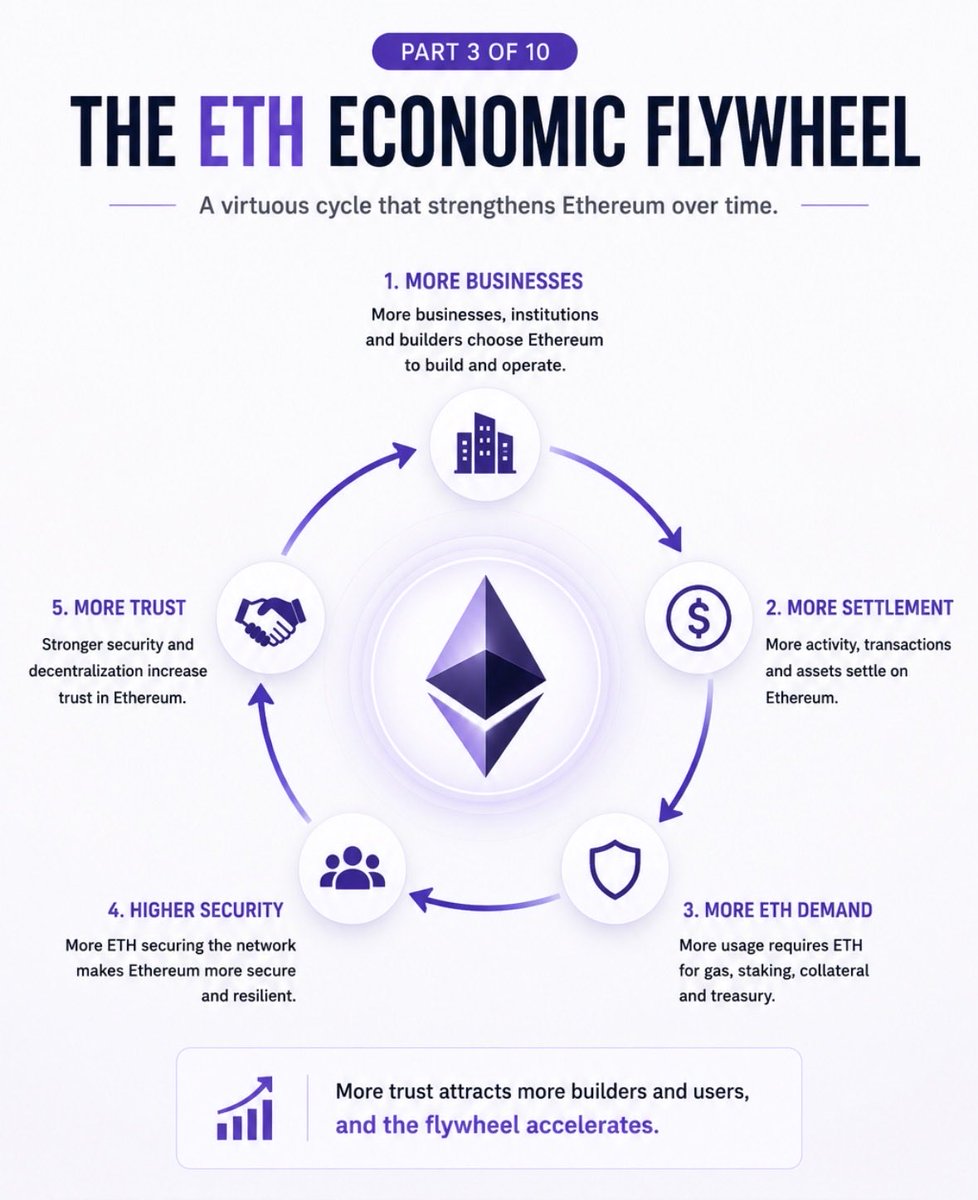
Part 3 of 10 - The ETH Economic Flywheel
In Part 2, we looked at the main sources of demand for ETH.
The key insight is this:
They don’t work independently, they reinforce each other👇
More adoption → more settlement → more demand for ETH → a stronger network → more trust → even more adoption.
That’s the flywheel.
If Ethereum becomes the settlement layer for the global economy, this cycle can become increasingly self-reinforcing.
Check out the graphic below for a visualization of the flywheel👇
In Part 4, we’ll explore why ETH’s economic value is essential to securing the network itself.
I really like this vision of human + AI. But I think the harder question isn’t whether we can build AGI, it’s whether we can build the right economic and social system around it.
If everyone has access to the same intelligence, how do we continue to reward creativity, risk-taking and genuine innovation? How do people still build something unique and make a living instead of converging toward the same AI-generated output?
My intuition is that we will need open, decentralized coordination rather than centralized control. We need infrastructure that lets billions of humans and AI agents collaborate, transact and compete under transparent rules, not systems where a handful of companies or governments decide the outcome.
That’s one of the reasons I think Ethereum can become very helpful in an AI-native world.
So what’s the game plan with $BOOE?
I’d say keep building the culture before the cycle demands it.
The biggest winners next cycle won’t just have liquidity. They’ll have communities people want to belong to. That’s where @Bookof_Eth stands apart.
It isn’t trying to be just another meme coin. It’s building a cultural layer around Ethereum by preserving its history, values, memes, and philosophy while onboarding new believers into the ecosystem.
Adoption doesn’t happen overnight. It happens one person, one conversation, and one believer at a time.
If Ethereum enters its next expansion phase, communities that have spent years building conviction, not just chasing hype, will already have the foundation in place.
Every new believer strengthens the movement. That’s how adoption compounds.
Believe in somETHing. 📖 Amen.