📚🧵Examining Democracy and Education:
Chapter 1: Education as a Necessity of Life, Renewal of Life by Transmission
The first sentence of Democracy and Education is, "The most notable distinction between living and inanimate things is that the former maintain themselves by renewal." He goes on to discuss the smashing of a rock into smaller stones. Dewey draws on the fact that the rock simply allows itself to be destroyed, while a living being uses its energies, even when severely outmatched, to further its own existence. Dewey suggests that "higher lifeforms" failing to use the appropriate amount of energy to ensure existence will result in splitting into smaller pieces and, eventually, a loss of "its identity as a living thing."
I believe these "smaller pieces" are a reference to humanity's drive towards tribalism. Since the dawn of mankind, humans have instinctually fought over land, resources, and beliefs. A constant fracturing of society into smaller and smaller factions will allow for Dewey's "superior force," in this case, the destruction of mankind, consistently break away at the rock of civilization. Dewey expresses the need for a living thing to use the energies and resources around it not only in the interest of preservation, but also progression. How does all of this relate to education? Going back to the subtitle of the chapter, "Renewal of Life by Transmission," Dewey is suggesting that life must be carried on, and made better by, the transmission that occurs in Education.
Control is another word Dewey defines and uses frequently. He says, "Understanding the word "control" in this sense, it may be said that a living being is one that subjugates and controls for its own continued activity the energies that would otherwise use it up. Life is a self renewing process through action upon the environment." Maintaining control is inherent and instinctual for survival. Just as beaver builds a dam, humans build shelters. Control is something every living being seeks, but not all living beings seek the same kind of control. While animals seek control for survival, humans, despite that being the initial reason for our desire to control, seek control for other reasons. However, it is possible that humans seek control for the same deeply buried biological response that fueled the survival of our ancient tribal ancestors. The final part of that quote, "self-renewing," puts a biological tag on the expansion life. Civilization puts consistently act upon and change its environment in order to maintain its existence. If people merely sought a static existence the progression on mankind wouldn't have made it past the Stone Age. We see evidence of cave people seeking to change their environment, and even leave their mark via 40,000 year old cave paintings. Through these paintings we see how they sought to control their surrounds and bring an identity to human beings above all other creatures roaming the Earth.
"Education, in the broadest sense, is the means of this social continuity of life." Dewey describes the social continuity as beliefs, ideals, hopes, happiness, misery, and practices. All of these are passed on the youth who Dewey refers to a, "the immature, helpless, without language, beliefs, ideas, or social standards." This transmission is crucial to the survival of a society. Without the transmission of the elements highlighted by Dewey society will continually devolve, transmitting less and less values, standards, beliefs, and ideas, increasing the amount of immature, helpless, and those without language. Could the idea of a high purpose help ensure these elements are continually passed on? Has the Nihilism assisted in the degradation of the renewal of life by transmission?
One relevant quote is, "there is the necessity that these immature members be not merely physically preserved in adequate numbers, but that they be initiated into the interests, purposes, information, skill, and practices of the mature members: otherwise the group will cease its characteristic life." Dewey is saying the number of people being produced in a society is not as important as the passing down of the society's core elements. He also highlights how important it is that these elements come from mature members. Undoubtedly, teens and young people, the immature of society, are the target audience for social media influencers. The connectivity between these two groups allows the immature to be handed their elements from the immature. This is further enforced in places like middle school, where students are surrounded by strictly youth of their own age. Society has a right to be concerned about the immature becoming a monetized by others who never properly grew out of immaturity. Dewey says as a society grows, "the gap between the original capacities of the immature and the standards and customs of the elders increases." Dewey believes that education alone can bridge the gap of disconnect.
Communication is another key factor Dewey highlights as necessary for the transmission of life. The communication MUST happen between the mature and immature members. Have we seen a drastic decline in communication between adults and the youth? Children sit on Ipads in restaurants while their parents scroll endlessly on their phone. Teenagers on their phones sit across from their grandparents. How can the communication and transmission of life break through the omnipresence of the smartphone? A grandparent, who is teeming with life and experience, should be a proprietary transmitter of ideas, beliefs, customs, misery, happiness, and more. Instead they are blocked out. I can't help but wonder what the teens refusing their elders' experiences will transmit to their grand children.
End of Sub Chapter: Renewal of Life by Transmission
Food for Thought: What is knowledge/ideas/customs did your grandparents pass down to you?
And as the moon rose higher the inessential houses began to melt away until gradually I became aware of the old island here that flowered once for Dutch sailors’ eyes—a fresh, green breast of the new world. Its vanished trees, the trees that had made way for Gatsby’s house, had once pandered in whispers to the last and greatest of all human dreams; for a transitory enchanted moment man must have held his breath in the presence of this continent, compelled into an aesthetic contemplation he neither understood nor desired, face to face for the last time in history with something commensurate to his capacity for wonder.
I often click on random RLM videos in my recommended, but recently I’ve noticed your videos are NOT there. No matter how much I scroll, I do not run into an RLM video, despite consuming more of your content than I care to admit. Your new videos are popping up right after they drop, but then fade into algorithm after about a day. I hope this helps you figure things out. Cheers, you hack frauds.
@MiddleearthMixr "There are many who do not know they are fascists but will find it out when the times comes.”– Ernest Hemingway, For Whom the Bells Toll
“That is why the peasant has wisdom, because he is defeated from the start. Put him in power and see how wise he is.”–Ernest Hemingway, A Farewell to Arms
“The search for lost things is hindered by routine habits and that is why it is so difficult to find them.”– Gabriel García Márquez, One Hundred Years of Solitude
“He ordered them to leave him in peace, insisting that he was not a hero of the nation as they said but an artisan without memories whose only dream was to die of fatigue in the oblivion and misery of his little gold fishes.”–Gabriel García Márquez, One Hundred Years of Solitude
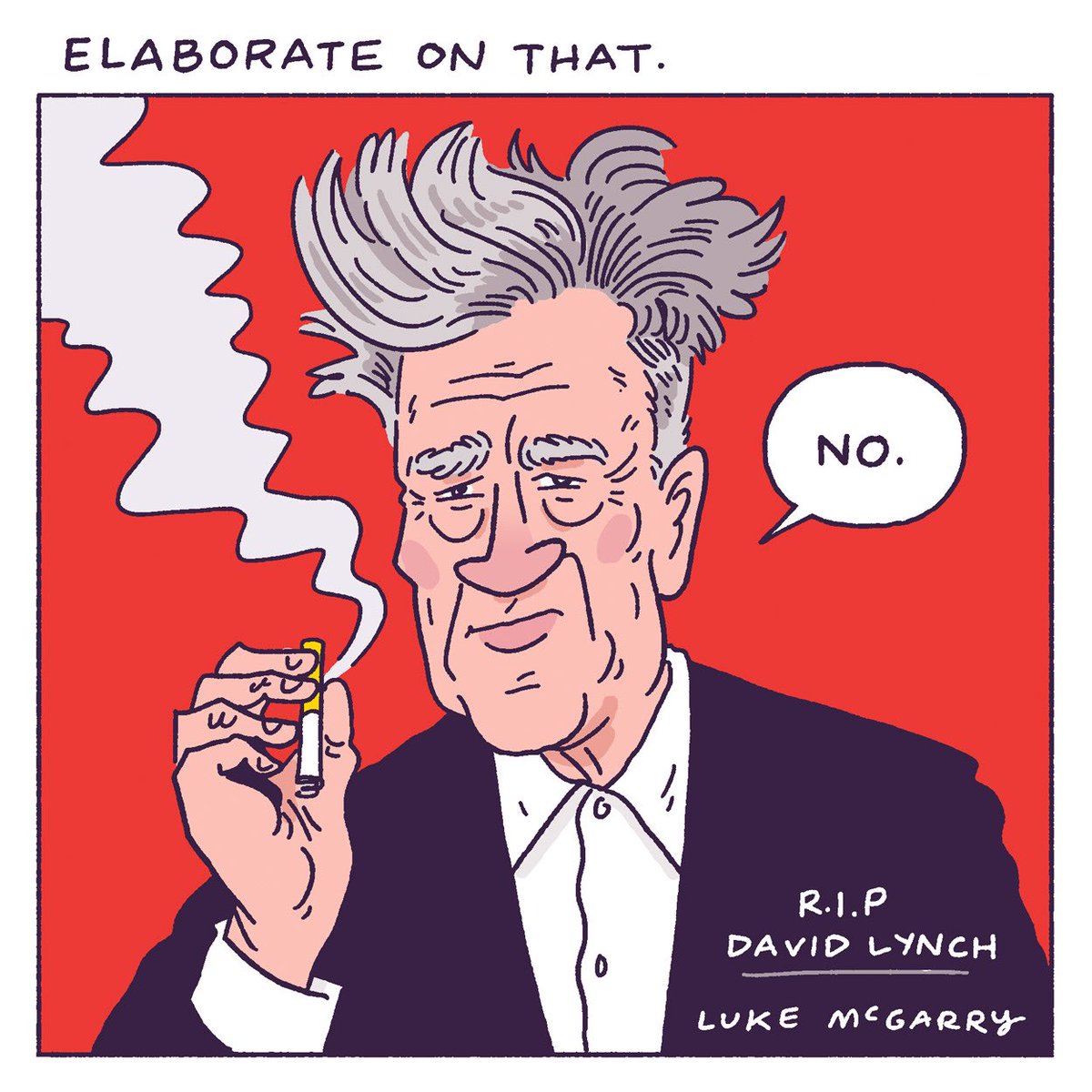
“Intuition is the key to everything, in painting, filmmaking, business - everything. I think you could have an intellectual ability, but if you can sharpen your intuition, which they say is emotion and intellect joining together, then a knowingness occurs.”–David Lynch