Pregnancy is the ultimate neuroplasticity event. Things I used to think about/worry about don’t bother me any more and have been replaced by other things. Wouldn’t be surprised if hormonal birth control actually has negative effects on neuroplasticity since the cyclical nature of hormones is what gives way to these changes
@nadiamartini I think the general rub with this advice is that pregnancy symptoms are horrendous for some people (hyperemesis gravidarum) and makes working out during pregnancy very difficult. BUT if you start out with a decent baseline and watch your weight, you’ll still be much better off.
@YEktefaie@adibvafa I can for sure see this becoming the norm and datasets specifically being curated to not overfit to one property or negatively impacting robustness, which is common with current finetuning methods
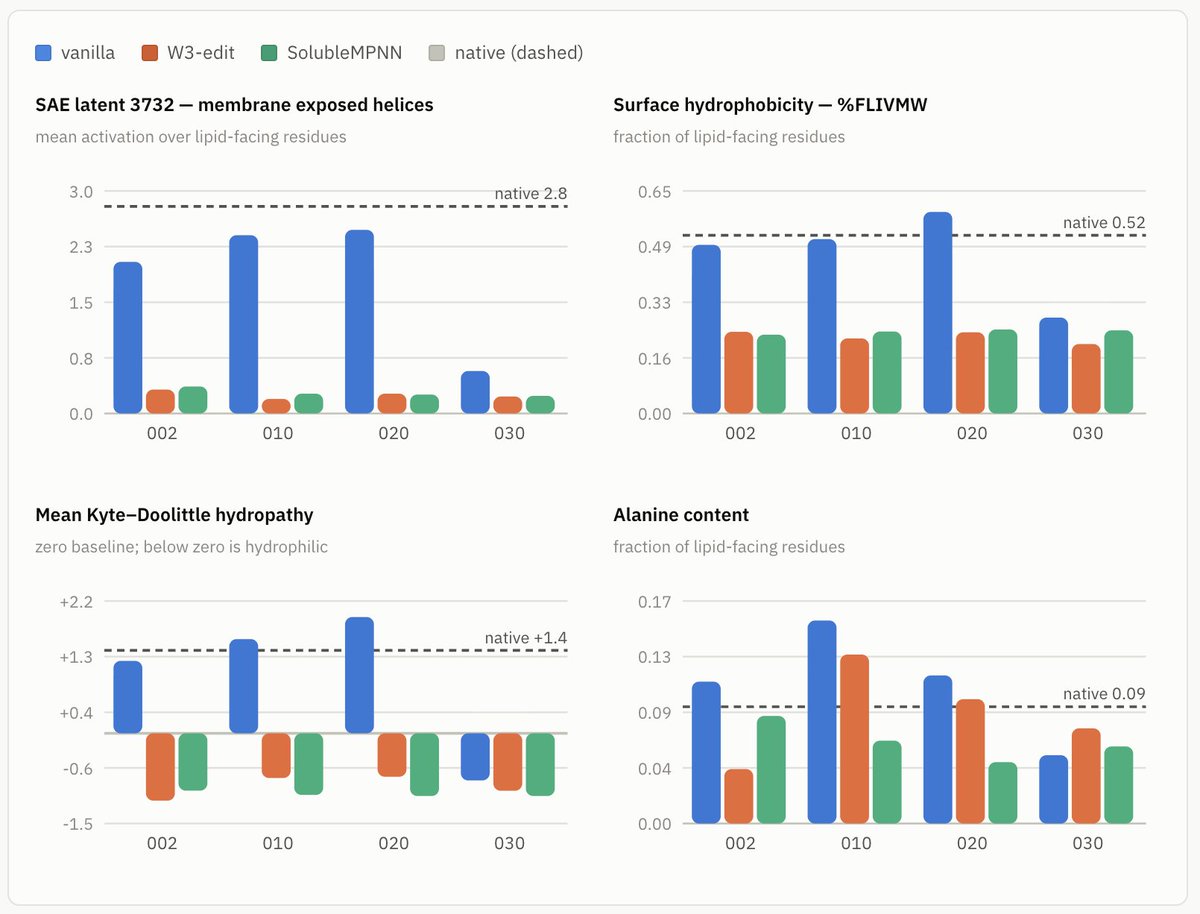
Turns out you can, in fact, just ask Opus 5 to do some mechinterp on the ProteinMPNN models and it will surgically edit ~1% of the weights to get SolubleMPNN-like behavior (apologies for the claudeslop figures). Interesting the 030 model already acts like SolubleMPNN w/o edits
@proteinrosh Abs are a huge and well established drug modality so I think that has a lot to do with the favoritism towards protein design. There’s a lot of people making real progress using AI in other drug modalities, but not at the same scale, and mostly using their own data.
@HarperSCarroll@alexrives@biohub I believe that virtual cell will have more of an impact on small molecule toxicity prediction than modeling of diseases or development of biologics. Still useful but it’s probably easier to model larger systems with broader abstractions than Biohub’s extensive cryoEM data
@DdelAlamo If you do this, definitely compare the distribution of amino acids used vs. SASA for the new version compared to both proteinMPNN and solubleMPNN.
@TensorTwerker This is more likely to come from new companies sprouting up than from established pharma, but would love to see an explosion in INDs for rare diseases
Cancer patients with the same diagnosis often have very different tumor biology.
Molecular testing can reveal underlying differences, but that's slow and expensive.
Introducing Holon-S1, our platform to predict genes and biomarkers from routine pathology slides.
• beats two other models at predicting spatial gene activity in a controlled comparison
• has identified potentially novel biomarkers in breast cancer and colon cancer
• evaluated across 16 organ types and more than 15 scanners, using slides from both formalin-fixed, paraffin-embedded and fresh-frozen tissue.
We believe Holon-S1 has the potential to help researchers find new biomarkers in slides they already have, discover treatment targets, and bring more personalized cancer care within reach!
@nlarusstone Disagree. Most of the problem is infra+security+IP+IT. If you cannot integrate or access the data you need for your agents, it becomes useless. Lots of start ups moving to running their own models. I could see this become standard across biotech+pharma