@JoeVisconti@joshforct Ha. No law enforcement at polling places. I’m sure all the criminals will respect that and stay away. Nothing like advertising for unprotected bait!
#SundayWisdom from Victor Glover — the first man to pilot a spacecraft to the Moon since 1972.
If you’re focused on personal credit, status, or recognition, you’ll never reach your potential.
If you’re focused on the mission and helping the team around you succeed, incredible things can happen – like going to the Moon.
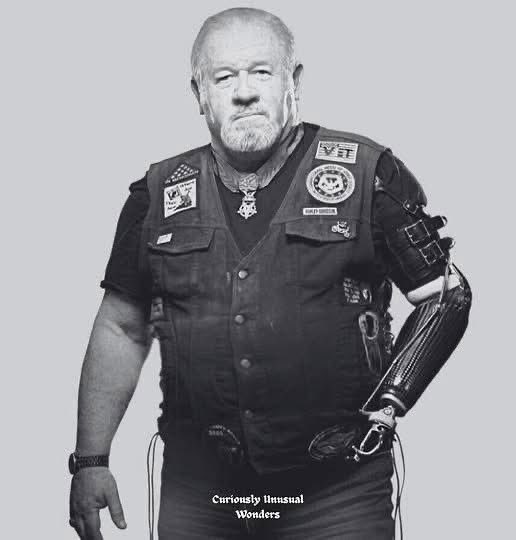
He tucked his severed arm into his waistband and kept firing—then what happened next will break you.
January 8, 1968. A rice paddy in Vietnam.
Twenty-year-old Gary Wetzel looked down at his body and saw the impossible.
His left arm was hanging by threads of flesh. His right arm was shredded. His chest was torn open. His leg was bleeding into the muddy water.
Two enemy rockets had just exploded inches from where he stood as a door gunner. The blast had hurled him out of his helicopter and into the paddy below.
Most men would have died from shock alone.
Gary Wetzel stood up.
His helicopter crew was part of the 173rd Assault Helicopter Company, inserting troops into what had become a kill zone. The moment they touched down, enemy fire erupted from every direction. Then the rockets came.
Now, bleeding out in a rice paddy, Gary realized something through the haze of agony: his machine gun was the only weapon still hitting the enemy position. American troops were pinned down. Men were dying. That automatic weapons emplacement had to be silenced.
And he was the only one who could do it.
Gary climbed back into his gun well.
He took his left arm—useless, nearly severed, hanging by skin and muscle—and tucked it into his waistband to get it out of the way.
Then, using his mangled right arm, he grabbed his machine gun.
And he opened fire.
The pain should have killed him. The blood loss should have knocked him unconscious. The shock should have shut his body down.
But Gary Wetzel kept firing.
He stayed at that gun until he eliminated the enemy emplacement that was slaughtering his brothers. Only then—only then—did he try to tend to his wounds.
He attempted to reach his aircraft commander, who was also badly hit. But his body had finally reached its limit. He collapsed, unconscious.
When he woke up—minutes or hours later, he couldn't tell—his first thought wasn't about survival.
It was about his crew.
Gary began dragging himself, inch by agonizing inch, across that rice paddy toward where his crew chief was trying to pull the wounded commander to safety.
He passed out from the effort.
He woke up.
He kept crawling.
When he finally reached them, Gary helped move the commander behind a dike. Then darkness took him again.
The next morning, rescue forces found Gary Wetzel barely alive. He'd been on the critical list for a week.
Doctors amputated his left arm in a field hospital. Infection set in. He needed another surgery in Tokyo, where physicians removed over 400 stitches and fought to keep him breathing.
But here's the part Gary remembers most.
While recovering in that Tokyo hospital, some of the men he'd saved—the soldiers whose lives he'd bought with his blood and his arm—found out he was there.
They walked up to his bed, one by one.
"Are you Gary Wetzel?"
"Yeah."
And they pulled out photographs. Wives. Children. Girlfriends waiting back home.
"Hey, man," they'd say, tears streaming. "Because of you, this is what I've got to go back to."
That's when Gary understood.
Not just in military terms—enemy eliminated, mission successful, lives saved.
But in human terms.
Families that would stay whole. Children who would grow up with fathers. Love stories that would continue. Futures that would happen.
November 19, 1968: President Lyndon B. Johnson pinned the Medal of Honor on Gary Wetzel's chest at the White House. He also received the Purple Heart and Air Medal. He was promoted to Specialist Four—a rank earned in the most brutal way imaginable.
After five months in hospitals learning to live with a prosthetic arm, Gary returned to South Milwaukee, Wisconsin. He went to work as a heavy equipment operator—a job that requires two hands.
Except Gary figured out how to do it with one and sheer determination.
He married Kathy. He raised a family. He lived quietly, never seeking attention.
But Gary Wetzel has never stopped serving.
Appreciate the wait Stephen...
There isn’t one cause. America’s division is the result of several forces hitting at the same time, each pouring gasoline on the others. Here are the big ones:
1. Social media rewired the country
Platforms didn’t just connect people — they radicalized them.
Algorithms reward outrage, conflict, and extremism because that content keeps people glued to the screen.
So the loudest, angriest voices get the most visibility, while moderate voices disappear completely.
Result:
People now live in different information worlds. Not different opinions — different realities.
2. Political parties realized division is profitable
Both parties figured out that fear and anger raise more money, get more clicks, and turn out more voters than unity ever will.
So political messaging shifted from:
“Here’s what we stand for,”
to
“Your neighbor wants to destroy the country — donate now.”
When politics becomes a war instead of a debate, your fellow citizen starts looking like the enemy.
3. Collapse of trust in every major institution
Government, media, public health, corporations, banks, higher education — trust in all of them cratered over the last 20 years.
Why?
Scandals, corruption, hypocrisy, manipulation, and blatant incompetence — across the board.
When no one trusts the referee, the game becomes a brawl.
4. The media abandoned neutrality for tribal loyalty
Outlets don’t even pretend to be neutral anymore.
They’re audience-targeting businesses.
So news isn’t designed to inform you — it’s designed to affirm your worldview and keep you locked in.
This creates two Americas:
•One that believes one storyline
•One that believes the total opposite
And each thinks the other is insane.
5. Economic stress made people angrier and more reactive
Stagnant wages, insane housing prices, medical debt, cost-of-living spikes, corporate consolidation, and the destruction of the middle class created a pressure cooker.
People under financial strain are more irritable, less patient, and more prone to blaming “the other side.”
6. Cultural shifts happened faster than people could process
Everything — gender norms, family structures, technology, entertainment, values — changed at warp speed.
Some people embraced it.
Some people panicked.
Some people felt erased.
Some felt liberated.
Rapid cultural change always produces backlash. Always.
7. Foreign adversaries exploited every crack
Russia, China, Iran, and others pumped disinformation into American social platforms to widen racial, political, religious, and economic divides.
They don’t need to defeat the U.S. militarily if the U.S. tears itself apart internally.
8. People stopped talking to each other in real life
COVID isolation, remote work, online communities, political bubbles — all of it reduced face-to-face humanizing interaction.
It’s easy to hate a caricature online.
It’s harder when someone is sitting across from you.
9. Loss of a unifying narrative
From WWII to the Cold War to the space race, America used to have shared goals and shared enemies.
Now?
No common project. No shared mission.
Just a lot of grievance and competing identities.
When a nation stops having a “we,” everything becomes “us vs. them.”
Bottom line
America’s division isn’t random and it’s not accidental.
It’s the predictable result of:
technology + political incentives + financial pressure + collapsing institutions + cultural upheaval + foreign interference.
You fix the division by addressing those root causes — not by attacking each other.
MUST-SEE: Stephen A. Smith absolutely erupted at a caller on his show.
Caller: "Going back to Nazi Germany, those people that obeyed illegal orders, when they said, 'Oh, I was just obeying orders…'"
Smith: "You stop that BS right now! …"