🚨SOS🚨
AISA President Neha Bora has been picked up by Delhi Police in an unauthorised vehicle, WITHOUT A SINGLE FEMALE CONSTABLE!
WE DO NOT KNOW WHERE THEY ARE TAKING THEM! THEIR WHEREABOUTS ARE UNKNOWN!
@DelhiPolice has crossed EVERY LIMIT!
In this era of artificial intelligence, it is becoming urgent to distinguish human art from what machines produce. There is an ontological difference, even before an aesthetic one, between art and what a machine can generate through statistical calculation based on millions of images created by others. Algorithms lack the spark of humanity. For this reason, the Church wishes to renew an alliance with artists and cultural institutions to safeguard our humanity.
the implication is not that every student graduating from there is evil obviously but i mean if the chancellor runs sonepat like his personal penal colony the optics are just horrible
okay we have to agree that an institution like jgls is fundamentally evil right - administratively, politically, and economically? can top quality research ever launder the inherent class position of that place?
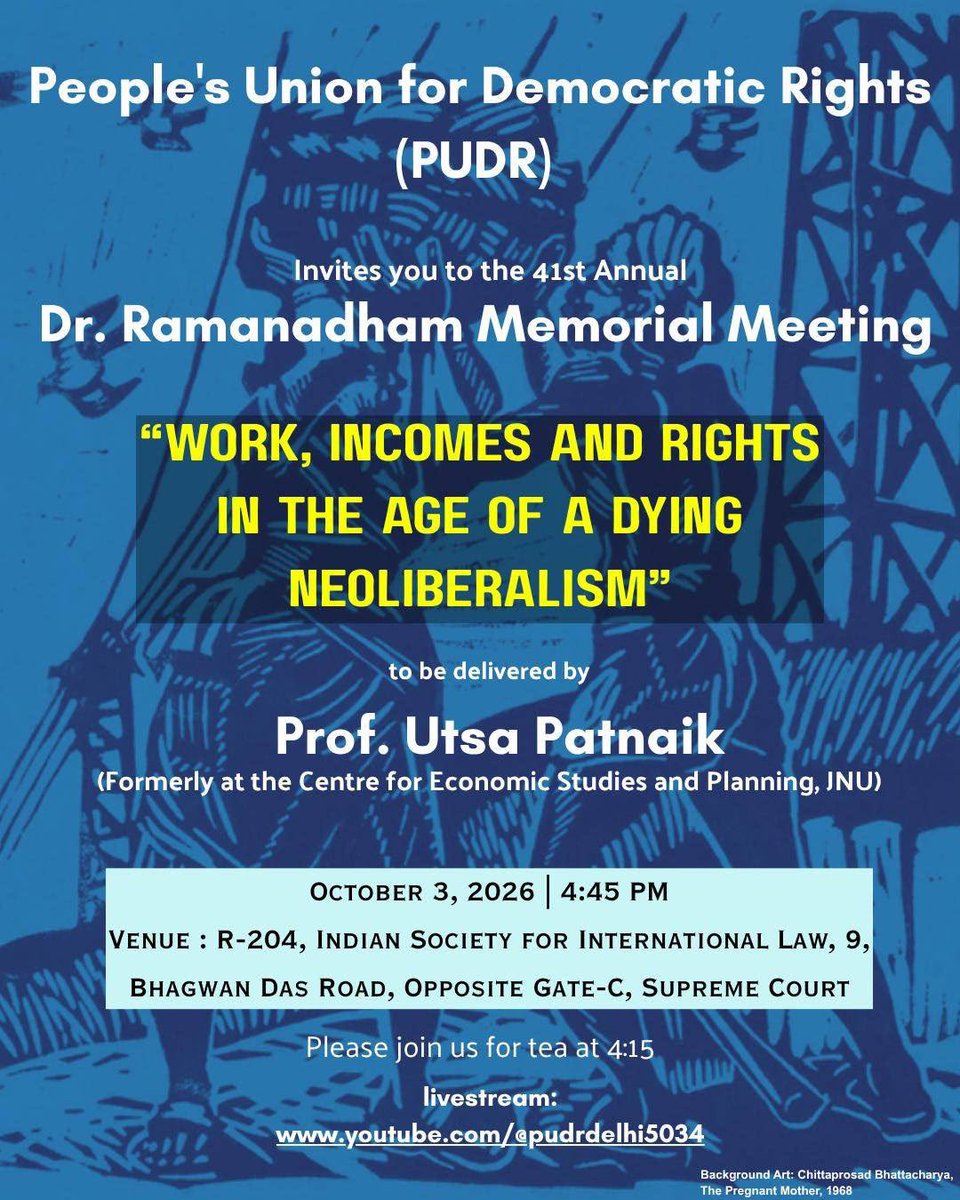
Peoples Union for Democratic Rights invites you to its 41st Annual Dr. Ramanadham Memorial Meeting on 3rd October, 2026 at the Indian Society for International Law. Check the poster for details.
#work#neoliberalism#rights
NEW: ✍️Masculinity, badmosi music, caste-pride stickers, blacked-out big cars, gym steroids and bhaukal reels.
In today’s Times of India, I write about Gurgaon road rage and the particular culture that makes Delhi NCR roads so dangerous.
Read here: https://t.co/dKzutTo9mv
We need to tell you something we have tried very hard not to say: @MaktoobMedia cannot continue like this.
For the last eight months, we have received only around half of what we actually need to run our newsroom.
Lakhs of rupees in salaries and contributor payments are pending. People who reported, edited, photographed, travelled, filmed and wrote for Maktoob are waiting to be paid for work they have already done.
And tomorrow, another day of journalism has to begin.
We have somehow kept doing this since 2014. Without a single day’s break.
For more than twelve years, we have reported what needed to be reported without first calculating what reporting it might cost us.
We travelled where stories demanded us to be, even when we did not have the budget for those journeys. We reported from places and on issues that were being ignored. We documented violence, discrimination, hate, state excesses and injustice when looking away would have been easier and safer.
Our opinion pages carried some of the most critical voices and arguments of our time, not as a favour to anyone, but because those arguments needed to exist in the public record. We published them knowing very well that some of them could invite attacks, cases, pressure and consequences for Maktoob.
We were equally uncompromising with language.
When words demonised people, we refused those words. When commonly used terminology reproduced prejudice or turned victims into suspects, we challenged it. When violence had to be named, we named it. When Islamophobia had to be called Islamophobia, we did not hide it behind softer language.
We did all this because journalism does not merely report the world. Journalism can determine whose suffering is believed, whose voice is heard, who is treated with dignity and who is turned into an object of suspicion.
And we are doing this in a media environment where, day in and day out, sections of the media manufacture suspicion, legitimise hatred, amplify prejudice and create conditions in which violence against vulnerable communities becomes imaginable and normal.
In such a time, you are the beneficiary of Maktoob's existence.
Not because you agree with every story or every opinion we publish. But because a society needs journalism that refuses to join the machinery of hatred.
We have always been proud that when institutions failed people, we tried to act not merely as journalism’s so-called fourth pillar, but sometimes as the first pillar people could turn to: to document, to question, to amplify and to make sure something did not disappear without a record.
And Maktoob itself is still a miracle to us.
It began in 2014 with college friends from non-privileged backgrounds. There was no capital behind us. No wealthy family. No media empire. No large investor waiting to build us.
Students and friends carried Maktoob in its early years without any monetary benefit. Later, journalists, editors, photographers, video journalists, contributors and staff built it into what it is today because they believed journalism could be a justice-delivering process.
They made Maktoob possible.
And this is the part that hurts us most: today, we are unable to do justice to them.
People who have given their labour to Maktoob are waiting for their money.
Lakhs of rupees are pending.
We are unable to pay salaries and contributors on time.
Every month, we try again. We raise what we can. We somehow keep the newsroom moving. But what is coming in is simply too little.
For the last eight months, we have received only around 50% of our actual budget requirement.
A newsroom cannot survive indefinitely on half of what it needs.
We cannot run another month like this. At this point, even running the newsroom day to day is becoming difficult.
Maktoob is a private limited media company. Our revenue comes from subscriptions and advertisements. But the nature of the journalism we do means advertising opportunities are extremely limited.
That leaves us with the people who read us.
You.
Subscriptions are now our most important source of survival.
A Maktoob subscription starts at ₹600 for six months and ₹1,200 for one year. If you have the means, premium subscriptions are available up to ₹1 lakh.
For readers outside India, subscriptions are available in USD and EUR, from $50/€50 up to $1,500/€1,500.
Please subscribe to Maktoob for one year.
If ₹1,200 is possible for you, please take the annual subscription.
If you can afford more, please take a premium subscription. We urgently need people who can do that now.
And if you cannot subscribe, please send this message to someone who can.
Our journalism remains outside a paywall. Even at a moment when we are struggling to survive, we cannot convince ourselves that these stories should be inaccessible to someone simply because they cannot pay. We believe the journalism we publish is too important for that.
Subscribers receive our curated newsletters and invitations to live conversations with experts. But we do not want to sell you a subscription by pretending this is primarily a transaction for benefits.
We are asking you to subscribe because Maktoob needs to survive.
We need to pay the people who make this journalism.
We need to send reporters where stories are happening.
We need to keep publishing voices that cannot afford to disappear.
We need to continue naming what others soften, documenting what others ignore and reporting what powerful people would rather not see reported.
For twelve years, we found a way.
We worked without money. We travelled without budgets. We took risks. Our journalists and friends carried burdens they should never have had to carry. Again and again, we somehow found enough to make the next day happen.
But we cannot keep asking our journalists and contributors to pay the price for keeping Maktoob alive.
This time, we need our readers to carry us.
Please don't read this appeal and leave it for someone else.
Subscribe. Take a premium subscription if you can. Send this message personally to people who can support us. Ask them to subscribe.
We have reached a point where your response to this appeal will materially decide how we keep this newsroom running.
Maktoob has reported for twelve years without looking away.
Please don't look away from Maktoob now.
Visit https://t.co/QuQA8NtpUI to subscribe, or pay via UPI at maktoobmedia@icici