We all know a small business owner that worked tirelessly to serve their neighbourhood.
I sure did, that’s me in the middle celebrating my birthday at family restaurant I grew up everyday in.
This photo is at 9:30pm after another long day in the kitchen.
Today let’s talk about the two things people care about most: how dividends and stock splits are settled, and how to avoid the hidden traps when investing in tokenized stocks.
After buying stock tokens, many people get confused when dividends or stock splits happen. Let me use a real example to explain.
In November 2025, Netflix ( $NFLX ) completed its well-known 10-for-1 stock split. Before the ex-split trading date on November 17, NFLX was trading around $1,100. After the split, the price dropped precisely to around $110. For investors, the total asset value did not change at all. They simply held 10 times more shares.
But if you look at corresponding stock tokens in the market today, such as $NFLXon and $nflxx, their prices are still sitting around $870 and $880. This is because their product design did not support synchronized rebase, meaning they failed to reflect the corporate action of the underlying US stock. As a result, the token price became almost 10x detached from the real stock price, which is now around $87. Users can no longer tell the real value of their assets at a glance.
Now let’s talk about dividends.
Anyone familiar with US stocks knows that when a company pays dividends, its stock price usually drops on the ex-dividend date. For example, if Apple is trading at $500 and pays a $10 dividend per share, the stock price will adjust to around $490 on the ex-dividend date because that $10 has already been “distributed” and is no longer part of the company’s asset value. This is how stock markets work globally, no matter which brokerage you use to buy US stocks.
But here is the problem: on some tokenization platforms, after a company pays dividends, the dividend is not directly distributed to users. Instead, the platform uses the dividend to buy more of the underlying asset and claims that the return has already been reflected in the token price.
The result is that the real stock price has already adjusted down to $490 after the dividend, but the token price on their platform still shows $500. It may look like the price did not fall, but in reality, your dividend has been “hidden” inside. If you want to know exactly how much dividend you received or how much your asset is really worth, the accounting becomes extremely unclear.
@RealityFi_xyz solves these two pain points at the mechanism level:
✅ Dividend settlement: Cash dividends are automatically converted into USDT and airdropped directly to your account. Stock dividends are issued as additional tokens on a 1:1 basis in real time. No manual claiming is required, and your returns are clear at a glance.
✅ Stock splits / reverse splits: Reality executes synchronized price rebase. Using Netflix as an example, if you held 1 token before the split, it would automatically become 10 tokens after the split, while the unit price would adjust in line with the real stock price. Your total asset value remains unchanged, and there will be no more price mismatch.
Also, don’t forget dividend tax. Just like traditional US stock brokerages, Reality withholds 30% dividend tax according to regulations, processed by its partner broker. The rules are transparent, with no hidden fees. This is a level of transparency many DeFi products cannot offer.
Finally, let’s talk about asset safety and compliance.
The underlying stocks are held in an independent SPV with segregated custody, ensuring 1:1 full reserve. A licensed third-party US audit firm verifies the underlying holdings and on-chain token supply every day and publishes audit reports externally. The platform also provides a real-time asset dashboard, so reserve status can be checked anytime.
In investing, clarity and transparency are the most practical protection for every user.
Morpho is hiring for a DeFi Desk - APAC, expanding across the pacific the desk held by @maccanomics and @talkintokens@shanandwater's most recent APAC tour has made clear the untapped opportunity this market represents for Morpho and our strategic decision to double down
👇
🇭🇰 ASIA EXPANSION: Hong Kong equities are now live on Pyth
Tencent, BYD, CSI300, and FTSE China A50 are live on Pyth Pro today. 70+ more HK-listed names rolling out soon.
Pyth goes to Hong Kong 🧵
Global investors are rushing into Chinese equities:
Foreign inflows into Chinese stocks surged to +$29 billion in April, the highest monthly inflow since January.
This was also the 5th-largest monthly intake on record.
This marks a sharp recovery from two consecutive months of outflows in February and March.
Year-to-date, investors from overseas have poured +$72 billion into Chinese stocks.
As a result, the CSI 300 Index rose +8% in April and is up another +1% so far in May.
Foreign appetite for Chinese stocks is surging.
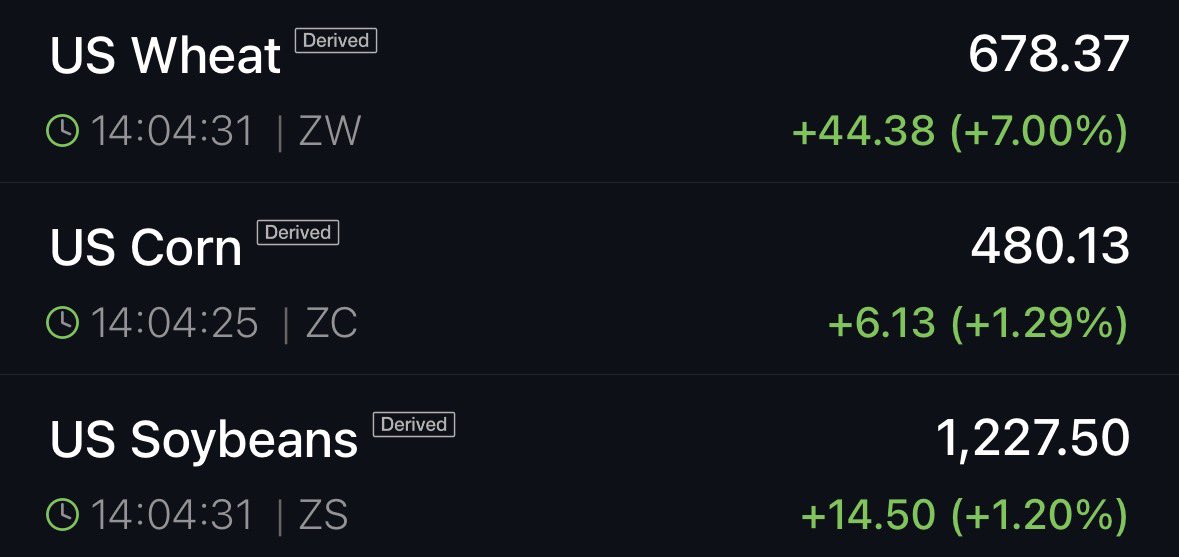
Wheat exploded in price yesterday (limit up) after USDA forecast that over 8 million acres of HRW (Hard Red Wheat) will be abandoned in the Great Plains
That's 37% of planted acreage reported in the March Prospective Planting report, and means U.S. farmers this year will harvest their smallest wheat crop since 1972.
This comes on top of already record-low planted acreage heading into the season (lowest since 1919 in some metrics). Global supplies are tightening too.
Expect bread, pasta, baked goods, and processed foods to climb in the coming months — and pressure on livestock feed could push meat/dairy prices higher as well. This is another brick in the wall of rising food costs.
Grow your own food — that is the answer. Stock seeds, expand the garden, learn to preserve, and connect with local growers.