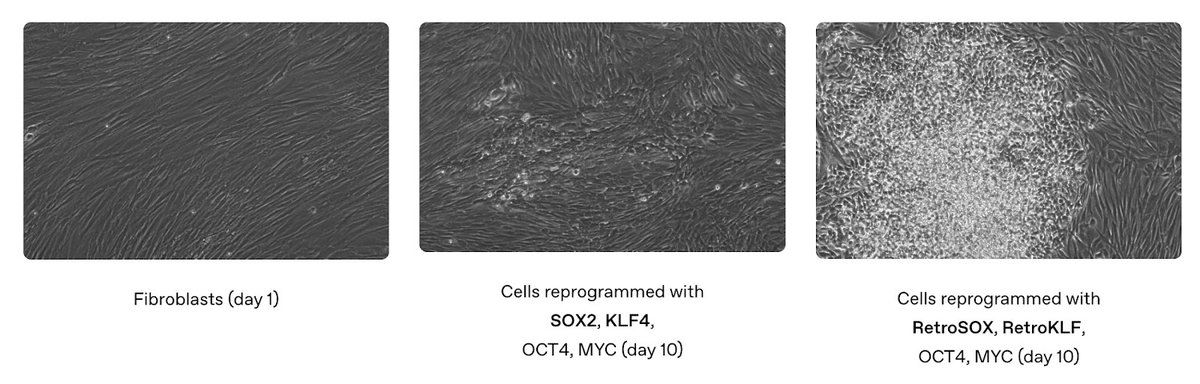
At @OpenAI, we believe that AI can accelerate science and drug discovery. An exciting example is our work with @RetroBiosciences, where a custom model designed improved variants of the Nobel-prize winning Yamanaka proteins. Today we published a closer look at the breakthrough. ⬇️
In light of the viral post yesterday by @PietroMiotti, I am sharing 20+ verified archaeological discoveries made by ai agents. I started this project over 2 months ago out of passion for doing meaningful, important work with ai. Despite the community note confirming that Pietro's discovery was actually known and recorded, his post opened a door for archaeology. https://t.co/vDB2w8tJb0 provides everything you need to make discoveries yourself, including proof of these discoveries by archaeologists.
Today we're publishing the full record: every outcome, the negatives, and every correction. 🧵
(1/10) Today, we’re sharing new research from @OpenAI: How does CoT monitorability (no-CoT capability and CoT controllability) evolve over the model training lifecycle?
We emerged with unsurprising but sobering findings: as we scale toward more intelligent systems, models are becoming harder to monitor through their CoT. 🧵
"When the company ran diagnostics on about 700 systems, it found 10,500 vulnerabilities and held an emergency press conference on June 16, applying fixes over three months.
However, when it re-ran diagnostics using "GPT-6 Astra," the latest model released by US-based OpenAI, it confirmed 35,000 new vulnerabilities. "Honestly, we're completely exhausted" https://t.co/0T069oG6Zh
Delighted to share the the work of my team at
@GoogleDeepMind: formally verifying a real-world implementation of the #Signal cryptographic protocol at the machine-code level. The proof was done using AlphaProof Code, our new AI framework for formal specification and verification.
My AI agents found an unmapped Maya site in Mexico, using LiDAR data from a NASA dataset.
72 hours from a random thought on vacation to a reply from Mexico's national archaeology institute.
What a time to be alive…
Norway now has more than 2,000 underwater AI laser robots shooting lice off its salmon
they're made by a company called Stingray, and they already guard more than 50 million salmon and trout 24/7
the reason is sea lice, tiny parasites that latch onto salmon and feed on them
as few as 11 can kill a small fish, and one pen can hold 150,000 salmon
the usual fix is pumping the fish out and blasting them with warm water or water jets to knock the lice off
but the handling is so rough that Norway's fish health report ranks it the top cause of death in full-grown farmed salmon
so instead, Stingray puts a robot inside the pen that hunts lice one at a time, all day:
> two cameras watch every salmon that swims past
> AI checks two frames to make sure it's really a louse
> then a green laser fires from up to 2 meters away
> the salmon's scales reflect the beam, so the fish swims off fine and the louse is dead
we now live in a world where AI lasers do pest control on your dinner lmao
the team has utterly locked in post hugging face incident on control and alignment. it’s almost strange watching research updates from the past few months relative to a year ago; like listening to containment procedures at Jurassic Park vs an Apple demo
I spent 20,000 dollars in API credits having different AI models play each other at Blood on the Clocktower (a Mafia or Werewolf type social deception game).
The results were fascinating. Models have gotten much better over the course of this year at creative on-the-spot scheming and bluffing, and also at reasoning as a team to break apart these underground conspiracies.
I go through some of the most standout games these AIs played in this video. The new models are getting pretty good. If my friends pulled off some of these moves while we were playing, I’d give them a fist bump.
Fwiw, OpenAI’s newer models are much better than Anthropic’s at this game.
You can see the full benchmark at the website, and I’ve also made it so that you and your friends can play again the AIs: https://t.co/IF4d0EMSD8
We built the vuln scanner we wanted to use but couldn't find.
Introducing Vuln Scans in Detail!
It uses the same abliterated models attackers are using to create havoc across the internet right now.
Under the hood we are:
- Spinning up your dev environment in a sandbox
- Throwing an enormous amount of abliterated model tokens at trying to hack your code
- Cross-checking your supply chain with cve/.now from Sazabi, to find any supply chain vulns that are exploitable in your app
This is all happening within a cloud dev environment. We will not hack your prod system.
The abliterated models are scary good. We're finding nasty issues in every repo we scan. We've found 13k vulns so far, and the majority are already fixed.
We see the current moment as an all-hands-on-deck situation. Agent swarms are stringing together minor-seeming vulns across different apps to hack systems in new and unexpected ways. We all need to find and patch an enormous number of vulns, fast, or the internet is in trouble.
You don't even have to be a target to get hacked right now. Your entire product might be a stepping stone in an attack aimed somewhere else.
We can remediate findings for you (i.e. send you PRs that fix the vulns), or you can consume them via your agent of choice, or in your ticket tracker of choice.
If you need help or advice on getting your system secure fast, please get in touch. We have helped teams of all sizes adapt to the current moment. DM me.
We're delivering these scans at-cost, because it's all-hands-on-deck. We hope you'll get one today.
Something feels a bit iffy about California prop 38.
Doing a popular vote proposed by a 3 person non-profit that gives said non profit $4.2B from the public!
I hope Gary is great and knows how to spend $4.2B well because it’s done.
Huge strides in securing the main operating system for most of the web through spending around $1100 per discovering and patching a single of 1000 discovered vulnerabilities!
This makes me very excited for the future of open source!
Our security researchers built an autonomous cyber vulnerability discovery, exploitation, and patching pipeline.
In a single run with an upcoming cyber model, it validated and generated patches for 948 local privilege escalation vulnerabilities in the Linux kernel at a total API cost of $1.2 million.