The bottom is in, but DXY still ~100+ and Brent still ~80. Still a long unwind to go for the rupee and Indian markets. Financials, metals, autos look good generally speaking.
Growth outlook is strong over a long timeframe and valuations are reasonable. Well navigated, RBI + GOI.
𝟒,𝟑𝟗𝟗 𝐃𝐚𝐲𝐬, 𝟏𝟐 𝐔𝐧𝐛𝐫𝐨𝐤𝐞𝐧 𝐘𝐞𝐚𝐫𝐬, 𝟏 𝐇𝐢𝐬𝐭𝐨𝐫𝐢𝐜 𝐋𝐞𝐚𝐝𝐞𝐫!
Shri Narendra Modi is officially set to become India's longest continuously serving democratically elected PM. This powerhouse tenure is completely reshaping the nation:
▶️ Next-Gen Reforms: Powering daily lives through Jan Dhan accounts, the UPI revolution, Ayushman healthcare, GST, and a massive surge in defense and semiconductors.
▶️ Rewriting Politics: Blasting through electoral records with a historic 207-seat win in Bengal and a legendary third-term victory in Haryana.
▶️ Global Dominance: Leading the Global South, reclaiming 600+ stolen heritage antiquities, and securing an unmatched 30+ highest international civilian awards.
Watch the video to see a full breakdown of the data, ground realities and structural reforms shaping the road to Viksit Bharat 2047 under PM Modi! 👇
India GDP per capita (PPP, constant) in 2024 is at China's ~2010 levels. Given that a significantly larger share of India GDP is private consumption, in actual living standard terms the difference is around a decade. Yes, given a more structurally undervalued rupee due to gold etc - Indian basket leans more towards services than tradable goods. That too will change, slowly then quickly.
Man, I don’t remember ever seeing people celebrate the defeat of an incumbent in a state election like this.
Mamata must be utterly shell-shocked. Years of near-total suppression of dissent by her cadre machinery probably convinced her that she was genuinely loved. When fear silences criticism, rulers mistake silence for admiration.
Now, with scenes like these emerging from virtually every locality and every city, she may finally be realising the scale of public resentment that had been buried beneath intimidation and political fear.
The brain is designed to learn through constant repetition and active, hands-on involvement. Through such practice and persistence, any skill can be mastered.
Micron's Sanand ATMP plant is ramping production right now. First chips already shipping. The real test has begun.
Here is what people miss about Micron Sanand: this is not an assembly plant in the traditional sense. ATMP — Assembly, Test, Marking, and Packaging — is where raw silicon dies get turned into finished chips that go into phones, servers, and cars. This is high-precision manufacturing with tolerances measured in microns.
Micron invested $2.75 billion. The Gujarat government co-invested ₹3,800 crore in surrounding infrastructure. Over 5,000 workers trained — most with no prior semiconductor experience. An entire workforce capability built from scratch.
The skeptics now say yields will be the challenge. They are right — meeting global profitability benchmarks at a greenfield site in India is genuinely hard. Operating costs, talent retention, supply chain maturity — all real concerns. This is not a victory lap.
But the shift in debate is the story. Two years ago the question was whether India could build a fab at all. Today the debate is about yield curves and profitability timelines. That is what progress looks like — the goalposts moved because the first set got cleared.
This paragraph by Richard Feynman hits so hard:
“Fall in love with some activity, and do it! Nobody ever figures out what life is all about, and it doesn’t matter. Explore the world. Nearly everything is really interesting if you go into it deeply enough. Work as hard and as much as you want to on the things you like to do the best. Don’t think about what you want to be, but what you want to do. Keep up some kind of a minimum with other things so that society doesn’t stop you from doing anything at all.”
India approved 139 data centres worth $10 billion in investment in the last 18 months. Total capacity under construction: 2.5 GW. This is not a tech story. This is an energy and real estate story.
A single hyperscale data centre consumes as much power as a small city. The 2.5 GW pipeline is equivalent to adding the power demand of three Jaipur-sized cities — just for data centres.
Adani, Reliance, Tata, CtrlS, NTT, Equinix — all building simultaneously across Mumbai, Chennai, Hyderabad, and Noida. AWS, Google, and Microsoft have each committed over $5 billion to Indian cloud infrastructure. NVIDIA is backing Indian AI startups at seed stage.
Here is the problem nobody is solving fast enough: where does the power come from? India's grid is already at 95% peak utilisation in summer. Adding 2.5 GW of always-on data centre load requires either massive new generation capacity or dedicated renewable installations.
This is why the semiconductor and data centre stories are connected. India cannot be an AI power without reliable 24/7 power. The grid infrastructure bottleneck — not talent, not capital — will determine whether India becomes an AI hub or just an AI consumer.
On these six points raised by Bernstein:
1. Employment question: no government can create massive number of jobs without destroying the economy, only the private sector can. The key is first and foremost to grow GDP, keep labour/factor markets flexible, have basic safety nets, exploit India's scale - which is what India is directionally going towards (whereas, Bernstein actually disses the safety net point.) India has a tight urban labour market - try hiring people, and you would know. The issue is lack of at-scale, white-collar, long-tenure/fixed jobs (for example, most government jobs.) Even blue-collar factory jobs will be largely automated in the coming 10-15 years. We must have more value-add onshore; new sectors will come up.
2. Agriculture in 1970s loop? This is completely off-base. Indian agriculture has massively diversified into cash crops/sea food/exports/higher valued added activities in the last half century. Moreover, Indian rural numbers are exaggerated given our definition of village and city in India. Indian agricultural labour is also over-estimated if one considers part time vs full time. Yes, the Lewis transition is still someway off. But that needs - again - more growth. And India remains the world's fastest growing major economy. On farm reforms, the Modi government tried it and we know what happened. It will be done via the back door now.
3. India risks becoming a permanent AI consumer - On this point, I partly agree. I have been talking about the risks of US Big Tech to India for long. However, on AI specifically given the large amounts involved, there is no harm in letting the first flush of big capex being done by others. We should try to win back the basics - email, chat, social media, office and OS software etc - gradually. They will give us the cash flow and optionality to enter AI. Meanwhile open source models are our friend and semiconductor PLI 2.0 is most welcome. Hardware/EMS is also happening finally.
4. Manufacturing: Actually India is doing very well in manufacturing given that the pivot towards industrial policy and large-scale infra investments are only a decade old or so. The best example is the auto and auto ancillary sectors. The fact that a certain percentage of GDP was not reached is notable sure, but it also says other sectors (services) are doing very well. No point comparing with Vietnam, which China does not mind investing in despite historical tensions - as Vietnam will never become a peer challenger. Bangladesh etc even narrower.
5. Cash transfers: An efficient welfare state - cash in parts, in-kind in parts - is necessary to have a safety net as mentioned to make sure that creative destruction can happen in the economy. It is a complete analytical mistake to see this spend as wasteful. Yes, one can argue about extent and efficiency, but without the buy-in from a majority capitalism as we understand it will itself stop in India or for that matter elsewhere. We have enough checks and balances in place to keep this within a limit, despite all the moral panic that breaks out about this once in a while.
6. R&D spend. Another chestnut that needs to be busted. India Inc will spend on R&D when it is profitable. To argue that they do not because they are comfortable in home market is just wrong - where is this protectionism? Is it in the room with us right now? In sector after sector, there is immense competition or there is now consolidation after intense bloodbath including foreign players/investors. Except Chinese players, that too in part, in almost all sectors almost all players are more than welcome. The government only asks for some domestic value-add irrespective of who does it. This is necessary and right. As India gets to the cutting edge of more and more sectors - like in 2W EVs - automatically more R&D spend will happen with scale. If we can build our own Big Tech, we will also have more R&D. But until then the government will have to do more, not the private sector. Suasion goes only so far - real incentives matter.
To understand significant parts of the Long India thesis, some key works you may want to study:
1. Adam Smith: Division of labour is determined by the extent of the market - India has the biggest latent extent/scale in the world. As a corollary, one can ready Kremer's under-appreciated 1993 paper on scale. Of course, the scale has to be knitted together which is what Modinomics has accelerated.
2. Karl Polanyi: Double movement of markets and welfare state - Indian democracy is doubling down on a safety net while making it efficient. This enables Schumpeter's creative destruction and Hayek's catallaxy. Without exit, there is no entry. The key is to lubricate change not to stop it.
3. Albert Hirschman: Structure of trade is linked to national power; it cannot be divorced from it. Follows Hamilton, List and followed by Ha Joon Chang etc - India started removing taboo on industrial policy around 2017, before it became mainstream.
4. Ibn Khaldun: Asabiyyah is key for the rise of any civilisation. Solidarity, coherence, organisation (I call it Dharma Sangathan.) Need mix of fraternity, diversity, unity to ground pluralism at scale - nobody does this better, from Vedas to having a larger population than America and China combined by mid-century.
5. Gerschenkron: the advantages of backwardness. Late-developing countries skip obsolete technology and institutional arrangements - India did this with landlines, debit cards and even earlier with partial franchise and economic frameworks. Learn from others' mistakes to accelerate convergence.
6. Kuznets: the U-curve dynamics - India has many U-curves or inverted U-curves playing out, which along with the global cycle, position us particularly well over a short to medium term over and above a structural-secular basis. Female labour force participation, pollution in our cities, the relative price levels of India, I would argue even religiosity of the proselytising variety.
7. McCloskey: bourgeois virtue/dignity/equality. In a modern and mobile society, peace is key. To sustain and drive that, the commercial sector necessarily takes a larger stage compared to feudal times. From Japan to the Anglo countries, this transition has happened everywhere which has seen prosperity. India is unabashedly in this phase, though still early.
8. Rostow/Lewis: The takeoff framing and the turning point conceptualisation. Beyond a point, the cycles become virtuous. Agglomeration kicks in, the snowball lollapalooza dynamic takes over. As disguised unemployment decreases in coming years, wages catch up faster for a while. Different stages of growth build on each other - political economy can tax/regulate/allow what it could not earlier. It maybe two steps forward and one step back, but India is definitely reaching there.
India Semiconductor Mission has approved 10 projects worth ₹1.52 lakh crore ($18 billion). In under 3 years.
Here is the full map:
FAB:
→ Tata-PSMC Dholera — ₹91,000 crore, India's first wafer fab, 28nm node
OSAT (Assembly & Test):
→ Tata Jagiroad, Assam — ₹27,000 crore
→ CG Power Sanand — ₹7,600 crore
→ Kaynes Sanand — commercial production already started
ATMP:
→ Micron Sanand — $2.75 billion, production underway
DESIGN:
→ 125,000+ engineers across 3,000 centres
→ Every major fabless company has India teams
MATERIALS:
→ Raana Semiconductors — only Indian private company building Czochralski crystal growth systems for silicon ingots
Three years ago India had zero semiconductor manufacturing. Today we have a full-stack ecosystem taking shape — from crystal growth to chip design to fab to packaging.
No country has built this from scratch this fast. Not even China, which started its semiconductor push in 2014 and is still struggling with advanced nodes.
India designs 20% of the world's semiconductor chips. Not manufactures. Designs.
Over 125,000 chip design engineers work across 3,000+ design centres in Bengaluru, Hyderabad, Chennai, Pune, and Noida. Intel, Qualcomm, AMD, Broadcom, Texas Instruments — all have major design teams here.
India's semiconductor story did not start in 2024 with the fab announcements. It started 25 years ago when Texas Instruments set up a design centre in Bangalore in 1985.
Every iPhone has Indian-designed logic. Every Qualcomm Snapdragon has blocks designed in Hyderabad. Every AMD processor has verification done in India.
The missing piece was always manufacturing. Now with Tata Dholera, Micron Sanand, Kaynes, and CG Power going commercial — we are closing the loop.
Design + Packaging + Fab. India is building the full semiconductor stack. Most countries have one piece. We are assembling all three.
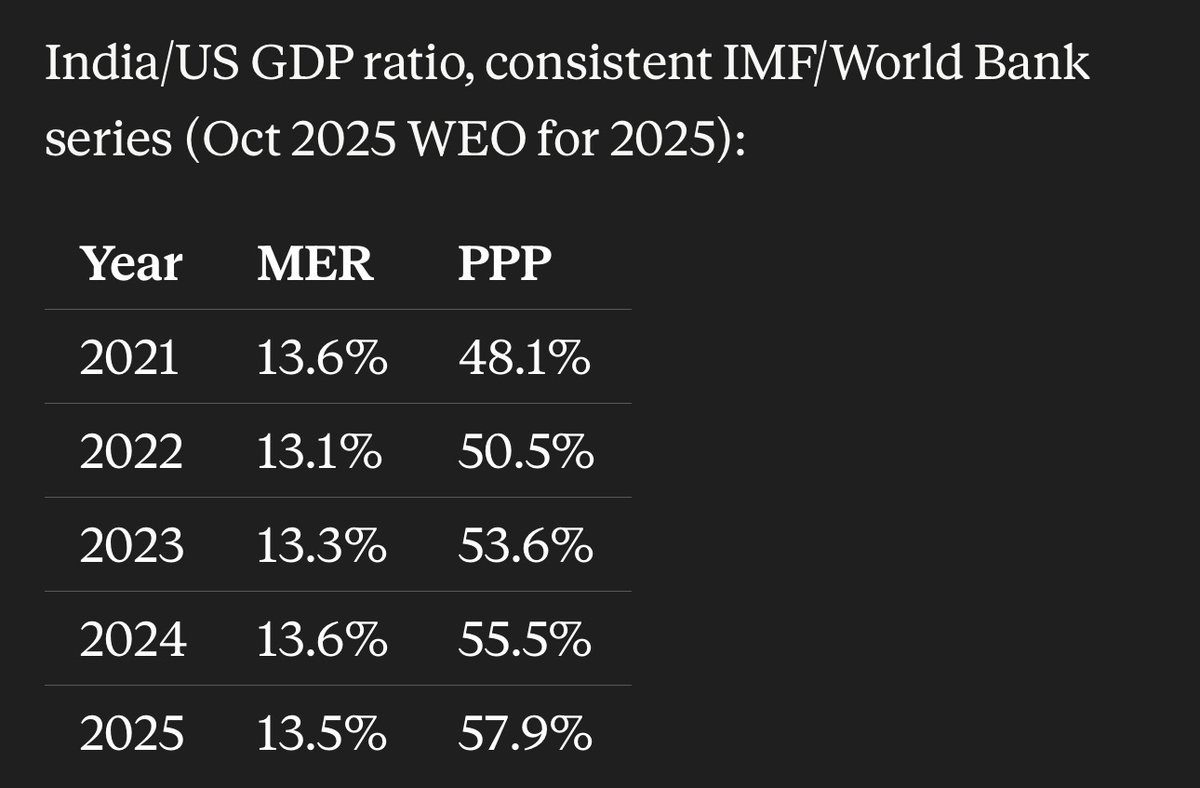
In four years, India has gone from 48% of US GDP PPP to 58%.
In that time, China has gone from 124% to 134%.
Do not be confused or carried away by currency cycles.
We are living in an epic shift of power eastwards.
The Brits too had a fin de siècle arrogance. It all came crashing down soon.
If you read 20 minutes a day, you see roughly 2 million words a year. If you read less than a minute, you see around 8,000. That exposure gap is most of why one person will write well by age 18 and the other won't.
In 2018, education researchers combined 54 experiments on 5,018 students to test whether reading actually makes people better writers. Reading improved writing more than most writing classes did on their own.
There are two reasons for this. The first is sheer volume. The average American high school graduate knows around 40,000 words, and you can't teach 40,000 words in a classroom. Direct vocabulary lessons cover a few hundred a year at best. The rest sneak in through reading. You pick up words the way you pick up slang from a new city. Hear them enough times and they stick.
The second is how the brain handles it. Brain scans show that reading and writing use heavily overlapping regions, especially the parts that handle language. When you read a sentence that works, your brain is quietly rehearsing the machinery you'll need to write one. Reading is practice for writing, even when you're not trying to practice.
Stephen Krashen, a language researcher at USC who has spent more than 40 years on this question, put it about as bluntly as anyone could. Writing style can't be taught in a classroom. You absorb it. And you absorb it almost entirely through reading.
There's one catch. Reading alone only gets you halfway. The same research that shows reading lifts writing also shows the biggest gains come from doing both, with each one feeding the other. Stephen King reads 70 to 80 books a year, and he writes 2,000 words a day. The reading gives him patterns to copy, and the writing is where he learns to use them.
So: reading is the part you can't skip. Writing is what teaches you to use what reading gave you. You need both. If you're only doing one, make it reading.
Part 2. A hospital in India can take someone who has been blind for years and give them their sight back in six minutes. It costs less than a pizza. And they have done it 6.8 million times.
The hospital is called Aravind. It was started in 1976 by a man named Govindappa Venkataswamy, known as Dr. V. He was 58, had just been forced to retire, and his hands were crippled by arthritis so bad he could barely hold a pen. He had scalpels custom-made for his twisted fingers and still performed over 100,000 eye surgeries in his life.
Two years before he retired, Dr. V walked into a McDonald’s for the first time. He looked at the menu, looked at the assembly line in the back, and came out with an odd idea. He would sell cataract surgeries the way McDonald’s sold burgers.
So he mortgaged his house. His brothers and sisters pooled their life savings. He opened an 11-bed clinic in Madurai. Then he flew to Chicago and enrolled in Hamburger University, the actual McDonald’s training program, to learn how the assembly line worked.
At Aravind, cataract surgery is broken into small steps. Nurses prep one patient while the surgeon operates on another. Each surgeon switches between two tables. The operation itself takes about six minutes.
So far Aravind has seen 55 million patients and done 6.8 million surgeries. More than half of those patients paid nothing. Not a rupee. The ones who can pay subsidize the ones who cannot.
A surgery at Aravind costs between $40 and $125 depending on the lens. In the US, Medicare pays about $1,766 for the same operation. Aravind also has better results. Their complication rate is 1.5%, and serious eye infections happen in about 2 out of every 10,000 surgeries. Most American hospitals are not that good.
They built their own lens factory too, called Aurolab. Imported lenses were costing hundreds of dollars each, so Aurolab makes them for around ten. Today Aurolab produces roughly 10% of the world’s eye lenses and ships to 160 countries.
Every year, Aravind sends doctors and nurses out to rural villages for 2,500 eye camps. They screen people who have been blind for years, bus them to the hospital, operate on them, and bus them back home seeing.
Dr. V died in 2006. His family still runs Aravind. Harvard Business School has been teaching the story as a case study since 1993. I still do not see it in my feed.
A 58-year-old with crippled hands walked into a McDonald’s. Fifty years later, 6.8 million blind people can see.