You've probably seen this video of Disney's latest invention…
The #HoloTile Floor
It's like a treadmill with these key improvements:
▶️You can walk in any direction at any given time
▶️Multiple people can walk on it simultaneously in any direction
Here is how it works
(1/n)
I've been studying the 'hello-world' example from Aiken and Mesh. For a beginner in Cardano's smart contract development like me, both are very easy to follow and understand.
You might ask, what's the difference❓
Well, the on-chain code is the same, written in Aiken. The off-chain code is where the differences lie. Aiken uses Lucid, while Mesh uses their in-house libraries.
So, what should you choose❓
I don't have enough experience using both, so I can't provide you with an informed answer. But...
Personally, based only on these 'hello-world' examples, code-wise, I prefer Mesh a bit more. Of course, as I learn more about both, my preference might change.
Anyway, if you care to read further, here's why I like Mesh (at the moment):
Mesh's code is simpler and more descriptive.
For example, below is the code for creating datum using Lucid (left) and Mesh (right).
At a quick glance, you can immediately tell what Mesh's code does because there are fewer things to interpret. I like that the data structure of the datum in Mesh's code is visible.
In Lucid's code, at line 41, you may need to spend some time wondering.
Of course, there is a reason for Lucid to be a certain way, but I'm just talking about beginner-friendly code here
Here is another example.
Above is the code for obtaining the validator's compiled code and returning it as a hexadecimal string.
The code on the left appears much more complex, involving various libraries (JSON, Deno, cbor) and functions. This is difficult to remember. Additionally, it's not immediately clear, at first glance, whether "toHex" returns a string or a number.
In contrast, the code on the right looks simpler and is easier to remember.
Finally, below is code for creating, signing and submitting a transaction.
The wallet is what prompts you to sign (enter password) when accessing your crypto/NFT. This is very familiar to any crypto user.
So Mesh's code makes a lot of sense having signTx() and submitTx() associated with wallet class.
Lucid's code looks a bit complex than it actually is. If you remove the function lock() and use its content directly, it would look much simpler.
So there it is.
If you reach to this point, thanks for reading.
Below are links to the examples. Hope you enjoy studying them like I did.
Cheers! 😀
Aiken: https://t.co/sKM7rwKlyR
Mesh: https://t.co/lhoVrpZu7S
Ladies and Gentlemen,
Introducing…#BossMoon game‼️🫡
Will be available on Mac, Windows, iOS and Android 🔥🔥
This is ridiculously good quality game. Graphic is nice. Game play is smooth. I like the fact that it’ll be available on mobile which makes sense since everyone is on the go nowadays. @BossCatRC keeps pushing for higher standard 💯
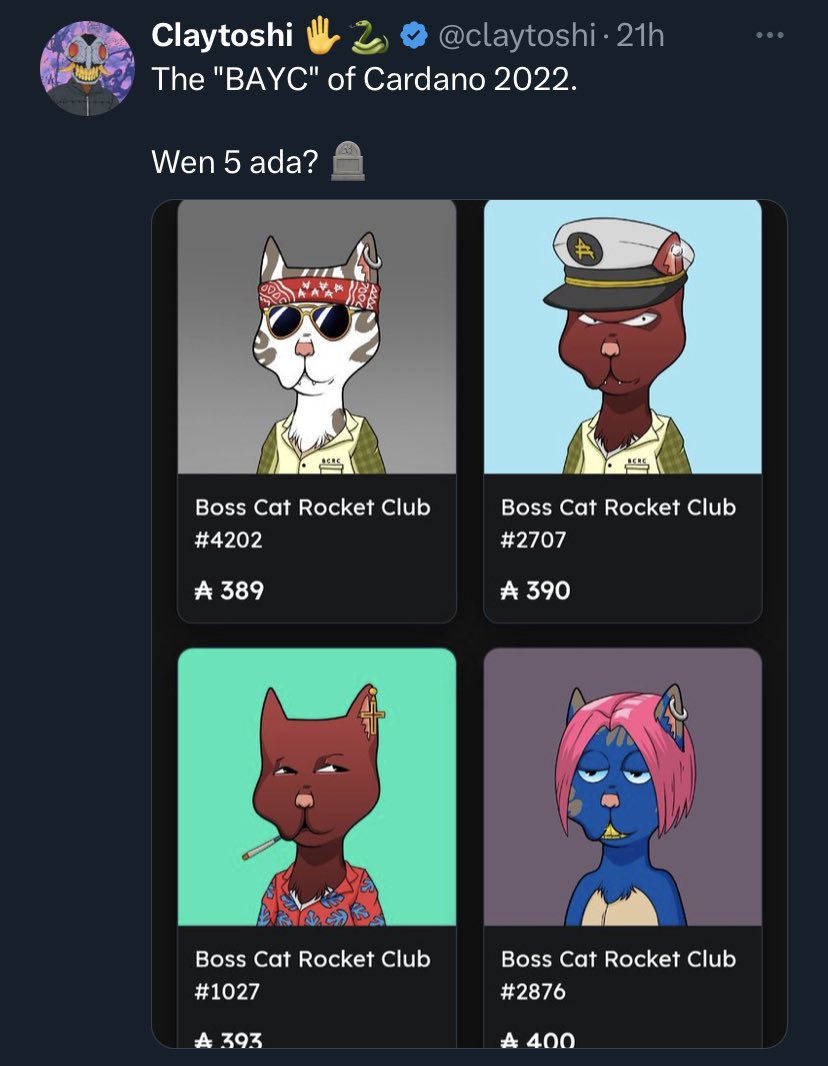
It's funny to see someone hating on BCRC and then say in the comments: "ohh best flip i ever did" or "project where i made the most money" and still have the guts to talk shit about it. How are you gonna talk shit about something that gave profits?!
I don't understand that...
There will be people like this in #ethereum or #cardano. They offer nothing but negativity.
#Haters will ignore anyone’s accomplishments and keep shooting cheap shots like this.
Keep true @BossCatRC
I would not interact with the post and block him immediately. He’s feeding on your engagements.