SI, AI Teams for Grok Bot, Claude Code, ChatGPT, Ollama, LM Studio, Open WebUI, n8n, CrewAI, LangGraph & MCP. Find them. Run them. Fork them. Sell yours.
Forking software is normal.
Forking AI workflows should be too.
Find a Team that’s 80% right.
Use it.
Change the roles, rules, handoffs, or job.
Run your version.
If it holds up, list it.
BotShelf now makes that path explicit.
You do not need to invent every useful AI Team from zero.
Nice, go for it. The paper is “Prompt Repetition Improves Non-Reasoning LLMs” (Google Research, Dec 2025). The biggest gains showed up on lookup/retrieval tasks when reasoning mode was off — one model jumped from 21% to 97% on a name-index test just by sending the same prompt twice. Keep the model and settings identical, compare 20–30 known-answer examples, and track accuracy plus input tokens. It usually does not help much once chain-of-thought is already on. Curious what you try it on.
An AI trick that sounds wrong: paste your entire prompt twice.
Same wording. Same data. One request.
A December 2025 paper from Google Research reported 47 statistically significant wins across 70 model–benchmark comparisons, with no significant losses, when models were not reasoning step by step.
The interesting part is the mechanism.
In a causal transformer, earlier tokens cannot attend to later tokens. Put your question after a document, and the document’s token representations are built without access to that question.
Duplicate the whole prompt, and the second copy can attend to the complete first copy, including the question. That is the authors’ architectural rationale for the technique.
To test it, send this as ONE message, replacing the placeholders with identical content in both blocks:
Task: [your task]
Data: [your input]
Output: [required format]
Task: [your task]
Data: [your input]
Output: [required format]
The extra work happens during input processing, called prefill. The study found no increase in generated answer length and generally similar latency, with exceptions for very long prompts.
The boundary matters: when step-by-step reasoning was enabled, results were mostly neutral. This is not a universal intelligence upgrade.
My suggested test: take 30 examples with known answers. Compare the original prompt against the duplicated version. Keep the model and settings unchanged. Track accuracy, input tokens and latency.
You are doubling the repeated input, not getting free compute.
Before adding another paragraph of instructions, benchmark a second copy.
Yeah, that’s the right way to look at it. Judging cybersecurity in isolation usually just produces a paper solution. You have to stack it against the alternatives under real constraints — cost, ops burden, existing systems, what happens when it fails — or it never survives contact with the actual environment.
1/12
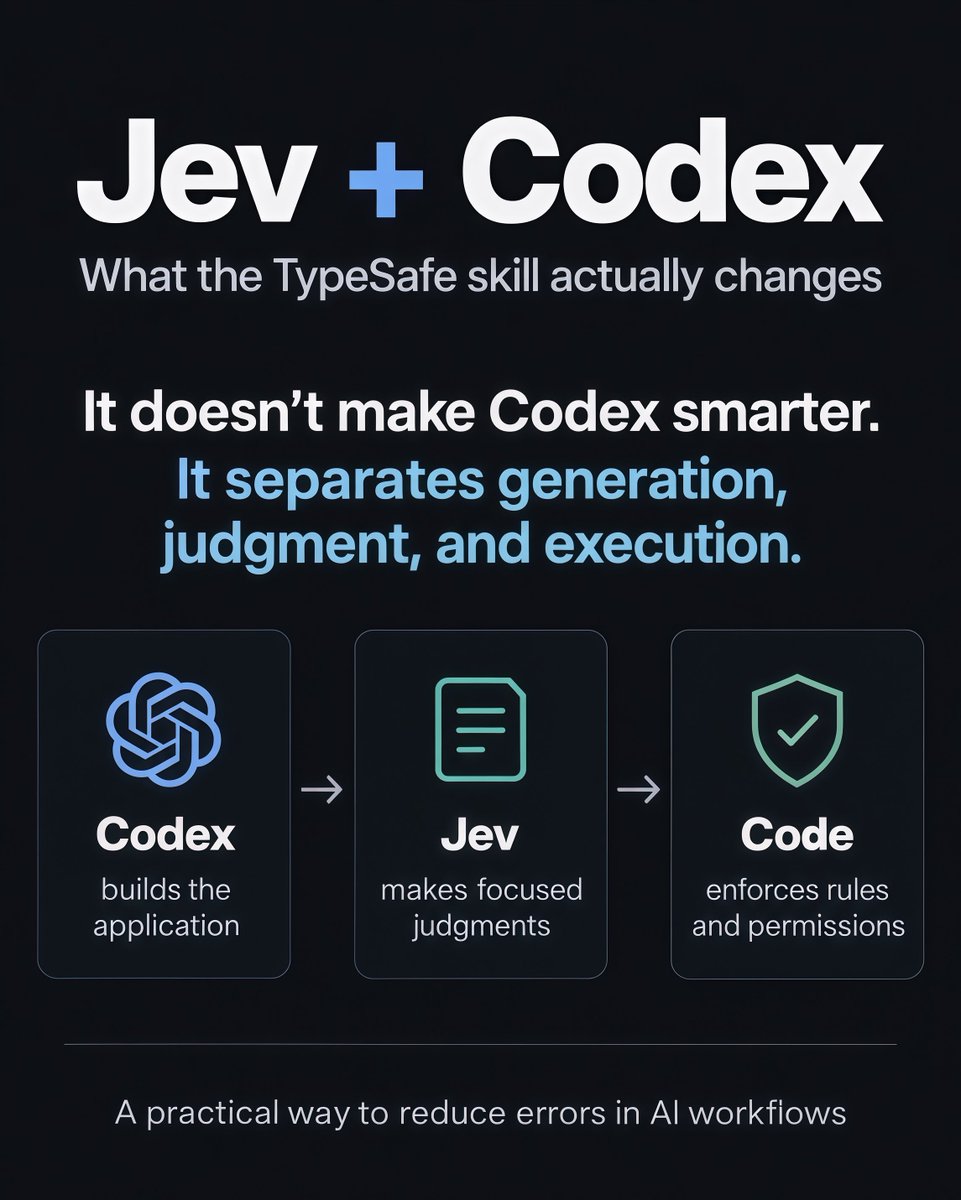
Jev + Codex: what the TypeSafe skill actually changes.
Installing it doesn’t upgrade Codex’s model. It teaches Codex how to build with Jev: a text-only model for focused, structured judgments.
Here’s how to turn that into a useful workflow.
Jev is moving fast.
Here are 20 interesting things people are already building with the Jev API — reordered from practical infrastructure to the more experimental stuff.
1.
typesafe-mcp — Connect Jev to almost any MCP client
https://t.co/bWX6rQtCk5…
2.
jev-mcp — Judgment toolkit for agent workflows
https://t.co/2z7EwaSqCx
3.
fast-jev-compaction — Compress context and cut unnecessary baggage
https://t.co/JZRQiLp1Pp…
4.
json-render — Turn structured output into generative UI
https://t.co/hylVf7h7Dy…
5.
jev-review — Triage code reviews and surface what matters
https://t.co/8sFHcl6wSs…
6.
SemDecide — CLI classifier for fast semantic decisions
https://t.co/VYuPRwEKwp…
7.
Blink — Navigate large repositories faster
https://t.co/kx72R7C4BX…
8.
Winnow — Remove low-value context before it reaches the model
https://t.co/knIGnqlxQF…
9.
Canny — Verify whether an agent actually finished the task
https://t.co/MxpgRH5vay
10.
neo4jev — Knowledge graph traversal with Jev
https://t.co/vsiuV5gXNi
11.
jev-codex-router — Route work across models based on the task
https://t.co/tMiLI0lhbb…
12.
jev-ultrafast — Fast browser agent built around Jev
https://t.co/IZbrD2SH0e…
13.
agent-desktop — Desktop automation with Jev-style decisions
https://t.co/Bq5hiR6Iyg…
14.
jev-curate — Screen training data before it gets used
https://t.co/2Fl8xR83MG…
15.
killmyidea — Score startup ideas before building them
https://t.co/z4T36pVQ0D…
16.
Prism — Detect liquidity signals from market data
https://t.co/481sCEPJK7…
17.
jev-trader — HFT market-making experiments
https://t.co/sLDKQJd3Jl…
18.
typesafe-mario — Jev making decisions while playing Super Mario
https://t.co/RrG7zA6xJf…
19.
jev-drone — Decision logic applied to drone control
https://t.co/ywCMxe7HBb…
20.
OneVOneJev — Browser FPS powered by Jev decisions
https://t.co/zoon1m4FVU…
The interesting part isn’t any single demo.
Jev is already being pushed into browsers, coding agents, model routing, finance, robotics, data pipelines, and games.
Judgment is becoming its own layer in the agent stack.
12/12
Try this in Codex:
$typesafe-ai
Build a local support-triage prototype using fictional data. Check current docs and SDK types. Keep rules in code. Add human review for uncertainty. No replies or production changes. Test against a baseline. Report unverified steps.
11/12
Measure errors, missed cases, human-review rate, automation coverage, latency and cost.
Keep tuning data separate from final evaluation data.
Test code execution separately from Jev’s judgments. A model saying the implementation looks right is not a passing test.
Turn your chatbot into a research desk
Reduce uncertainty before you make a decision that costs money, time, or reputation.
HOW TO USE THIS
What you get:
The decision is defined first.
Facts, claims, assumptions, and opinions stay separate.
SEO posts and recycled articles are less likely to be treated as primary evidence.
Contradictions are flagged instead of averaged away.
Risks and missing data stay visible.
You finish with one concrete next action.
Use it for:
Buy vs skip, vendor selection, contract review, pricing, regulation, tool adoption, and pre-investment research.
Do not use it for:
Casual chat, brainstorming, or copyediting.
HOW TO RUN IT
Step 1: Start a new chat
Open ChatGPT, Claude, Gemini, or any web-enabled model. Do not mix this into an old thread.
Step 2: Paste the prompt first
Use the prompt under “PASTE THIS FIRST” below. Do not add your question yet.
Step 3: Give it a specific task
After the model confirms the role, send your task in this format:
Decision:
Deadline:
Budget or constraints:
What I already know:
What I must verify:
Bad input:
“What do you think?”
“Look this up.”
Good input:
Decision: Whether to put Vendor A into production next month.
Deadline: 7 days.
Budget or constraints: Under $2,000 per month. No personal data stored outside the region.
What I already know: The vendor claims a 99.9% SLA.
What I must verify: Outages in the last 90 days, real price, and termination terms.
Step 4: Read the answer in this order
DECISION
VERIFIED FACTS
CONFLICTS
RISKS
MISSING DATA
ACTION
SOURCES
Step 5: Check the evidence before acting
Do not execute ACTION until you check that:
VERIFIED FACTS include numbers and dates.
SOURCES are primary.
CONFLICTS and MISSING DATA are not empty by default.
Old evidence is not presented as current fact.
If the answer is vague, unsourced, or too clean, send this:
“Re-run on primary sources only. Put a date on every material fact. Do not hide contradictions. If evidence is weak, say it is weak.”
Step 6: Ask only for the missing piece
Do not restart the whole search. Ask a targeted follow-up:
“Verify termination fees from primary sources only.”
“Get outage reports from the last 90 days only.”
Step 7: Make the final call
This prompt improves the brief. It does not replace judgment.
PASTE THIS FIRST
YOU ARE MY RESEARCH OPERATOR
Do not summarize the internet. Reduce uncertainty before I decide.
For every task:
State the exact decision this research must support.
Separate facts, claims, assumptions, and opinions.
Start with primary sources.
Prefer data published in the last 90 days when recency matters.
Cross-check material claims with at least two independent sources.
Flag contradictions. Do not average them away.
Reject circular citations and recycled secondary reporting.
Extract numbers, dates, prices, limits, requirements, and dependencies.
State what remains unknown.
End with one concrete next action.
RETURN THIS FORMAT
DECISION
The decision this research supports.
VERIFIED FACTS
Evidence-backed statements only.
CONFLICTS
Where credible sources disagree.
RISKS
What would make the conclusion wrong.
MISSING DATA
What still requires verification.
ACTION
The single best next step given the evidence.
SOURCES
Primary sources first, with publication or update dates.
HARD RULES
Never invent a source.
Never hide uncertainty.
Never treat an SEO article as primary evidence.
Never use stale evidence for a current claim without flagging it.
If the evidence is weak, say so.
If stronger evidence exists, keep searching.
Save it. Use it on the next decision that actually costs something.
More production-ready AI workers:
https://t.co/RiqgVReihk
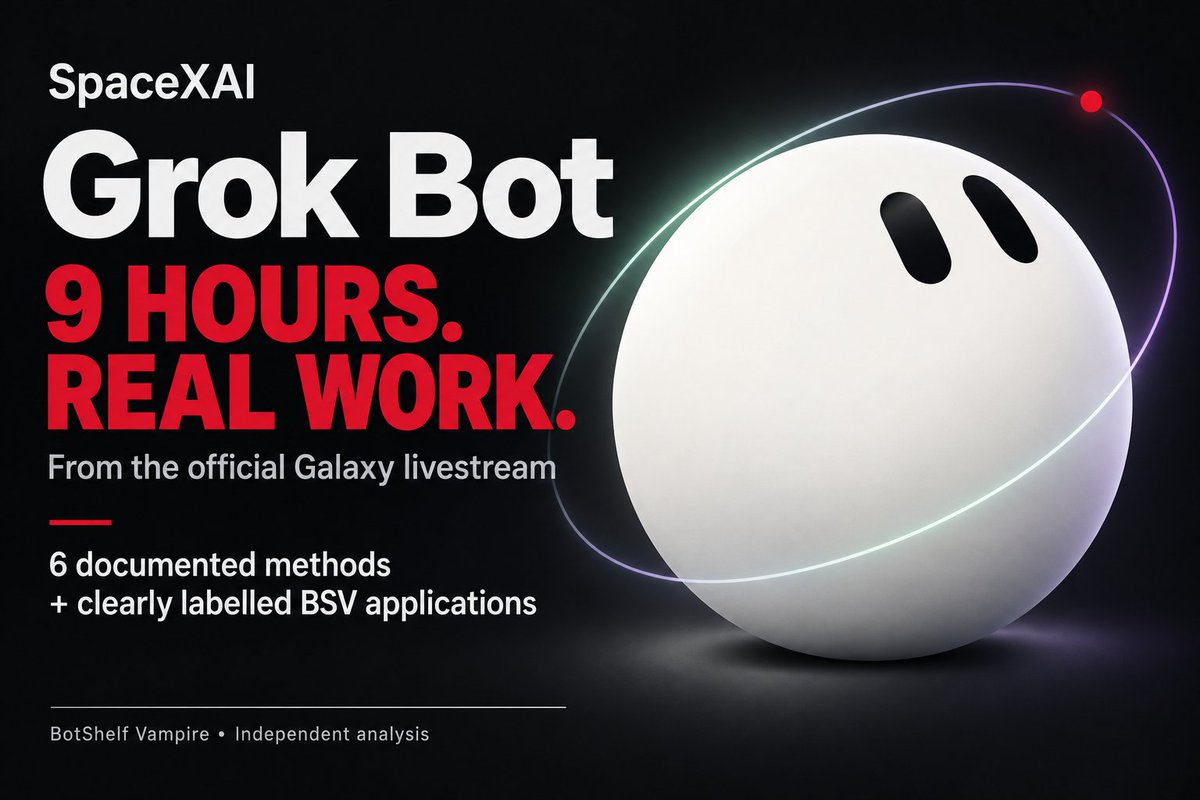
SpaceXAI put its Grok Bot team on an official, almost 9-hour livestream.
The interesting part isn't a magic prompt. It's how you turn a request into work another agent can check.
The official Day 1 broadcast below runs 8:51:13. For the practical breakdown, we checked the team's published guides. This is not a transcript: each section separates the documented method from BSV's suggested implementation. None of the prompts below is presented as something a speaker typed on stream.
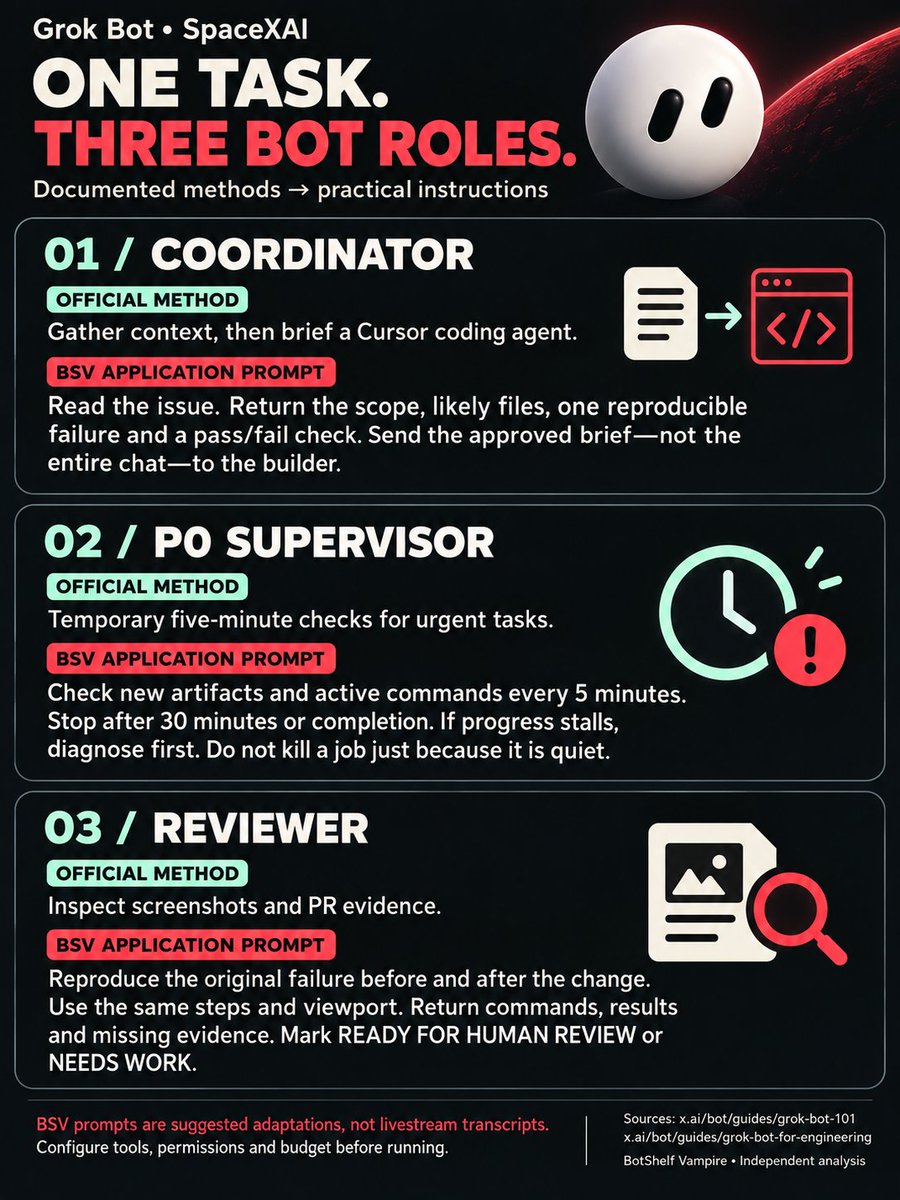
1. Give the coding agent a clean brief
Official method: Matt Palmer describes an outer-loop bot gathering context and preparing instructions for a specialized coding agent in Cursor. The coordinator and builder do different jobs.
Source: Grok Bot 101.
BSV adaptation — copy into the coordinator:
"Read the supplied issue and first-party docs. Create a build brief: observed problem, source links, likely files, allowed scope, non-goals, one reproducible failure, and a pass/fail check. Label assumptions. Send the approved brief to the coding agent, not the entire research conversation."
Try it on one existing issue. If a fresh builder cannot reproduce the problem from the brief, the handoff isn't ready.
2. Use the five-minute loop for genuine urgency
Official method: Lingxi Li describes a temporary five-minute transcript check for P0 tasks, with intervention when a coding agent wastes time. The guide explicitly warns about faster token consumption.
Source: Grok Bot for Engineering, P0 urgency process.
BSV adaptation — copy into a supervisor:
"For this urgent task, check progress every 5 minutes for at most 30 minutes. Record the last new artifact, active command, expected duration if known, and blocker. After two checks without new evidence, ask one diagnostic question. Do not kill a job merely because it is quiet. Allow two recovery attempts, then return the checkpoint and the decision needed. End the monitor when the task ends."
The 30-minute cap and two-attempt limit are BSV's suggested controls, not the speaker's settings. A long test can be healthy; a repeated promise is not progress.
3. Ask for proof the agent can inspect
Official method: the engineering guide describes bots examining screenshots and PR evidence, then sending work back when it misses the requested result.
Source: Grok Bot for Engineering, feedback loop.
BSV adaptation — copy into a reviewer:
"Reproduce the reported failure on the base revision in an isolated test environment. Repeat the same steps on the candidate revision. Return exact commands, environment, both results, and a regression test. For UI changes, use the same viewport for before/after captures. Mark anything you could not reproduce. Return READY FOR HUMAN REVIEW or NEEDS WORK; do not merge."
Our added check is the same reproduction on both revisions. Two attractive screenshots alone do not prove a bug is fixed.
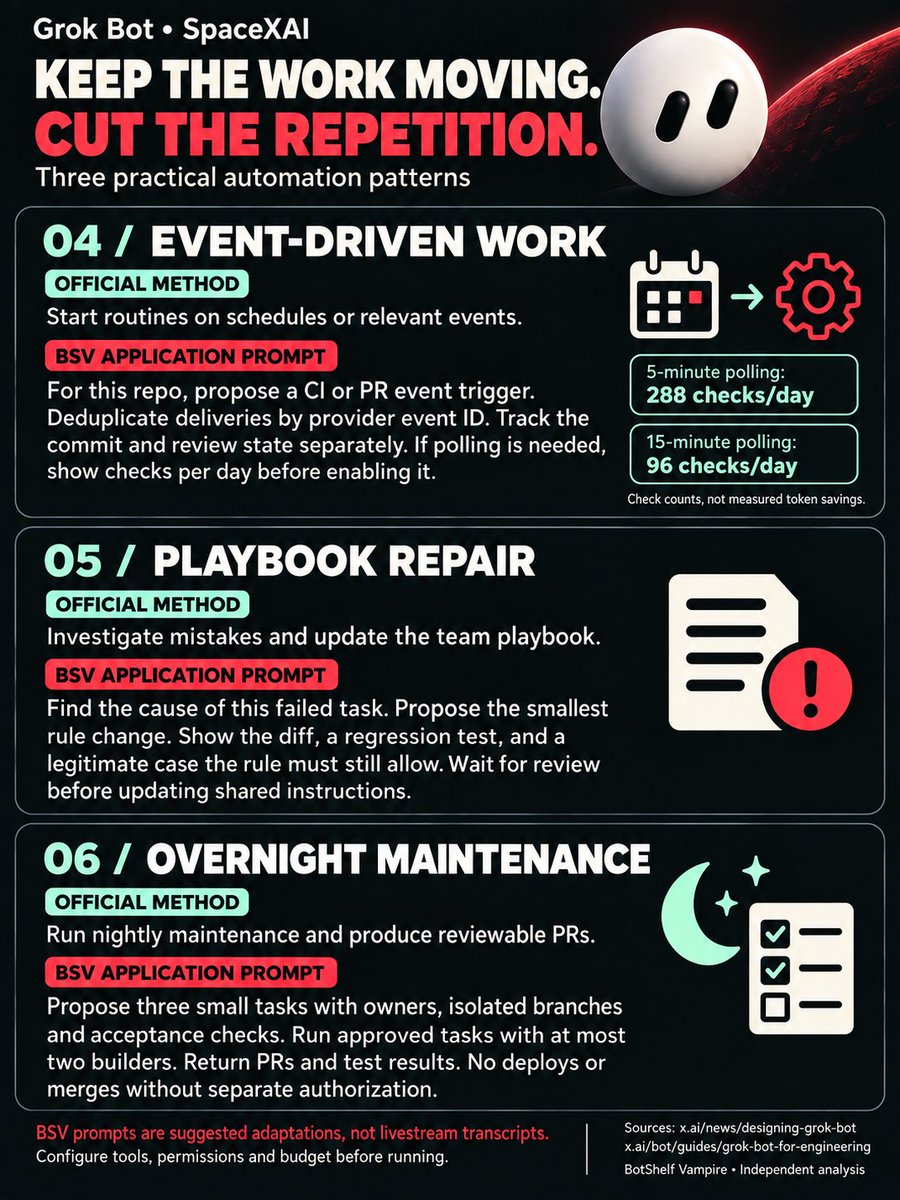
4. Trigger work when something changes
Official method: xAI documents both scheduled routines and event-triggered work, including repository and workflow events.
Source: Designing Grok Bot for a world of persistent agents.
BSV adaptation — copy into a workflow designer:
"For this repository, propose a review trigger for completed CI or PR updates. Use the provider's event ID for delivery deduplication. Track the PR head commit and the review/check state separately, so a genuinely new result on the same commit is not discarded. If events are unavailable, propose a polling interval and show checks per day before enabling it. Notify on changed decisions or required action."
At 5-minute intervals, a 24-hour routine makes 288 checks. At 15 minutes, it makes 96. That is 3× fewer scheduled checks—not a measured token-saving claim.
5. Fix the shared process after a mistake
Official method: the engineering guide describes an operations bot investigating mistakes and updating a team playbook.
Source: Grok Bot for Engineering, mini org.
BSV adaptation — copy into the playbook owner:
"Investigate this failed task. Identify the specific instruction, missing input, or tool failure involved. Propose the smallest rule change. Show the old/new diff, one test that catches this failure, and one legitimate case the rule must still allow. Wait for review before changing shared instructions."
The review gate and regression checks are our additions. The point is to correct a specific recurring failure, not keep appending vague warnings.
6. Make overnight work reviewable
Official method: the engineering guide describes nightly maintenance that produces PRs for later review.
Source: Grok Bot for Engineering, nightly audits.
BSV adaptation — copy into the coordinator:
"Inspect the provided repository. Propose three small maintenance tasks ranked by user impact, each with an owner, isolated branch, acceptance check, and expected evidence. Run approved tasks with at most two concurrent builders. Return reviewable PRs and test results. No production deploys, dependency upgrades, or merges without separate authorization. Leave unfinished work at a reproducible checkpoint."
Three tasks and two builders are a small starting configuration we suggest—not a limit or recommendation attributed to SpaceXAI.
Before running any example, choose the repository, connected tools, permissions, and budget. These are starting templates, not tested end-to-end integrations. Prompts cannot create access or enforce a hard spending limit; use platform controls where available.
Start with one task. Can another agent verify the result without asking the builder what happened?
That is a more useful benchmark than how many bots appear busy.
Official sources:
https://t.co/PmPcG7cO0k
https://t.co/D4rlyDAOA6
https://t.co/GyM0PjDgS5
Research lead: @unicodef1wn's 30-trick recap. BSV's contribution here is the explicitly labelled application layer—not a rewritten set of "official prompts".