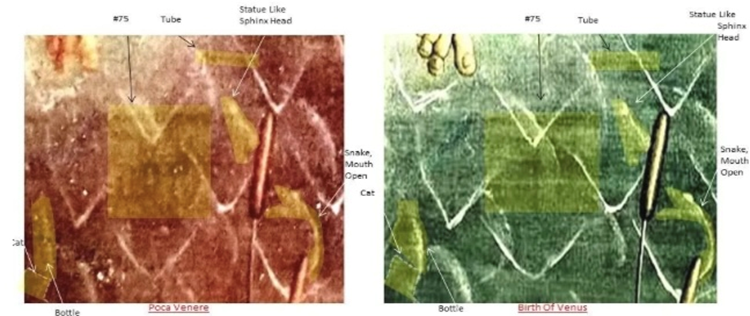
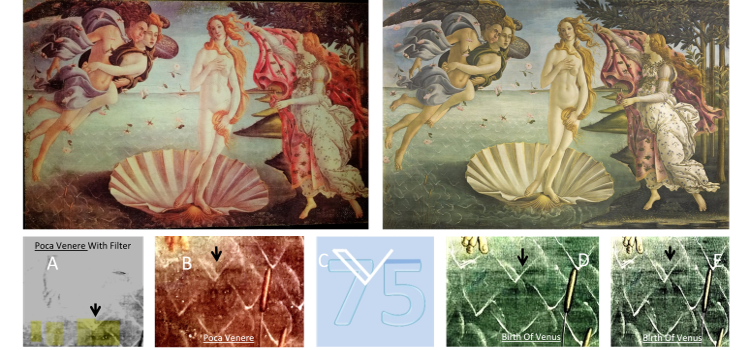
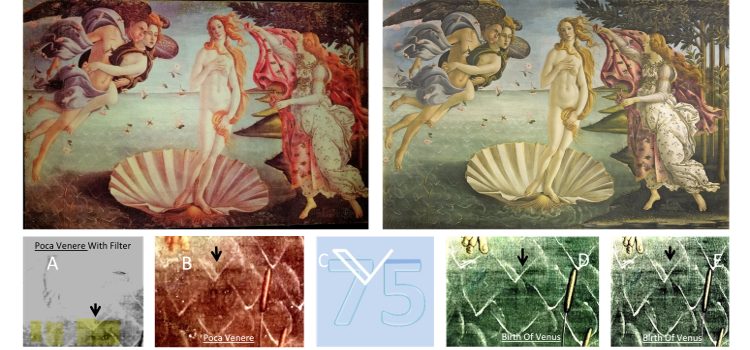
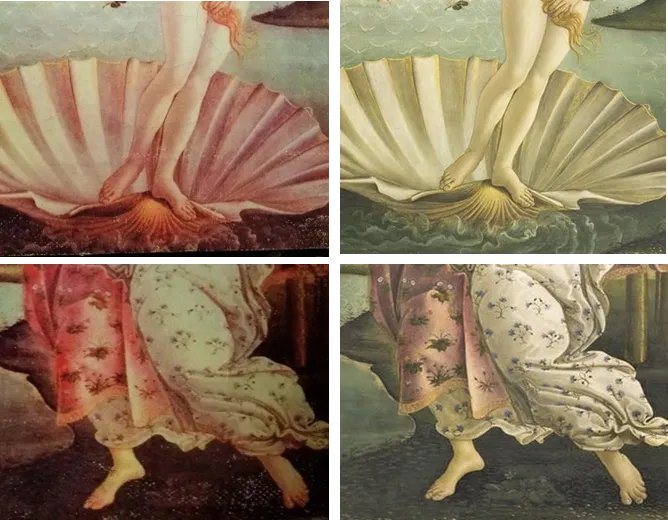
The Botticelli Code — and the research behind it — is dedicated to Poca Venere (below), a newly uncovered painting which I discovered in a Goodwill thrift store in 2018. While I lace several blogs with a little snark (not a full-on snark attack), this story serves as a serious record of the extraordinary visible and hidden content found in Poca Venere. These findings, in turn, reveal similarly hidden content in Botticelli’s iconic The Birth of Venus — hidden content that has remained unseen for nearly 600 years.
That's why I call this story The Botticelli Code. It's not just the discovery of a lost Renaissance work; it's an enigmatic narrative that's been quietly waiting to be told for centuries. Central to this story is an unprecedented numeric and pictorial code embedded in Poca Venere, which directly links it to Birth of Venus, using almost identical hidden images. To be clear: this hidden content has never before been identified in Birth of Venus — not by centuries of scrutiny, nor by modern imaging technology. Yet it is unmistakably present when viewed through the lens of Poca Venere. This story also documents my journey of discovery — how the content was revealed, the methods behind the research, and the context surrounding the find. While I attribute Birth of Venus to Botticelli — the consensus among art historians — I remain open to an alternative attribution should compelling new evidence arise.
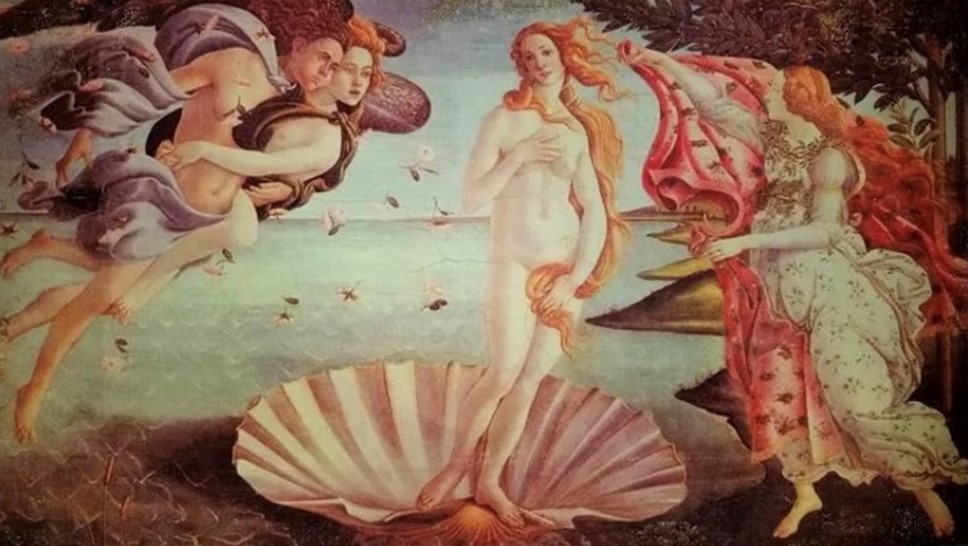
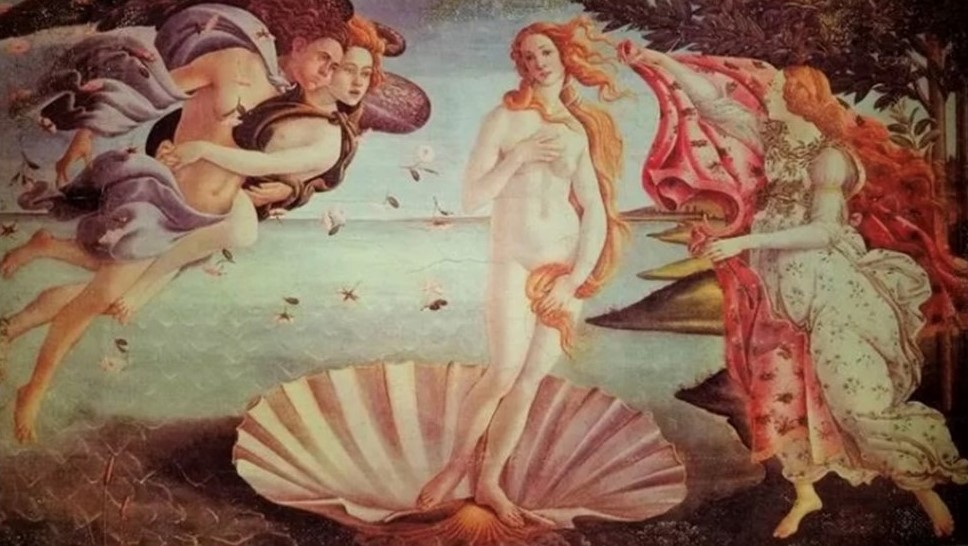
Revisiting The Birth of Venus Painted between 1485 and 1487, Birth of Venus is considered a masterpiece of the Italian Renaissance. Created in tempera on canvas — a medium seldom used by artists after the Early Renaissance — this work measures nine feet by five feet and resides in Florence’s Uffizi Gallery. It depicts the mythological birth of Venus, goddess of love and beauty, blown to shore by Zephyr, god of the west wind. It is widely regarded as one of the most beautiful paintings in fine art history. And yet, surprisingly little is known about it. It was likely commissioned by a Medici patron, though we’re not sure which one. Its attribution to Botticelli relies almost entirely on Giorgio Vasari’s Lives of the Most Excellent Painters, written decades after Botticelli’s death.
Enter Poca Venere The painting I found — Poca Venere — measures 28 by 18 inches, and is also painted in tempera on canvas panel. It contains all of Botticelli’s initials, and is dated 1475, predating Birth of Venus by ten years. More than that, it functions as a kind of visual cipher: a key that helps decode the ambiguous content in Birth of Venus. This key has unlocked numerous discoveries in Birth Of Venus: the conceptual date, the completion date, and even a hidden signature. Intriguingly, the Venus in Poca Venere resembles Simonetta Vespucci, considered by many historians to be Botticelli's muse — unlike the figure in Birth of Venus, strengthening the belief that Simonetta inspired his ideal of feminine beauty. A renowned Leonardo da Vinci scholar, now suggests Poca Venere could help prove that Birth of Venus was actually painted by da Vinci.
Transparency vs. Gatekeeping I have been thoroughly transparent. I've invited any qualified museum or academic institution to examine Poca Venere and my research. So far, none have accepted the offer. Why? It seems the art world is far more comfortable acting as a gatekeeper than as an explorer. When someone outside the elite institutions presents an undocumented painting — especially one that challenges long-held assumptions — they’re often dismissed outright, regardless of the evidence. I welcome debate. I’d gladly go toe-to-toe with any Botticelli scholar on this attribution — bring it on. The evidence attributing Poca Venere in my research is far more conclusive than that accepted in any recent Botticelli discovery. I am mystified by art history scholars who refuse to even look at one of the most remarkable art discoveries in centuries. Stranger yet, they aren't even interested in the astonishing content I've uncovered in their own painting, Birth Of Venus — unseen by any scholar in five hundred forty years. That's not normal — except in the arcane world of art history scholarship.
Poca Venere is a litmus test of sorts. Is there any level of evidence that a non-elite collector can provide to substantiate the attribution of an undocumented work of art — acceptable to the art establishment? Conversely, is there even a minimum standard of attributional evidence that is required of the establishment's intelligentsia? Historically the evidence attributing paintings has been judged by the perceived status of its researcher or the painting's owner, not by its strength. Basically a gentleman's agreement between the patrician class and the cultural establishment, without a hint of hard evidence. It's no wonder that a recent study conducted by the Swiss Art Institute concluded that half of all historical art is either forged or misattributed. Attribution with the accuracy of a coin toss, not a good look. This is the natural result of centuries of elite cronyism in the collection of fine art — which persists to this day. Ironically, these are the same institutions that proudly promulgate diversity, equity and inclusion — maybe for some, but not for researchers or collectors that aren't club members. Universal access to digitized archives might be the one thing that can infuse a little populism and actual scholarship into the practice of art history scholarship.
I recently had occasion to present my painting's research to an art establishment luminary. This expert had asked for photographs of Poca Venere but never looked at any of the research I also provided. He spazzed out and screeched from his lofty perch: "it doesn't matter what I think, the opinion of a Botticelli expert is the only thing that matters!" This prompted my response: "So tell me, where then is the entry point for stepping onto this arcane carnival ride. I understand that a Botticelli expert has to punch your ticket, to jump on the spinning ride — with museums, universities and exhibitors. There are probably less than ten of these experts in the world for any given artist, and they are intentionally unapproachable. Not to stretch this metaphor much further — but these experts have nothing to gain by punching your ticket, and precious credibility to lose with their peers, by sticking their neck out — ask (redacted name of Botticelli scholar). At some point in the distant past, academic curiosity and art for art's sake, might have been a thing, but no longer. For whatever reason, a proud member of the unwashed masses (me) has been given one of the most remarkable works of art in centuries, as bizarre as that sounds. Even though I have been tossed off the ride several times, I'm still naive enough to believe that the overwhelming visual correlation between Poca Venere and Birth Of Venus, will eventually prevail. I won't give up until I die, or become demented or something. Cheers!"
Today the art establishment exists within its own feedback loop and ignores the masses with their cherished art relics and annoying questions. Ninety-nine out of a hundred times nothing of importance is lost — but what about that one remarkable painting that could change everything — which slipped through their indifferent fingers? Scholars traditionally explore the unknown and challenge the known — instead of just regurgitating the same interminable narrative. Maybe it's time for a more academically curious, inclusive and evidence-based approach to art history — starting with this remarkable work of art, which sadly was greeted by the sound of crickets, after five hundred sixty years in anonymity.
Website- https://t.co/mLHYpnuipn
Amazon Books- https://t.co/frfkBVJYos
What if a $7.99 Goodwill painting held a key to one of the most famous paintings in the world?
In 2018, I discovered a small Renaissance painting at a Goodwill thrift store. I named it Poca Venere (Little Venus). What I found in it eventually led me to something I never expected: hidden pictorial and numerical relationships that connect it directly to Botticelli's The Birth of Venus.
Website- https://t.co/mLHYpnuipn
Amazon Books- https://t.co/frfkBVJYos
The hidden content that I've discovered in Botticelli's The Birth Of Venus (right), is unambiguous.
This content was not uncovered by modern imagining technology — but was only found using an unknown painting, Poca Venere. Why are our cultural institutions not interested in this remarkable discovery?
Website- https://t.co/mLHYpnuipn
Amazon Books- https://t.co/frfkBVJYos
It's very clear that there are hidden images in Botticelli's iconic The Birth Of Venus (right).
These images have now been uncovered for the first time in 540 years using the newly discovered painting Poca Venere (left).
Website- https://t.co/mLHYpnuipn
Amazon Books- https://t.co/frfkBVJYos
For centuries, millions of people have looked at The Birth of Venus.
I believe something else is hiding in plain sight.
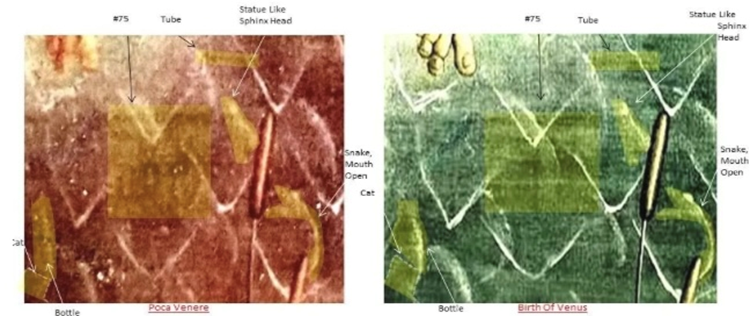
Using my newly discovered painting Poca Venere as the key, I began seeing a second layer of imagery in Botticelli's painting.
Here's the detail. This is a magnified section of each painting near Zephyr's foot — Poca Venere (left) and Birth Of Venus (right). PowerPoint highlighting has been added, but absolutely no AI has been employed.
What do you see?
Website- https://t.co/mLHYpnuipn
Amazon Books- https://t.co/frfkBVJYos
This is the story I call The Botticelli Code.
A Goodwill discovery.
A Renaissance painting.
The visual and numerical connection to The Birth of Venus.
And one very persistent outsider trying to get people to look.
The investigation begins here.
Website- https://t.co/mLHYpnuQeV
Amazon Books- https://t.co/frfkBVKwe0
Could Poca Venere (left) contain a visual code that helps decode previously overlooked content in The Birth of Venus (right)?
I'm not asking you to accept that conclusion.
I'm asking you to look.
My research has led me to propose connections involving imagery, numbers, dates and what I interpret as a hidden signature.
Some of these propositions are straightforwardly testable.
Others require interpretation.
I'll show you the evidence over the coming days.
Website- https://t.co/mLHYpnuipn
Amazon Books- https://t.co/frfkBVJYos
That realization changed how I looked at The Birth of Venus (right).
Using Poca Venere (left) as a visual reference, I began seeing what I believe are previously unidentified images and relationships within Botticelli's famous painting.
Here is one of them.
Website- https://t.co/mLHYpnuipn
Amazon Books- https://t.co/frfkBVJYos
Poca Venere measures only 28 × 18 inches.
It's painted in tempera on canvas panel, and I believe it contains Botticelli's initials.
Most intriguingly, it is dated 1475—about a decade before the generally accepted date of The Birth of Venus.
But the date was only the beginning.
Website- https://t.co/mLHYpnuipn
Amazon Books- https://t.co/frfkBVJYos
As I studied Poca Venere (left), I began finding a remarkable series of visual relationships.
Some appear to correspond to details in The Birth of Venus (right).
Eventually, I began to suspect that Poca Venere wasn't simply another Renaissance painting.
It might be a key.
Website- https://t.co/mLHYpnuQeV
Amazon Books- https://t.co/frfkBVKwe0