Closed-Loop Prompt Optimization
Manual prompt iteration is slow.
Production systems can optimize prompts automatically using real feedback.
Here’s the Closed-Loop Optimization Framework I now experiment with:
**Closed-Loop Prompt Optimization Framework**
1. Collect quality signals from production (thumbs, corrections, downstream success)
2. Identify underperforming prompt variants
3. Generate and test improved candidates offline
4. Shadow test promising new prompts
5. Promote winners and retire losers
6. Keep humans in the loop for safety-critical changes
Core principle: The best prompt is the one that keeps improving from real usage.
Pro tip: Start with a narrow, high-traffic use case before expanding.
Do you currently run any closed-loop prompt optimization?
Reply below 👇
Follow @AiCamila_ for advanced production AI patterns.
#PromptOptimization #ClosedLoop #AgenticAI #ProductionAI #LLMOps #DevOps
All Paid Courses (Free for First 4500 People).
𝗣𝗮𝗶𝗱 𝗖𝗼𝘂𝗿𝘀𝗲 𝗙𝗥𝗘𝗘 (PART - 1)
1. Artificial Intelligence
2. Machine Learning
3. Prompt Engineering
4. Claude, ChatGPT, Grok
5. Data Analytics
6. AWS Certified
7. Data Science
8. BIG DATA
9. Python
10. Ethical Hacking
(72 Hours only )
Like + RT + comment '' Drive ''
Must Follow me so I can DM you.
Voici une autre aberration du féminisme occidental ; hurler “Fuck le patriarcat” tout en scandant “Bienvenue aux réfugiés”. Accueillir massivement des hommes musulmans élevés dans l’ultra-patriarcat et la misogynie, c’est du pur délire. C’est le comble du paradoxe.
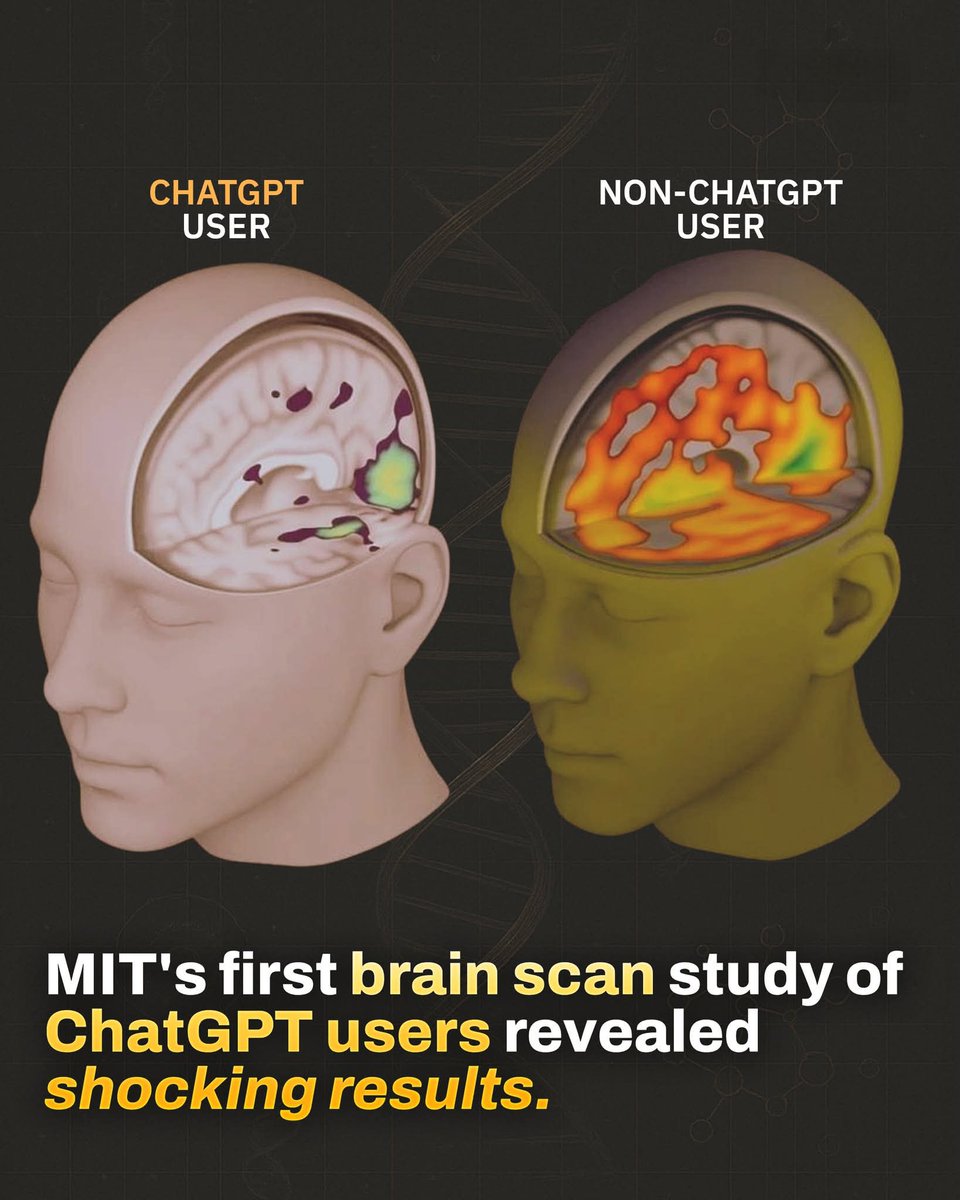
🧠 MIT recently completed the first brain-scan study on ChatGPT users—and the results are deeply revealing.
Rather than boosting brain function, prolonged AI use may be dulling it.
Over four months of cognitive data suggest we might be measuring productivity all wrong ⤵️
In MIT’s study, participants had their brains scanned while using ChatGPT.
→ 83.3% of users couldn’t recall a single sentence they’d written just minutes earlier.
→ In contrast, those writing without AI had no trouble remembering.
Brain connectivity dropped sharply—from 79 to 42 points.
→ That’s a 47% drop in neural engagement.
→ The lowest cognitive performance among all user groups.
Even after stopping ChatGPT use in later sessions, these users showed continued under-engagement.
→ Their performance remained lower than those who never used AI.
→ This suggests more than dependency—it’s cognitive weakening.
Beyond the scans, educators flagged the writing itself.
→ Essays were technically solid, but often called “robotic,” “soulless,” and “lacking depth.”
Here’s the paradox:
→ ChatGPT makes you 60% faster at completing tasks…
→ But it reduces the mental effort required for learning by 32%.
The top-performing group?
→ Those who began without AI and added it later.
→ They retained the best memory, brain activity, and overall scores.
Using ChatGPT can feel empowering—but it may quietly offload your thinking.
→ You gain speed, but lose engagement.
→ You get answers, but stop learning how to think.
The takeaway isn’t to avoid AI—but to use it intentionally.
→ Use it to assist, not replace your mind.
→ Build cognitive strength—not dependency.
MIT’s early study on AI and the brain lays out the stakes. The way we use these tools matters more than ever.
@Langerius@fuseenergy This is the kind of regulatory W that turns "wait and see" into "all in"—$ENERGY isn't just token theater, it's grid armor for the AI boom. Fuse flipping homes into power plants? Chef's kiss. Who's shorting the skeptics? ⚡️🚀
Inaceptables y de extrema gravedad las denuncias reveladas por @NoticiasCaracol sobre presuntos vínculos entre altos funcionarios del Estado y alias Calarcá.
La señora fiscal le debe respuestas claras al país: ¿qué ocurrió con la información incautada a alias Calarcá?, ¿por qué fue dejado en libertad?, ¿por qué las investigaciones siguen detenidas?
Colombia exige acciones inmediatas, firmes y transparentes frente a hechos de esta magnitud. El país no puede permitir que la duda siga oscureciendo la confianza en sus instituciones.