When my son gave his graduation speech, he began reading from a prepared text. "I want to thank my mother & the wonderful influence she has had on my life. She is a shining example of parenthood." He paused, looked up & said, "Sorry, it's so hard to read my mum's handwriting."
Grievance is an efficient solvent for restraint, because it lets you act badly while feeling righteous doing it. A dangerous combo. Another issue is that it's easy for us to fool ourselves, as Feynman said. You stop measuring your behaviour against your own standards and start measuring it against the worst thing the people you resent did recently, which means the lower limit of your ethical downfall is now being set by the people you claim to be better than.
A Soviet psychologist walked into a café in 1927 and watched a waiter do something impossible.
He remembered every open order at every table. Perfectly. Without notes. Without effort.
Then a table paid their bill. She asked him to repeat the order.
He couldn't remember a single item.
She spent the next two years figuring out why. What she found is now the operating system underneath every platform fighting for your attention.
Her name was Bluma Zeigarnik, and she was a graduate student at the time, sitting with her professor Kurt Lewin, watching the waiters work the room. What caught her attention was something so ordinary that it had been happening in restaurants for centuries without anyone asking why.
The waiters could remember every open order with perfect accuracy. Table four wanted the schnitzel with no sauce. Table seven had changed their wine twice. Table twelve owed for three coffees and a dessert. Every detail, held without effort, without notes, without any visible system at all.
But the moment a table paid their bill, the information vanished. Completely. Lewin tested it on the spot. He called a waiter back minutes after a table had settled up and asked him to recite the order. The waiter could not do it. Not partially. Not approximately. The information was simply gone.
Zeigarnik went back to her lab and spent the next two years turning that observation into one of the most replicated findings in the history of psychology.
Here is what she proved, and why it changes how you think about attention, memory, and almost every piece of media you have ever consumed.
She gave participants a series of tasks. Some tasks they were allowed to finish. Others were interrupted before completion. Then she tested recall across both groups.
The unfinished tasks were remembered at nearly twice the rate of the completed ones.
Not slightly better. Nearly twice. The brain was holding the incomplete work in a state of active tension, returning to it, keeping it warm, refusing to file it away. The finished tasks were closed, archived, released. The unfinished ones were still running.
She called it the resumption goal. When the brain commits to a task and cannot complete it, it opens a file that stays open until resolution arrives. That open file consumes a portion of your cognitive bandwidth whether you are thinking about it consciously or not. It surfaces in idle moments. It pulls at the edge of your attention during other work. It is the thing you find yourself thinking about in the shower when you were not trying to think about anything at all.
This is not a flaw in human cognition. It is a feature. The brain evolved to finish things. An open loop is a signal that something important is unresolved. Keeping that signal active increases the probability that you will return to it and complete it. In an environment where most tasks had real survival stakes, this was an extraordinarily useful mechanism.
In the modern world, it is the most exploited vulnerability in human attention.
Netflix did not invent the cliffhanger. But it industrialized it in a way no medium before it ever had. When a show ends on an unresolved question, it does not just create curiosity. It opens a file in your brain that stays active until the next episode closes it. The autoplay countdown that begins at 15 seconds is not a convenience feature. It is a precise calculation about how long the average person can tolerate an open loop before the discomfort of not knowing overrides every other intention they had for the evening. One more episode is not a choice. It is your brain doing exactly what it was designed to do: return to what is unfinished.
The writers who built Lost, Breaking Bad, and Succession understood this intuitively without ever reading a psychology paper. Every episode ended on an open question. Every season finale answered three things and opened five more. The entire architecture of prestige television is a Zeigarnik machine running at industrial scale.
But television is not where this gets dangerous.
Every notification on your phone is an open loop. Every unread email is an open loop. Every task you wrote on a list and have not yet crossed off is an open loop. Each one is consuming a small but real portion of your available attention, pulling fractionally at your focus, degrading your capacity to be fully present in whatever you are actually doing right now. TikTok's algorithm does not just serve you content you like. It serves you content that ends one loop and immediately opens another, keeping the resumption system permanently activated so the cost of stopping always feels higher than the cost of continuing.
The research on this accumulation effect is striking. Psychologists studying cognitive load have found that unfinished tasks do not sit passively in memory. They actively interrupt. They surface at the wrong moments. They are the reason you are reading something and suddenly remember an email you forgot to send. The brain is not malfunctioning. It is running its resumption system exactly as designed. It is just running it across forty open loops simultaneously, in an environment that generates new ones faster than any human nervous system was built to process.
The most important practical implication Zeigarnik's research produced is one that most people use backwards.
David Allen built his entire Getting Things Done system on the insight that the only way to close a cognitive open loop is to either complete the task or make a trusted commitment to complete it later. Writing something down in a system you actually trust has the same effect on the brain as finishing it. The file closes. The bandwidth is released. This is why writing a task down feels like relief even before you have done anything about it. You have not solved the problem. You have simply told your brain that the loop is registered and will be returned to, which is enough for the resumption system to stand down.
The inverse is equally true and far more destructive. Every task that lives only in your head, unwritten and unscheduled, is an open loop burning cognitive resources around the clock. The mental cost is not proportional to the size of the task. A tiny nagging obligation consumes the same active tension as a major project. Your brain does not discriminate by importance. It discriminates by completion.
Zeigarnik published her findings in 1927. The paper sat in academic literature for decades before anyone outside psychology paid attention to it.
Then television got good. Then the smartphone arrived. Then the entire attention economy was engineered, largely by people who understood intuitively what she had proven scientifically: an open loop is the most powerful hook available to anyone who wants to hold human attention.
Netflix knew it. Instagram knew it. Every designer who ever made a notification badge red instead of grey knew it.
The café in Vienna is long gone.
The mechanism she discovered there is now the operating system underneath every platform fighting for your time.
Every "to be continued."
Every unread notification.
Every thread that ends with "part 2 tomorrow."
All of it is the same waiter, the same unpaid bill, the same brain refusing to let go of what it has not yet finished.
Zeigarnik noticed it over coffee in 1927.
A century later, it is the most valuable insight in the history of media.
And nobody taught it to you in school.
The use of primary energy on the vertical axis is an old trick by the fossil fuel industry to mislead people into thinking that one unit of fossils = one unit of renewables. In fact, one unit of primary energy for wind or solar electricity is the equivalent of three units of fossil fuels for electricity.
Another trick is to pretend we need all those fossils if we switched to renewables. In fact, if we switch to renewables, 12% of the fossil fuel energy disappears because that is how much energy is used to mine-transport-refine fossil fuels+uranium for energy, and we wouldn't need to do that anymore
A third trick is to pretend we need so much energy if we go to all electricity powered by renewables. In that case, because EVs use 75% less energy than gasoline/diesel vehicles, heat pumps use 75% less energy than combustion heating, etc., energy demand goes down another 42%.
In sum, this plot illustrates the real story of where we are and where we need to go. The proper metric is end-use energy, not primary energy.
https://t.co/MUCW2YS7dF
and here's the paper
https://t.co/w4nO2LlL2F
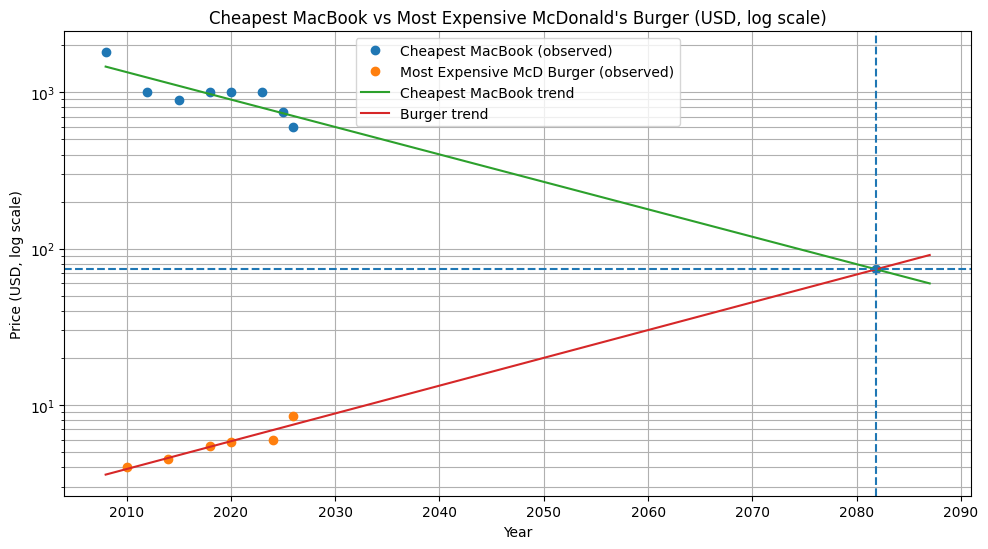
I've plotted the most expensive McDonald's burger and the least expensive MacBook over time. This analysis projects that the most expensive burger will be more expensive than the cheapest laptop as soon as 2081
it’s actually not hard to gauge the quality of any given tv show—if the characters involved make correct moral choices, it’s a good show. this is why the sopranos is considered one of the worst shows ever made, and it’s why every year the outstanding drama emmy goes to paw patrol
I chose the green door ninety-three days ago.
At the time, it seemed obviously correct. Not even a close call. The red door offered two billion dollars immediately—a sum so large it would solve every material problem I'd ever face, fund any project I could imagine, and still leave enough to give away amounts that would meaningfully change thousands of lives. But two billion is a number. It has a fixed relationship to the economy, to the things money can buy, to the world.
The green door offered one dollar that doubles every day.
I remember standing there, doing the mental math. Day 30: about a billion dollars. Day 40: over a trillion. Day 50: a quadrillion. The red door would be surpassed before the first month ended, and after that, the gap would grow incomprehensibly fast. Choosing the red door would be like choosing a ham sandwich over a genie's lamp because you were hungry right now.
So I walked through the green door.
The first few weeks were unremarkable. I had a dollar, then two, then four. By day ten I had $512, which felt like finding money in an old jacket. By day twenty I had over a million, and I started getting calls from financial advisors I'd never contacted. By day thirty-one I had crossed the two-billion threshold—officially richer than I would have been behind the red door.
I didn't understand what was happening until around day sixty.
The money, you see, had to exist somewhere. Not philosophically—I mean physically. Digitally. When I checked my bank balance, a computer somewhere had to store that number. And storing the number 2^n requires n bits.
One bit per day. That's it. That's the rate at which my fortune's representation grows. A linear function. Almost comically modest.
But here's what I'd failed to understand about exponential growth: the value doesn't care about the representation. The bits grow linearly. The dollars they encode grow exponentially. And dollars make claims on the physical world.
Day sixty. My balance: 2^60 dollars. About 1.15 quintillion. Roughly 1,000 times the entire global GDP. The number itself required only 60 bits to store—less than a tweet, less than this sentence, trivially small from an information-theoretic perspective.
But money is not information. Money is a claim.
The calls started coming from the Treasury Department. Polite, confused, increasingly frantic. They explained that the M2 money supply of the United States was approximately 21 trillion dollars. I now held about 15,000 times that amount. When I tried to spend any of it—even a tiny fraction—the transaction represented a claim on more goods and services than the entire human economy had ever produced in its history.
"The number in your account," a Treasury official said, "is not meaningful."
"It's in your computer," I replied.
"The computer," she said carefully, "does not understand what the number represents."
Day seventy-five. 2^75 dollars. I could purchase—in principle—roughly 350 million copies of the entire Earth's annual economic output. The representation remained elegant: 75 bits. Nine and a half bytes. I could write my net worth on a Post-it note in binary.
But representations aren't wealth. Wealth is factories, farmland, human labor, time, attention, atoms arranged into useful configurations. And I had laid claim to more atoms than existed.
This is where it gets strange.
The global financial system is, at its core, a system of ledgers. Distributed, reconciled, audited. When the Federal Reserve's systems recorded my balance, and Chase's systems recorded my balance, and the IRS's systems recorded my balance, those numbers had to match. And they did match—trivially, easily, using a handful of bytes each.
But then the systems tried to do things with the number.
Calculate taxes owed. Assess systemic risk. Determine what fraction of GDP was held by a single individual. Run inflation models. Price assets in a market that now included a participant with claims exceeding the value of all other claims combined.
Day eighty-two. The S&P 500 became undefined. Not zero, not infinity—undefined. My proportional ownership of the market, if I chose to exercise it, exceeded 100%. The shares I could theoretically purchase outnumbered the shares that existed. Financial models divide by market cap; market cap now included a term that broke the arithmetic.
Day eighty-five. The International Monetary Fund published a paper titled "On the Representability of Post-Scarcity Claims." It concluded that exchange rates could no longer be calculated because the dollar itself had become paradoxical—simultaneously the world's reserve currency and a unit of measurement that had lost all meaning.
My balance on day eighty-five: 2^85 dollars. Still just 85 bits. About ten and a half bytes.
The representation remained trivial. The reality it pointed to had become impossible.
Day ninety. I tried to buy a coffee.
The transaction failed. Not because of insufficient funds, not because of a technical error, but because the payment system could not determine a meaningful exchange rate. My card represented a claim on approximately 10^27 dollars. The coffee cost $4.50. The ratio between these numbers—the percentage of my wealth the coffee would cost—was so small that it rounded to zero in every floating-point system on Earth. I could not pay because the act of payment required representing a number smaller than any computer could distinguish from nothing.
I offered to pay in cash. I had a twenty.
The barista looked at me like I'd offered to pay with a seashell.
"Where did you get physical currency?" she asked.
That's when I realized: I had broken cash too. The Treasury had stopped printing bills three weeks earlier. Why maintain physical currency when one account holder could—at any moment—claim more dollars than had ever been printed in human history? The symbolic relationship between paper and value had always been a polite fiction, but my existence had made the fiction impossible to maintain.
Day ninety-three. Today.
My balance is 2^93 dollars: approximately 10^28. About 10 billion times the estimated value of all assets on Earth. The representation requires 93 bits. Twelve bytes. Smaller than my name.
The economy hasn't collapsed, exactly. People still trade, still work, still produce. But they've stopped using dollars. They've had to. A currency in which one person holds virtually infinite units is not a currency at all—it's a monopoly ticket that everyone has silently agreed to stop playing with.
I keep thinking about what money actually is. It's not the bits. The bits are trivial; they always were. It's not even the paper or the gold or the entries in a ledger. Money is a shared agreement about who has claims on what. A story we tell together about value and exchange and debt.
I broke the story.
Not through violence, not through fraud, not through any action more dramatic than walking through a door and watching a number tick upward. Just by existing. Just by holding a claim that grew faster than the world's ability to honor it.
The red door offered two billion dollars. A large but finite claim. A claim that fit within the story, that could be exchanged and spent and taxed and inherited. A claim the world could accommodate.
The green door offered something else entirely: a claim that would grow until it consumed all other claims, until the very concept of claiming became incoherent.
I still have the 93 bits. They're sitting on a server somewhere, humming along, doubling quietly at midnight. By next week they'll represent more dollars than there are atoms in the observable universe.
And I still can't buy a coffee.