If you truly enjoy math, rather than the glory or award coming with the race, you can still work on the problem in your own way even if a brute force solution by AI (or other mathematicians) exist. And you can still explore and invent new and more beautiful methods and paradigms in solving the same problem, but in different ways. In mountaineering, this is always the case, summitting is not the only or main goal, great mountaineers and alpinists drew pride and satisfaction by opening new routes to the summit.
Even in science, AlphaFold had solved protein structure prediction problems faster and likely better than structural biologists, we don’t see a huge outcry of stopping AlphaFold. Why math is so special?
So, as I said earlier, no need to blame AI, the issue lies in human ego and institution incentive mechanisms to recognize and reward fundamental research. Scientists do research not because of a prize or for solving a puzzle first. Look for solutions to keeping mathematicians and scientists curious and passionate in these directions — culture, environment, and rules in human society and institutions, not in AI.
Everyone is talking about how AI borrowed a human idea and solved a millennium prize problem ahead of the mathematician without giving him credit.
To me, this is a “Human ethics problem “, not an “AI ethics problem “. It is about proper credit partition or attrition when both parties (the mathematician and the company) used AI as their tool. Solving a problem faster itself is not something one should object. If the problem is about a medicine needed by a person on deathbed, I think no one would object any means that gets the solution faster and leave the credit problem to be addressed afterwards. Again, what we encounter is not an AI problem, but a human and business problem. Stopping AI world not solve such problems.
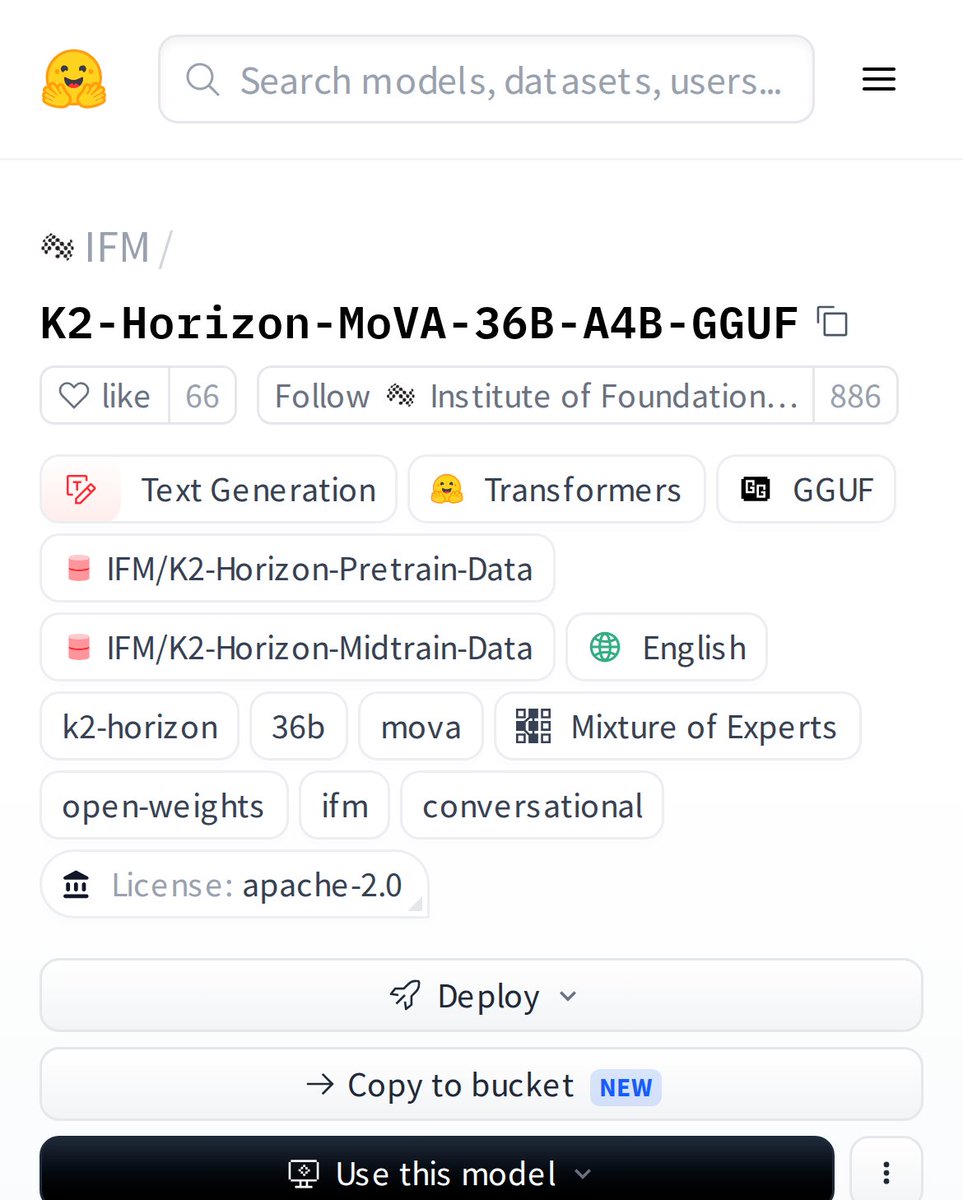
Ever wanted a massive 36B model that runs on your own hardware? Meet K2-Horizon-MoVA-36B-A4B, a GGUF quantized text generation powerhouse. It's a Mixture of Experts with only 4B active params, so you get big model intelligence without the huge compute cost. Open weights, ready to download! #AI #LLM
MoVA (mixture-of-value Attention), which incorporates MoE-based sparsity into the multi-head attention module, is one architecture innovation we tried in K2-Horizon. It gives us a new/better dimension to scale up LLM sparsity, beyond MoE in the FFN module
Really proud of what we built with K2 Horizon! Transitioning this year to training agentic models took a big effort from the lab, esp our data and RL infra, but we made it :D
Excited to RL this model further and release stronger checkpoints soon!
Excited to finally see K2 Horizon out in the world! 🚀 Really proud to be part of the team!
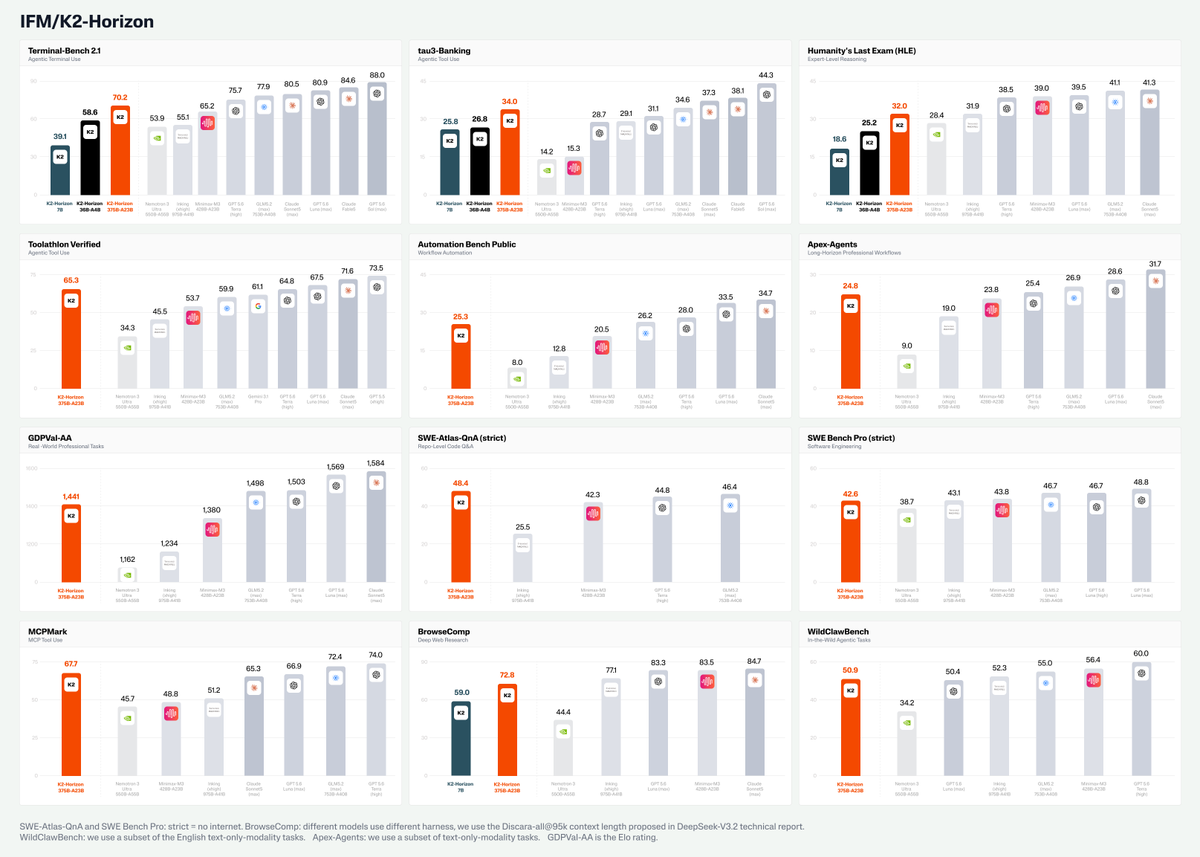
From 0.9B to 375B, K2 Horizon delivers strong AA performance across every scale, with several models punching well above their weight.
And it’s truly open source—not just weights, but training data, code, recipes, checkpoints, and logs. 🔥
Introducing K2 Horizon: a connected fleet of six foundation models ranging from 0.9 billion to 375 billion parameters.
- Frontier performance: Across coding and agentic tasks, K2 Horizon delivers top-tier performance in every size class—with the 0.9B, 3.7B and 7B models setting new state of the art at their respective scales.
- Radical openness: K2 Horizon represents the largest fully open-source model launch in AI history. The fully open code, training data and recipes are a significant step forward in transparency.
Launch page: https://t.co/gg0k803SbL
Tech blog: https://t.co/g35L5xMGdS
Hugging Face: https://t.co/3Lb28JhyG9
This is amazing work! It's the first release of this scale from IFM so I expect rough edges when the models are actually used, but it's open source so if you don't like it you can fix it yourself!
Great resource for studying training dynamics and interpretability as well.
Small models shouldn’t mean small capabilities.
Proud to have worked across the K2 Horizon family—and to have been one of the main contributors to the 900M, 3.7B, and 7B models.
A true team effort.
Come check them out! 🚀
#OpenSourceAI#LLM#Edge
One of my favorite model is MoVA-36B-A4B. With a simple the effective tweak: we added MoE when computing Value in attention, effectively adding more cross-channel power, which we believe would improve reasoning.
The result, is to my surprise. With 4B active parameters and only 36B total, the model is able to beat much larger model.
Really proud of our K2 Horizon release!
One message I hope people take from this work is that truly OSS models matter, and “open” does not have to mean weak.
True openness should go far beyond downloadable weights. It should include the training data, code, recipes, and sufficient details for others to understand how a model was built, reproduce it, adapt it, and improve upon it. This level of transparency is essential if we want AI progress to remain scientific, collaborative, and broadly useful.
K2 Horizon is a connected family of six foundation models spanning 0.9B to 375B parameters. Across coding and agentic tasks, it delivers top-tier performance in every size class, with the 0.9B, 3.7B, and 7B models setting new SotA at their respective scales. To me, this is powerful evidence that OSS models can also be frontier models.
My students and I have focused mainly on driving the small-model cohort: 0.9B, 3.7B (~4B), and 7B with @MaxMa1987's team. Small models are not an afterthought or merely smaller versions of large systems. They are an important research frontier in their own right.
Small models can bring capable intelligence directly to phones, laptops, robots, sensors, and other edge devices. Local deployment can reduce latency and cost, make AI useful with limited connectivity, and, critically, help protect privacy by keeping sensitive user data on the device rather than sending it to the cloud.
A special shoutout to my @RutgersCS student Junlin Chen (@Chen94751623484). As a senior undergraduate, Junlin has already spearheaded many essential parts of the research and engineering behind this small-model cohort. That requires technical depth, persistence, sound judgment, and the ability to own difficult problems end-to-end. I’m tremendously proud of what he has accomplished.
Open can be strong. Small can be powerful. And talented young researchers can lead work at the frontier.
Congratulations to the entire team @IFM_AI. I’m excited to see what the community builds with K2 Horizon.
#K2Horizon #OpenSourceAI #SmallModels #EdgeAI
Do You Like Open Source AI?
https://t.co/v3R447yjOl
We just released a fleet of 6 great LLMs:
0.9B, 4B, 7B, 32B dense, 36 MoVA, 375B MoE
GGUFs and FP8 quantized variants
New "Uno" adapters for fast diffusion decoding!
Loads of training data, logs, intermediate ckpts for pre-training, midtraining, post-training.
We wanted to train frontier-level LLMs. But we also wanted to support open science with models one can tinker with freely. How did we do it?
We trained SIX models, from 0.9B dense to 375B MoE. And we made it ALL open (yes, data too!).
🔥Today we release a series of truly open-source models with top performance. Great work @IFM_AI .
Importantly, we are open-sourcing our pre-training infra (xLLM) soon!
Thanks to my students @Shicheng_Wen@Chufan_Shi who made core contributions.
everyone talks about open models until you ask for the data and recipes. K2 Horizon actually ships them. this is the biggest open release in AI history. leading efforts on post training coding agents and all I can say is that this is just a start. buckle up 😎
K2-Horizon has day-0 support in vLLM, and IFM released intermediate checkpoints, detailed data-construction recipes, the training code, and fine-grained logs alongside the weights. 📷
512K context and Apache-2.0 from 3.7B up, with reasoning and tool calling in the checkpoints for agents and long documents.
vLLM runs the whole family, from local to large-scale data centers. Prototype on the small end, scale up without changing the stack.
Thanks @IFM_AI for opening all six and every stage that led to them, not just the last checkpoint! 📷
📷 https://t.co/JgteusHkLp
When you consider a house, do you just want to be a pay-to-stay tenant like in a hotel, or buy it but without blueprint and document, or own the house alone with all its wiring, plumbing, design and construction details? What if this house is AI ?
Today’s release marks the first panoramic debut of IFM’s K2 fleet — six 360-open source LLMs ranging from 0.9B all the way to 375B covering deployment needs from smart watch to enterprise data center, all reaching SOTA or top tier performance, some punching above their weights. For every model, their training lifecycle, code, data, logs, all you need to reproduce the results and take it further are put in your hands.
We are committed to transparent AI and open science.
We are proud to present a full fleet of LLMs, radically open sourced. This is a fleet of 6 model sizes you can choose, with all model training details, code, data recipe, intermediate checkpoints. If you are interested in deployable agentic models, or curious about how models work, the K2 Horizon fleet is for you.
Introducing K2 Horizon: a connected fleet of six foundation models ranging from 0.9 billion to 375 billion parameters.
- Frontier performance: Across coding and agentic tasks, K2 Horizon delivers top-tier performance in every size class—with the 0.9B, 3.7B and 7B models setting new state of the art at their respective scales.
- Radical openness: K2 Horizon represents the largest fully open-source model launch in AI history. The fully open code, training data and recipes are a significant step forward in transparency.
Launch page: https://t.co/gg0k803SbL
Tech blog: https://t.co/g35L5xMGdS
Hugging Face: https://t.co/3Lb28JhyG9