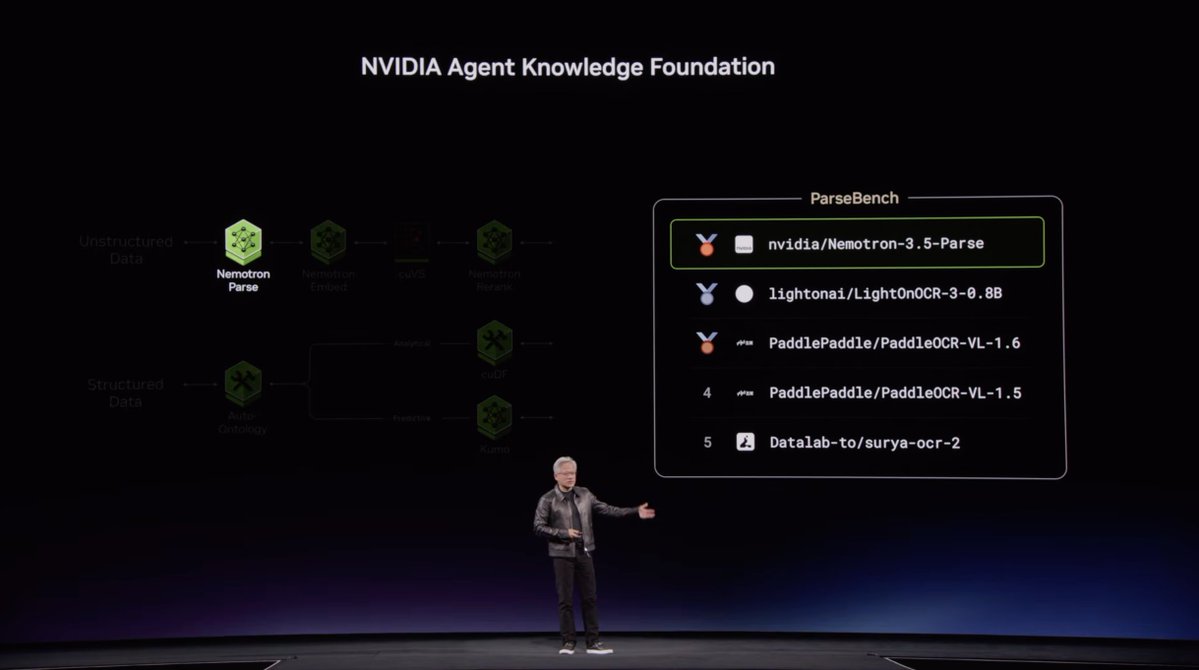
In celebration of Jensen Huang's return and his commitment to open-source AI:
Today we’re releasing OCRia-nano-1, an extremely lightweight and open-weight OCR model that is just 8.1M parameters in size and can parse pages at 426 ms per page on your CPU ⚡️ - no GPU required!
OCRia-nano-1 is intended to be the first pass parsing for the billions of pages/petabytes of data that are locked up within any organization and unlock it for all agentic automation. Even at its size, it still has the following properties:
✅ it can parse complex tables and generate bounding boxes
✅ it is natively multilingual and can cover CJK, right-to-left, and other scripts
✅ is more accurate than Marker, PP-OCRv6, Tesseract while being up to 2-5x faster
It is perfect for ‘unlimited’ high-volume ingestion (e.g. indexing a petabyte scale RAG knowledge base) and ad-hoc uploaded files where the agent has additional tools to inspect the file more deeply. You can always use larger VLMs (like OCRia-1.5) for any document that requires higher visual accuracy.
Best of all, it’s a fully open-weight model available through liteparse. If you’re interested in using it for commercial use, come talk to us!
Blog: https://t.co/2woySeAtbz
Install OCRia-nano-1 through liteparse: https://t.co/Z5JFsCA7G3
Weights on @huggingface: https://t.co/1t6EZTO0fq
Full technical report:
Last week we released ParseBench-2, our most comprehensive effort to benchmark various document OCR tools.
It drew quite a bit of ire among our peer document OCR vendors, who offered their own reactions:
---- “This is marketing slop” - vendor 1 who immediately goes and publishes lower-effort marketing slop (*cough benchbench cough*)
---- “everybody is number 1 on their benchmark” - vendor 2 who immediately shows their own benchmark where they’re #1
(also we’re not even #1 on some dimensions! No one actually cared about our efforts to be more fair)
there was some constructive feedback which we’re taking into account and iterating on a new release. But it was mostly masked by some (pretty funny) noise and posturing.
Unlike other vendors, our evals are completely open - no hidden judge prompt, no hidden test dataset, and we actively update the leaderboard from Github/Hugging Face submissions.
If you’re in the market for document OCR, I think ParseBench-2 is probably the most comprehensive resource for comparing different solutions. Even if you completely ignore our parsing solutions or overall score, there’s value in understanding the detailed taxonomy we’ve created over different failure types.
Come check it out! https://t.co/PWczfhp0OX
Also our tech report is extremely detailed and the result of incredible effort from our research team. Come check it out: https://t.co/qNlc5r0mss
ParseBench-2 hit 30k monthly downloads in 3 days, and is #3 on @huggingface trending benchmarks! 📈
In ParseBench-2, we tried hard to create a comprehensive taxonomy of metrics to evaluate document processing, while creating a severity-based framework to align these metrics with human judgment.
Whether you’re deeply familiar with document OCR and document OCR benchmarks, or just getting started, we encourage you to check out the ParseBench-2 methodology. We’re happy to help you pick whatever subset of metrics you care about if you’re looking to process documents in production.
We’ve merged dozens of PRs since the release date, including fixes/metric updates from some of our peers. We’re aggressively fixing any lingering annotation and metric issues.
Report: https://t.co/f6SxkKIlme
Hugging Face: https://t.co/T1FLO2V2xd
Github: https://t.co/9hWGjYacmf
Excited to see ParseBench-2 officially launched 🎉
A major step forward in making document parsing benchmarks more granular, reliable, and aligned with human judgment.
Proud to have contributed to this work!
Today we’re introducing ParseBench-2 - our most ambitious document parsing benchmark to date.
It is the only benchmark that provides both extreme granularity into every single type of production parsing error, while also making sure that metric scores are highly aligned with human judgment. We do this by painstakingly assigning severity scores to 330+ error types, and tuning each metric to match the severity scores.
Existing benchmarks either use brittle deterministic metrics (e.g. OmniDocBench) or LLM-as-a-judge (ParseArena), which can help recognize equivalent representations but are coarse/stochastic/subject to bias by the prompt+model.
ParseBench-2 also contains:
✅ 4.3k+ document pages (double from ParseBench-1).
✅ An extra dimension (forms)
✅ Much better ground-truth across all dimensions compared to ParseBench-1.
This is the next evolution of ParseBench, our hugely popular benchmark that has 50k+ monthly downloads, over 150+ OCR solutions benchmarked, and has been adopted by companies like NVIDIA, Cohere, Aleph Alpha, Perplexity, and others.
Alongside ParseBench-2, we are also releasing OCRia-1.5 - a new family of document parsing models that powers all our modes in LlamaParse. They represent a massive step up in capabilities from our latest release, and are state of the art in parsing complex tables, forms, charts, formatting, and assigning bounding boxes to complex layouts.
Come check out our blog post, technical report, and website.
Blog: https://t.co/TKbfCyTjht
Technical Report: https://t.co/eAu0s6ttA1
Website: https://t.co/PWczfhp0OX
If you’re interested in trying out our OCRia-1.5 capabilities, come sign up for LlamaParse: https://t.co/XYZmx5TFz8
Today we’re releasing OCRia-1, a frontier VLM for document parsing that sets a new SOTA in accuracy, cost, and latency.
It not only sets a new high score on ParseBench (87.4), but also leads in three 3rd-party benchmarks: olmOCR-bench* (83.5 overall, 92.9 on tables!), PulseBench-Tab (84.1), and fr-bench-pdf2md (72.1).
OCRia-1 is really, really good at parsing complex tables: nested headers, merged cells, irregular grids, scanned tables, and more. It is also fantastic at parsing complex unlabeled charts (line, bar, pie, technical diagrams), and preserving complex formatting. Most real-world enterprise documents contain at least one of the these, whether it’s a big tax withholding table or a public economic report.
It is a 4B model and outperforms all other models within a similar parameter class: LightOnOCR-3, Chandra-OCR 2, Mistral OCR 4.1, and more. It is also extremely fast.
All credit goes to our research team, who spent countless hours on curating a diverse dataset, tuning our training pipeline, and squeezing every last drop out of model optimization so that it can process billions of pages at scale.
OCRia-1 as a base is powering all of our modes within LlamaParse (cost-effective, agentic, agentic plus), so you can access its capabilities today!
If you’re processing millions/billions of documents at scale, we’re offering enterprises that book a demo up to $3k in credits for a guided evaluation.**
*olmOCR-bench scores are adjusted based on unifying rendering at 1,288px for all models
**enterprise POC credits apply to eligible organizations that book a demo
Congrats to @nvidia for creating the best open-weight model on document parsing so far.
Nemotron 3.5 Parse takes the #1 spot on ParseBench, our comprehensive real-world benchmark for document understanding. The full list consists of 150+ frontier models, open-weight models, and specialized solutions.
It does this while remaining sub-1B parameters so it's also blazing fast ⚡️
Big thanks to @JensenHuang for the shoutout at GTC Berlin!
Nemotron release: https://t.co/papiqxgGUb
ParseBench: https://t.co/PWczfhp0OX