For decades, financial systems have pushed complexity onto users.
Need to make a payment? Navigate multiple apps. Approve transactions. Manage liquidity. Worry about settlement paths.
The problem was never the user.
The problem was infrastructure that couldn't understand intent.
That era is ending.
The future of finance isn't built around clicks and dashboards. It's built around outcomes.
Imagine telling an AI:
"Pay my supplier in Nairobi using my Naira balance before the end of the day."
No manual routing. No endless approvals. No guesswork.
The system handles liquidity, execution, settlement, and optimization automatically.
This is the future Canza Finance is building.
With CAPP (Canza Autonomous Payment Protocol) on Aptos, we're creating an autonomous payment layer where AI agents can execute cross-border transactions seamlessly, securely, and efficiently.
For Africa's businesses, where payment friction remains one of the biggest barriers to growth, this isn't just innovation. It's necessity.
The next generation of financial infrastructure won't compete on user interfaces.
It will compete on trust, execution, liquidity, and the ability to turn intent into results.
At Canza Finance, we're building for that future.
@Canza_Finance
PayPal rejected me.
Wise was too slow.
Fees ate my money.
So I stopped complaining and switched to @HurupayApp.
Real USD account. 2% fees. Stocks. Crypto. All in one app.
I found the fix... and I put it on video 👇
🎥 Watch. Then download and thank me later.
👉 https://t.co/OEDH8UWzS9
#Hurupay #TellYourHurupayStory
We thought FX apps were the ultimate solution to global money movement. Turns out, they just digitized the friction.
Open the app. Compare the fees. Check the rate. Wait.
That era is ending. The next evolution is Agentic Finance, and it operates entirely on intent rather than manual labor.
Imagine giving a single instruction:
"Send 100 USDT to Nigeria every Friday at the best available rate."
Instead of forcing you to jump through hoops, the system works silently in the background:
Aggregating the deepest liquidity
Routing around conversion traps
Executing trades at optimal times
Adapting to rate fluctuations in real-time
This is exactly why the infrastructure being built by @Canza_Finance is worth paying attention to right now.
In Africa, the true bottleneck isn't just sending capital, it's the massive fragmentation underneath it all. We are constantly battling multiple exchange rates, dry liquidity pools, slow legacy rails, and hidden costs.
Agentic finance flips the script completely. Instead of users constantly navigating a broken financial system, the underlying infrastructure actively solves the fragmentation for them while they do absolutely nothing.
Quick recap from the Pollinet Bounty.
We asked creators to do one thing: explain Pollinet to the world.
What you delivered:
➧ 100+ entries.
➧Creators from across the globe.
➧Endless threads, graphics, videos, and breakdowns teaching what we're building.
Honestly? Some of the best educational content this ecosystem has seen.
Now comes the hard part, picking 10 winners from a sea of incredible work.
Think your entry deserves to win? Drop it in the comments.
Let the mesh see what you cooked.
Announcements drop soon.
@sol_pollinet The quality of entries in this bounty has been incredible to see! Truly a massive win for the ecosystem.
Proud to have contributed to the mix, here is my submission:
https://t.co/lCrnWEaROn
What happens to crypto when the internet disappears?
Most blockchains quietly assume one thing:
you’re always connected.
But real life doesn’t work that way.
Networks fail.
Governments shut internet access down.
Remote communities struggle with weak connectivity.
Natural disasters knock infrastructure offline.
And suddenly, “decentralized” systems become very dependent on centralized internet access.
That’s why I’ve been looking into @sol_pollinet and the infrastructure they’re building around Solana.
Pollinet isn’t trying to create “just another token.”
It’s building a decentralized wireless relay layer for Solana using BLE mesh networking and store-and-forward communication.
Here’s the interesting part:
With Pollinet, transactions don’t need to immediately hit the internet.
Instead:
a transaction can be signed offline, fragmented into packets, and relayed device-to-device through Bluetooth Low Energy (BLE) until it eventually reaches a gateway node with internet access, which then submits it to Solana RPC.
Think of it like digital pollen traveling between devices 🌼
One phone passes data to another.
Then another.
Then another.
Until the network finds a route home.
That’s what the Pollistem app enables.
Your Android device becomes a lightweight relay node inside the mesh network, helping move transaction data across nearby devices while using minimal battery in the background.
Every new node strengthens the network.
And honestly, this matters far beyond speculation.
Because resilience infrastructure is becoming one of the most underrated parts of crypto.
If blockchain systems only function under perfect internet conditions, then adoption in underserved regions becomes fragile by default.
But systems designed for:
• disaster response
• unstable networks
• remote communities
• censorship resistance
• offline coordination
…can operate in environments where traditional connectivity breaks down.
That changes the conversation.
Pollinet is essentially exploring how Solana could remain usable even when internet access becomes unreliable.
Not by replacing the internet;
but by reducing dependency on it.
That’s a very different vision from most crypto projects chasing hype cycles.
Infrastructure rarely looks exciting at first glance.
But infrastructure is what determines whether systems survive real-world stress.
And turning ordinary phones into relay nodes?
That’s one of the more creative approaches I’ve seen lately.
Downloaded the Pollistem app and exploring the network more closely 👀
@sol_pollinet
#Pollinet #POLLEN
The daily scramble for USD liquidity to pay overseas suppliers is one of the biggest bottlenecks for African enterprises right now.
Relying entirely on scarce foreign currency reserves stalls growth. By leveraging local stablecoin liquidity pools, @canza_finance changes the game, allowing businesses to settle trade without the constant bottleneck.
Solve the liquidity issue, solve the scale issue.
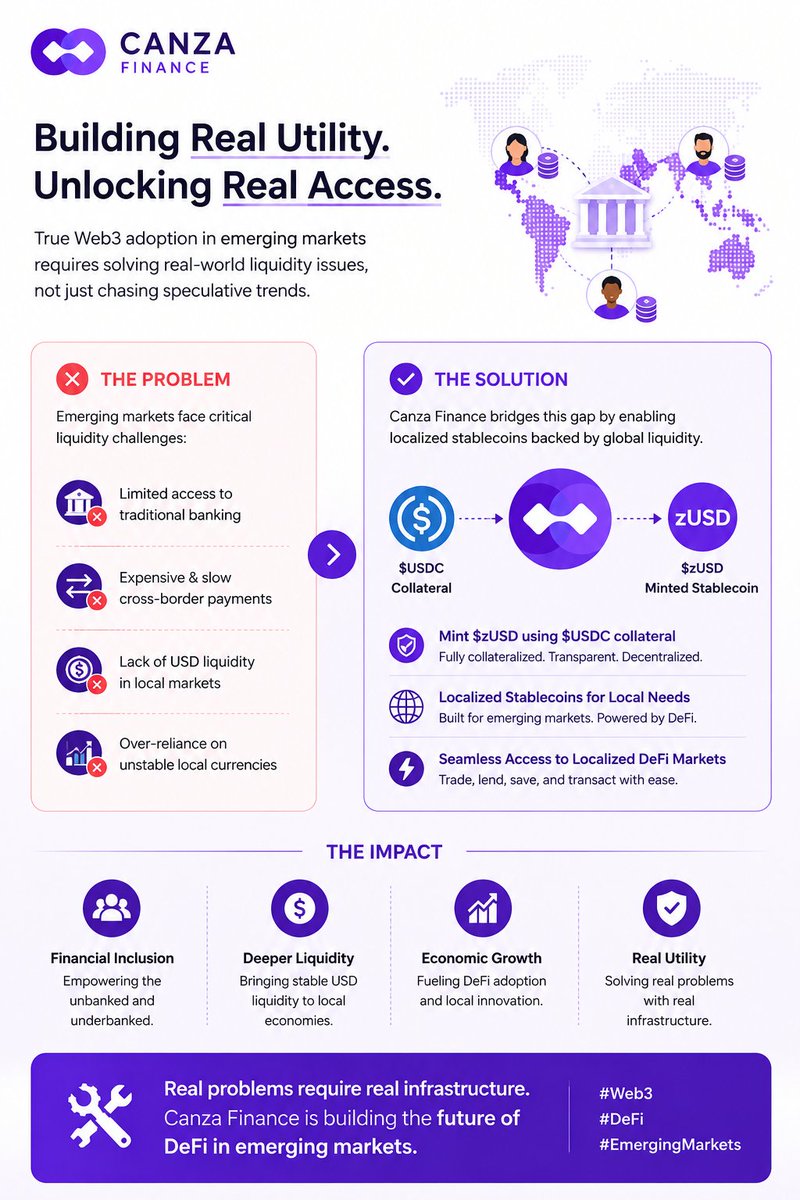
For Web3 to truly scale in emerging markets, we need to stop chasing hype and start solving local liquidity challenges.
@Canza_Finance is doing exactly that by letting users mint localized stablecoins ($zUSD) backed by $USDC collateral.
By anchoring DeFi to regional, real-world needs, they are creating actual utility and opening up financial markets where traditional banking falls short.
Infrastructure wins, always.
#Web3 #DeFi
Solana is permissionless by design, but the infrastructure it runs on is increasingly in the hands of private companies.
At our summit we will discuss about: "Public Chain, Private Stack: Who Controls Solana's Infrastructure?"
This debate asks the uncomfortable question: if a handful of players control the stack, how decentralized is Solana really?
🔗 June 13th, register below 👇
How did we miss this masterpiece of an article?
@Canza_Finance perfectly articulates "The Wall" holding back African businesses, minimum balances, rigid compliance, and zero local branches.
Turning WhatsApp into a settlement layer via Web3 custody isn't just clever; it's essential infrastructure. 🌍
Something big is brewing! ⏳
Make sure you’re plugged into the @Canza_Finance community on @CoinMarketCap to catch every major announcement and update as it drops.
Don't miss a beat, join the inner circle here: https://t.co/6LcTVlWj7o
Naira moves. Cedi moves. Rand moves.
So why are your settlements still stuck in a queue somewhere between banks?
Baki by @Canza_Finance changes the game.
Infinite on-chain liquidity for African currencies means you can swap, settle, and scale in minutes, not days. No middlemen. No correspondent bank bottlenecks. Just seamless value movement across borders.
The future of African payments isn't waiting for approval.
It's already here.
Who's trading with Baki today? Drop your latest swap 👇
#CanzaFinance #Baki #Stablecoins #Africa
Naira moves. Cedi moves. Rand moves.
So why are your settlements still stuck in a queue somewhere between banks?
Baki by @Canza_Finance changes the game.
Infinite on-chain liquidity for African currencies means you can swap, settle, and scale in minutes, not days. No middlemen. No correspondent bank bottlenecks. Just seamless value movement across borders.
The future of African payments isn't waiting for approval.
It's already here.
Who's trading with Baki today? Drop your latest swap 👇
#CanzaFinance #Baki #Stablecoins #Africa