Sooner or later, you'll need to integrate with a third-party API.
Sometimes it's because you don't have the bandwidth to build the feature yourself. Other times it's simply because there's someone else with a better solution to the problem you have.
https://t.co/mvRIyw6Yu2
Everyone agrees that having a high-quality API is critical. However, most people who run APIs don't know how to measure quality.
https://t.co/c3vohlWq3l
"What happens when you develop API calls inside your code and, suddenly, the API is upgraded and some of its methods or parameters change? You’ll have to change your application code to handle those changes."
Revisiting something I wrote in 2013: https://t.co/blsZdCQ0pS
What exactly is the problem AI agents have with the API documentation you and I have been creating?
Actually, there’s more than one kind of problem. And they all have to do with the ability to understand what each operation really does.
https://t.co/5qLqCygCtW
User journeys usually start with one or more requests to a REST API followed by events triggered and received via WebSockets, Webhooks, Kafka streams, or other similar technologies.
Why do we document synchronous and event-driven APIs separately?
https://t.co/8uVuWUugJN
Can’t developers copy a curl snippet or a URL and some authorization parameters? Don’t they have an API client at hand?
Most of them do, but making a developer leave your API documentation to be able to try making a request creates unnecessary friction.
https://t.co/cGOeAd4UQc
Nice article by @bpedro for #APIChangelog on "Solving the Agent API Bottleneck" and why human-centric portals can break agent experience.
Happy to contribute to the piece along with @philsturgeon, @dret , and Jérôme Louvel.
https://t.co/lrmom2oMt7
APIs serve as technological ecotones where different software systems meet and interact. Like biological interface ecosystems, APIs are characterised by specialised adaptations that facilitate exchange across boundaries.
https://t.co/5w2rNrs5Nb
There’s no way to know what an AI agent is doing.
Not in the sense of knowing exactly the steps the agent took to complete a task, or to reach a failing state.
https://t.co/41S9I8RURb
Your API looks healthy but isn't getting any traffic from AI at runtime.
What you've been doing to attract developers to your API has to be rethought. API design, definition, discovery, and security have to be reimagined to work well with AI agents.
https://t.co/Dn8q173aFP
Where’s the innovation, the collaboration between adjacent disciplines? Where are the new ideas being shared and discussed, the demos of crazy new prototypes?
https://t.co/OzKxRQtmov
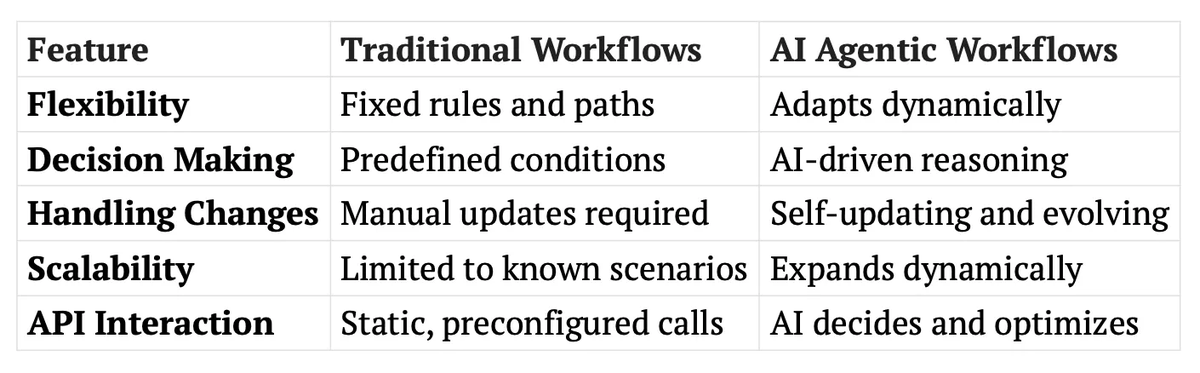
Most integrations are just glorified if-this-then-that logic!
If APIs can sometimes fail during a workflow, how can they also be the key to improving the agentic decision-making ability?
https://t.co/OjopGe0ciD
@KakaluoteW45042 Notifications are considered "fire-and-forget," so we don't need to handle all those failover scenarios. Also, polling is still available in case an agent wants to check if something has changed.
One of the best MCP features is event subscription for agents.
2 approaches:
- Resource subscriptions (subs/listen)
- MCP Events (experimental)
My team has just built a PoC to test both at scale.
It's amazing the amount of things you can do after having MCP events working.