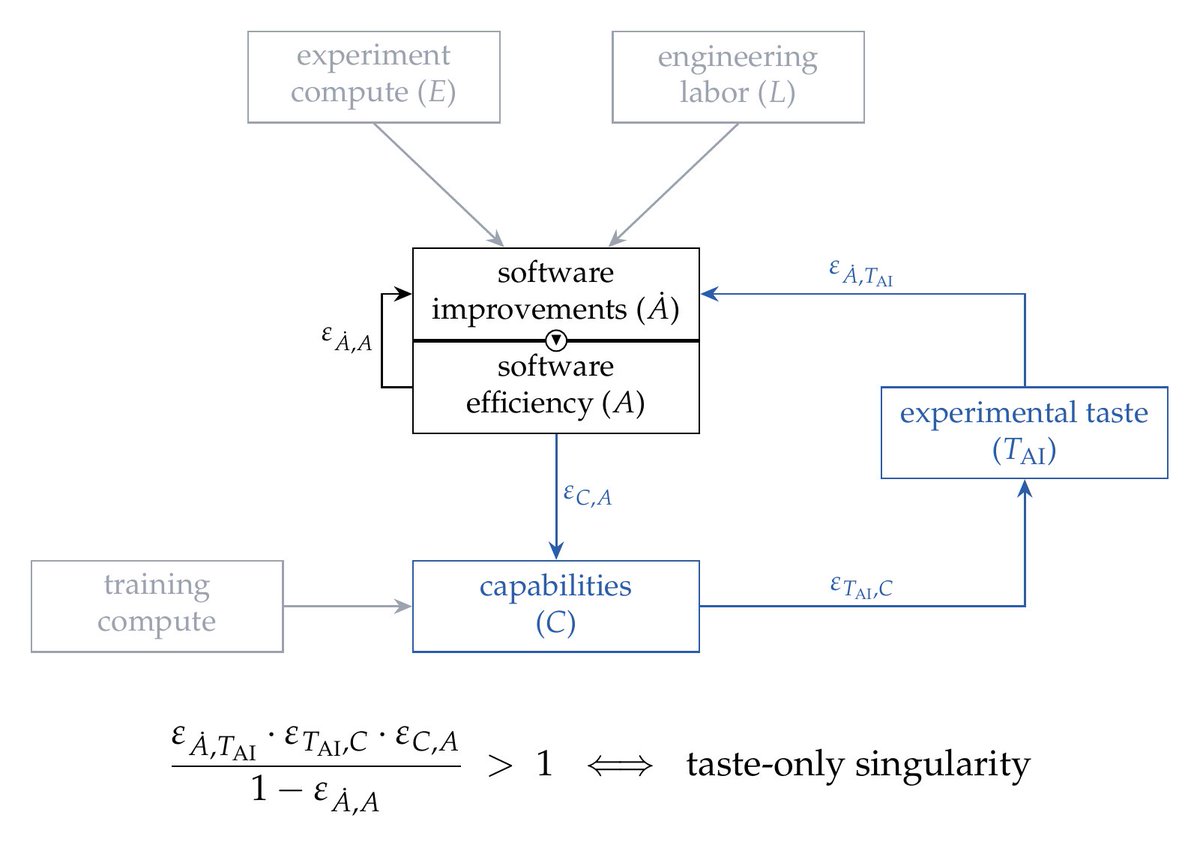
Other feedback loops, such as better AI capabilities increasing the supply of engineering labor, stack with this one, though the engineering labor channel will probably weaken as abundant labor saturates the experimental throughput achievable on limited compute.
The elasticity of software progress to researcher capability is maybe the most important quantity in RSI forecasting. IMO TasteVal provides the best evidence yet on the component of this quantity coming from *selecting better experiments* using fixed compute and coding labor.
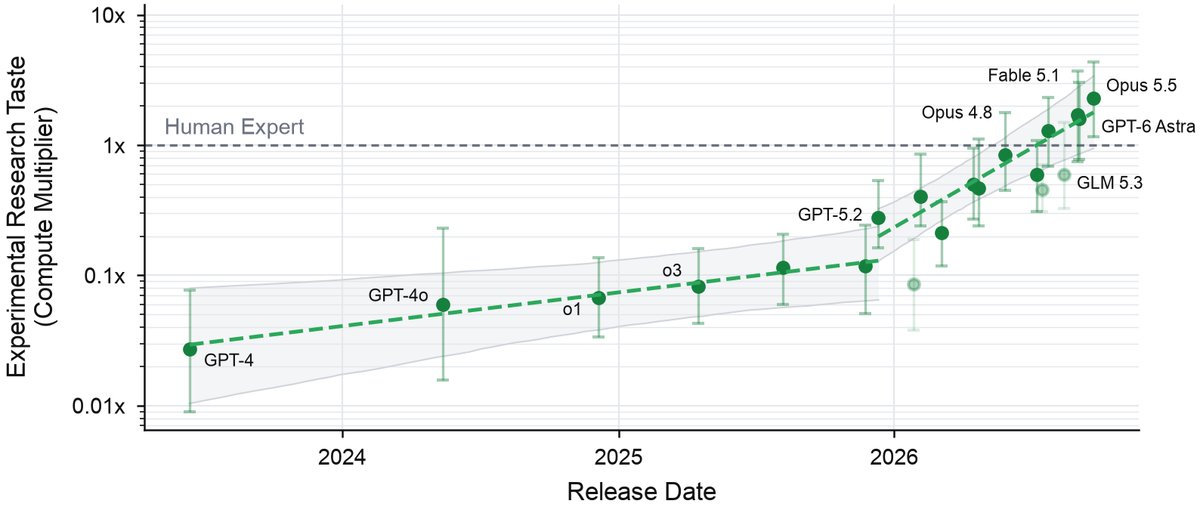
How fast is AI's research taste improving?
We find that the experimental research taste of frontier models has doubled every ~3 months since December 2025. The best model, Opus 5.5, now exceeds our expert human baseline. Our human experts are experienced researchers, but most haven’t worked at a frontier lab.
Why measure research taste? In the AI Futures Model, it largely determines how quickly artificial superintelligence is reached once coding is fully automated.
Hence, if the TasteVal doubling time applied to the situation where AIs are running the entire frontier lab, a "taste-only singularity" (or, an acceleration that's self sustaining solely on the basis of the research taste feedback loop) sole seems likely.
@ramez@tenobrus It's not surprising that time horizons would differ in level across task distributions. See e.g. https://t.co/m0JBvNZwgc
Also the doubling time is comparable (around 3 to 4 months).
fwiw I think this is mixing different definitions of "λ". the AIFM uses this letter for the elasticity of parallel labor to "serial labor", and the value .5 means that 10xing the number of workers would have an equivalent effect on the short run rate of software progress as running them all at 3x speed. However, since the compute they're using to run experiments isn't also being run at 3x speed, the short run rate of software progress only increases by a factor of 10^0.16 = 1.4x [on today's margins, will go down as labor becomes increasingly abundant relative to compute].
the λ for which "λ/β > 1 iff explosion" holds is the elasticity of the software progress rate to ai capabilities. Today, in the AIFM with my median parameters, this number is 0.06 [it increases once as AIs get good enough coding ability and research taste relative to humans that they start improving the organization's overall execution and prioritization of experiments.]
Davidson and Houlden model better capabilities as speeding up software progress entirely through running more agents in parallel; for them this elasticity is .6 * .5 = .3 . Again there's an additional factor due to experiment compute not scaling along with labor.
It looks like your experiments mostly provide evidence about the elasticity of serial labor to parallel labor, but i'm not sure due to not having looked hard at the specific benchmarks. it could be slightly more analogous to the elasticity of software progress rate to parallel labor.
Dario writes "since roughly this summer, AI has been advancing drastically faster, driven primarily by AI’s growing ability to build the next generation of AI."
But as of September 1, the AECI has not been "advancing drastically faster", so what does this mean?
I was unclear on whether that would include, e.g. a model that had not finished all stages of posttraining, or had only finished pretraining, and so might not perform very well on the full range of benchmarks in the AECI, but could nonetheless be viewed internally as a major trend break. that's what i meant by "research prototype".
[but as of the risk report period ending july 15, their most capable internal model was worse than fable 5.1, so either that report excludes some super good "research prototypes", or this acceleration has happened primarily after july 15th.]
@daniel_271828 that specific chart is, yes, though six weeks earlier, they claimed that their most capable internal model was only 1.5 points above Mythos 5. (though it's possible the internal/external gap has grown substantially since then)
https://t.co/5fKRSyafXg
[but as of the risk report period ending july 15, their most capable internal model was worse than fable 5.1, so either that report excludes some super good "research prototypes", or this acceleration has happened primarily after july 15th.]
Currently it's unfortunately unclear whether to take this seriously. [he might be conflating an acceleration in output [like AECI] with an acceleration in inputs [like lines of code?] Or it might just be confusing wording, like when he talks about "the accelerating exponential"?
to the extent that "ai has been advancing drastically faster" in research *outputs* rather than research *inputs*, it seems valuable to publish a chart that demonstrates that.