BAWE Quicklinks Project @BQuicklinks
https://t.co/gll7cf24v5
This site is designed as an aid for teachers who’d like to introduce students to concordances that can help raise their awareness of how English works.
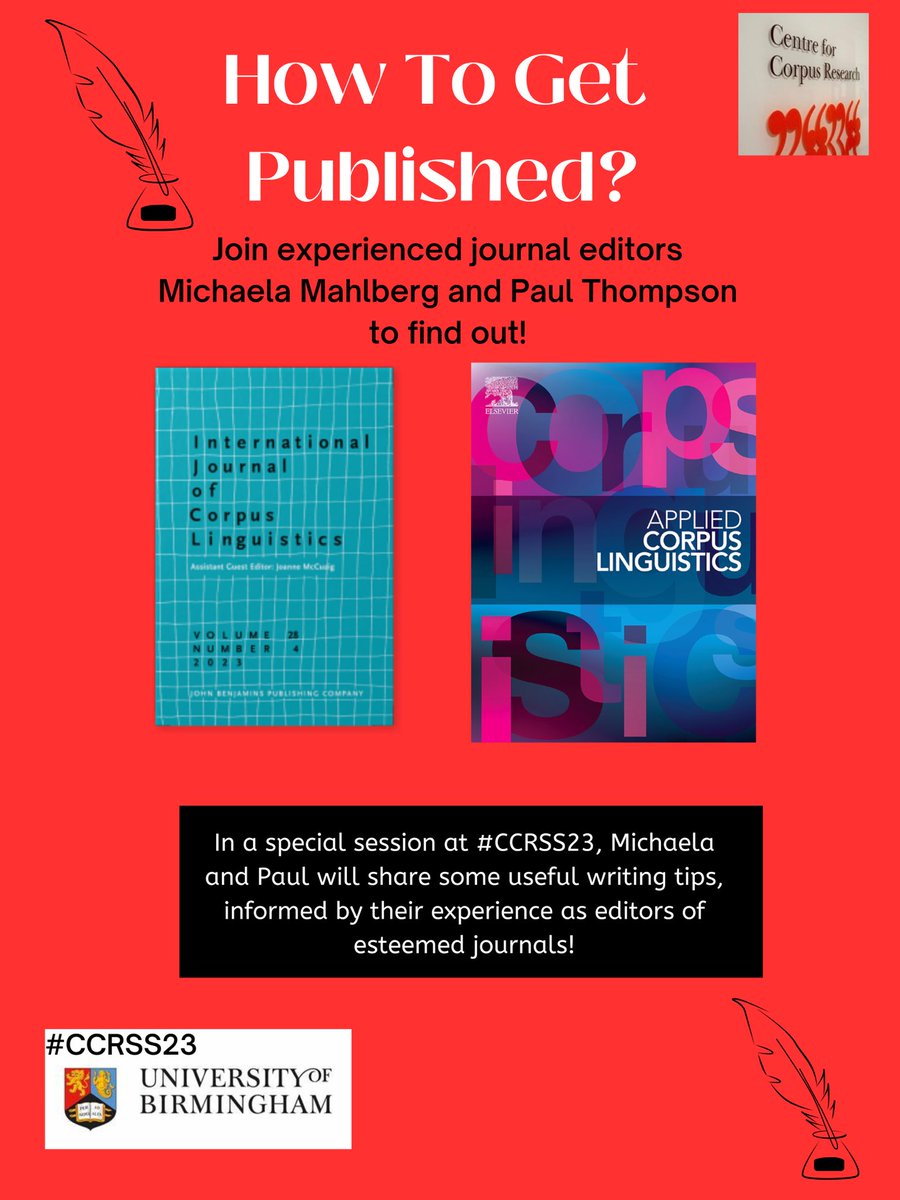
“How to get published?” We will have a special session at #CCRSS23 by experienced editors @MichaMahlberg and @paul_ccr on preparing a journal article submission
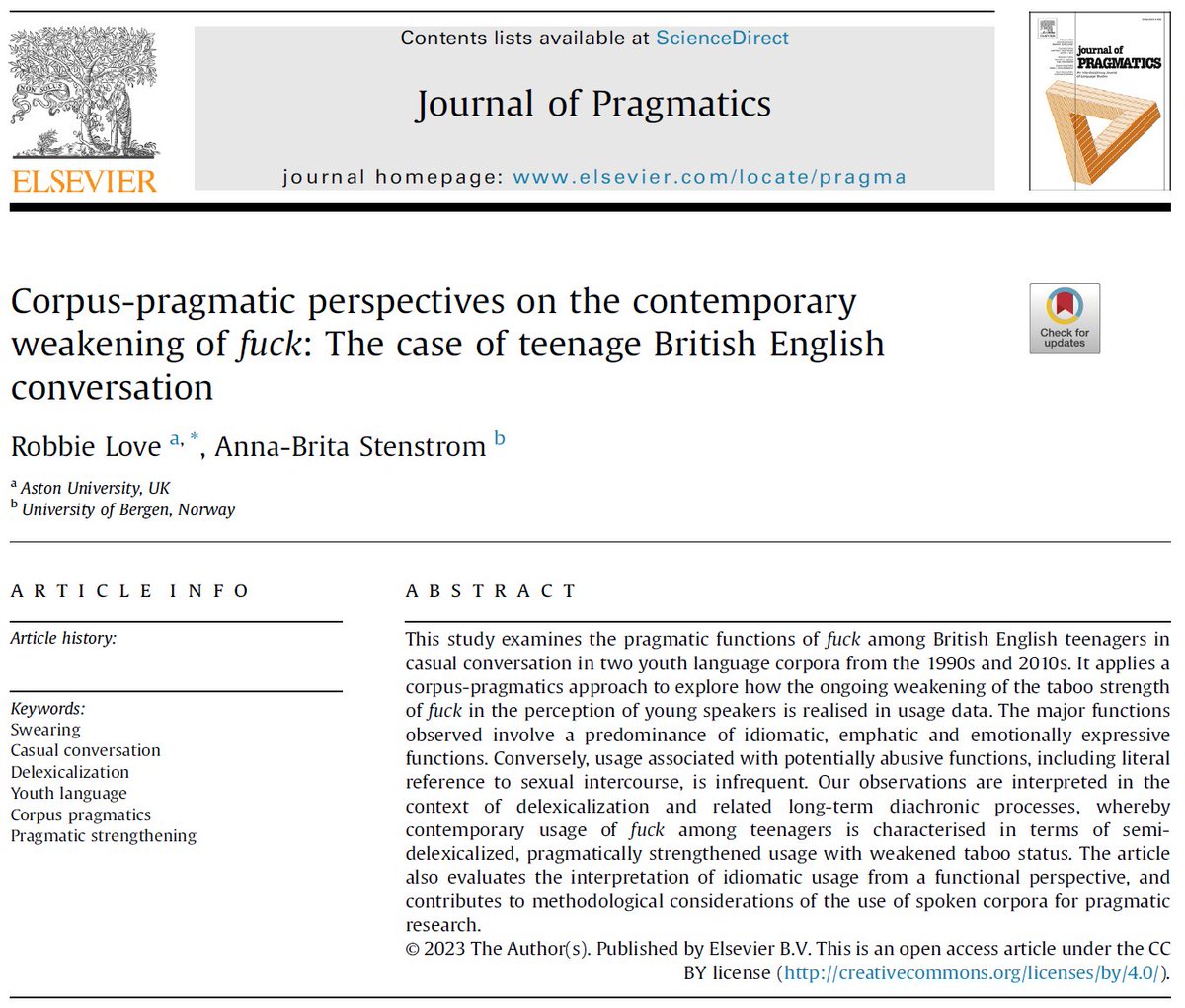
New paper! "Corpus-pragmatic perspectives on the contemporary weakening of 𝘧𝘶𝘤𝘬: The case of teenage British English conversation", written with Anna-Brita Stenström for the Journal of Pragmatics.
Available open access here: https://t.co/Xd3g5i2V8D
Latest addition to JCADS Vol 6 free on-line: Book review: Gillings, M., Mautner, G., & Baker, P. (2023). Corpus-Assisted Discourse Studies, CUP. Reviewed by Alan Partington
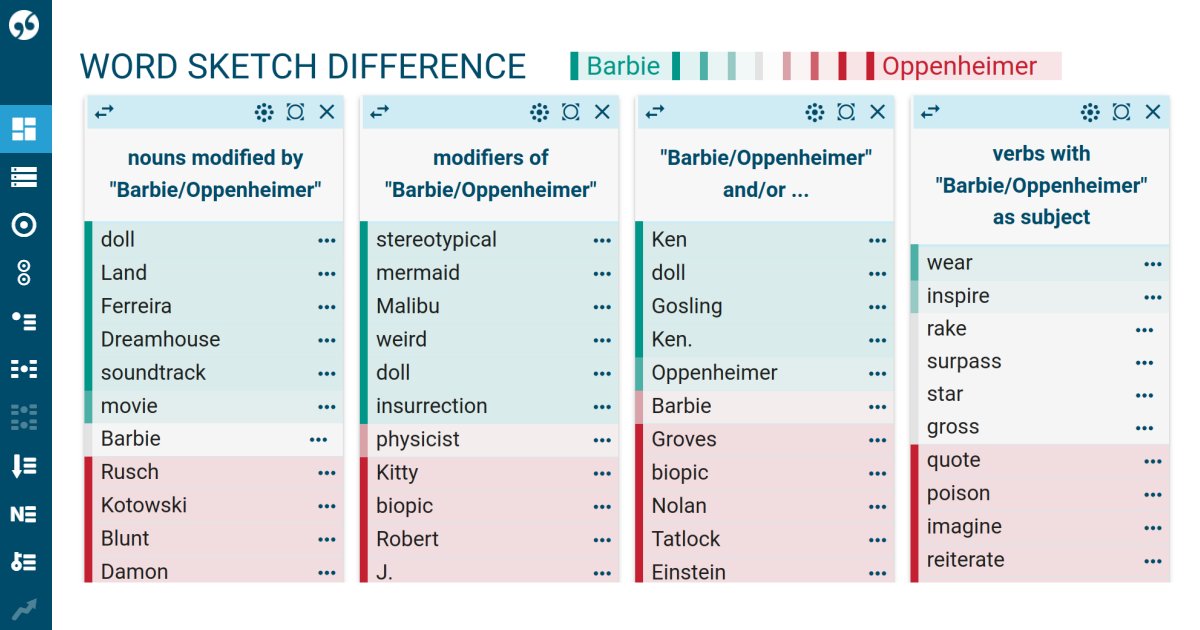
🔎 Compare the words "Barbie" and "Oppenheimer" with Word Sketch Difference! You can easily reveal their collocation behavior and word usage patterns within a few seconds! 🚀 https://t.co/cUH3d9Nft8
#collocations#corpuslinguistics#textanalysis
🌐 https://t.co/6xBgSdM9rT
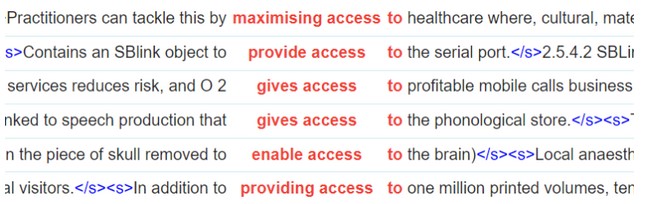
New entries have been added to our Quicklinks database thanks to our new associate, Elena Mazzeri (https://t.co/E6dtuJR6ZP), who's been doing some great work over the summer, e.g. this new one on the use of 'access': https://t.co/Pyr5c1ImPf
#DDL#BAWE
Would you be able to spot #fakenews?
Learn what linguistics has got to say about news that intentionally aims to deceive.
Here is the latest episode of #LifeandLanguage 🎧 with @JWGrieve
https://t.co/mid1Fh8EtB
We are very exited to announce the next LANA seminar!
Raffaella Bottini & Elen Le Foll:
“The effect of the reference corpus on mean-frequency measures of lexical sophistication”
When? Friday, Sep 8, at 5pm UK/9am AZ
Where? Link to attend: https://t.co/R2uQcgD85H
Here are eleven of the most widely used statistical methods in #CorpusLinguistics. #CorpusStatistics#Frequency Analysis: This is the cornerstone of corpus linguistics, used to identify the frequency of words, phrases, or syntactic structures. Biber’s “Variation Across Speech and Writing” (1988) is a classic study that employed frequency analysis to distinguish between spoken and written registers. #FrequencyAnalysis
#Collocation Analysis: This method identifies words that tend to appear together more often than would be expected by chance. Stefanowitsch and Gries’ “Collostructions” (2003) is a notable study in this area. #CollocationAnalysis
#Concordance Analysis: This involves examining all the occurrences of a particular word or phrase within its context. John Sinclair’s work, particularly in “Corpus, Concordance, Collocation” (1991), has been foundational. #ConcordanceAnalysis
#Keyness Analysis: This method identifies statistically significant words in a corpus compared to a reference corpus. Paul Rayson’s “Matrix: A Statistical Method and Software Tool for Linguistic Analysis” (2003) is a key reference.
#KeynessAnalysis
#Cluster Analysis: This is used to group similar items in a corpus, often revealing patterns or themes. Douglas Biber’s “University Language” (2006) employed cluster analysis to study academic registers. #ClusterAnalysis
#Mutual Information: This measures the strength of association between two words. Church and Hanks’ “Word Association Norms, Mutual Information, and Lexicography” (1990) is a seminal paper that introduced this concept.
#MutualInformation
#Log-Likelihood Ratio: This is used to test the significance of the difference between two proportions, often in comparing corpora. Dunning’s “Accurate Methods for the Statistics of Surprise and Coincidence” (1993) is a key study here. #LogLikelihoodRatio
Principal Component Analysis (#PCA): This reduces the dimensionality of the data while retaining most of the original variance. Baayen et al.’s “Mixed-effects modeling with crossed random effects for subjects and items” (2008) utilized PCA.
#PrincipalComponentAnalysis
#Chi-Square Test: This tests the independence of two categorical variables. It was notably used in McEnery, Xiao, and Tono’s “Corpus-Based Language Studies” (2006).
#ChiSquareTest
#T-Score: This measures the “bond” between two words in a collocation. “Collocations in Use” (Hill and Lewis, 1997) is a study that employed T-Scores. #TScore
#Log-Dice Statistics: This method is an advancement over Mutual Information and is particularly useful for large corpora. It provides a normalized score that allows for better comparison of word associations across different datasets. Rychlý’s “A Lexicographer-Friendly Association Score” (2008) is a seminal paper that introduced log-dice statistics as a lexicographer-friendly measure. #LogDiceStatistics
Each of these methods has its own advantages and specific applications, making them invaluable in the toolkit of any corpus linguist. Whether you’re exploring lexical trends or syntactic structures, these methods offer robust, reliable ways to make sense of the data.
Check out my latest article: People should stay alert! Understanding prime ministerial directives in COVID-19 crisis communication https://t.co/9mc9rqzhYB via @LinkedIn with @power_kate and @benetvincent17
Do you to unroll this thread?
We compiled all this info + resources for teachers in the corpus & teaching page of the CORAL lab website
https://t.co/40Bq73oV6e
Print copies of our Element on Corpus-Assisted Discourse Studies have arrived!! Exciting to finally get the ‘real thing’. 😊 @GerlindeMautner @_paulbaker_ https://t.co/Vqw5nTX03f
Off to China soon to learn about the language of STEM lectures, thanks to a @cn_British EME in HE grant, and Prof. Jiang at Jilin Uni. 'A study of the CPD needs of science teachers at 5 universities in NE China'- can't wait! @CLaC_CU@CovUni_GLEA@COVUNI_CAMC#corpuslinguistics
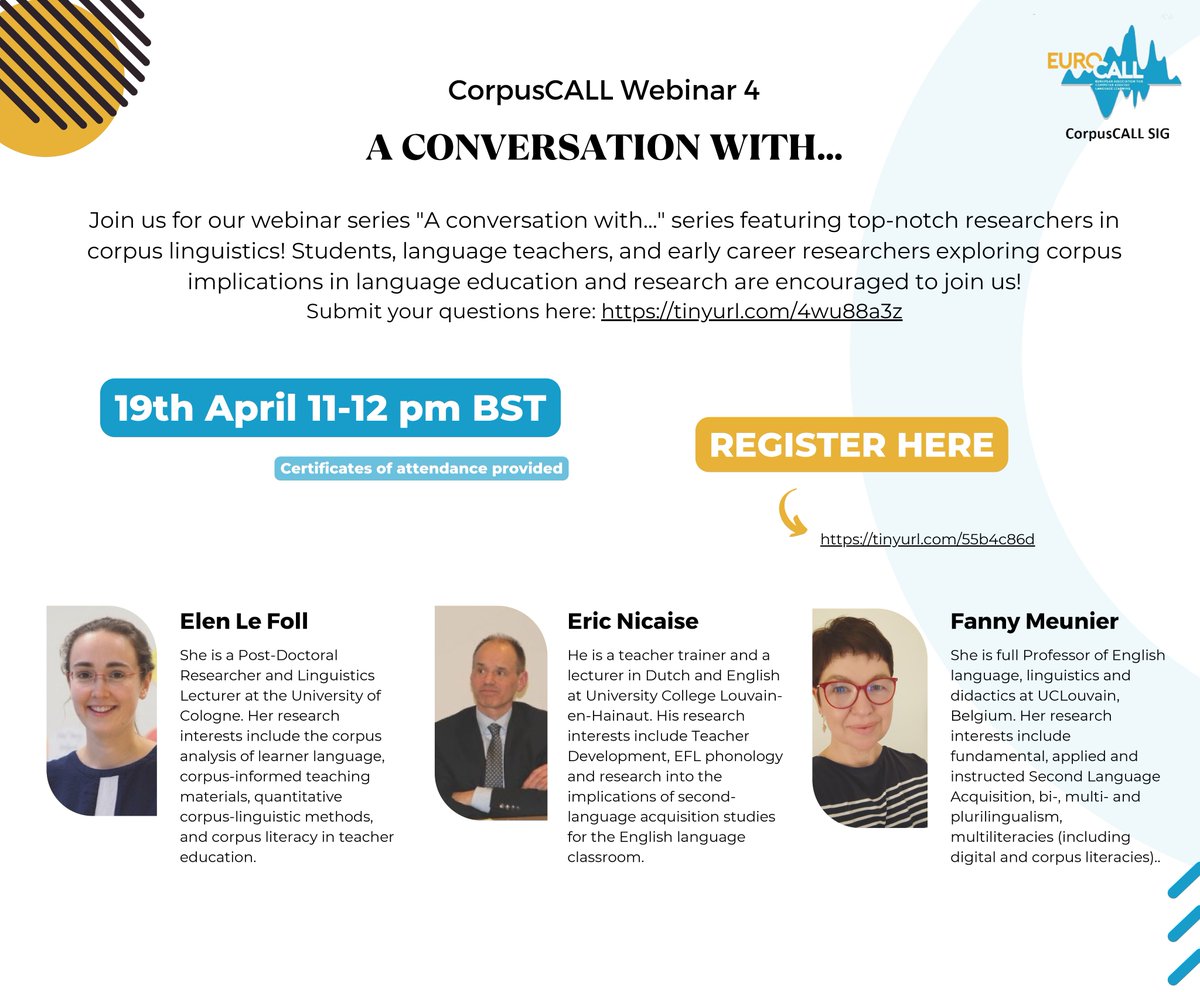
Join us for our fourth webinar of the series "A conversation with..." featuring this time Elen Le Foll, Eric Nicaise, and Fanny Meunier! 19th April 11-12 pm BST. Submit your questions here: https://t.co/aUZ2xXgZlY Register here for this free event: https://t.co/1LwJaQhhNU
Is growing up bilingual more difficult than learning just one language?
Thanks to @SilleBrandt at Lancaster University for sharing some thoughts: https://t.co/7TMt459CKn
New Cambridge Element Metalinguistic Awareness in Second Language Reading Development by @Echoechoke Dongbo Zhang and Keiko Koda out now! Read for free for 2 weeks
https://t.co/53mEGnKWGc
#cambridgeelements#languageandlinguistics
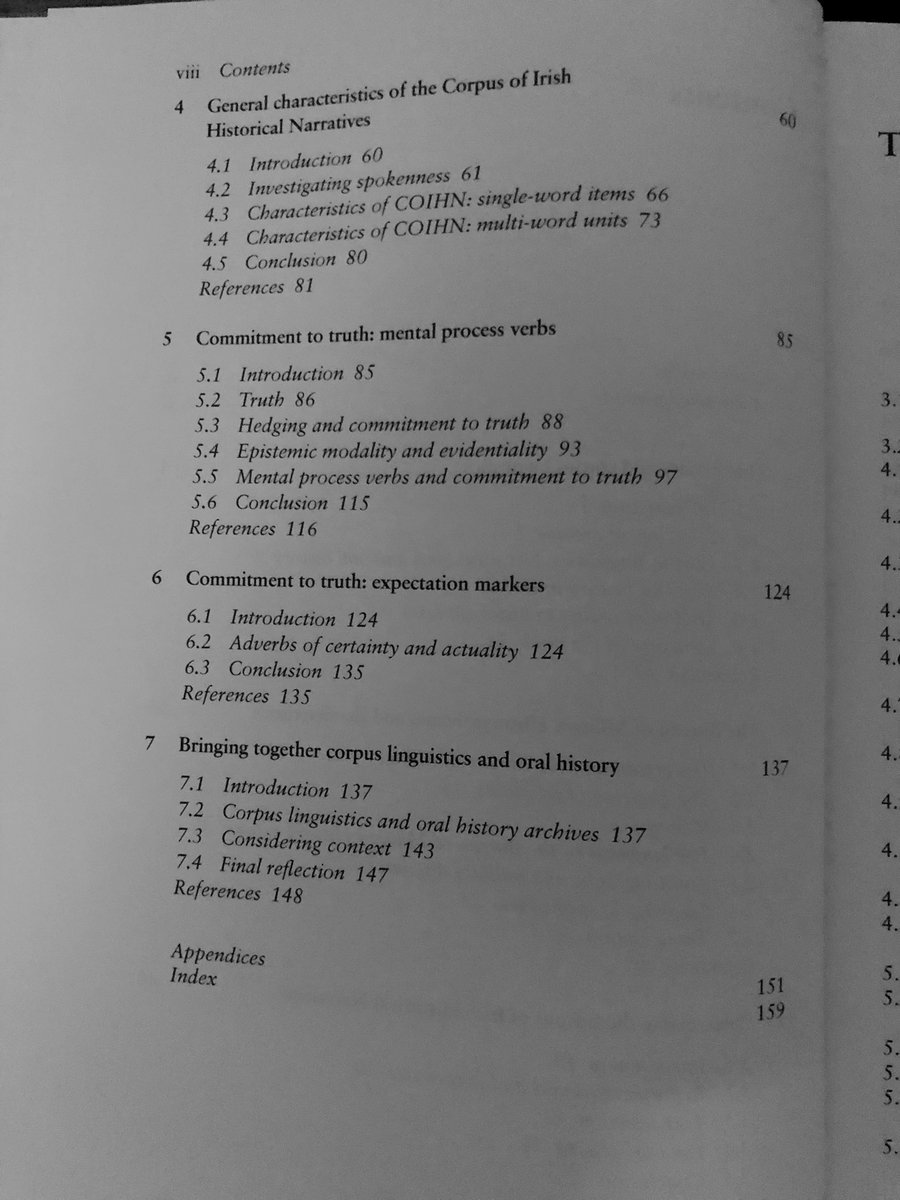
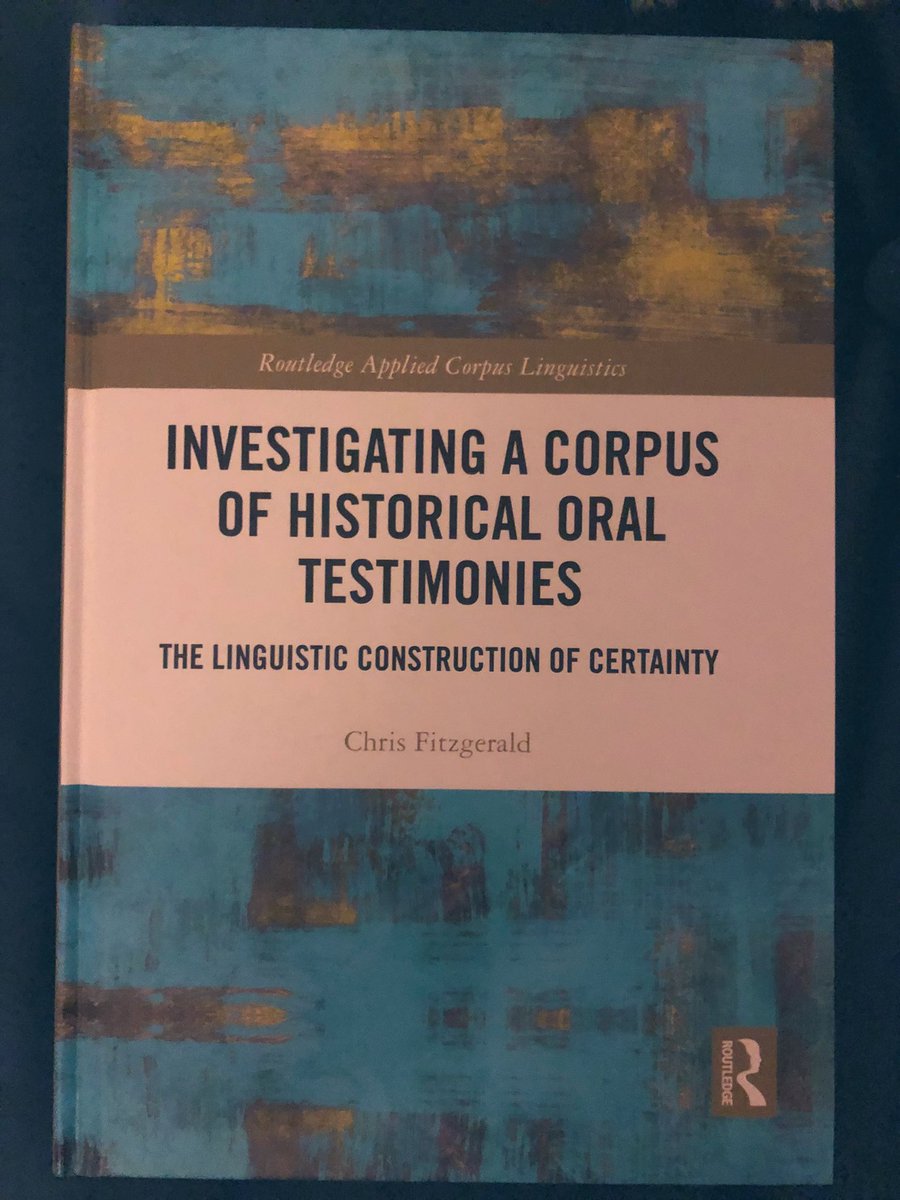
Another great book in our Routledge Applied Corpus Studies series: “Investigating a Corpus of Historical Oral Testimonies: the linguistic construction of certainty” by Chris Fitzgerald. It looks the language of certainty in data from the Irish Bureau of Military History