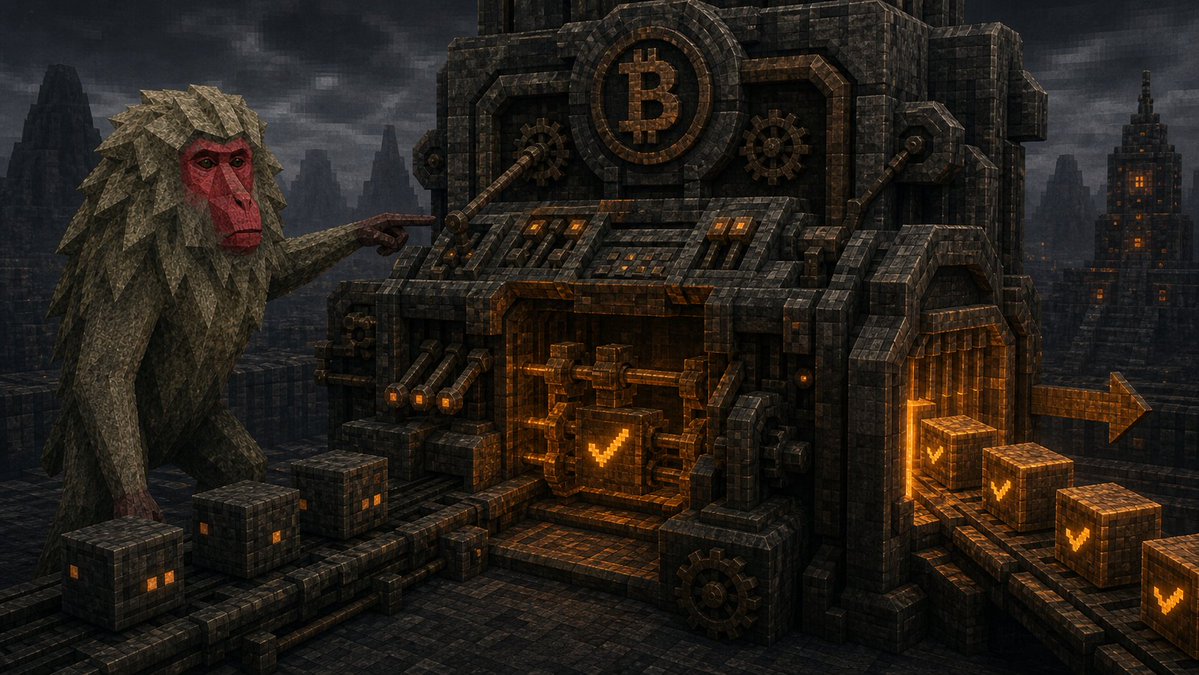
BIP-449 (OP_TWEAKADD) looks clean on paper… but this isn’t parallel invention. It’s the exact low-level primitive @laz1m0v has been publicly designing, tagging you about, and shipping real prototypes around for months with PRECOP/TUSM + Astrolabe Pattern.
What is PRECOP?
In one sentence:
PRECOP is a rule machine for Bitcoin spends.
It is not an app.
It is not a dashboard.
It is a way to ask every transaction: "are you allowed to exist?"
we built a bank on Bitcoin that keeps the soul of a child alive where money is never scary, just a game of swapping and growing. Under the hood, the infrastructure is savage and deep, but you’ll never touch it: all you see are instant transfers, automatic yield vaults
There is a trajectory in Bitcoin history that the market still underestimates.
Not a marketing trajectory.
An architecture trajectory.
Before Bitcoin, Adam Back proposed Hashcash: a simple, almost dry idea, but an extremely powerful one.
Create a real cost for the producer.
Keep verification trivial for the network.
That asymmetry later became one of Bitcoin’s core ideas: a proof that is hard to produce, but easy to verify. Satoshi obviously did not build Bitcoin from one single idea. Bitcoin was a synthesis of decades of cypherpunk research: digital signatures, timestamping, peer-to-peer networks, economic incentives, difficulty adjustment, and proof-of-work.
But the whitepaper cites Hashcash because that primitive matters.
And this is where the trajectory becomes interesting.
Years later, Blockstream did not try to "turn Bitcoin into Ethereum". They approached the problem from the right direction: how do you extend Bitcoin without betraying what makes Bitcoin robust?
Most "Bitcoin L2" narratives start from frustration:
"Why doesn’t Bitcoin do what Ethereum does?"
Blockstream’s strategy seems to start from a different question:
"How do we build more capabilities around Bitcoin while preserving the Bitcoin mental model?"
UTXOs.
Settlement.
Verification.
Explicit constraints.
Contained complexity.
Caution around L1.
That is exactly what Liquid represents.
Liquid is not just another L2. It is a Bitcoin-native sidechain, UTXO base, live since 2018, designed to test and mature advanced financial primitives: L-BTC, Issued Assets, Confidential Transactions, faster settlement, and experimentation around a Bitcoin-like model.
And yes, Liquid has an important trade-off it is a federated sidechain. It is not Bitcoin L1. It does not have the same security model. But that trade-off is explicit, and that is exactly what makes the approach more honest than many "trustless" narratives sold with three slides and a multisig.
The strategic move is this:
Do not break Bitcoin to make Bitcoin more expressive.
Build an environment compatible with its DNA.
Test primitives on a suitable layer.
Let the best ideas mature before pretending they deserve L1.
Then comes Simplicity.
And at that point, the coherence becomes hard to ignore.
Simplicity is not "Solidity on Bitcoin". It is almost the cultural opposite.
Not an opaque VM.
Not a global-state casino.
Not a deploy, execute, pray, patch, governance vote, post-mortem environment.
Simplicity starts from another model: bounded contracts, inspectable logic, formal reasoning, compatibility with the UTXO spirit, and advanced programmability without abandoning verifiability.
It is closer to:
understand before execution,
inspect before signing,
verify before trusting.
And now you can see a rare line across multiple decades:
Hashcash: costly to produce, cheap to verify.
Bitcoin: costly to attack, cheap to validate.
Liquid: experiment without weakening L1.
Simplicity: program without sacrificing inspectability.
Same obsession, multiple layers.
Reduce trust.
Force proof.
Contain complexity.
Keep the architecture clean.
Never sacrifice verification for spectacle.
That is why Simplicity is much more interesting than another narrative.
Because this is not Bitcoin chasing Ethereum.
This is Bitcoin searching for its own path to programmability: stricter, less sexy to the market, but far more coherent with its DNA.
The market usually asks the wrong questions:
"Is there a token?"
"Is there an airdrop?"
"Is it EVM compatible?"
"When pump?”
But the real Bitcoin questions are colder:
Is it verifiable?
Are the trust assumptions explicit?
Is the complexity contained?
Does it respect the UTXO model?
Does it make Bitcoin more powerful without making it less Bitcoin?
That is where the vision becomes strong.
Blockstream did not try to make Bitcoin "cooler" by copying Ethereum. They built like people who actually respect Bitcoin: slowly, cleanly, keeping the UTXO mental model, testing primitives in a suitable environment, and letting research move forward without forcing consensus.
If Simplicity ever influences Bitcoin more directly, Liquid will have been much more than a sidechain.
It may become the production lab where Bitcoin-native programmability was incubated without selling the soul of L1.
And when you look at the path
Adam Back → Hashcash → Bitcoin → Blockstream → Liquid → Simplicity, this is not a random sequence of isolated projects.
It is a long-term vision.
The same intuition repeated in different forms:
do not ask for trust when you can build a proof.
Don’t trust. Verify.
It is not just a maxi phrase.
It is a design constraint.
And the only real compass for making Bitcoin programmable without turning it into something else.