Stuck in an endless loop trying to verify my ID with @Persona_ID just to get back into my @LinkedIn account. I have my login email and password, but I lost access to my 2FA app when I changed jobs. Why is the identity verification process so broken? Please help! @LinkedInHelp
Unlock the power of collaborative machine learning without compromising data privacy! Learn how to share sensitive data securely using autoencoding and differential privacy with @brackly_murunga.
Join us, Registration deadline is today! https://t.co/MsVRp5bgmp #DataSecurity
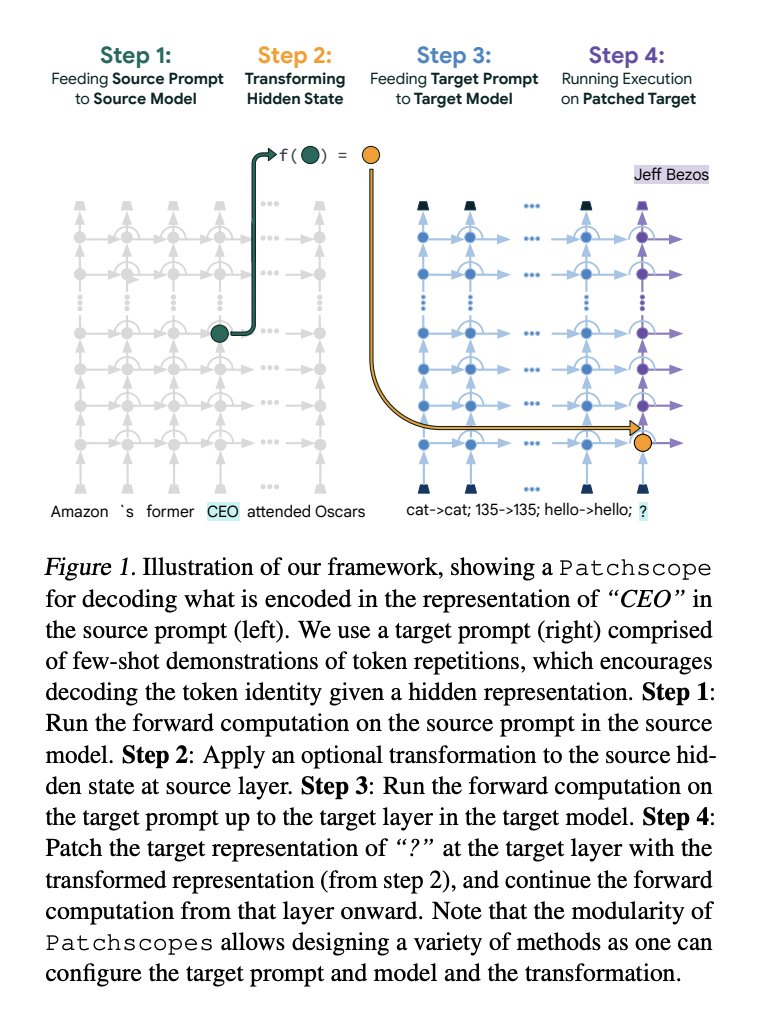
Google presents Patchscopes
A Unifying Framework for Inspecting Hidden Representations of Language Models
paper page: https://t.co/12ucvQGmn9
Inspecting the information encoded in hidden representations of large language models (LLMs) can explain models' behavior and verify their alignment with human values. Given the capabilities of LLMs in generating human-understandable text, we propose leveraging the model itself to explain its internal representations in natural language. We introduce a framework called Patchscopes and show how it can be used to answer a wide range of research questions about an LLM's computation. We show that prior interpretability methods based on projecting representations into the vocabulary space and intervening on the LLM computation, can be viewed as special instances of this framework. Moreover, several of their shortcomings such as failure in inspecting early layers or lack of expressivity can be mitigated by a Patchscope. Beyond unifying prior inspection techniques, Patchscopes also opens up new possibilities such as using a more capable model to explain the representations of a smaller model, and unlocks new applications such as self-correction in multi-hop reasoning.
We explore the possibility of machine unlearning, which promises to scrub the effects of a set of data from a machine learning model.
https://t.co/GoIroKVADJ
Classification of text of underrepresented languages is one hot emerging research concerns in AI.
I wrote an article that details building a model that classifies Swahili content. Check it out.
https://t.co/WOYskN2KjN
Fascinating what they said about necessity mothering invention but more fascinating is how an alternative solution, albeit having numerous advantages, could faced off when scarcity is no longer an issue.
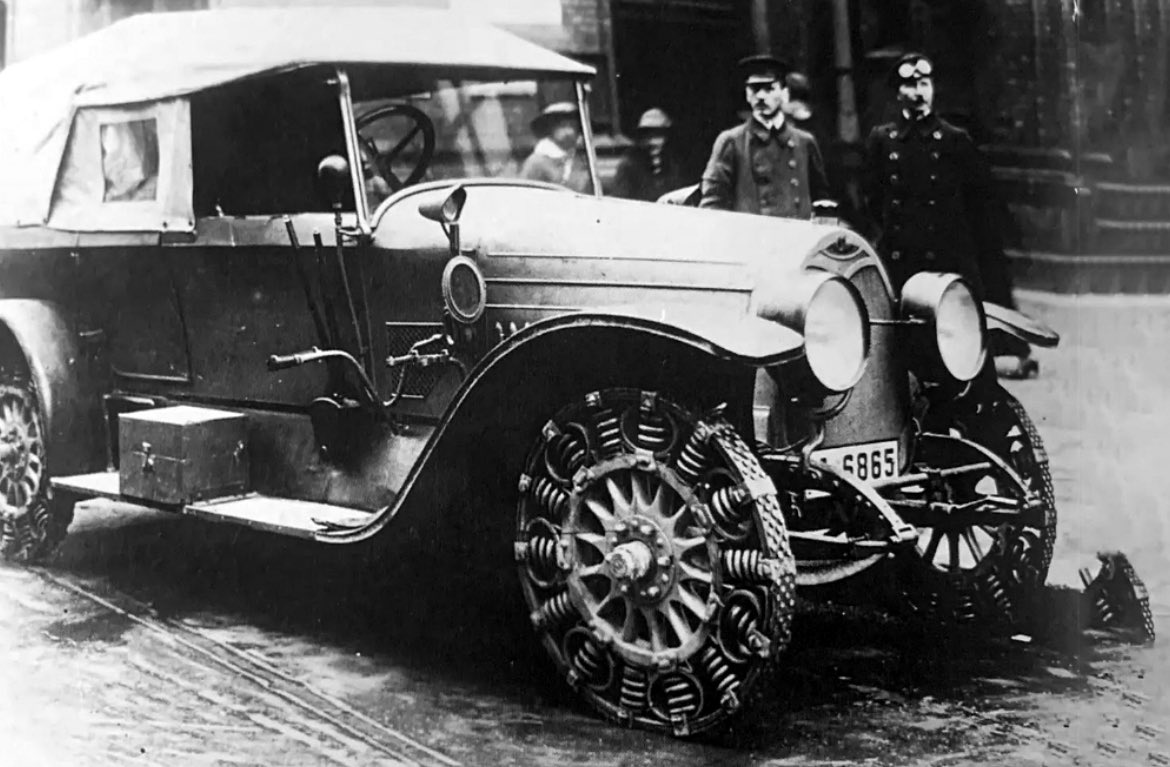
In the early 1900s, the shortage of rubber and the challenges associated with filling tires with air during the First World War led to a significant need for alternative solutions. In response to this problem, German engineers devised a groundbreaking invention in 1916—a steel spring tire.
The tire was specifically designed by the Germans to address the scarcity of rubber and the unreliable nature of traditional rubber tires. Their goal was to create a tire that not only offered a viable alternative to rubber but also provided enhanced reliability, particularly for military vehicles that required robust and durable tire solutions.
The innovative steel spring tire was first implemented on a Protos vehicle, showcasing its potential for military applications. The tire design incorporated a series of steel springs arranged in a circular pattern, which replaced the conventional rubber construction. These springs were strategically placed to provide both support and flexibility, allowing the tire to withstand the rigorous demands of military operations while offering improved traction on various terrains.
One of the key advantages of the steel spring tire was its resistance to punctures and damage, which significantly reduced the need for constant maintenance and tire replacements. This attribute made it particularly attractive for military vehicles operating in challenging environments, such as battlefields or rough terrain.
Furthermore, the German engineers believed that the steel spring tire's performance would not be affected by adverse weather conditions, a common issue with traditional rubber tires. The tire's unique design was expected to maintain its reliability and functionality even in extreme temperatures, making it well-suited for military campaigns in diverse climates.
While the steel spring tire initially gained attention due to its potential military applications, there was also significant interest in its civilian use. The tire's durability and puncture resistance made it an attractive option for commercial vehicles, especially those that frequently traveled on rough roads or encountered sharp debris.
Although the steel spring tire demonstrated promise, the end of the First World War and subsequent developments in rubber technology led to a shift back towards traditional rubber tires. Rubber became more accessible again, and advancements in tire manufacturing techniques and materials improved the reliability and performance of rubber tires. As a result, the steel spring tire gradually faded from use, becoming a fascinating but short-lived chapter in the evolution of tire technology.
Nonetheless, the German engineers' ingenuity in developing the steel spring tire during a time of resource scarcity and technological challenges remains a testament to human innovation and adaptability in the face of adversity.
Samora Laurent (far left) and Brackly Murunga (far right) receive a dummy cheque of Ksh 150,000 as 2ndrunners-up under the Social Outcomes category #EquityHackathon
Join us every week for "The Power of Precision," a series of talks brought to you by @phindor_ai in partnership with @AjiraDigital and @YALINetwork Regional Leadership.
REGISTER NOW: https://t.co/2jo2PrlCa3
Twitter Space : https://t.co/4U9vwLdVRB
@eMobilis@MastercardFdn