As investors we're paid to analyze probabilities, not possibilities. Almost anything is possible. The question is what is probable. A $4 trillion revenue business would be unprecedented in corporate history. I'd rather own great companies at reasonable expectations than chase heroic assumptions that require everything to go perfectly. Remember, even the best growth story needs valuation discipline.
Before you buy @SpaceX stock...
I don’t normally disagree with Warren Buffett, but I definitely do when it comes to his advice on index funds. And I disagree even more now that SpaceX is going public next week.
Buffett has long argued that most investors shouldn’t pick individual stocks since it’s too dangerous. Too easy to mess up.
It’s better to just go buy an $SPY fund instead, he’s said repeatedly throughout the years:
“I don’t think most people are in a position to pick single stocks… [They’re] much better off buying a cross-section of America and just forgetting about it.” – stated at the 2020 annual Berkshire Hathaway shareholder meeting.
“Consistently buy an $SPY low-cost index fund. I think it’s the thing that makes the most sense practically all the time.” – recommended during a 2017 CNBC interview.
“What I advise here is essentially identical to certain instructions I’ve laid out in my will… Put 10% of the cash in short-term government bonds and 90% in a very low-cost $SPY index fund.” – included in his 2013 annual letter to shareholders.
I get what he’s saying. But when I look at the full list of $SPY companies, there are plenty I just don’t want to own.
Some are speculatively valued, meaning they have no margin of safety to offer. Others don’t produce the predictable sales, earnings, and/or cash flow growth I want to see from a long-term investment.
And most importantly to me, many aren’t very generous with shareholder returns via dividends and buybacks. So why would I want to buy an index that forces me to own the good with the bad?
Add to that $SPY's initial agreement to immediately include @SpaceX, and I’m even less inclined to buy into it as a whole. Its last-minute change of heart matters – but only by so much.
If you’re interested in learning more, sign up for the Wide Moat Daily...links in my bio.
I'd be careful about assuming all REITs are destined to fall 40% while all private investments are destined to triple. Over long periods, the best real estate companies have compounded wealth by owning irreplaceable assets, generating cash flow, and paying dividends. That's not as exciting as a SpaceX headline, but it has worked remarkably well for decades.
Because of what my business partner did, I learned to think about risk in a much more constructive light. I realized the importance of studying not just what a company has done, is doing, and wants to do…
But also who’s in charge of making those decisions.
Studying executive teams on top of financial specs has changed my entire way of investing. I now buy into higher-quality companies and avoid recommending less stable ones.
My portfolio – and the portfolios of so many of my followers – is now growing strong in ways I might never have otherwise achieved.
As Epictetus warned two thousand years ago, I couldn’t control my business partner’s actions. Nor could I do much to control the outcome once I became aware of what was going on.
I could only control my responses.
The timeless truth Epictetus passed down for people like Charlie Munger, you, and me is that adversity is inevitable. It’s only a matter of whether we allow it to make us or break us.
Will we emerge from our troubles with better judgement, stronger characters, and a deeper understanding of what truly matters?
Whenever we do, we tend to find the highest return on investment of all.
If you’re interested in learning more, sign up for the Wide Moat Daily...links in my bio.
Everyone knows, “Location, location, location.”
But in the age of AI, I think there’s a better investing framework: Monopoly, monopoly, monopoly.
The best Monopoly players don't win because they own Boardwalk. They win because they control assets that everyone else has to use.
The same is true in investing.
AI can write code. It can analyze data. It can design products.
But it cannot recreate:
- A global wireless tower network
- The internet's interconnection platform
- Southern California industrial land
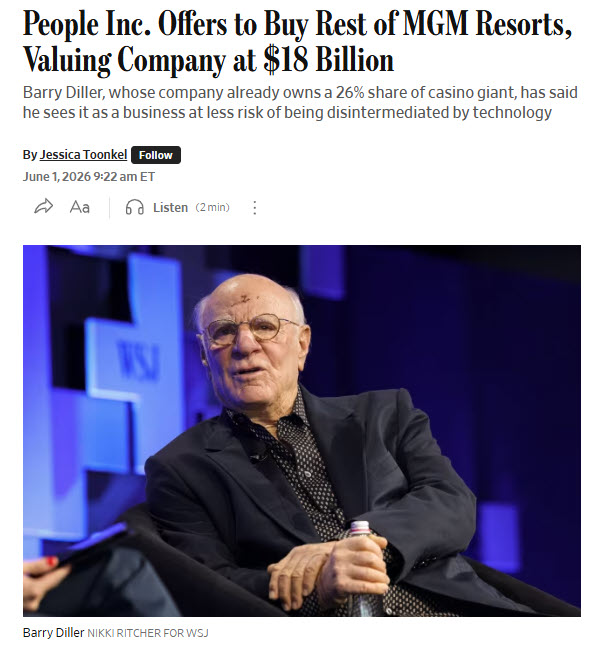
- 660 acres on the Las Vegas Strip
- Prime billboard corridors
- Global cold storage networks
That's the essence of HALO Investing. Heavy Assets, Low Obsolescence. Own what nobody can recreate.
I break down my HALO picks on the latest episode of The Wide Moat Show: https://t.co/c9lvDRZ8tu
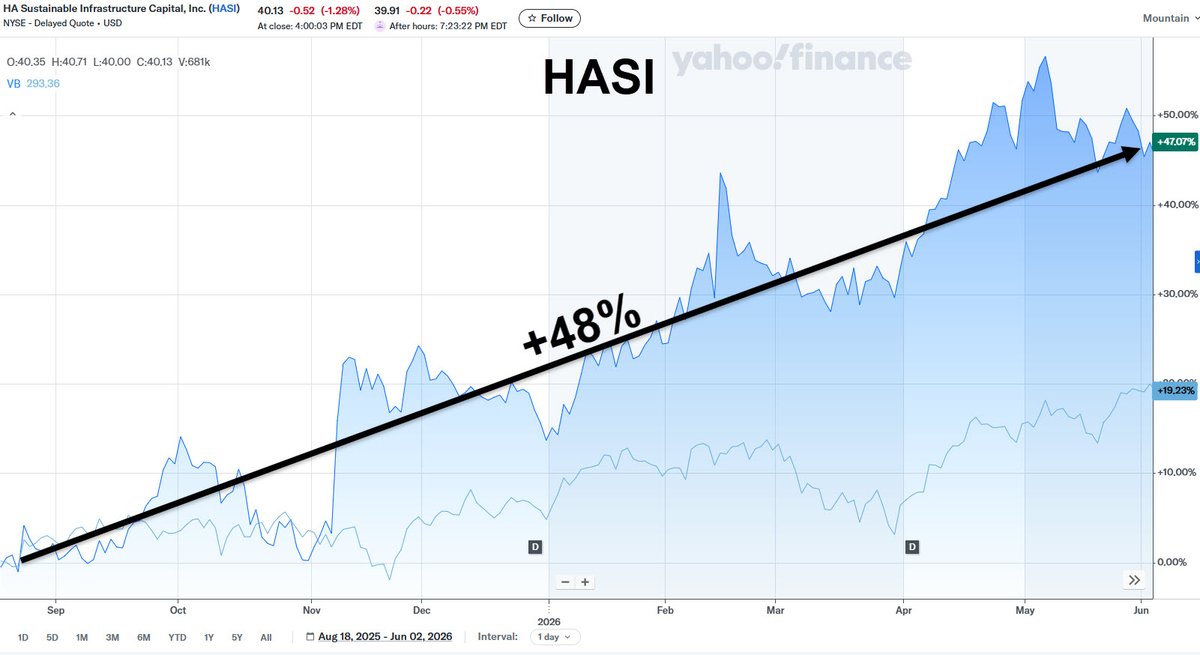
$HASI, one of our best-performing recommendations, just keeps delivering....now up +48% in Wide Moat Confidential.
This is why we focus on quality management, durable cash flows, and long-term secular growth, not short-term market noise.
If you’re interested in learning more, sign up for the Wide Moat Daily...links in my bio.
A “great business” can still be a poor stock at the wrong price.
That’s the lesson behind so many fallen angels.
The market doesn’t just reprice bad companies. It reprices great companies when growth slows, rates rise or expectations get too high.
$VICI checked every box:
Durable cash flows
CPI-linked leases
Strong tenants
Reliable income
Then, rates rose and the market started asking a different question:
“How much growth is left?”
That’s what creates fallen angels.
Sometimes they’re opportunities. Sometimes they’re value traps.
The hard part is knowing the difference.
On the latest episode of The Wide Moat Show, we break down 10 former market darlings that investors are debating right now: https://t.co/LqOsVutRHa
4 reasons I'm still writing on Seeking Alpha!
I've been writing on the platform for 16 years with over 4,500 articles, 84,500 comments, and 120,000 followers.
@BrattoBiz Yes. Also, when you count Forbes, the street, motley fool and wide moat research it's more like 7500 articles over 15 years. The most durable education is self education.
$BRK.A is acquiring $TMHC for $72.50/share, or ~$8.5B EV. That’s roughly a 24% premium, but the valuation still looks very Berkshire-like:
~9.3x LTM earnings
~8.8x adjusted earnings
~1.2x book value
Historically, homebuilders have traded hands around 1.0x–1.5x book, so this lands toward the lower end of the range.
The strategic angle is even more interesting since Clayton Homes has been pressured by higher mortgage rates, something CEO Greg Abel called out directly at the 2026 Berkshire meeting.
For this deal to make sense, $BRK.A likely thinks that mortgage rates are at or near peak pressure. It also fits the broader housing ecosystem Berkshire already owns: Clayton, MiTek, Benjamin Moore, Acme Brick, Shaw, and Berkshire HomeServices.
I'm also wondering which REIT $BRK.A will buy next... they dumped a modest position in $LAMR in Q1-26 after a 25% run-up... maybe manufactured housing $ELS $SUI $UMH, or perhaps cold storage $COLD $SUI ... or why not timber? $WY $RYN
Having watched, researched, and analyzed your father — and now you and Jared — over the last decade, I’ve seen an extraordinary evolution into entrepreneurs focused on creating long-term value and opportunity for the world. Your discipline, resilience, and vision continue to stand out. I truly appreciate our friendship and the example you set through leadership, family, and innovation.
One reason I've admired investors like Buffett is that they emphasize stewardship over dynasty. The goal isn't simply to preserve wealth, but to allocate capital in ways that create value for society. Philanthropy, entrepreneurship, and reinvestment all play important roles in that process. At the end of the day, wealth creation and wealth preservation are very different skills, and history suggests that the former is usually harder than the latter.