Figma outgrew PgBouncer. Single-threaded, no priority routing, no backpressure, no way to stop one misbehaving workload from starving the rest. So they built PGKeeper, a Go service that replaced it entirely. In Q4 2025 alone, it prevented 20 incidents that would have caused user-visible outages 🧵
TL;DR:
→ PgBouncer's single-threaded model, lack of backpressure, and no admission control made it the wrong fit for Figma's scale and reliability bar
→ PGKeeper: a Go service built on PGX, exposing a gRPC interface, sitting between DBProxy and Postgres
→ Three-stage request pipeline: admission control, connection pool, query execution
→ V1 admission control: priority-based semaphore with CoDel + adaptive LIFO queuing
→ V2: multi-dimensional fair-share tree to prevent single workloads from monopolizing their priority tier
→ Token-bucket rate limiting on both connection creation and teardown; since deployment, zero massive connection churn incidents
Three failure modes PGKeeper explicitly does not solve, and what Figma does instead. Expensive queries: a single sequential scan can monopolize I/O even at low concurrency, mitigated by Guardrails, an adjacent project that flags inefficient queries at CI time.
Skewed load distribution: uneven traffic across PGKeeper pods limits per-instance load management, mitigated today via NLB and multiple gRPC connections per client, with a service mesh as the long-term target. Small connection pools: fair sharing needs enough total concurrency to slice meaningfully, acknowledged as a hard constraint with no current mitigation.
@figma
Key Takeaway
The rollout design is as important as the system design. Figma classified every database instance group by criticality and rolled out strict low-to-high. They started with a single replica per cluster, where DBProxy's hedging meant PgBouncer served traffic if the PGKeeper replica had problems.
A sliding window error detector in DBProxy automatically flipped traffic back to PgBouncer if error rate exceeded threshold for a sustained window. The detector triggered early in rollout, avoided availability issues, and validated the escape hatch before they rolled to primaries. The architecture work would have meant nothing without the rollout discipline.
Spotify's release process used to live in Jira. A Release Manager juggling tabs, chasing ticket statuses, answering Slack questions all at once. They replaced it with a single dashboard, and then automated 8 hours out of the release cycle entirely 🧵
TL;DR:
→ Release Manager Dashboard: one page aggregating data from ~10 systems across Android, iOS, and Desktop tracks
→ Backend v1 was slow and expensive. Caching + 5-min pre-aggregation cut load time from "long" to 8 seconds
→ Time-series data from polling revealed the two biggest time sinks: bug triage and App Store approval
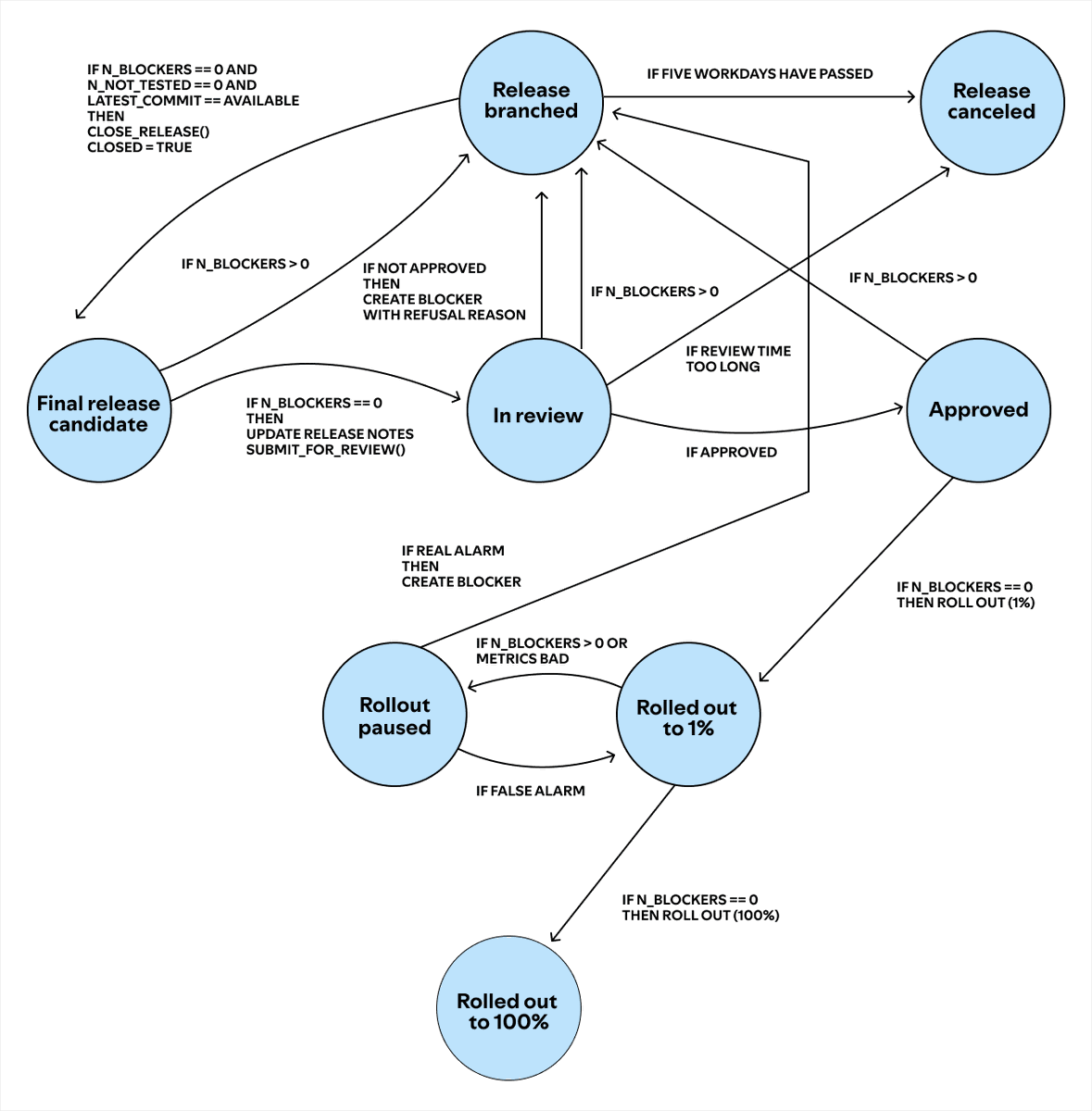
→ The Robot: a state machine that auto-advances releases when conditions are met, saving ~8 hours per cycle
→ Built on Backstage; 5 years old and still maintained over off-the-shelf alternatives
The dashboard is 5 years old. Off-the-shelf alternatives now exist. Spotify keeps their own for concrete reasons: Backstage integration means release data is queryable by other internal tools (Confidence uses it for experiment analysis), org data from Backstage auto-assigns bugs to the right teams, and having all developer tooling in one place reduces friction across the whole engineering org. The build vs. buy decision gets clearer when the alternative requires re-integrating with everything you already have.
@Spotify
Key Takeaway
The 8-hour saving came from one observation: release steps were completing outside work hours and sitting idle until someone checked. The fix wasn't more process, it was making the state machine explicit and automating the transitions.
Once conditions are codified, a backend service can advance the release at 3am just as reliably as at 3pm. The time-series data made the problem visible. The Robot made it irrelevant.
Spotify ships a new app version every week to 675 million users across iOS and Android. Here's exactly how the two-week release cycle works, and the decisions that keep 95%+ of releases from ever getting cancelled 🧵
TL;DR:
→ Weekly cadence: two-week cycle per version, branched every Friday
→ Week 1: trunk-based dev, nightly alpha builds, bug triage, metrics monitoring
→ Week 2: branch cut, regression testing, blocking bug fixes, App Store submission
→ Rollout: 1% first, 100% the next day if metrics hold
→ 3-5 release-blocking bugs per release is normal; Release Manager owns triage and prioritization throughout
The Audiobooks rollout in 8.9.2 is the clearest example of how the process handles high-stakes features. It was the only major feature scheduled that week, another was deliberately pushed to the following release to reduce risk. Internal employees got access during Week 1.
The Audiobooks team triaged every crash during testing. Additional test accounts and detailed App Store review instructions were prepared in advance. The feature went to 100% without issues. That outcome was engineered, not lucky.
@Spotify
Key Takeaway
The weekly cadence is the most important design decision in the whole system. A cancelled release isn't a crisis, next week's release ships regardless.
That cadence changes the risk calculus at every decision point: a bug that would have been a high-stakes blocker in a monthly release cycle becomes a "fix it next week" call. It also means the Release Manager can make tougher quality calls without the pressure of a long wait before the next opportunity to ship.