FIFA World Cup 2026 Prize Money
1. Champions — $50M
2. Runners-up — $33M
3. Third Place — $29M
4. Fourth Place — $27M
Quarter-finalists — $19M
Round of 16 — $15M
Round of 32 — $11M
Group Stage Exit — $9M
Every Participating Nation — $1.5M
Total Prize Pool: $727 Million
Parliament has moved with commendable speed to establish the Section 89 impeachment committee. The committee itself has also worked diligently through its preliminary processes and appears close to commencing its substantive work.
I am particularly pleased that the chairpersonship landed outside of the EFF, MKP and BOSA camps. Indeed, I predicted that the eventual chair would most likely come from a smaller party acceptable to both the ANC and DA, and the selection of Magashule Gana broadly confirms that logic.
From here, the committee must finalise its programme, adopt procedural rules consistent with the Constitutional Court judgment, and prepare for hearings. Yet it is precisely at this point that I expect the process to encounter its greatest obstacle.
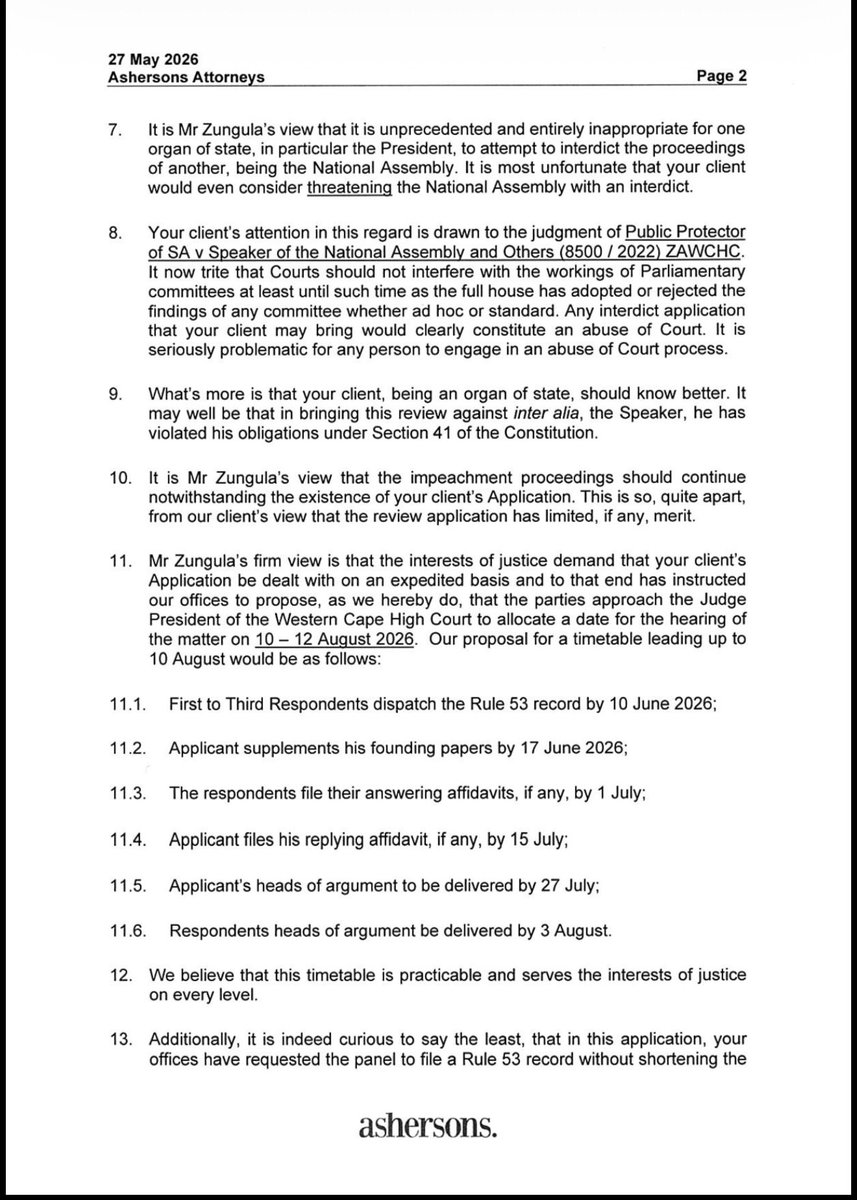
Before the committee can meaningfully proceed, President Cyril Ramaphosa is likely to insist that Parliament await the outcome of the pending review proceedings. Whether by correspondence, formal objection, or litigation, the argument will be straightforward: the validity of the Section 89 process is inextricably linked to the validity of the underlying Section 89 Panel Report. If that report is susceptible to being reviewed and set aside, then any impeachment process founded upon it risks being built on unstable legal ground.
Should the committee decline to postpone its work, an interdict becomes the obvious next step. In my view, that litigation would raise a serious question for the courts: whether it is prudent to allow an impeachment process against a sitting President to proceed while the very foundation of that process remains under judicial scrutiny.
The question that interests me most, however, is not the interdict. Nor is it the review itself.
The more intriguing question is what happens afterwards.
If the review succeeds and the Section 89 Panel Report is set aside, does that mark the end of the Phala Phala impeachment effort? Or do opponents of the President return to Parliament and seek a fresh process founded upon a newly constituted panel and a new report?
I suspect that, legally speaking, a successful review would not necessarily prevent Parliament from revisiting the matter. A court could set aside the panel report because of flaws in its reasoning, procedure, or legal approach while leaving the door open for Parliament to constitute a new panel and begin afresh. In other words, a successful review may not extinguish the impeachment project altogether. It may merely require its proponents to start over.
Whether they would have the political appetite to do so is another matter entirely.
By the time a review has been heard, argued, adjudicated and any appeals exhausted, years may have passed. The political landscape may have shifted dramatically. New scandals may have emerged. Election cycles may have intervened. Some of those currently most invested in Phala Phala may no longer occupy the same political positions they do today. What appears urgent now may not command the same energy then.
That is why I believe the real battle is not over whether the committee sits next month or the month thereafter. The real battle concerns what remains of the Phala Phala project once the courts have finally pronounced on the validity of the Section 89 Panel Report.
The legal skirmishes between now and then are almost inevitable. There are already suggestions of further court action should certain parties become dissatisfied with how the committee conducts itself. More litigation is therefore foreseeable.
But the decisive question is whether a successful review merely delays the impeachment project or whether the passage of time, combined with a fresh legal process, effectively drains it of its political momentum. That, more than any procedural dispute currently before Parliament, may determine the ultimate fate of the Phala Phala matter.
I will never hate on intelligent people trying their hand at public service.....with so many imbeciles in important places, this is definitely better for society
FRESH LEADS:
Sources say there were tense negotiations in the background. It's alleged the BB Zondi (KZN) slate was initially expected to secure a victory (full sweep); however, a compromise was ultimately reached.
Zondi's proposed candidates would occupy most positions, with Mr M.A. Tsebe (Gauteng) retaining the presidency as the sole individual from his slate to be elected.
Below is SANTACO's Top 9, including three leaders of the PCF (Presidents Consultative Forum): Mandla Gcaba, Joe Sibanyoni, and AJ Mthembu.
@eNCA
With respect President, if you can’t name them. Sicela uyiyeke lento kunini inguwe noNxamalala nithetha nje without revelation to save your ANC, surely, those spies aren’t as dangerous as you imagine.