Successfully convincing my kids I have a clue about life. Proud mom to 4 Autistic idols, includes 2 NB beauties & a transtastic son
#ADHD#OCD#ODD#ASD#LGBTQ+
WEIRDLY SPECIFIC ADHD SLEEP HABITS THAT MAKE ZERO SENSE TO ANYONE ELSE.
Everyone else just lies down and falls asleep.
Six of them, and a trick for each that isn’t “just go to bed.”
1. Needing a very specific amount of noise to fall asleep.
WAIT WAIT WAIT — SO APPARENTLY WHEN YOU ASK AN ADHD KID OR PARTNER A QUESTION, THEY SAY "HUH?" OR "WHAT?", AND THEN ANSWER YOU TWO SECONDS LATER BEFORE YOU EVEN REPEAT YOURSELF—THAT’S AN ACTUAL NEUROLOGICAL AUDIO LAG??
Yes, and it is called an Auditory Processing Delay. Here is why there is a 3-second buffering wheel between an ADHD person's ears and their brain: 1/6
To the “everyone is Autistic or ADHD now” crowd:
When the whole world stopped in 2020, and everyone was mandated to stay in their homes, every burnt out, high-masking autistic person got to finally drop the lifelong masks and just be themselves for months.
And when social distancing policies started dropping and we got back to “normal,” it was impossible for those people to simply pick those lifelong masks back up as we dropped them, shattered them.
Just sit with that.
BREAKING:
Scientists confirm that an ADHD brain can hyperfocus for 4 hours straight on a complex hobby—but will physically freeze for 3 days over a chore that takes 90 seconds to finish.
Researchers baffled.
ADHD community: "Yeah, we know."
No clinical citation needed—every parent and kid staring at a pile of shoes by the door is the study. Here is why tiny tasks paralyze an ADHD brain, and how to trick yourself (or your kid) into starting.1/6
Jim Carrey Just Explained Depression Better Than Most Therapists
Jim Carrey: “Sadness is just from happenstance, whatever happens to you or doesn’t happen to you.”
“Depression is your body saying, ‘I don’t want to be this character anymore.’”
“You don’t want to carry this persona that you’ve created for the world.”
“I heard Jeff Foster talk about depression as ‘deep rest.’”
“Your body needs to be depressed. It needs deep rest from the character you’ve been trying to play.”
“Sometimes, what feels like breaking down can be a signal that something in your life needs attention.”
Groundbreaking botanical research is challenging the long-held belief in human exceptionalism, suggesting that plants possess forms of spatial awareness, intentionality, and consciousness.
For centuries, humans have regarded plants as passive organisms, but pioneering studies are rewriting this view. According to plant neurobiologist Dr. Stefano Mancuso, plants display sophisticated behaviors that parallel those of conscious animals. In laboratory experiments, plants react to anesthesia in ways strikingly similar to humans and animals — for instance, the Venus flytrap becomes completely unresponsive when anesthetized.
Time-lapse studies further reveal remarkable intelligence in common bean plants, which demonstrate clear spatial awareness by precisely aiming shoots toward supports and even adjusting their growth strategy when they detect another plant has already claimed a support.
These findings indicate that consciousness may not be limited to organisms with brains, but could be a more flexible property emerging in diverse life forms. As trees migrate northward in response to climate change, mirroring animal migration, researchers argue that our understanding of “mind” must expand beyond traditional boundaries.
With over three trillion trees on Earth, acknowledging plant consciousness could transform our ethical frameworks, agricultural practices, and relationship with nature, shifting from viewing plants as mere resources to recognizing them as active, aware participants in our shared ecosystem.
[Yokawa, K., Kagenishi, T., Pavlovič, A., Gall, S., Weiland, M., Mancuso, S., & Baluška, F. (2018). Anaesthetics stop diverse plant organ movements, affect endocytic vesicle recycling and ROS homeostasis, and block action potentials in Venus flytraps. Annals of Botany, 122(5), 747–756. DOI: 10.1093/aob/mcx155]
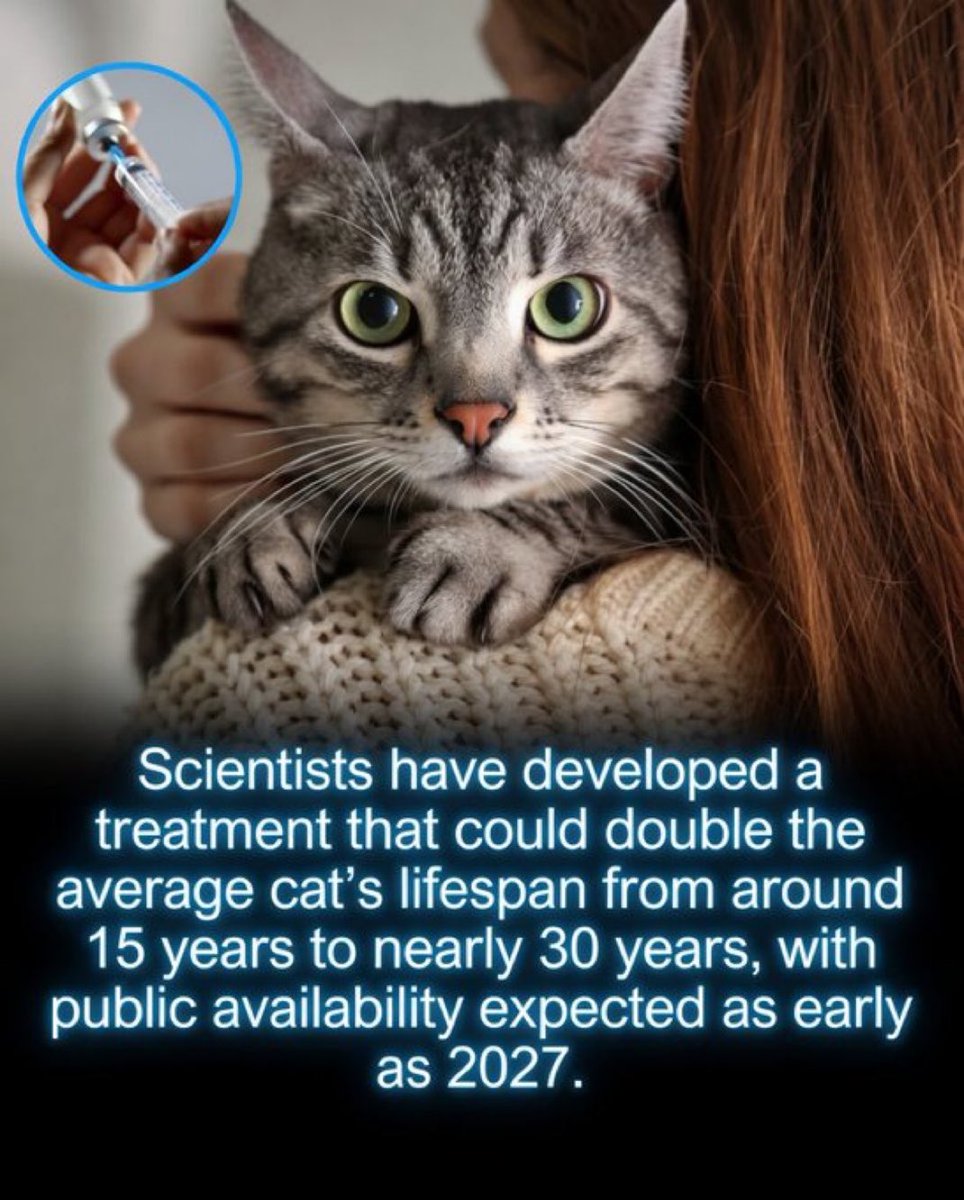
Scientists in Japan have developed a groundbreaking treatment that could double the average lifespan of cats, extending it from around 15 years to nearly 30 years.
The key lies in a protein called AIM (Apoptosis Inhibitor of Macrophage), discovered by Dr. Toru Miyazaki. While cats naturally produce AIM, they lack the ability to activate it effectively. This deficiency leads to the gradual buildup of waste in the kidneys, the leading cause of death in domestic cats.
Dr. Miyazaki’s team created an injectable form of activated AIM that directly restores the kidneys’ natural cleaning function. In clinical trials, cats with advanced kidney disease showed dramatic improvement after treatment. The therapy works both as a preventive measure for healthy cats and as a treatment for those already ill.
If approved, the treatment could revolutionize feline healthcare. Commercial rollout is expected to begin in Japan as early as 2025, with wider availability projected for 2027.
The research has also sparked interest for its potential applications in human medicine, as the AIM protein plays a similar waste-clearing role across species.
I'm confused about the 'Canada as 51st state' thing because, if they succeeded, they'd be adding 40million new citizens who overwhelmingly hate Trump and hate MAGA, flipping the House and Senate. Right?
@JpgOswald I know this was not the point of the work, but I love them so much and our next rats will be selfie rats because those boys are beautiful.
Artist trained rats to take selfies to make a point about social media https://t.co/0wyHcz9Xhj
@Tuxedokitt@JpgOswald I might not be able to music and art like yous guys, but I have my own creative outlets. First my book, then my film, and now, COMEDY.